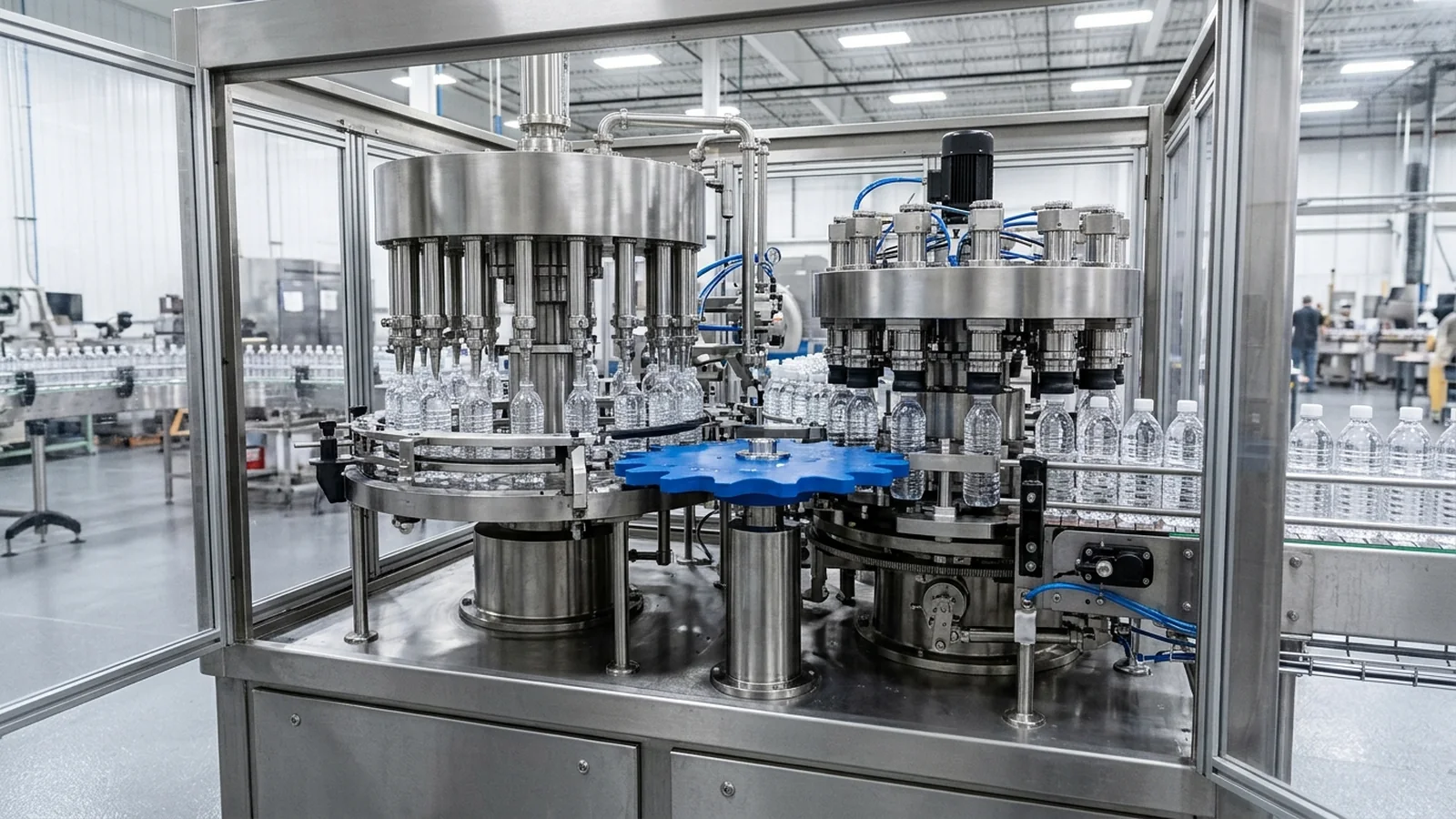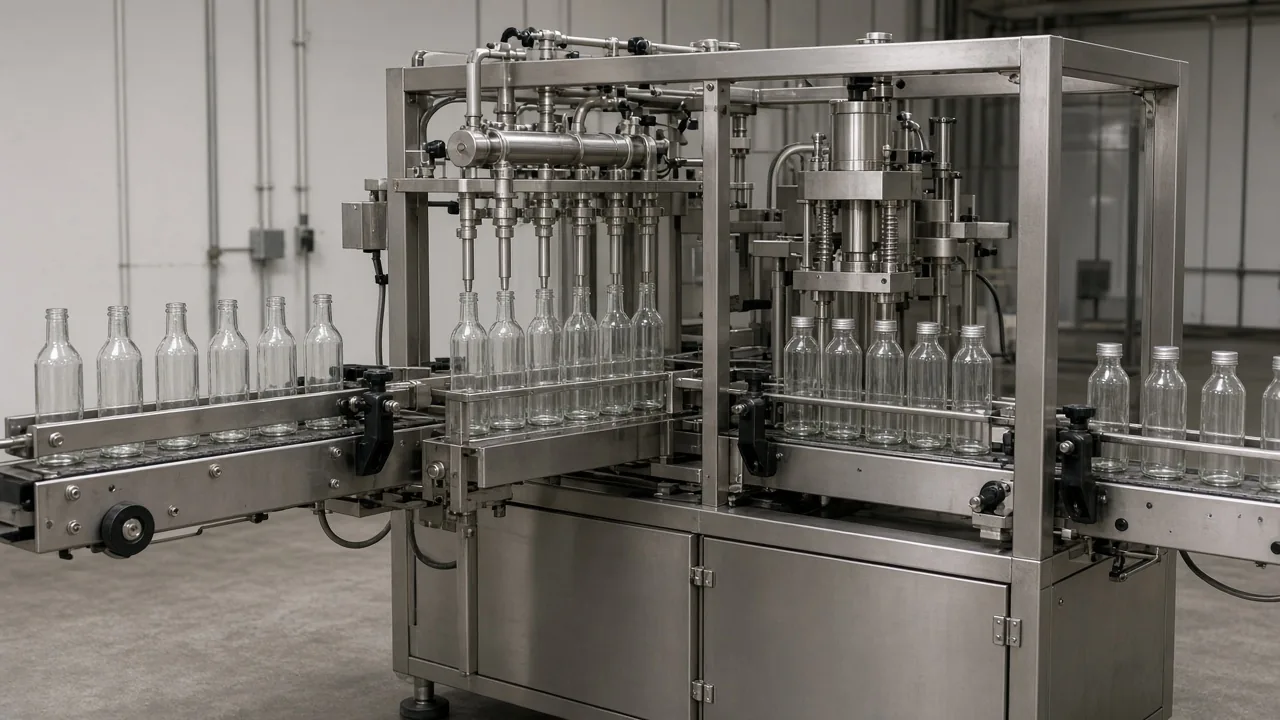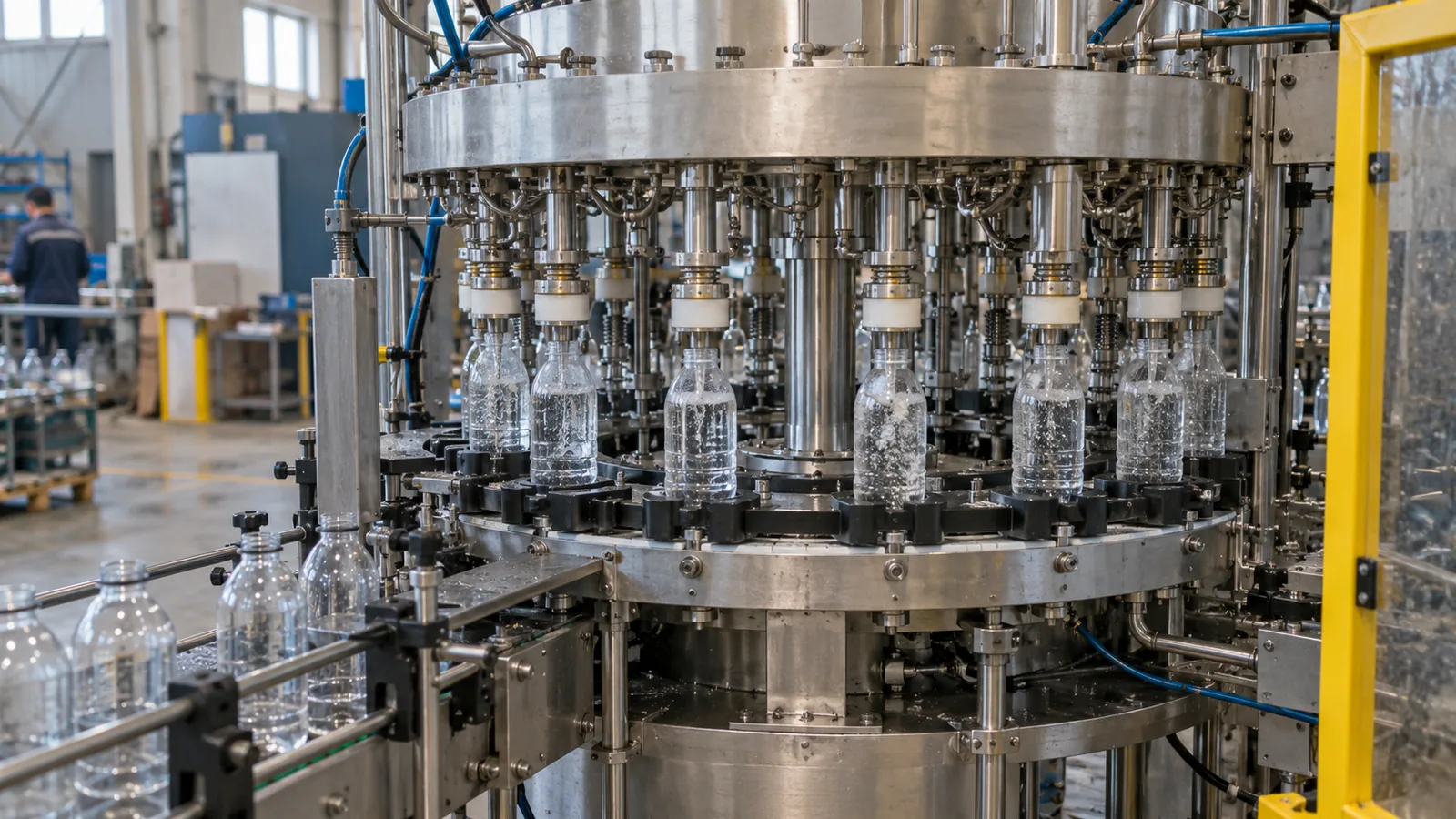
Choosing a rotary filler from the circular label alone wastes the trial when the record you need is mass and the machine only holds a neck level. A rotary filling machine is the circular route the containers take, and the quantity check is a separate line on the manufacturer’s page.
A rotary filling machine describes an arrangement in which containers or packs progress around a circular path; it does not specify how the product is measured. Start with the actual container and product, then require an identified filling configuration, transfer plan and cleaning scope. This guide provides a layout-versus-metering comparison, input sheet and responsibility matrix.
| Input or item | Typical value or source | Why it matters |
|---|---|---|
| Container or pack | Approved drawing and physical samples | Establishes the object being transferred |
| Product condition | Product-owner data and representative sample | Frames the filling-method evaluation |
| Fill requirement | Defined target and measurement basis | Separates weight, volume and fill-level questions |
| Format schedule | Current container/product combinations | Defines changeover scope |
| Line boundary | Layout and interface schedule | Identifies upstream and downstream responsibility |
| Cleaning requirement | Product-owner/site requirements | Defines the supplier’s documentation and demonstration task |
What does rotary describe, and what does it leave open?
Rotary describes the path. Metering describes the quantity. Serac’s RB header puts both on one machine: filling and capping, net weight, containers from 100 g to 60 kg, materials PET, PP, PS, aluminium, and glass, outputs up to 42 000 containers/h (1 L). Accutek’s ROF-52 description puts fill-to-level on a turret: containers enter from the left, each platform raises the container so a nozzle enters it, and the container leaves on the right toward a capper or a labeler. Those are two machine pages. A shared word, rotary, does not merge the ceilings.
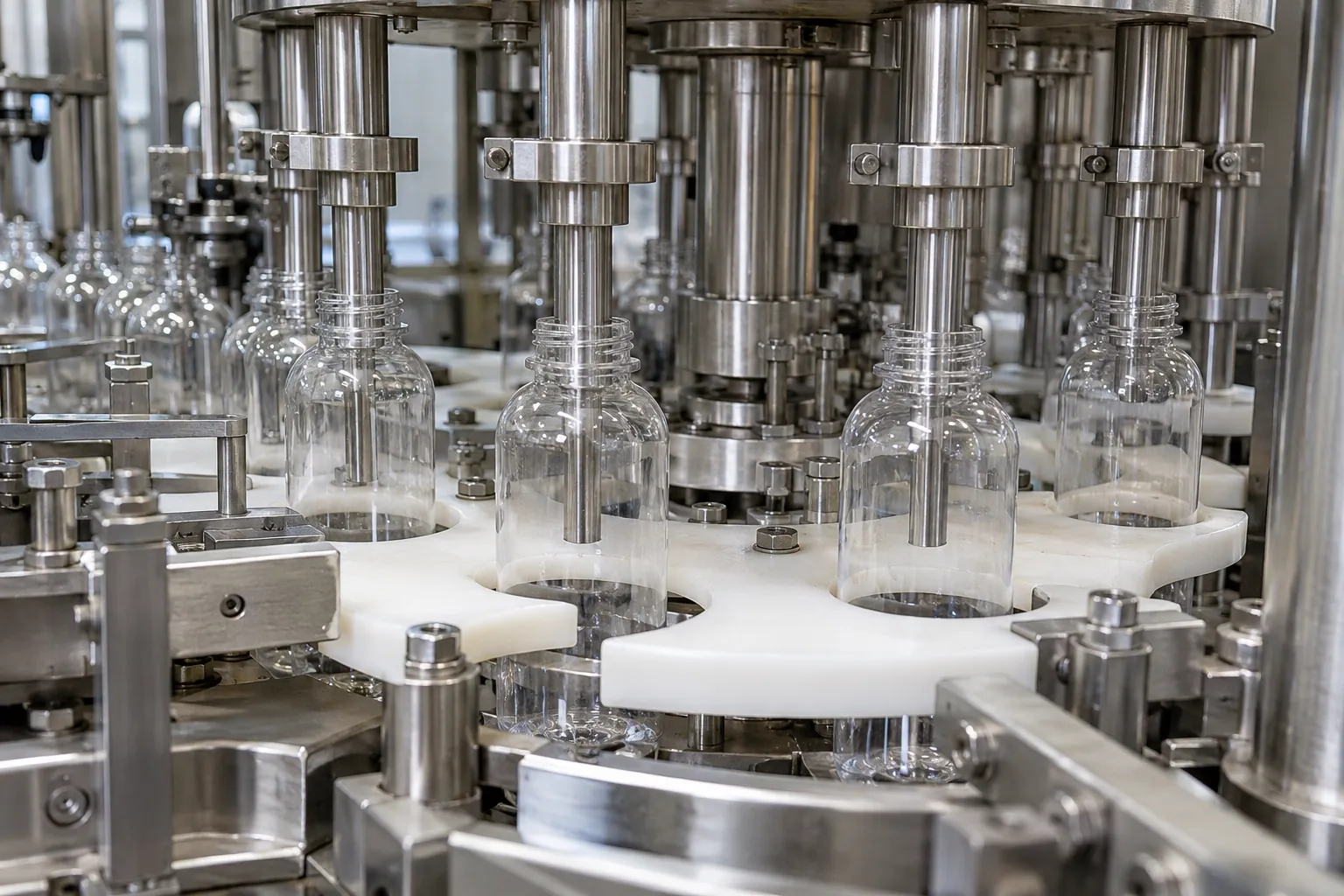
| Specification field | Serac RB page | Accutek ROF-52 page | Accutek ROF-40 page |
|---|---|---|---|
| Route | Rotary filler-capper | Turret. Containers enter left and leave right | Named rotary overflow filler. Route detail is not in the saved description |
| Quantity check | Net weight, controlled as the bottle fills | Fill-to-level. The page says the nozzle fills and then releases the container | Fill-to-level for free-flowing, non-carbonated liquids |
| Printed ceiling | Up to 42 000 containers/h (1 L) | Specifications tab: up to 450 CPM. Features list: glass, plastic, and metal containers up to 450 CPM | No CPM line in the saved HTML |
| Container window | 100 g to 60 kg | Description: ounces to gallons, rigid plastic, metal, or glass. Specifications tab: length 69 in (175.26 cm), height 89 in (226.06 cm), width 75 in (190.5 cm), weight about 3100 lb (1406.14 kg) | Description: rigid plastic, metal, and glass, ounces to gallons |
| Product window | Homogeneous liquids, including food, fragile, abrasive, corrosive, or inflammable. The page also names foamy and viscous products on one nozzle family | Description: free-flowing, non-carbonated. Specifications tab: foamy Yes, corrosive Yes, heated Yes, particulates No, viscosity 1 to 2000 cP | Free-flowing, non-carbonated. No viscosity line in the saved HTML |
The ROF-52 description and its specifications tab are both on the fetched page, and they do not use the same product words. The description says free-flowing and non-carbonated. The tab says foamy products are in scope and particulates are not. Keep both sentences. A foamy sample still has to sit inside the tab’s 1 to 2000 cP line, and a liquid with pieces is outside the tab’s “Particulates Product: No” line.
Serac’s advantages section states an accuracy of approx. 1 g/liter (1 sigma standard deviation) for its net-weight fillers. That sentence lives on the RB page with the 1 L output line. It is not a line on either Accutek page.
Takeaway: Write the route in one field and copy each ceiling from the page that prints it.
Which printed ceiling belongs with which page?
Use the page’s own ceiling, container condition, and failure point. The two speed lines are far apart once 450 CPM is converted, and they still cannot be averaged, because one is a 1 L net-weight claim and the other is a fill-to-level claim with no container size on the speed line.
| Page and section | Quantity check | Printed figure | Dominant failure mode | Prevention |
|---|---|---|---|---|
| Serac RB header, 17 October 2026 | Net weight during the fill | Up to 42 000 containers/h (1 L); containers 100 g to 60 kg | A container outside 100 g to 60 kg, or a liquid that is not homogeneous, used with this ceiling | Keep the 1 L line with this page. Record container mass and whether the sample is one phase |
| Serac RB advantages, same page | Net weight | Approx. 1 g/liter at 1 sigma | Treating that gram as Accutek’s level tolerance, or as a measured giveaway | Use it only as Serac’s stated standard deviation. Demonstrate it on the named 1 L container at FAT |
| Accutek ROF-52 specifications tab | Fill-to-level | Up to 450 CPM; viscosity 1 to 2000 cP; particulates No | A sample above 2000 cP, or a sample with pieces, still carrying the 450 CPM line | Compare the measured sample with the tab. Record the product condition before the shortlist |
| Accutek ROF-52 description | Fill-to-level | Free-flowing, non-carbonated; ounces to gallons; no separate CPM | A carbonated liquid, or a mass acceptance record, read into a level description | Level is the check this description names. Mass stays a different column |
| Accutek ROF-40 description | Fill-to-level | Free-flowing, non-carbonated; ounces to gallons; no CPM | Copying the ROF-52 450 CPM onto the ROF-40 row | Leave the ROF-40 speed cell blank until a document for that model prints a speed |
| Accutek ROF-52 FAQ | Bearing lubrication | Names “the RVF” at 100 rotations per minute, and a maximum of 1500 rotations per minute | Using 1500 rotations per minute as the ROF-52 carousel speed | File the sentence under the FAQ’s RVF wording. The filling-speed line remains the tab’s 450 CPM |
For pouches, record the intended pouch rather than assuming bottle-transfer arrangements apply. For bottles or jars, obtain the supplier’s description of starwheel and neck-guide support and presentation for the actual samples.
The level check and the mass check answer different defects. Accutek’s ROF-52 description says the machine compensates for minor changes in container volume so the fill level stays even. An even neck can still hold a different mass when the bottle’s internal volume changes. Serac’s page states that weight filling controls the amount as the bottle fills. A buyer who accepts by mass uses the RB sentence. A buyer who accepts by the visible level uses the ROF sentence. The three-column fill record keeps those units apart.
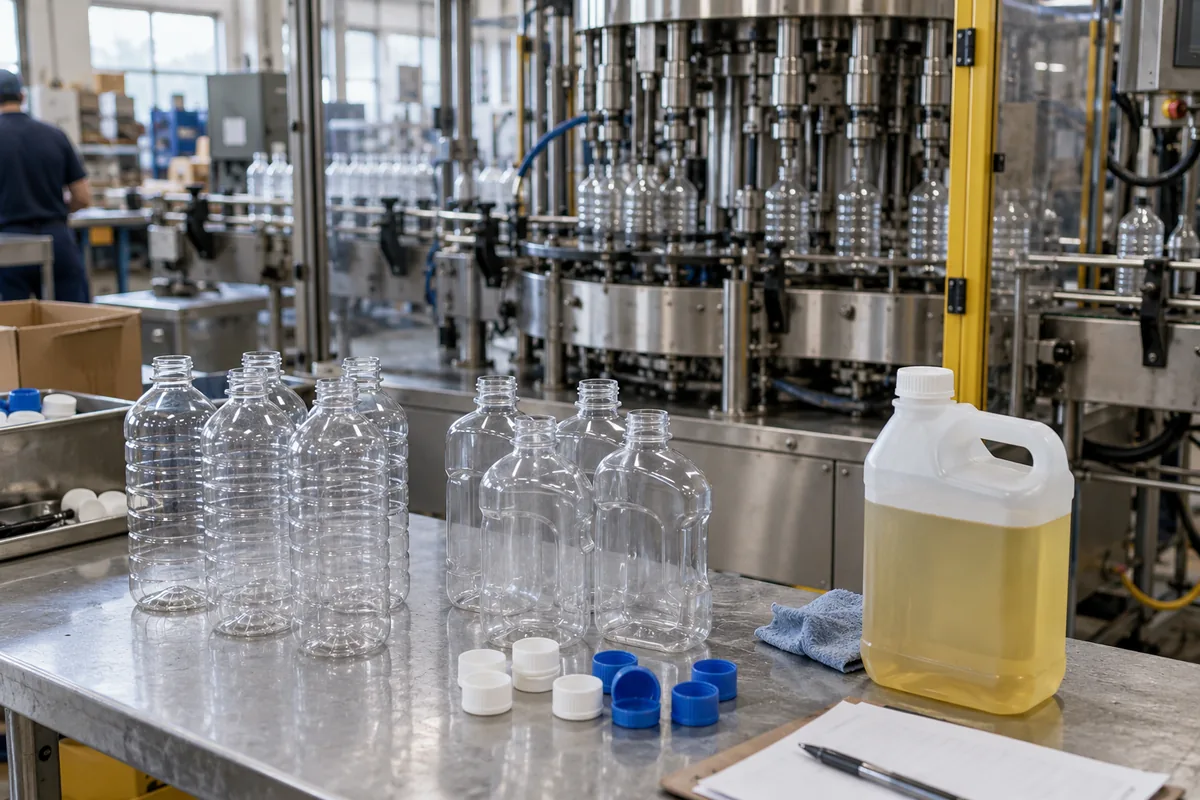
Keep the container, product and fill requirement tied to one proposed configuration.
How do you convert a ceiling without mixing the pages?
Two formulas use only the figures above. Each worked line names its page.
Containers per hour
containers per hour = containers per minute × 60
Worked example, Accutek ROF-52 specifications tab only. The tab prints “Filling Speed: Up to 450 CPM.”
450 × 60 = 27,000 containers per hour.
That 27,000 is the unit conversion of the tab’s ceiling. The RB page already prints containers per hour, so it does not go through this conversion. Its line remains up to 42 000 containers/h (1 L). The 27,000 figure stays with ROF-52. The 42 000 figure stays with RB.
Stated one-sigma mass
stated one-sigma mass (g) = 1 g/L × fill volume (L)
Worked example, Serac RB page only. The advantages section prints approx. 1 g/liter at 1 sigma. The header prints the 1 L condition next to the output line.
1 g/L × 1 L = 1 g.
Accutek’s saved pages do not print a grams-per-liter line. The 1 g result stays on the RB page.
Extra product if the setpoint offset equals that 1 g
extra product per hour = containers per hour × offset per container
The RB page does not print the setpoint offset. If the buyer sets the offset equal to the page’s stated 1 g on that 1 L container, then at the same page’s ceiling:
42,000 × 1 g = 42,000 g/h = 42 kg/h.
That 42 kg/h is the arithmetic of a buyer-chosen offset equal to Serac’s stated 1 g, run at Serac’s printed ceiling. It is the standard engineering baseline under those reference conditions. Aeration, temperature, and viscosity are the shifts Serac says the filler adjusts for, and they are also the shifts that move a real hour away from 42 kg. Confirm the offset and the hour on a sample trial and at FAT. The arithmetic does not use 450 CPM.
A stop has its own line, and neither machine page prints the stop minutes. Lost containers = hourly ceiling × stop minutes / 60. Using the converted ROF-52 ceiling, and a 6-minute stop the buyer writes on the trial sheet:
27,000 × 6 / 60 = 2,700 containers.
The 6 minutes are the buyer’s written stop, not an Accutek changeover time. Serac names SMED and does not print a measured minute count, so the 6 minutes are not an RB time either. Price stays off this page. The bottling quote-scope guide is where one-time and ongoing cost rows are separated, and the buying-guides desk is the wider place to compare two offers against the same scope.
Takeaway: Convert 450 CPM on the ROF-52 tab. Leave 42 000 containers/h on the RB header.
Who owns transfer, closing and cleaning interfaces?
Name the party who demonstrates each boundary. Serac’s RB page includes capping: the company says it designs and assembles its own capping turrets, and the technical list covers torque repeatability, cap handling, and torque set on the HMI. Accutek’s ROF-52 FAQ places the capper or the labeler after the container leaves the filler. Closing is inside the RB purchase as that page describes it, and it is a later machine on the ROF-52 FAQ.
The monoblock guide is the checklist for stations that share a frame. Use it when the offer says filler and capper are one machine. Use the ROF-52 FAQ’s “on to a capper” sentence when the offer shows a separate closer.
| Interface or task | What the buyer records | What the cited page already names |
|---|---|---|
| Empty-container infeed | Drawing, mass or volume, and the star or guide that fits it | ROF-52 FAQ: infeed and discharge stars are change parts. RB: plug-on circulation tools, color codes, HDPE or stainless steel, no tools |
| Product supply | Homogeneous or not, carbonated or not, measured viscosity, pieces or none | RB: homogeneous liquids. ROF-52 tab: particulates No, viscosity 1 to 2000 cP, foamy Yes. Both Accutek descriptions: non-carbonated |
| Filling to closing | Whether the capper is on this frame | RB: capping turret on the machine. ROF-52 FAQ: capper or labeler after discharge |
| Utilities | The supply the quoted frame needs | ROF-52 tab only: 120/240 VAC, single-phase, 60 Hz (optional 220/240 VAC, 3-phase), 20 AMP; air 100 PSI at 5 to 10 CFM. The RB page has no matching electrical line in the saved text |
| Cleaning | The outcome the product owner requires | RB: CIP inside and outside the tank, scales, table, and nozzles, plus closed-loop dry cleaning with collectors under the nozzles. No chemical recipe and no minute count |
| Discharge | Who receives the pack, and whether a later wrap is in this purchase | A shrink tunnel is a different machine. The heat-shrink buying guide covers that later step when the filled container still has to be wrapped |
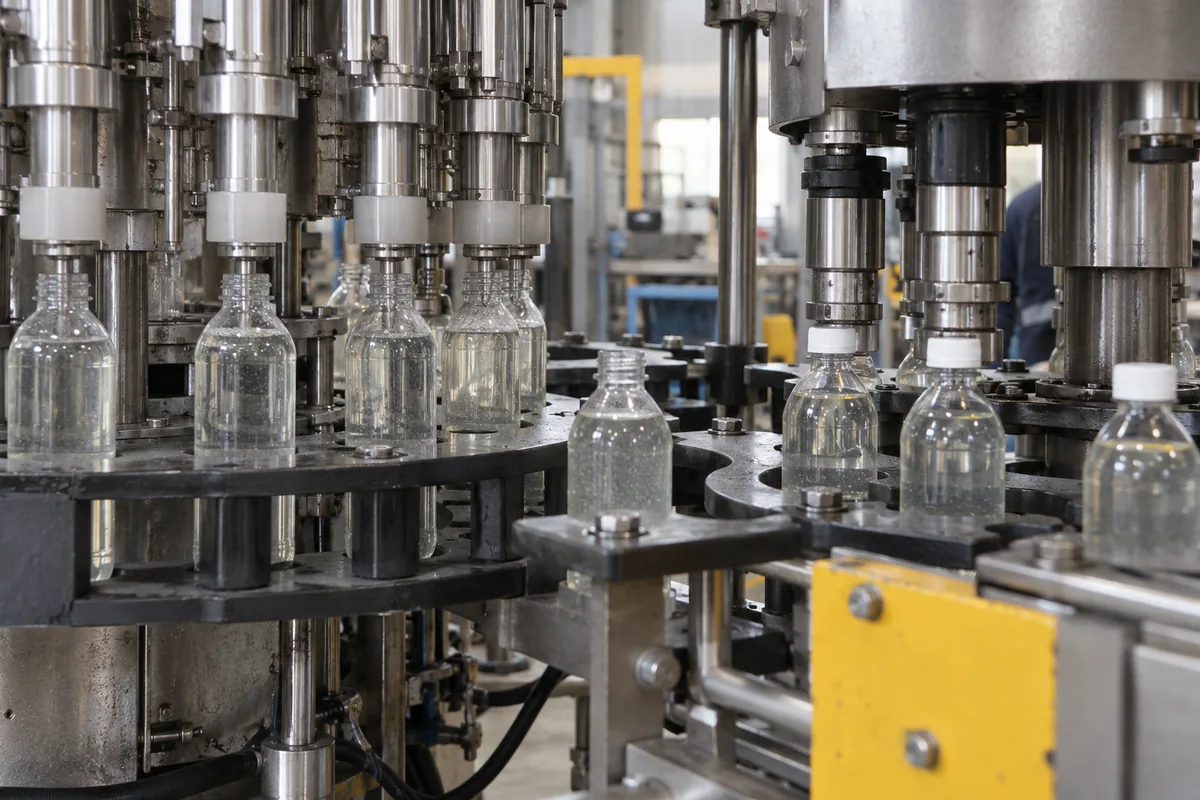
Responsibility surrounds the filler.
Use the complete-line responsibility matrix to retain named parties. A supplier can own several boundaries, but each still needs a recorded answer. Use the automation desk when framing interface questions for the responsible engineering team.
Keep a cleaning proposal separate from proof that it meets the product owner’s required outcome. Have the relevant technical and quality staff review the agreed evidence. No general sanitary approval follows from the word rotary or from the presence of a cleaning option.
Takeaway: Record the included interface scope and the party responsible for demonstrating it.
What should a representative filling and changeover trial retain?
Tie the record to one page’s ceiling, one container, one product, and one quantity check. A short public clip cannot stand in for that record. The FAT checklist is the map from each requirement to the evidence you keep.
| Record | Content to retain |
|---|---|
| Page baseline | RB, ROF-52, or ROF-40, plus the section the number came from. The 450 CPM row cites the specifications tab. The 42 000 containers/h row cites the RB header |
| Container | Drawing revision, mass, and the star or tool identity. ROF-52 FAQ names infeed and discharge stars as the change parts |
| Product | Lot, temperature, whether it is one phase, carbonation, pieces, and the measured viscosity you will compare with 1 to 2000 cP |
| Quantity check | Mass, volume, or level, in the column the offer claims. Level evidence does not close a mass requirement |
| Ceiling used | 42 000 containers/h at 1 L, or 450 CPM, or a blank for ROF-40. The trial sheet writes which one |
| Observation window | Start, stop, interruptions, and whether rejected containers are in the count |
| Changeover | Formats, tools, people, and the minutes you actually time. SMED on the RB page is the method name. It is not a printed minute count |
| Cleaning | What ran, inside or outside, wet or the RB closed-loop dry arrangement, and the product owner’s review. No recipe is supplied here |
| Open item | Missing evidence, the owner, and the next check |
Filling evidence and transfer evidence are separate rows in the same trial. A filling-only run leaves the starwheel, the capper, and any downstream conveyor unproven. Write what was connected and what was simulated.
Takeaway: One trial record names one page’s ceiling and the container that ran.
When this does not apply
These three pages cover rigid containers on the materials they list: Serac names PET, PP, PS, aluminium, and glass, from 100 g to 60 kg; both Accutek descriptions name rigid plastic, metal, and glass from ounces to gallons. A pouch rotary filler is outside the saved pages. So is an aseptic process, a carbonated fill, and any nozzle count inferred from a model name.
Serac’s durability sentence, an average lifetime of over 20 years, stays Serac’s sentence. It is not a life figure for the Accutek machines. The ROF-52 electrical and air lines stay on that tab. They are not an RB utility list.
Cleaning chemistry, fill settings, and lockout steps belong in the manufacturer’s manual and in the site procedure. This guide records the boundaries those documents have to cover.
Takeaway: Keep each figure on the page, the container, and the quantity check that were saved with it.
Method and sources
Compiled from public manufacturer documentation:
- Apex inline-versus-rotary comparison (April 30, 2025): manufacturer explanation of layout distinctions.
- BW Packaging Hema SENSI: dairy-specific public product description, including weight and mass-flow filling-method and surrounding-equipment choices.
- Furui filling-method classification: first-party explanation of volume-based filling.
- ILPRA pre-made rotary fillers: rotary system for pre-made doypack pouches, illustrating why rotary layout must be paired with the specific pack format.
Read the editorial evidence policy for our attribution rules.
Takeaway: The ceilings used here are the ones in the three saved pages.
Related reading
- Volume, mass, and fill level records the acceptance unit the rotary route does not choose.
- Viscous-liquid sample inputs are the measurements you compare with the ROF-52 range of 1 to 2000 cP.
- Monoblock stations list what shares the frame when the offer includes closing.
- Packaging FAT evidence maps each ceiling and each handoff to a record.