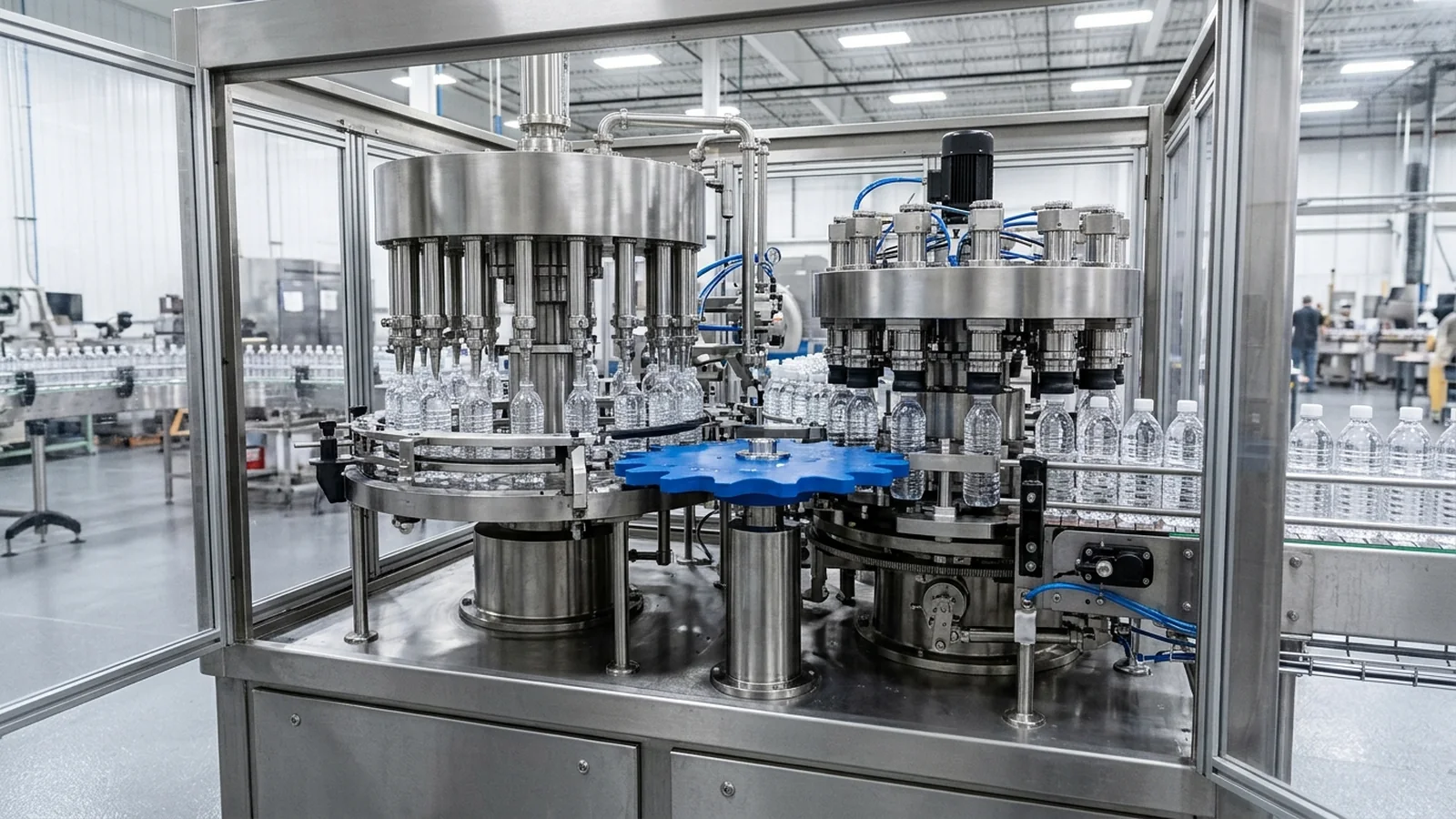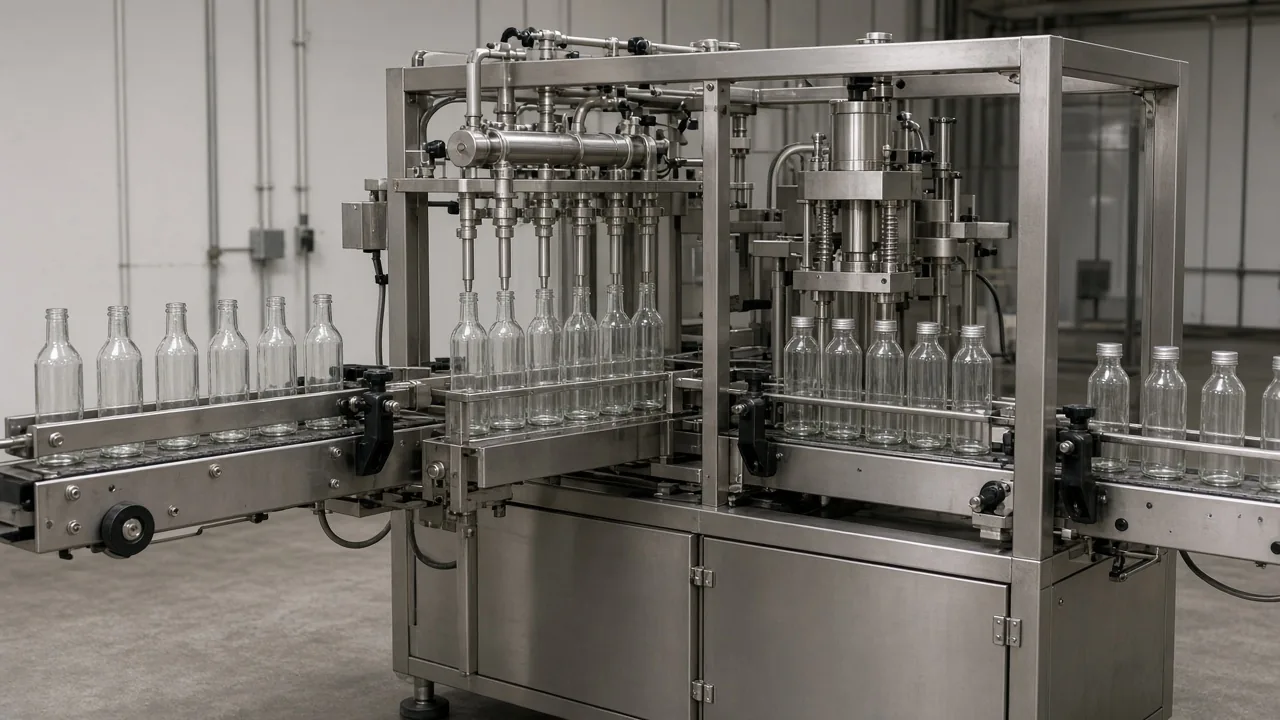
A viscous liquid filling machine chosen from a thick-product label wastes fill and rejects packs when the real product viscosity never enters the trial. Record the viscosity report, the container, and the fill target before the supplier names a metering path.
For a viscous-liquid filling-machine purchase, use an identified product sample and its recorded conditions rather than an unverified viscosity label. Ask suppliers to explain which metering and product-handling configuration they propose, what sample evidence it needs and what the offer includes. This guide provides a measured-versus-unmeasured material sheet, candidate-method questions and a sample-evaluation record. Rotary versus inline layout is a separate decision handled in the linked system guide.
| Input or item | Typical value or source | Why it matters |
|---|---|---|
| Product viscosity | Blank until the product report states the value, the unit, the temperature, and the shear condition. Brookfield, 18 October 2026 | A category word such as cream or sauce does not fill this cell |
| Accutek APOF band | Low to medium viscosity (200 cps). Accutek filling-machines page, same date | That series page names one overflow band. It is not the product’s viscosity |
| Cleveland SGP path | Hopper-fed piston for creams, liquids, and highly viscous products. Smaller single-head range 10 to 1,000 ml across five sizes. Air only. Same guide | Thick product feeds down from the hopper. The page prints no centipoise cutoff |
| Cleveland SGP accuracy | +/- 1% on liquids. +/- 2% on creams. Same guide | Two ratings on one family. The cream rating does not move onto a liquid trial |
| Cleveland SGY path | Draw hose, 1 in inside diameter, dispensing hose 1/2 in inside diameter, for liquids that pour like water or oil. Same guide | Those hose diameters belong to the SGY description. The SGP nozzle size is blank on that page |
| Cleveland utility | 5 CFM at 90 PSI, with a recommended compressor of at least 30 gallons. Same guide | Pneumatic SGP and SGY machines. The page prints no viscosity at which this air supply fails |
| Cleveland cycle ceiling | Smaller single-head models up to 50 cycles per minute. Dual-head models and larger fills up to 30 cycles per minute per head. Real-world speed depends on product, fill size, and operator. Same guide | A catalog ceiling. The page prints no separate viscous derate, so none is applied here |
| Mass-meter accuracy | Ideal Pase states average fill-volume accuracy for mass-metered machines is generally around +/- 0.25%. Article dated 30 April 2026, fetched 18 October 2026 | A mass-meter statement. It is not the SGP cream rating |
| Product centipoise, nozzle orifice, fill temperature | Blank | Absent on the pages above, so absent here |
Which product conditions should be measured or described?
What belongs on the product viscosity record?
Brookfield’s definition page treats viscosity as internal resistance to flow, the friction between layers of fluid. Its temperature and shear-rate page states that, in most fluids, viscosity decreases as temperature increases, and it names the reverse as temperature falls. The same page separates shear-thinning fluids, which become less viscous when shear is applied, from shear-thickening fluids, which become more viscous. Ketchup is Brookfield’s shear-thinning example. Cornstarch in water is the shear-thickening example. Those examples stay on Brookfield’s page. They do not become the viscosity of the product in the trial.
Write the report as five fields: value and unit, temperature, shear condition or spindle speed, instrument, and sample identity. Brookfield lists temperature, shear rate, time under shear, composition, and sample history as reasons a result moves. A single number with those fields empty describes a different test than the fill.
E-PAK’s viscous-liquid page, fetched 18 October 2026, says its machines are designed for many products of high viscosity and prints no centipoise value. Its common-liquids chart page says the chart is an image of average estimates for a conversation with its staff. The HTML of that page does not print a centipoise table, so this guide does not copy numbers off the image.
Rule of thumb. If product viscosity is above 200 cps on the report, Accutek’s APOF series sits outside the low-to-medium band that page prints for its automatic pressure overflow fillers. If the report has no centipoise value, leave the comparison blank.
Takeaway: The product row carries the report’s value and its conditions. A maker’s band stays on the maker’s row.
Which path matches a thick product?
E-PAK’s piston-versus-vacuum article, posted 11 July 2025 and fetched 18 October 2026, describes a piston filler as a cylinder that pulls product in on the intake stroke and pushes it out on the discharge stroke. Stroke length sets the volume. That article assigns piston fillers to thick or chunky liquids, including sauces, syrups, creams, gels, and products with particulates, and it says they handle flexible or rigid containers. It assigns vacuum fillers to thin, free-flowing liquids in rigid glass or hard plastic, and it says vacuum fillers do not handle particulates. The comparison table on that page marks piston speed as moderate and vacuum speed as fast, with no cycles per minute and no centipoise cutoff.
Cleveland’s guide draws the split inside piston fillers. The SGP is hopper-fed. Product sits in a hopper, 3 gallons standard on the smaller models, and feeds down into the cylinder. The SGY pulls product up a 1 in inside-diameter draw hose and dispenses through a 1/2 in inside-diameter hose. Cleveland tells the buyer to choose the SGP when the product is thick, and the SGY when it pours like water or oil. Gravity and overflow fillers, on that same page, struggle with thick product.
Ideal Pase’s 30 April 2026 article says overflow fillers need free-flowing product because they use gravity, and that thicker fluid has a harder time entering the overflow tube. Accutek’s SAPOF series is described as suited to low to medium viscosities and to products that foam, with no centipoise figure on that sentence. The 200 cps figure on the same Accutek page belongs to the APOF series sentence, not to SAPOF, and not to a piston.
Cleveland’s FG1000 gear pump is listed for low-to-medium viscosity liquids at 5 to 4,000 ml on 110V, with no centipoise value. Its FT1000 peristaltic pump is listed for small-volume, non-viscous pharmaceutical and cosmetic liquids at 10 to 5,000 ml. Leave those two machines off a thick-product shortlist unless the quote attaches a different page that states the product.
The rotary filling layout guide keeps the container route separate from this metering choice. A rotary base does not decide hopper versus draw hose.
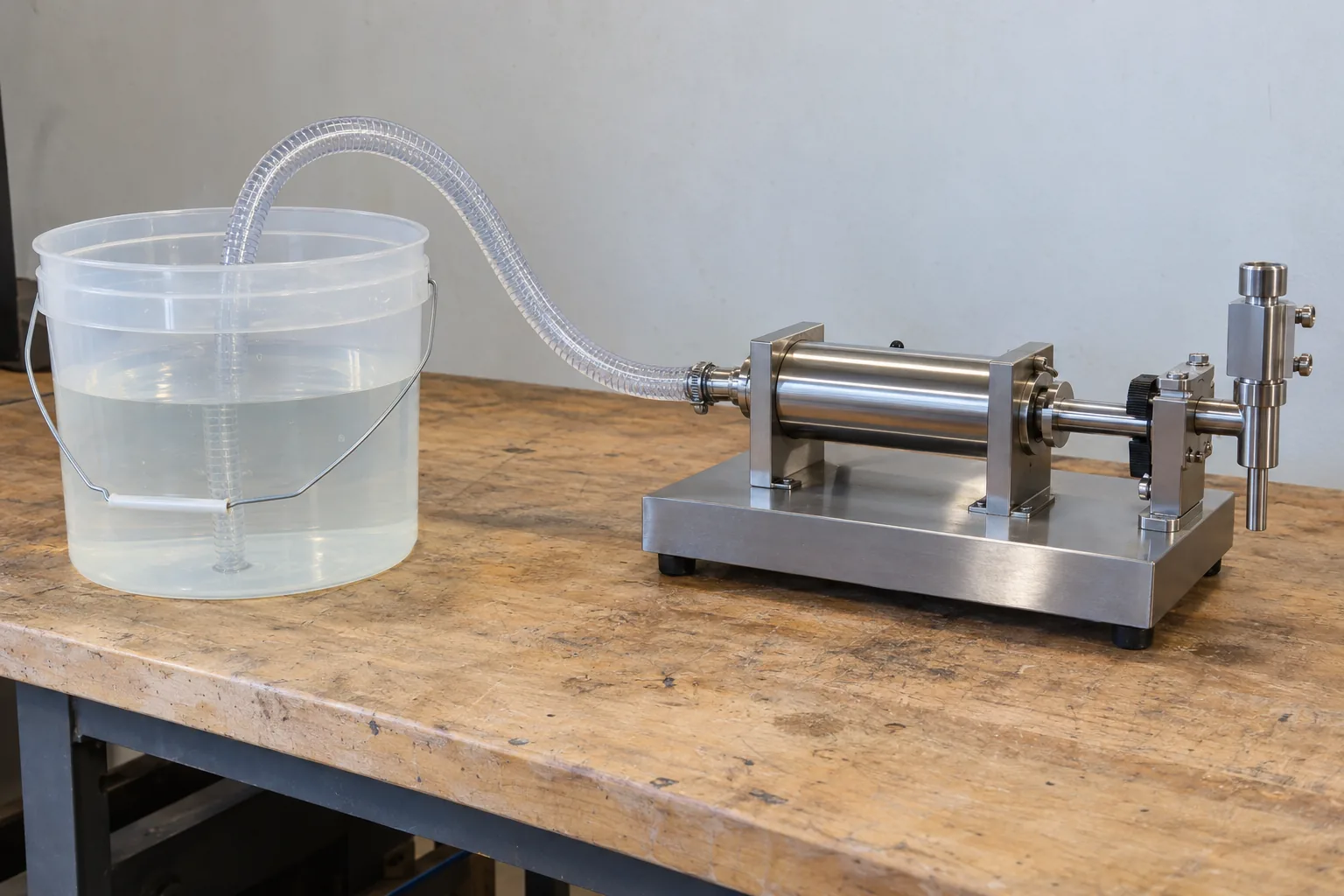
Example of a draw-hose feed. Editorial illustration, not an SGY installation or a measured hose diameter.
Rule of thumb. If the product has to feed down from a hopper because it will not climb a draw hose, Cleveland’s guide assigns the SGP. The SGY on that page is the free-flowing machine, with the 1 in draw hose and the 1/2 in dispensing hose printed only for that family.
Takeaway: Mechanism, feed path, and container rigidity are three fields. A viscous label fills none of them by itself.
Where does the catalog accuracy band stop?
Cleveland rates SGP and SGY piston fillers at +/- 1% accuracy on liquids. The SGP, which also fills creams, is rated at +/- 2% on creams. The SGP-250 size on that page fills 45 to 250 ml. Those three figures support one catalog check. They do not rate an unnamed filler.
Worked example. Catalog accuracy band = fill volume × accuracy fraction.
At the top of the printed SGP-250 range, using the cream rating on Cleveland’s page:
250 × 0.02 = 5 ml.
At the same 250 ml set point, using the liquid rating on that page:
250 × 0.01 = 2.5 ml.
The 2.5 ml gap is the difference between the two printed ratings. It is not a weighed cream-versus-liquid loss. A set point other than 250 ml needs its own line, and a set point the quote does not state stays blank.
Ideal Pase states that a piston fills by volume, while density fluctuates through the day as temperature changes, so equal volumes can weigh differently. Brookfield’s temperature page gives the matching viscosity direction for most fluids: hotter fluid, lower viscosity. Neither page prints a degree setpoint. The volume, mass, and fill-level columns are where a scale reading stays a mass result until density and temperature are in the same report.
Ideal Pase’s +/- 0.25% figure is its stated average fill-volume accuracy for mass-metered machines. Keep it on that row. Do not write it into the SGP cream band.
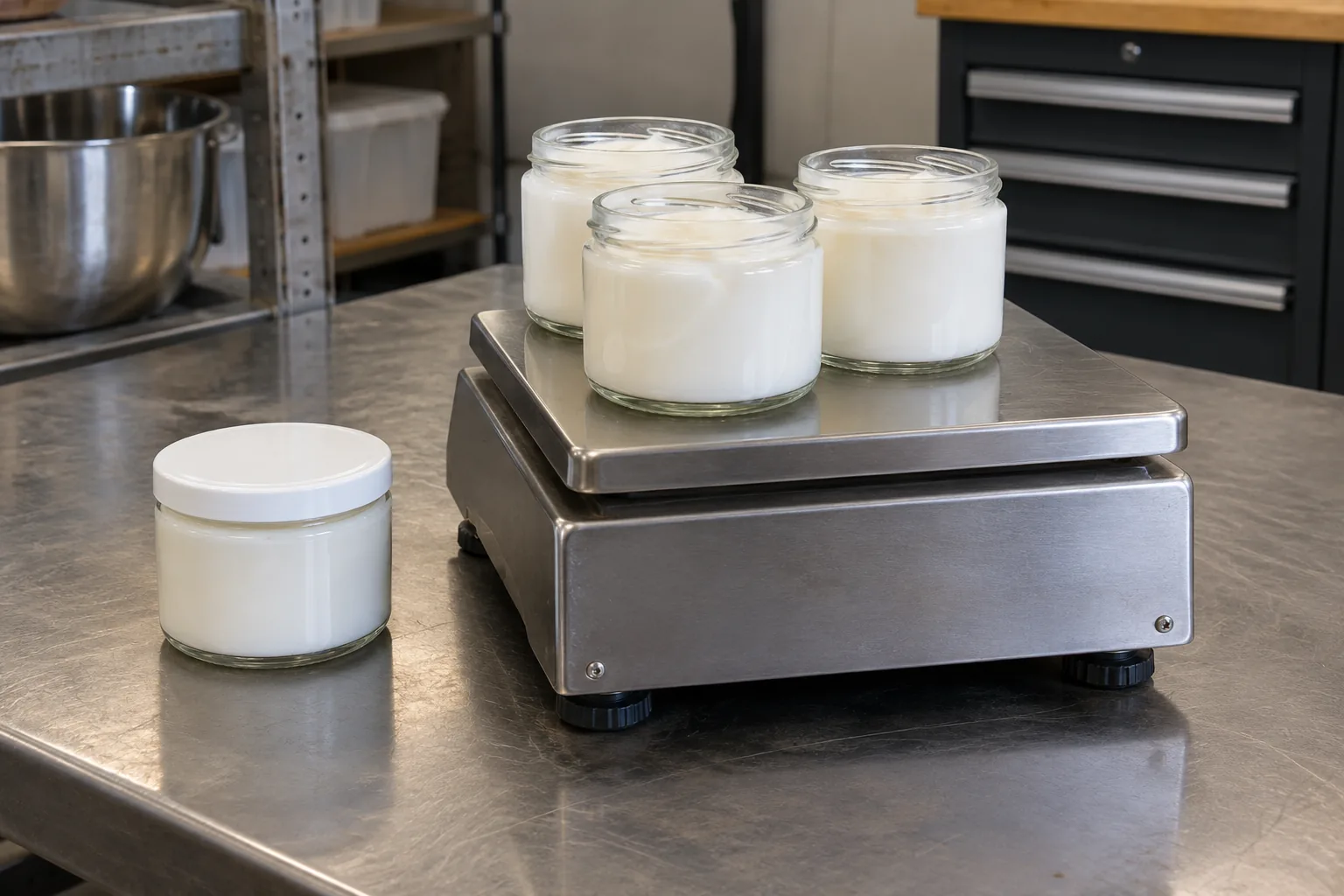
Example of a mass check kept separate from the volume set point. Editorial illustration, not a recorded trial.
What fails when viscosity shifts on the run?
E-PAK’s inconsistent-fill article, posted 26 August 2026 and fetched 18 October 2026, states that when viscosity changes, the volume delivered per cycle changes with it if the settings stay the same. A cycle calibrated at one viscosity overfills or underfills after the shift. The article names temperature swings in the supply tank, batch-to-batch ingredients, and seasonal raw material as causes, and it says thick or semi-viscous products are especially sensitive. The fix it prints is to monitor temperature and viscosity at the start of each run and after a batch change. For a temperature-sensitive product it names a heated or jacketed supply tank. It prints no temperature setpoint and no centipoise limit.
| Path | Printed scope | Dominant failure mode | Prevention |
|---|---|---|---|
| Overflow or gravity on a thick product | Ideal Pase: gravity overflow needs free-flowing liquid, and thicker fluid struggles in the overflow tube. Accutek APOF: low to medium viscosity (200 cps). Cleveland: gravity and overflow struggle with thick product | Short fill, or no flow through the overflow path | Keep overflow inside the band that page prints. For product that does not pour freely, use a hopper-fed positive-displacement path. Leave nozzle diameter blank |
| Draw-hose piston on a thick product | Cleveland SGY: 1 in ID draw hose and 1/2 in ID dispensing hose, for water-thin products | Starved cylinder and short fills | Assign the hopper-fed SGP so product feeds down. The SGP nozzle size is blank on that page |
| Volume set point while temperature moves | Ideal Pase: equal piston volumes can weigh differently when density changes with temperature. Brookfield: in most fluids, viscosity falls as temperature rises | A weight check fails while the volume set point is unchanged | Record temperature with the viscosity report and with the fill. Keep mass in its own column |
| Settings left in place after a viscosity shift | E-PAK, 26 August 2026: delivered volume changes with viscosity when settings stay the same | Overfill or underfill after a batch change or a tank-temperature swing | Recheck temperature and viscosity at the start of the run and after a batch change. The previous calibration does not carry forward |
| Worn or clogged nozzle | E-PAK: a partially clogged, worn, or misaligned nozzle drips or restricts flow. Foamy and viscous products accelerate that wear | Drip after the valve closes, or a restricted stream | Replace the nozzle on the machine and record the exact orifice diameter from its parts list |
Common mistake: Treating Cleveland’s 50 cycles per minute as the rate a thick product will run. That page rates smaller single-head models up to 50 cycles per minute, rates dual-head models and larger fills up to 30 cycles per minute per head, and states that real-world speed depends on the product, the fill size, and the operator. Verify the actual cycle rate on the target viscosity during line trials.
What overhead belongs on the job?
Worked example. Using the 5 ml cream band from the SGP-250 line above, and a counting basis of 1,000 containers:
5 ml × 1,000 = 5,000 ml.
Those 5,000 ml are catalog-band arithmetic at the high side of the +/- 2% cream rating and the 250 ml top of the SGP-250 range. They are not a plant giveaway. The weighed loss stays blank until the trial writes it down. Replace 1,000 with the lot size on the order when that lot size exists. A second set point, or the +/- 1% liquid rating, needs its own product of band times count.
Ideal Pase states that piston changeovers often take a full day or more, because the machine is disassembled and the internal parts are scrubbed. One extra product change books another full day on that statement. The day is not a price, and it does not transfer to a filler Ideal Pase did not describe. The site’s own timed changeover stays blank until someone times it.
That pair, catalog-band product and a published changeover day, is the hidden account on a viscous liquid filling machine. Cleveland’s 5 CFM at 90 PSI is a third line for SGP and SGY machines only: the compressor is part of the purchase, and the page does not print a power draw for those pneumatic fillers.
The buying guides desk is where two offers get compared on included scope. The filler-to-closer handoff names who owns the next machine after the filler. The packaging sample checks for a factory test are the place to attach this product, this container, and this temperature to the acceptance record. A completed fill on a substitute sample does not close those rows.
Takeaway: Book the printed accuracy band as millilitres and the printed changeover as time. Book price nowhere on this page.
What closes the confirmation sheet?
| Confirmation row | Answer to copy | Leave blank when |
|---|---|---|
| Product identity | Version, sample lot and relevant production history | Obtain an identified representative sample |
| Viscosity record | Value and units from an existing report | Mark “not measured”; ask what evaluation is needed |
| Report measurement conditions | Method, instrument, measurement temperature and any reported speed/shear conditions | Retain the limitation; request the original report |
| Intended filling condition | Product-owner’s proposed filling temperature and other required conditions | Ask the responsible parties to define unknowns |
| Actual evaluation condition | Recorded sample/filling temperature and actual conditions at the trial | Identify differences from intended conditions |
| Particles | Existing size/content/condition records and their sources, if available | Supply identified representative material; agree the particle observations needed |
| Foaming/air | Known observation, when/under what conditions it occurred and sample identity | Agree whether and how the concern will be observed |
| Product changes | Observed variation, condition-specific sample identities and proposed schedule | Identify which samples represent the different states |
| Container | Drawing and sample of the proposed pack | Obtain the actual pack before closing suitability |
Do not backfill an unknown viscosity value from an online list for a similar product. A product-category example can help describe the application, but it does not establish the measured condition of this sample. Preserve the record’s source and revision in the buyer’s own project files.
The filling and bottling desk supplies the wider selection context. The rotary-system guide distinguishes container route from metering, preventing a material label from deciding layout automatically.
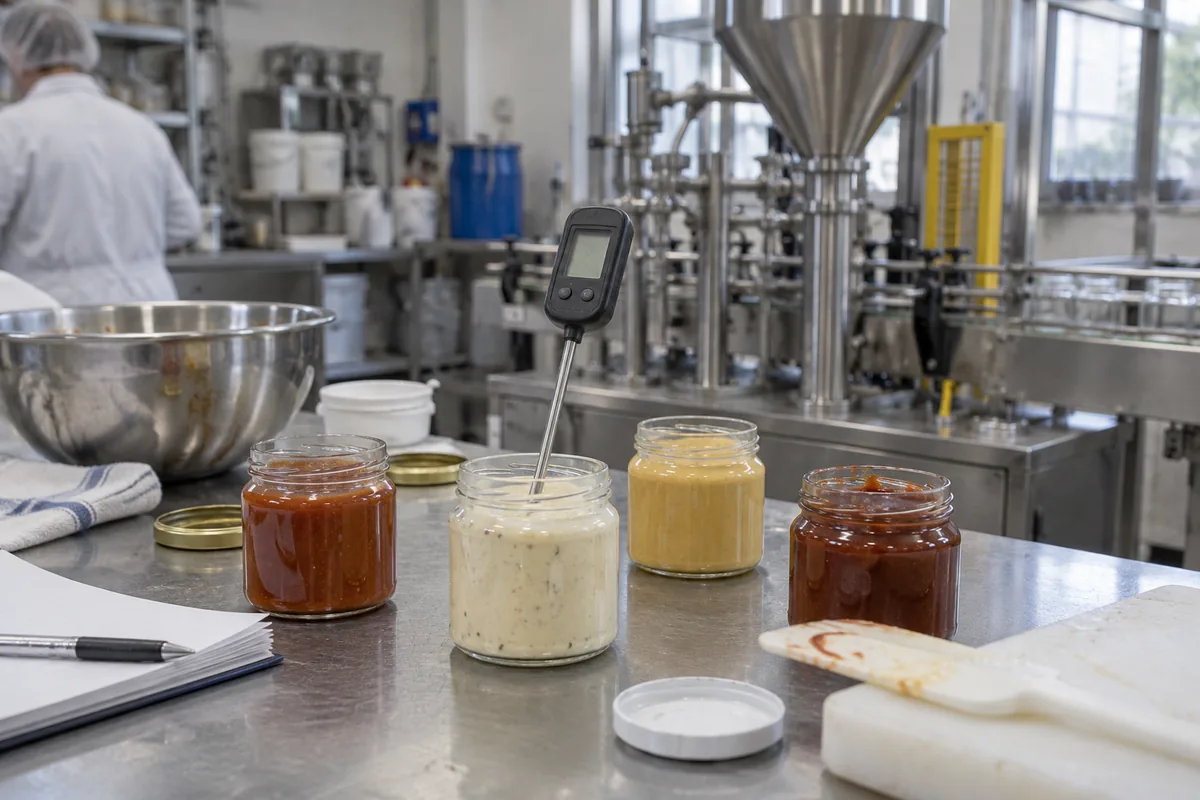
A description, measurement and unknown field have different evidence status.
Takeaway: Preserve what has actually been measured and identify the missing conditions.
How can candidate filling methods be compared?
Ask each supplier to connect its proposed method to the sample and required output. Furui’s public classification distinguishes gravity, piston, vacuum and peristaltic mechanisms, and separately discusses volume and weight measurement. These categories help organize the questions; they are not evidence that one mechanism handles every thick product.
| Candidate described in public sources | Source-level explanation | Project evidence to request |
|---|---|---|
| Gravity | Furui describes gravity transfer for readily flowing, low-viscosity liquids | Classification reference, not an equally supported thick-product candidate; ask for project-specific evidence if proposed |
| Piston | Furui associates its chamber/dispensing description with medium/high-viscosity products | Source view only; obtain the proposed product path and representative sample evaluation |
| Vacuum | Furui describes pressure-difference filling for non-viscous, non-foaming liquids | Classification reference; do not infer thick-product suitability from this description |
| Peristaltic | Furui describes tube-based transfer in sensitive-product applications | Its source scope is not a viscous-product threshold; obtain configuration and sample evidence |
| Volume-based measurement | Furui describes a specified volume basis | How the target is established and checked for this product |
| Weight-based measurement | Furui describes using scales/weighing sensors | How the target weight and result are checked |
The last two rows are measurement bases, not additional mutually exclusive mechanisms. Record the proposed mechanism and measurement basis in separate fields. A product may be described as suitable in a manufacturer guide while the required machine configuration and trial remain unresolved.
Our shortlist advice is conditional. If a supplier provides a documented application review for the actual sample, retain that proposal for comparison. If the answer relies only on a category label or omits the product-path/pack scope, request clarification before treating it as a supported candidate. If its stated application excludes a required product condition, remove that proposal from the current requirement rather than changing the product silently.
Common mistake: Selecting a piston or pump simply because the label says viscous. Ask which configuration is proposed and what evidence supports this sample, container and output.
Use the buying-guides desk for the scope-comparison approach. The rotary layout-versus-metering table handles the independent container-route choice.
Mechanism and measurement basis are separate entries.
Takeaway: A method name becomes useful when its configuration and sample evidence are identified.
Which product-path and container questions need an answer?
Specify where the product enters the offered system and where the filled pack leaves it. Include the proposed container presentation and next operation. E-PAK describes viscous-filling equipment together with cappers, labelers and conveyors; that public scope discussion supports asking what is actually included, not assuming a complete line in every offer.
| Question | Record to obtain | Responsibility to assign |
|---|---|---|
| What supplies product to the filler? | Source boundary and proposed feed scope | Buyer/product owner and equipment supplier |
| What path is proposed for this material? | Configuration-specific description and included equipment | Equipment supplier |
| How is the container presented? | Actual pack and handling arrangement | Equipment/line supplier |
| What defines the delivered quantity? | Required target, units and method | Buyer and supplier |
| What happens after filling? | Closing/handling boundary | Supplier or named integrator |
| What changes between products? | Change and cleaning scope | Site/product owner and supplier |
| Which site conditions matter? | Required utilities/layout compared with verified site record | Supplier and site technical staff |
Describe particles, foaming and any product-owner handling concerns as evaluation inputs rather than assuming a single universal pump geometry. The responsible supplier should state how its proposed path addresses them and what the trial will observe. Record any product-conditioning equipment proposed as part of the scope, along with the target temperature window specified by the product owner.
The complete packaging-line interface matrix keeps the filler-to-closer handoff explicit. If a later grouped pack is required, the shrink-packaging scope guide handles that separate stage; it is not evidence for filling compatibility.
Takeaway: Connect the material, quantity and container questions to an identified product path and delivery boundary.
What should the sample-evaluation request contain?
State the requirement and the available sample evidence before asking for a demonstration. Then have the supplier identify what its proposed evaluation can and cannot show. This gives a buyer a comparable request without prescribing settings, treating a substitute sample as identical or promising that a category-listed machine will work.
| Input to the evaluation | What the buyer records |
|---|---|
| Product | Identity, representative sample and condition/history record |
| Measurement information | Existing report, measured temperature and reported speed/shear conditions, or named gaps |
| Filling condition | Intended temperature/condition and agreed actual-trial record; differences retained |
| Pack | Actual container, closure and drawing revisions |
| Desired output | Defined fill target, units and accepted-pack requirement |
| Production objective | Product mix, target per agreed time unit and run boundary |
| Proposed machine scope | Identified equipment, method, metering and product-feed arrangement |
| Quality observations | Product-owner requirements to review after filling |
| Measurement plan | Method, instruments, agreed sample/counting plan and criteria |
| Changes | Product/pack changes and cleaning evidence requested |
Agree in advance how the filled quantity will be measured, what counts as an accepted pack and how interruptions are recorded. The product owner’s acceptance requirements should remain a separate entry from the equipment supplier’s explanation of its process.
Use the packaging FAT planning guide when this sample plan becomes part of the purchase acceptance requirements. An exploratory evaluation can inform selection but does not automatically satisfy every contract requirement.
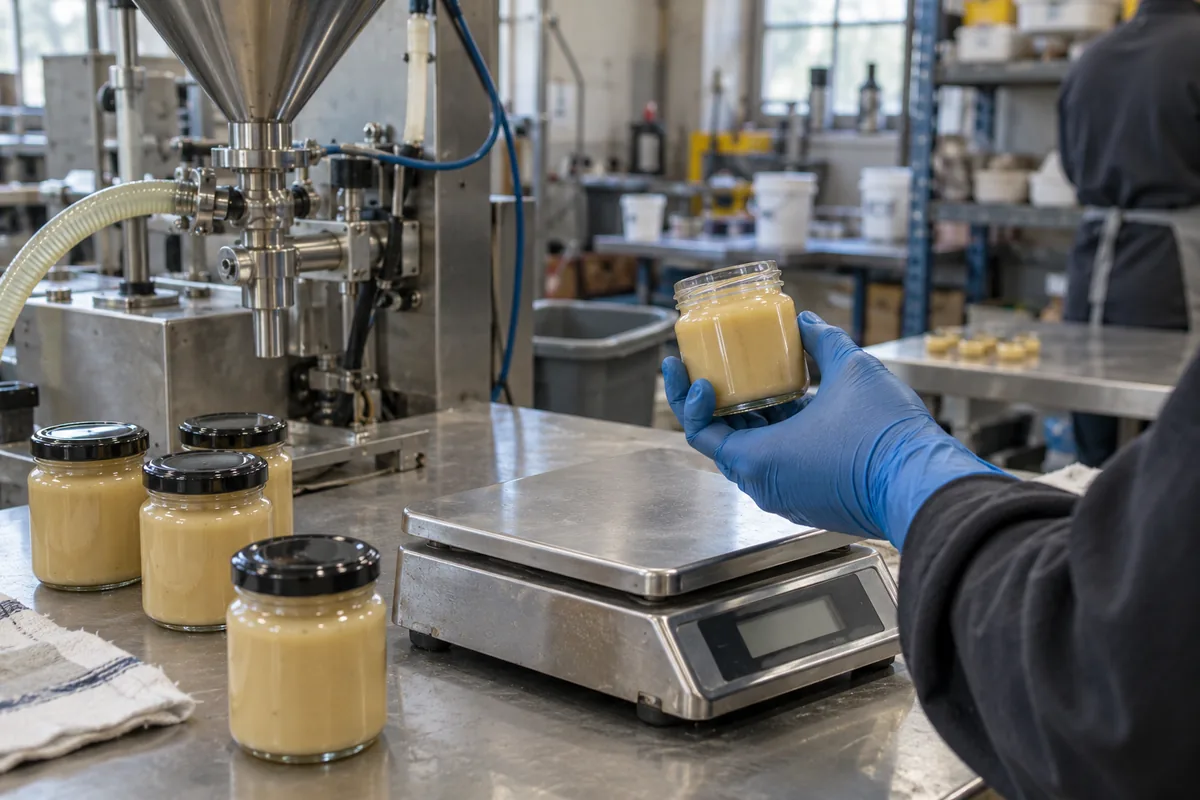
The sample-evaluation request ties the product, pack and required measurement together.
Takeaway: Send a defined evaluation task, not just an unlabelled jar of product.
How should results and open items be recorded?
Retain raw observations alongside the requirements they address. Record the actual product, pack, configuration and conditions so another reviewer can identify what was shown. Missing cleaning, transfer or product-quality evidence should remain an open item rather than being closed by a general claim of compatibility.
| Requirement or agreed rule | Actual observation to enter | Evidence and follow-up |
|---|---|---|
| Product and pack identities | Actual sample/configuration used | Identity records and any differences |
| Fill target and measurement plan | Individual readings and their units/conditions | Raw record, method and instrument identity |
| Accepted output | Accepted packs and agreed timed window | Count/event record and interruptions |
| Product-owner checks | Actual agreed observations after filling, including particle/foaming concerns or mouth residue/product condition if relevant | Sample/photo/report identity and responsible reviewer |
| Material condition | Actual evaluation temperature and condition-specific sample identity, compared with the intended filling condition | Raw condition record and differences |
| Transfer and closure | Actual connected downstream scope | Handoff observations and missing equipment |
| Change/cleaning task | Actual demonstrated task and condition | Supplier documentation and agreed review evidence |
| Unresolved requirement | What was not shown or did not match | Owner, required evidence and follow-up status |
Connect each observation to its agreed requirement, retained evidence and unresolved item.
Keep measured values distinct from the supplier’s interpretation. A recorded difference may call for another sample review, a configuration change or a decision to exclude the proposal. Preserve the previous observation so a later successful trial does not erase the earlier limitation.
The automation desk helps frame which functions were demonstrated, while the rotary trial record carries the container-route and transfer evidence.
Common mistake: Reporting only a successful fill. Preserve the product condition, measuring method and unresolved tasks with the result.
Takeaway: Results close identified requirements only within the conditions actually recorded.
When this does not apply
Requirements for food-contact, product quality, hygiene, cleaning chemistry and safety need the responsible product/site review and configuration-specific supplier documents.
A substituted product, changed container or undocumented sample condition is a different evaluation scope. Keep that limitation with the result rather than generalizing from it.
Takeaway: Use the record to define a supplier evaluation; keep unknowns visible until that evaluation is documented.
Method and sources
Compiled from public manufacturer and instrumentation documentation:
- Furui liquid-filling classifications: public explanation of mechanisms, material categories and volume/weight bases.
- E-PAK viscous-liquid filling page: public overview of viscous-filling equipment and surrounding-line scope (cappers, labelers, conveyors).
- AMETEK Brookfield viscosity definition and temperature/shear-rate discussions: first-party measurement guidance supporting the terminology and condition-recording structure.
The editorial policy explains our separation of manufacturer statements, sample evidence and buying recommendations. Existing catalogue examples are not a measured viscosity table for your product.
Takeaway: Public categories organize the review; identified samples and records support the project decision.
Related reading
- Rotary filling-system checks separate container route from metering.
- Volume, mass, and level keep a scale reading in the mass column.
- Packaging machinery FAT checklist attaches the sample, the configuration, and the open items to acceptance.