Selecting a monoblock filler capper over a modular inline bottling line requires balancing positive starwheel container control and defect rejection against multi-SKU changeover tooling. In its filling line integration guide, E-PAK Machinery notes that if any downstream station cannot keep pace with the filler, the line backs up and the filler is forced to stop and start repeatedly, which creates accuracy and wear problems. For buyers comparing equipment across our filling and bottling equipment guides and evaluating how stations are grouped in monoblock filling machine included functions, this engineering guide examines published starwheel part counts, bottle diameter envelopes, chuck versus spindle capper adjustments, and inline accumulation dynamics.
How a Monoblock Filler Capper Synchronizes Bottle Handling
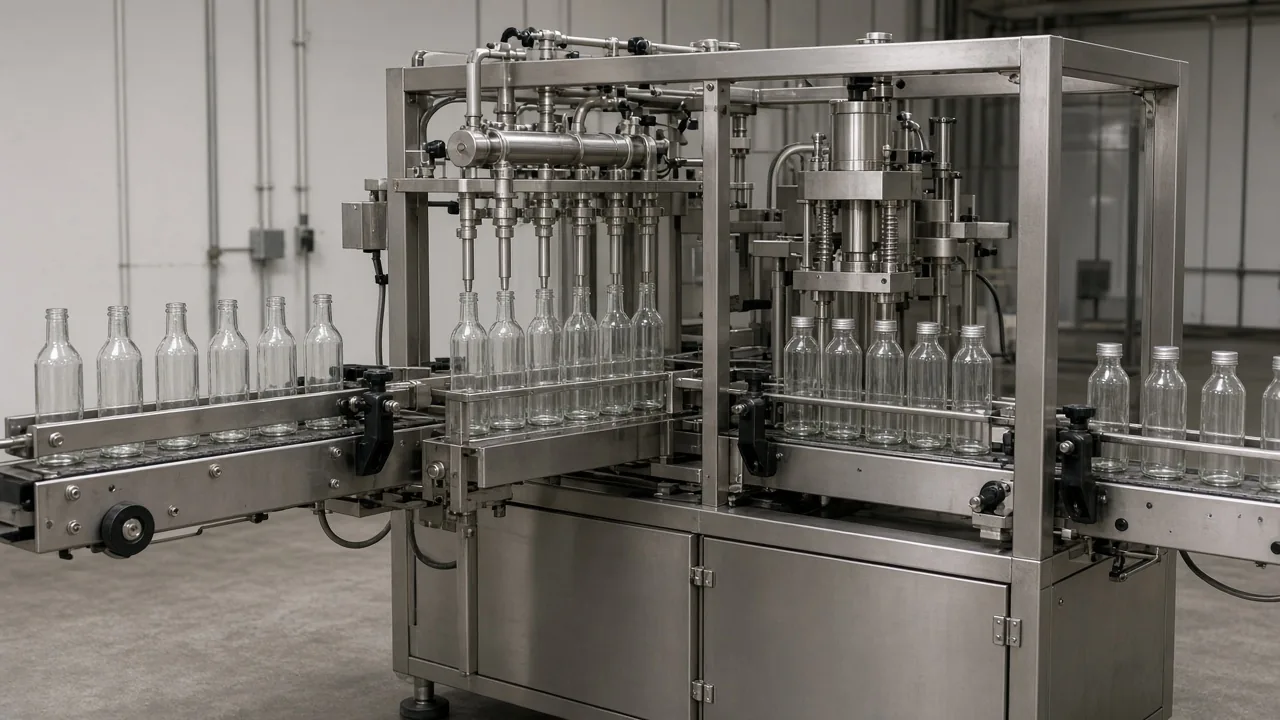
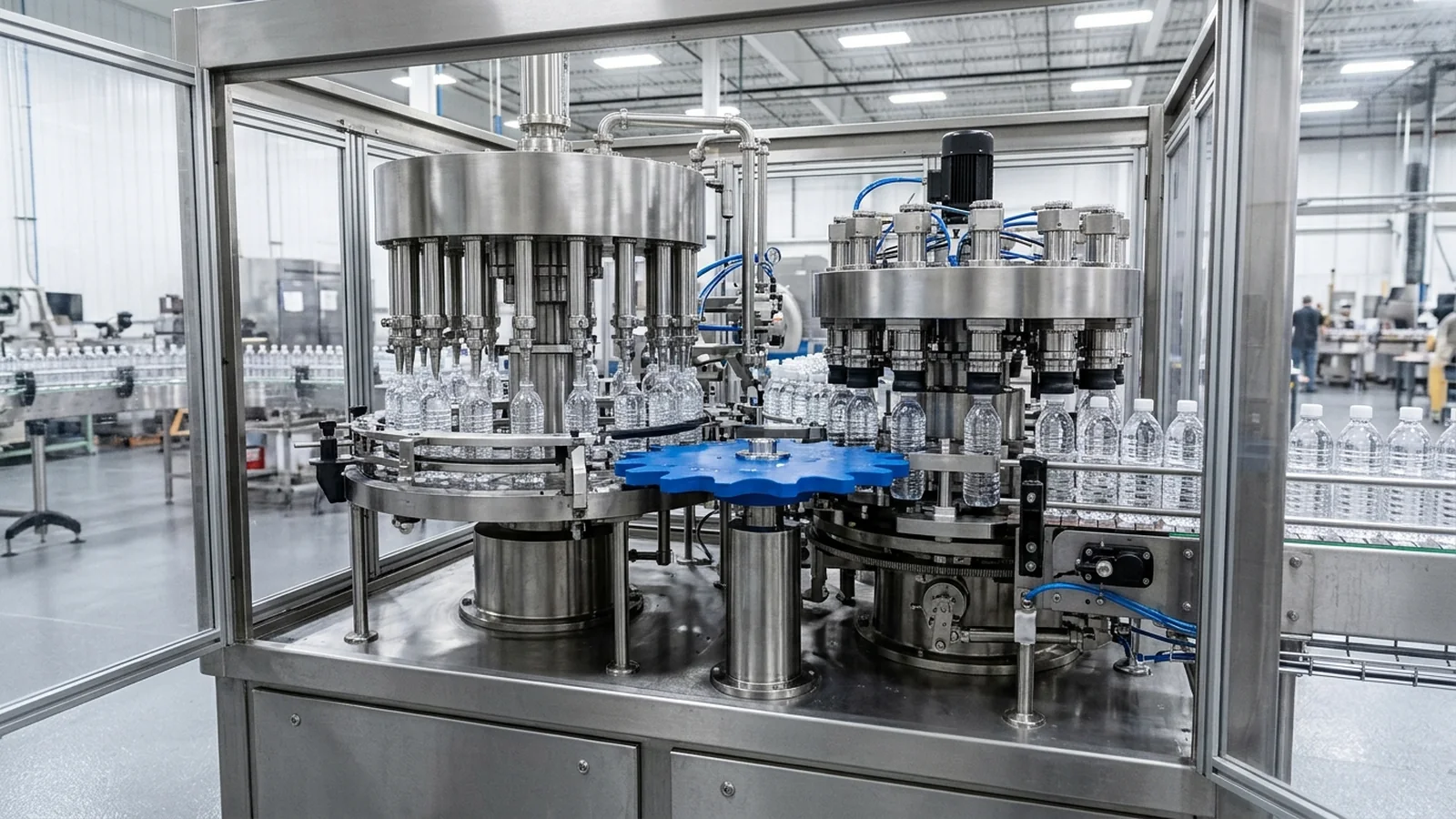
Before comparing changeover times, packaging engineers must separate the format parts required by high-speed multi-head capping from the parts added when integrating the filler onto the same base. Mengibar states that its Monoblock equipment combines two or more liquid filling and capping operations in one single machine base and assures traceability of each bottle while it is inside the Monoblock. According to Mengibar, once you operate at speeds above 60 u.p.m. with either pumps or caps, you need a multiple-head capping machine capable of a higher capacity. Mengibar states that a multiple-head capping machine already includes a specific infeed screw, infeed starwheel, back guides, central starwheel, discharge starwheel for each bottle format, and a reject device. According to Mengibar, when combining a filler in one Monoblock, only two additional starwheels are required: one for the filling carousel and another for the transfer from the filling to the capping carousel.
Consolidating both carousels onto a single base also changes how open containers move between filling nozzles and closure application. Mengibar notes that when filling and capping operations are done in the same machine base, you no longer have opened bottles moving down the line or product splashing when bottles accumulate at the entry of the capping machine. In a Mengibar Monoblock, each bottle is monitored from the time it enters the Monoblock and rejected when it leaves the Monoblock for empty bottles, overfilled or underfilled bottles, unseated (cocked) closures, and missing closures. Buyers comparing circular turret layouts can review our companion guide on rotary filling systems alongside the metered dosing principles covered in volumetric filling measurement basis.
Quick-Specs Comparison: Published Inline vs Monoblock Platforms
The table below compiles published head counts, speed ratings, and container size envelopes across inline fillers, monoblock filler-cappers, and standalone cappers.
| Machine Architecture | Published Model & Head Configuration | Published Bottle & Closure Envelope |
|---|---|---|
| In-Line Gated Liquid Filler | CVC 3036-4 / CVC 3036-8 / CVC 3036-12 in-line fillers: 4, 8, or 12 filling heads rated up to 48 BPM, up to 64 BPM, and up to 72 BPM (subject to trial confirmation). | CVC 3036-4, CVC 3036-8, and CVC 3036-12 bottle size envelope: Ø30-110 mm (1 1/4" to 4 1/4") diameter and 50-200 mm (2" to 7 3/4") height. |
| Walking-Beam Filler + Rotary Capper Monoblock | CVC F0804 Monoblock: 8 filling heads and 4 capping heads rated up to 100 BPM (subject to trial confirmation). | CVC F0804 bottle size envelope: Ø30-70 mm (1 1/4" to 2 3/4") diameter and 65-165 mm (2 5/8" to 6 1/2") height. |
| In-Line Filling (Bottle Gating) + Indexing Starwheel Monoblock | CVC 3085-2 Two-Station Monoblock: 6 or 8 filling heads and 2 capping heads rated up to 50 BPM (subject to trial confirmation) for Ø30-110 mm bottles and Ø18-50 mm caps. | CVC 3095 three-in-one monoblock: 4 or 6 filling heads rated up to 32 BPM (subject to trial confirmation) for Ø30-110 mm bottles and Ø20-30 mm caps. |
| Standalone Chuck & Rotary Cappers | CVC 3034 1-head chuck capper: 1 head rated up to 40 BPM (subject to trial confirmation) for Ø30-110 mm (1 1/4" to 4 1/4") bottles with up to 50 recipes. CVC 3034-2 2-head chuck capper: 2 heads rated up to 60 BPM (subject to trial confirmation) for Ø30-90 mm (1 1/4" to 3 1/2") bottles. | CVC 3074-8 8-head rotary capper: 8 heads rated up to 200 BPM (subject to trial confirmation) for Ø30-70 mm (1 1/4" to 2 3/4") bottles with up to 500 recipes. BellatRx Secure Star Capper: 2 or 3 starwheel indexing stations rated up to 120 cpm, 15 – 63mm closures (bowl) or 15 – 130mm closures (elevator), and 10 – 100 in. lbs. torque. |
| Vial & Rotary Monoblock Series | Cozzoli RFPC monoblock series: 1-4 nozzles rated up to 200 vials per minute with ± .5% fill accuracy. | Adinath AMBF 2, AMBF 4, and AMBF 8 rotary monoblocks: Two, Four, or Eight filling heads and Single, Single, or Four capping heads rated up to 30, 60, and 100 bottles/minute for 25mm to 85mm* bottles and 18mm to 55mm caps. |
Container Volume Range and Turret Sizing Trade-Offs
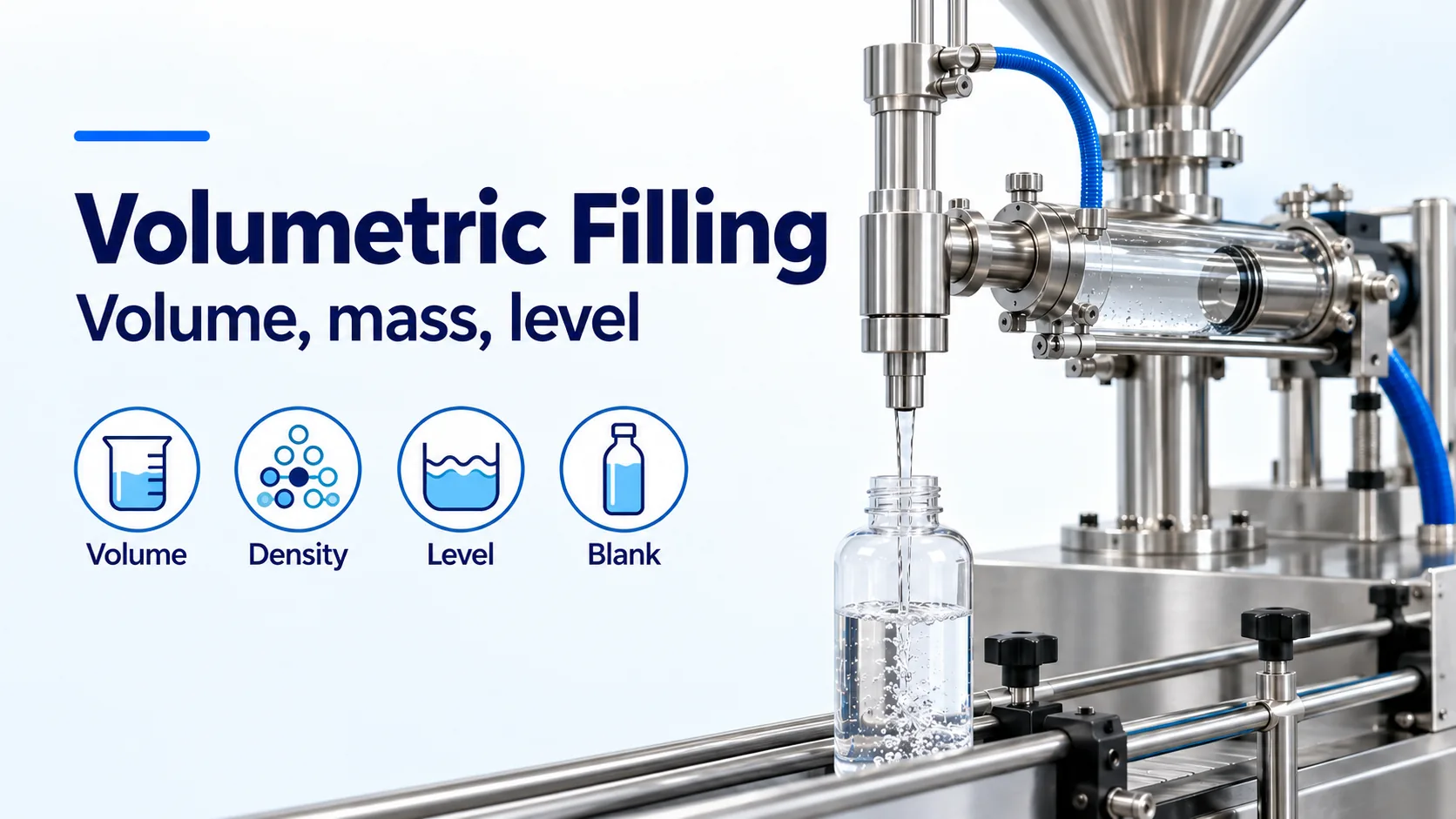
Published manufacturer specifications below outline the container volume ranges and metering technologies offered across monoblock filling systems. Filamatic states that Monoblocs can handle a large range of commodities, from 1ml up to 1-liter. The Mengibar Monoblocks XL Series integrates MagFlow and Mass Flow technology into a rotary platform, ensuring precision in filling 5, 10, and 15-liter containers. For edible oils, Serac’s Net Weight Monoblock Filler/Capper is engineered for bottles ranging from 40 oz to 1 gallon and features Net Weight Filling Technology with a TCS4 Capper. Pacific Packaging offers monobloc fill-cap systems that integrate Pacific’s rotary filling technologies—Volumetric Timed Orifice, Mass Flow Meters, Mag Flow Meters, and Overflow—with Zalkin rotary bloc capping systems.
Evaluating multi-size container schedules on a single turret requires reviewing how container range affects part counts, footprint, and throughput. Filamatic notes that one of the challenges with multiple sized containers on one machine can be the growing number of changeover parts, as well as time in changing over from one container size to another. According to Filamatic, due to fielding a wider array of containers, a Monobloc may become larger in footprint and require potentially larger changeover parts such as a larger turret. Filamatic states that depending on commodity sizes and fill volumes, a larger turret may make a Monobloc run at a slower speed and lower throughput for that particular size commodity. Filamatic notes that there is no cleaning validation required with peristaltic pumps since they use single-use tubing.
Fixed Starwheel Pitch and Change Part Tooling Inventory
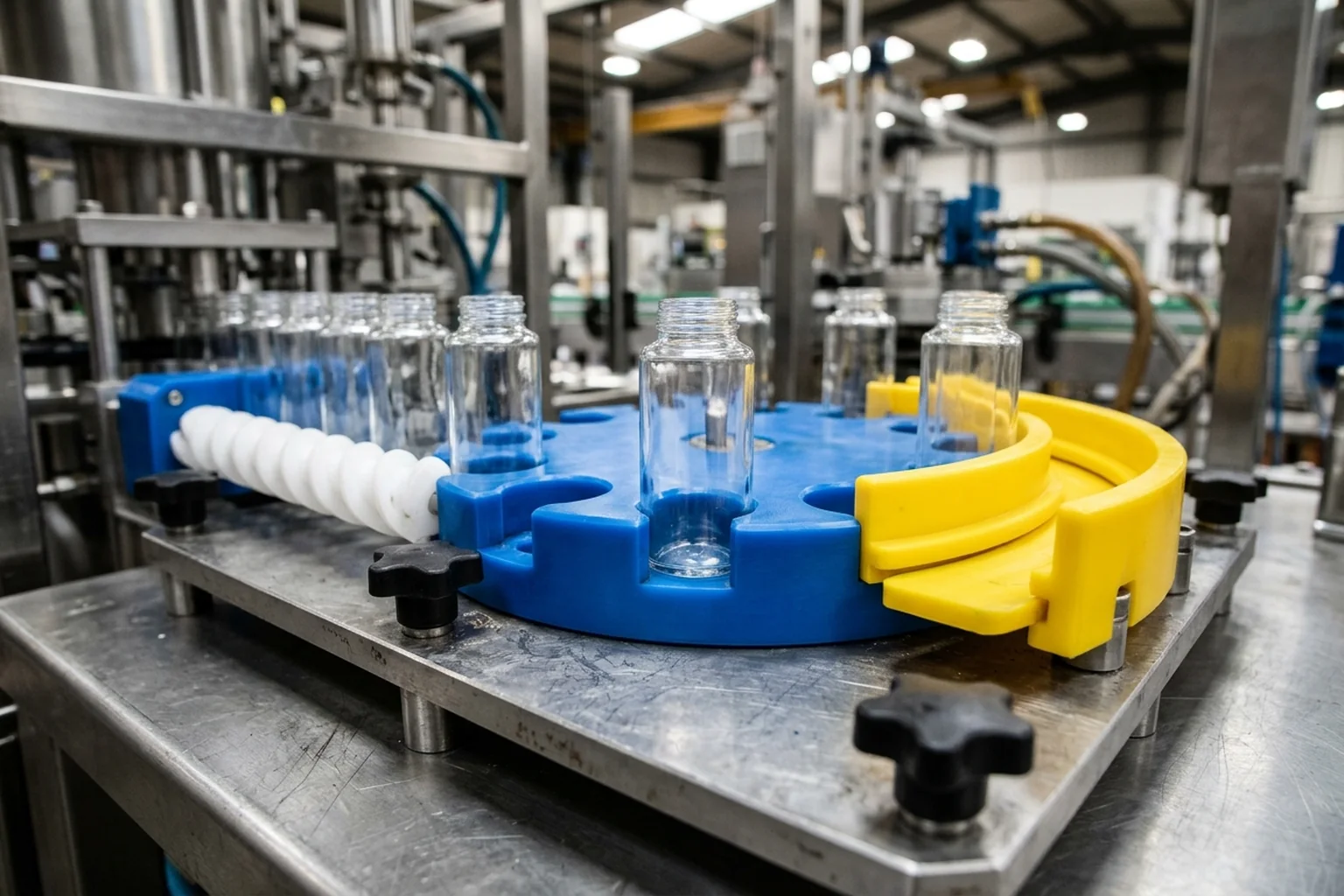
When specifying a bottle filling and capping machine, buyers should review the format change parts and identification systems documented by tooling manufacturers. Septimatech specifies that its bottle-handling machine change parts include star wheels, guides, positioners, bottle plates, and centering bells, where puzzle-cut parts and locating pins ensure precise positioning. For proper change part identification and installation, Septimatech change parts offer color-coding with a choice of 36 color combinations for SKUs and machine differentiation. Septimatech states that its change part solutions are supplied and installed on over 2,700 different machine makes and models.
The following comparison outlines how linear filling and capping configurations differ in changeover part requirements. For low and moderated speeds that require high flexibility, Mengibar states that linear machines have no need for changeover parts in the filler, only one starwheel in the capper for each different bottle, and only one capping chuck for each different closure. Mengibar reports that a linear filler is ready for a totally new bottle in minutes by adjusting elements such as guides and alignment of the filling heads. To see how fluid rheology interacts with nozzle selection during format switches, consult our technical guide on viscous-liquid filling machines.
Published Bottle Diameter Envelopes: Inline vs Monoblock Catalog Data
Catalog specifications from CVC Technologies, Cozzoli Machine Company, BellatRx, and Adinath Pharma Machinery illustrate published head counts, speed ratings, and bottle diameter windows across inline and monoblock platforms. In the CVC Technologies catalog, the CVC 3036-4, CVC 3036-8, and CVC 3036-12 in-line liquid fillers specify 4, 8, and 12 filling heads with productivity up to 48 BPM, up to 64 BPM, and up to 72 BPM (subject to trial confirmation). The CVC 3036-4, CVC 3036-8, and CVC 3036-12 in-line liquid fillers specify an applicable bottle diameter of Ø30-110 mm (1 1/4“ to 4 1/4“) and a bottle height of 50-200 mm (2“ to 7 3/4“).
The following CVC Technologies specifications detail the motion architecture, head count, and container envelope of the continuous-transfer monoblock model. On the CVC F0804 Monoblock liquid filler and capper, bottles are carried through the filling area by a servo-driven feed screw and the liquid filling nozzles are mounted on a walking beam mechanism, after which bottles travel continuously to the rotary capping system. The CVC F0804 Monoblock technical specifications list 8 filling heads, 4 capping heads, and productivity up to 100 BPM (subject to trial confirmation). The CVC F0804 Monoblock specifies an applicable bottle diameter of Ø30-70 mm (1 1/4“ to 2 3/4“) and a bottle height of 65-165 mm (2 5/8“ to 6 1/2“). The CVC F0804 Monoblock specifies a cap diameter of Ø30-60 mm (1 1/4“ to 2 1/4“), a cap height of 13-28 mm (1/2“ to 1 1/8“), and a 20-500 ml filling range.
Comparing the published catalog envelopes side by side quantifies the difference in container diameter span, height span, and rated speed. Comparing the 8-head in-line filler bottle diameter envelope of 30 to 110 mm (an 80 mm diameter span) and height range of 50 to 200 mm (a 150 mm height span) against the 8-head walking-beam monoblock bottle diameter envelope of 30 to 70 mm (a 40 mm diameter span) and height range of 65 to 165 mm (a 100 mm height span) shows that the rotary-capping monoblock narrows usable bottle diameter span by 40 mm and bottle height span by 50 mm while raising peak output from 64 BPM to 100 BPM (a 36 BPM gain).
Additional CVC Technologies monoblock models pair in-line filling (bottle gating) with starwheel-indexed capping, or three-in-one liquid filling, plug/stopper inserting, and capping/crimping. On the CVC 3085-2 Two-Station Monoblock System, bottles are positioned precisely under the filling nozzles with a bottle gating system while two servo-driven ROPP crimping heads or screw capping heads are synchronized with an indexing starwheel. The CVC 3085-2 technical specifications list 6 or 8 filling heads, 2 capping heads, productivity up to 50 BPM (subject to trial confirmation), bottle diameter Ø30-110 mm, and cap diameter Ø18-50 mm. The CVC 3095 three-in-one monoblock combines liquid filling, plug or stopper inserting, and capping or crimping, specifying 4 or 6 filling heads, productivity up to 32 BPM (subject to trial confirmation), bottle diameter Ø30-110 mm, and cap diameter Ø20-30 mm.
Published specifications from Cozzoli Machine Company and Adinath Pharma Machinery further illustrate nozzle counts, capping head counts, and container envelopes across vial and rotary monoblocks. Cozzoli’s RFPC Filling, Plugging and Capping series can be equipped with 1-4 nozzles and is capable of filling up to 200 vials per minute with a fill accuracy of ± .5%. Cozzoli’s VR840S liquid filling and stoppering Monoblock achieves a fill accuracy of better than ± .5% with speeds up to 120 bpm and uses a diving nozzle system with bottom-up fill on a range of 0-6“ to facilitate a quick changeover. Adinath’s AMBF 2, AMBF 4, and AMBF 8 Monoblock Rotary Liquid Filling & Capping Machines specify outputs up to 30, 60, and 100 bottles/minute, Two, Four, and Eight filling heads, Single, Single, and Four capping heads, a 25mm to 85mm* bottle diameter, and an 18mm to 55mm cap size. On 100 BPM rotary monoblock platforms pairing 8 filling heads with 4 capping heads, the 2:1 filling-to-capping head ratio equates to 12.5 BPM per filling head and 25 BPM per capping head at peak catalog rating, whereas 2-head (30 bottles/minute) and 4-head (60 bottles/minute) rotary monoblocks with 1 capping head equate to 15 bottles/minute per filling head.
Capping Head Changeover: Chuck Tooling vs Spindle Adjustment
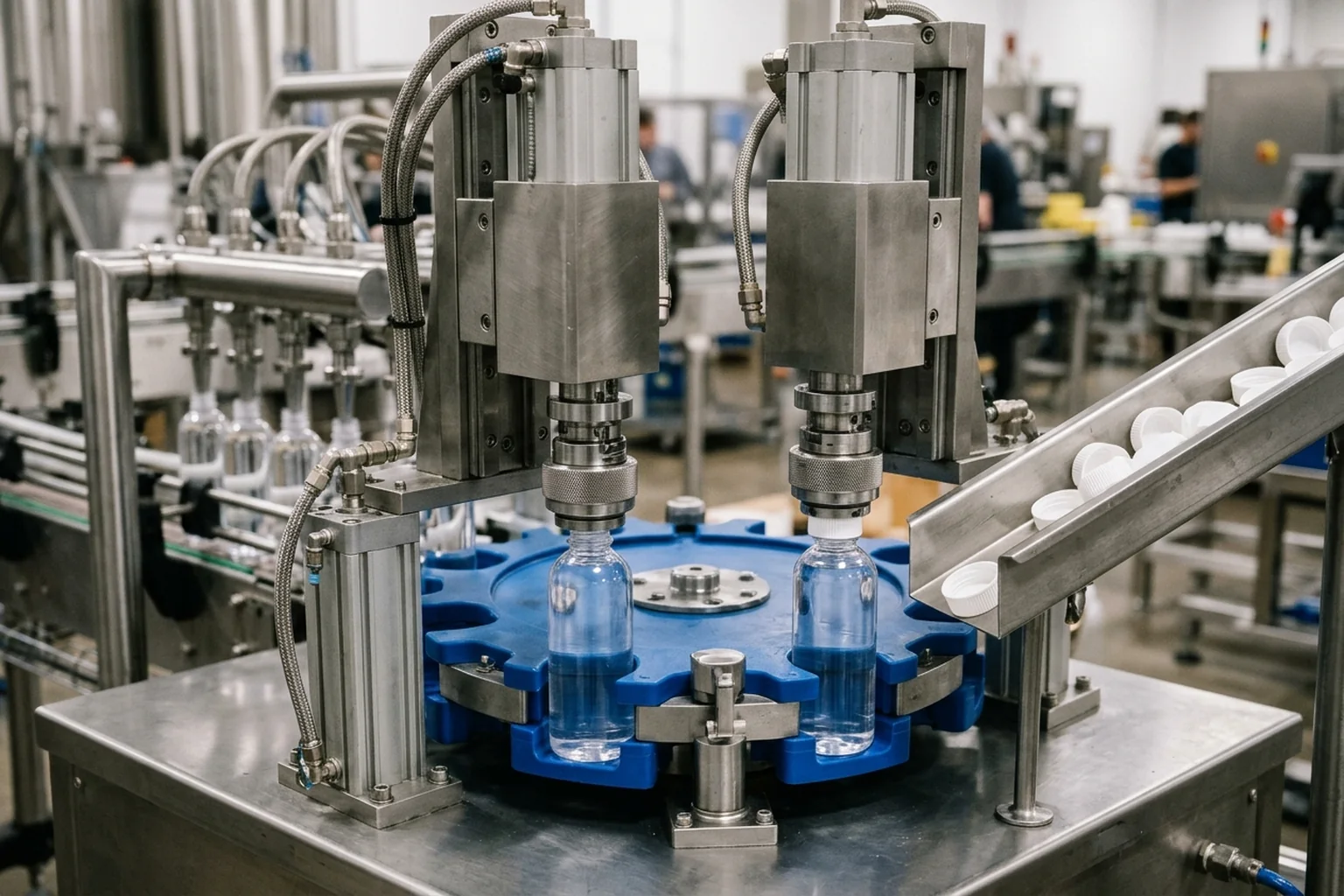
Evaluating a filling and capping monoblock or standalone capper also requires comparing how chuck and spindle cappers handle closure size changes. In E-PAK Machinery’s comparison of chuck and spindle cappers, chuck changeovers require the chuck tooling to be swapped out when the cap size changes, using one chuck per cap size. By contrast, E-PAK Machinery states that spindle capper changeover adjusts spindle spacing and height for faster changeover and is adjustable to handle a range of cap sizes.
When specifying standalone chuck, rotary, or starwheel-indexed cappers, engineers should also compare published bottle diameter windows, closure ranges, and recipe memory capacities. The CVC 3034 1-head chuck capper specifies 1 head, productivity up to 40 BPM (subject to trial confirmation), bottle diameter Ø30-110 mm (1 1/4“ to 4 1/4“), and up to 50 recipes. The CVC 3034-2 2-head chuck capper specifies 2 heads, productivity up to 60 BPM (subject to trial confirmation), and bottle diameter Ø30-90 mm (1 1/4“ to 3 1/2“). The CVC 3074-8 8-head rotary capper specifies 8 heads, productivity up to 200 BPM (subject to trial confirmation), bottle diameter Ø30-70 mm (1 1/4“ to 2 3/4“), and up to 500 recipes. The BellatRx Secure Star Capper uses a precision starwheel indexer with 2 or 3 stations at speeds up to 120 cpm, with a 15 – 63mm closure range with a bowl, a 15 – 130mm closure range with an elevator, and 10 – 100 in. lbs. application torque.
Inline Modular Lines: Speed Matching, Accumulation Buffers, and Servicing
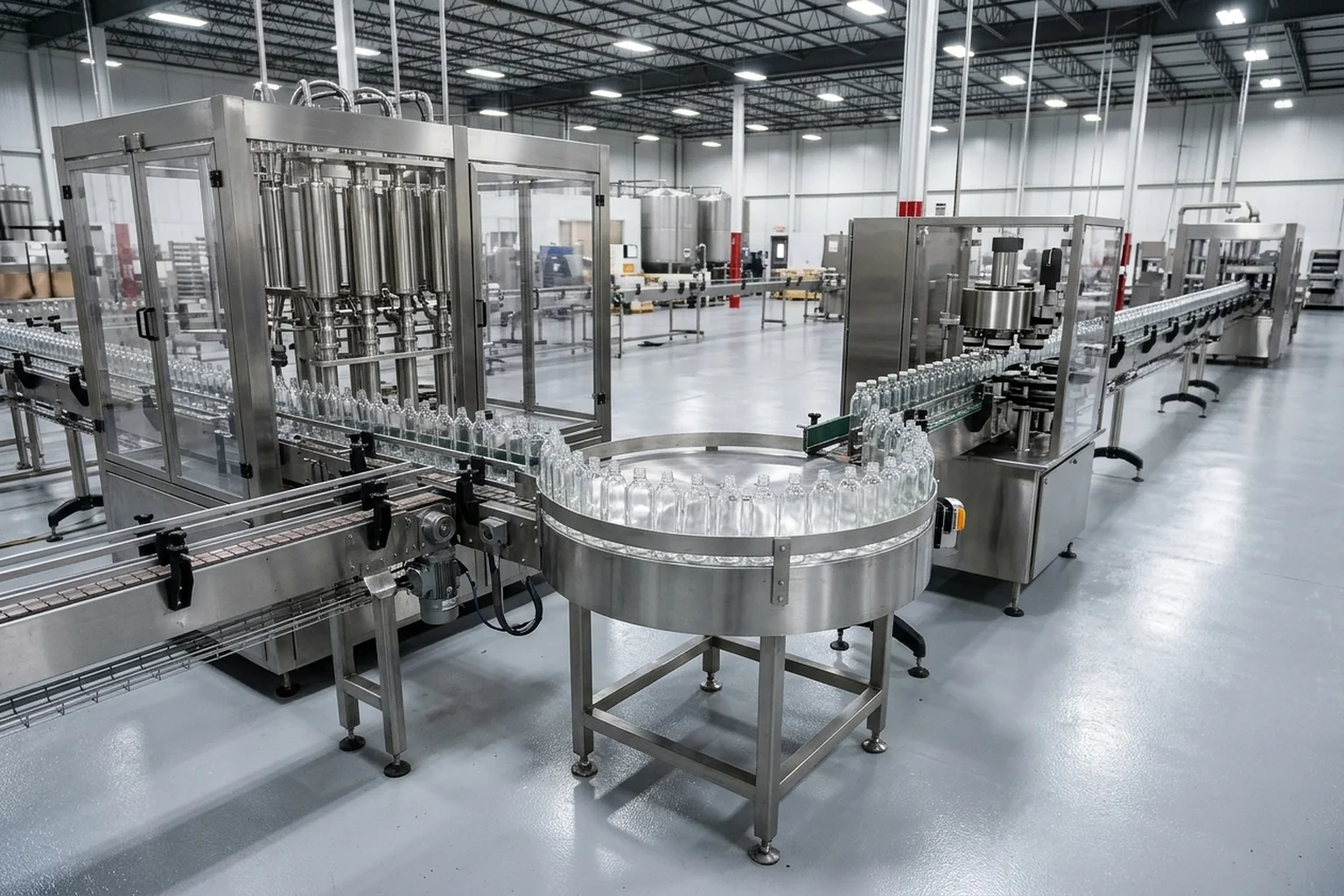
Comparing a monoblock filler capper against a modular inline layout requires reviewing how conveyor-linked machines handle servicing and station speed matching. In Zonesun Auto Pack’s comparison of monoblock and inline systems, an inline bottling system consists of several independent machines connected by conveyors, where individual machines can be serviced separately. In E-PAK Machinery’s speed-matching example, if the filler runs at 50 containers per minute but the capper is rated for 35, the effective line speed is 35.
Applying speed matching to published inline filler and chuck capper ratings illustrates how the lower-rated machine sets the combined line ceiling. Pairing the 4-head in-line filler rated up to 48 BPM with the 1-head chuck capper rated up to 40 BPM caps combined line output at 40 BPM (an 8 BPM filler curtailment), whereas pairing the 8-head in-line filler rated up to 64 BPM with the 2-head chuck capper rated up to 60 BPM raises the ceiling to 60 BPM (a 4 BPM differential).
In addition to matching station speeds, inline integration guides describe how intermediate accumulation tables and control systems coordinate upstream and downstream machines. E-PAK Machinery explains that accumulation tables between stations absorb minor speed variations without forcing the entire line to stop, whereas without adequate accumulation a brief pause at one station cascades into stoppages across the rest. According to E-PAK Machinery, when one station stops, a well-configured control system signals upstream stations to pause and lets downstream stations continue running on accumulated containers.
Step-by-Step Buyer Verification Procedure Before Issuing an RFQ
When preparing a complete packaging line specification, comparing supplier proposals in bottling machine cost and quote scope, or planning acceptance trials with our packaging machinery FAT checklist, follow this six-step engineering verification sequence:
- Map the complete container diameter and height matrix: List the minimum and maximum bottle diameters, bottle heights, and fill volumes across all current and planned SKUs before selecting a turret pitch.
- Count format-dependent starwheels and guides per SKU: Request an itemized list of infeed screws, infeed starwheels, transfer starwheels, central starwheels, discharge starwheels, centering bells, and bottle plates required for every container format.
- Audit capping chuck and closure feeder boundaries: Verify whether closure changes require swapping dedicated chuck tooling or adjusting spindle spacing, and confirm whether the cap feeder uses a sorting bowl or an elevator across your full cap diameter range.
- Verify turret speed across container sizes: Request written confirmation of rated throughput for each container size and fill volume in your production schedule.
- Size inline conveyor accumulation and pause logic: When selecting a modular inline layout, specify accumulation table buffering and upstream pause signaling between the filler and capper.
- Define witnessed changeover and rejection trials for FAT: Include timed format changeovers using color-coded change parts and challenge tests for empty, underfilled, overfilled, cocked-cap, and missing-cap rejection in the factory acceptance protocol.
Buyer RFQ Verification Checklist
- Confirm whether each container SKU requires dedicated starwheel pockets, back guides, and timing screws or linear guide adjustments.
- Record the exact bottle diameter, bottle height, cap diameter, and cap height limits printed on the manufacturer datasheet for the quoted model.
- Confirm whether the metering system uses single-use peristaltic tubing or requires cleaning validation between batches.
- Verify that standalone filler and capper speed ratings are matched and supported by intermediate accumulation on modular inline lines.
Sources
- Mengibar — Rotary Filler or Linear Filler: What Should I Do?
- Mengibar — Monoblock Filling and Capping Machines
- Filamatic — Monobloc Filling Systems: Evolution or Revolution?
- Septimatech — Machine Changeover Change Parts (Starwheels, Guides, Timing Screws)
- E-PAK Machinery — Chuck Cappers vs. Spindle Cappers: Comparison & Selection Guide
- E-PAK Machinery — Filling Line Integration: How Fillers, Cappers, Conveyors, & Labelers Work Together
- Zonesun Auto Pack — Monoblock vs Inline Bottling Systems: Which Is Right for Your Production Line
- CVC Technologies — Liquid Filling and Capping Equipment Catalog (PDF)
- Cozzoli Machine Company — Monoblock Filling Machines
- Serac — Net Weight Filler-Capper for Edible Oils
- Pacific Packaging Machinery (ProMach) — Monobloc Filler / Cappers
- BellatRx — Secure Star Capper (Starwheel Indexing Platform)
- Adinath Pharma Machinery — Monoblock Rotary Liquid Filling & Capping Machine