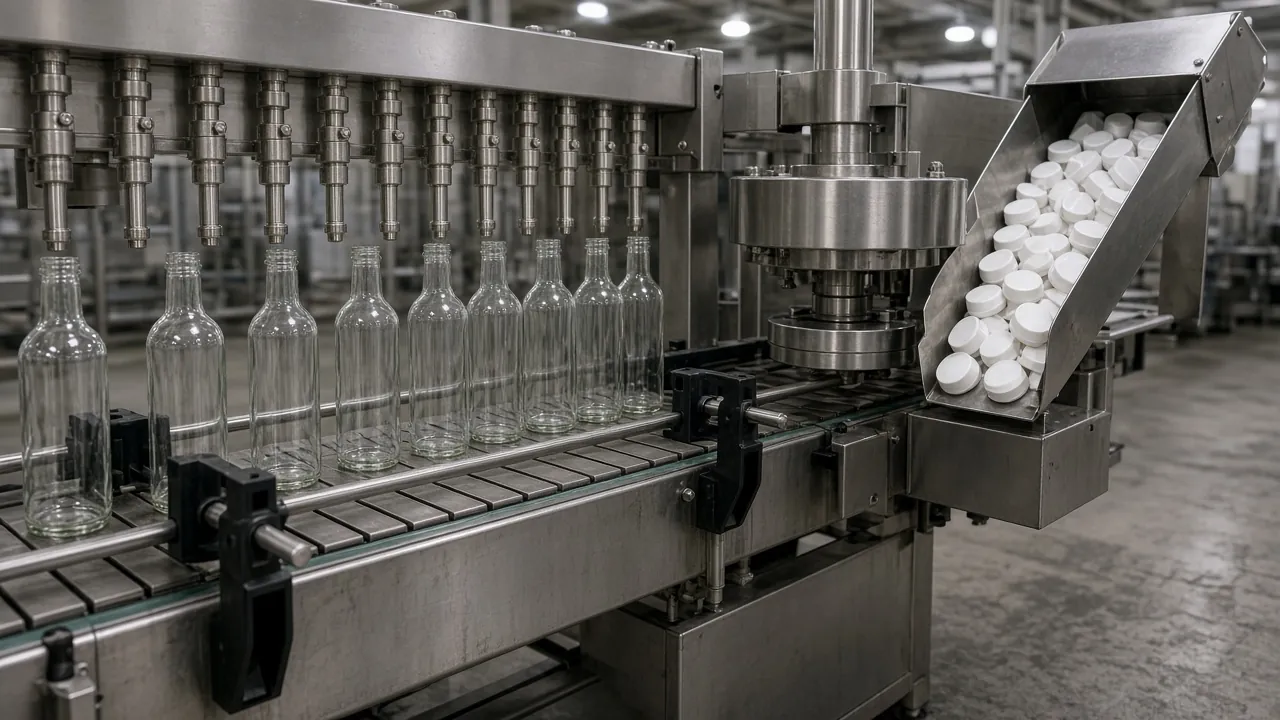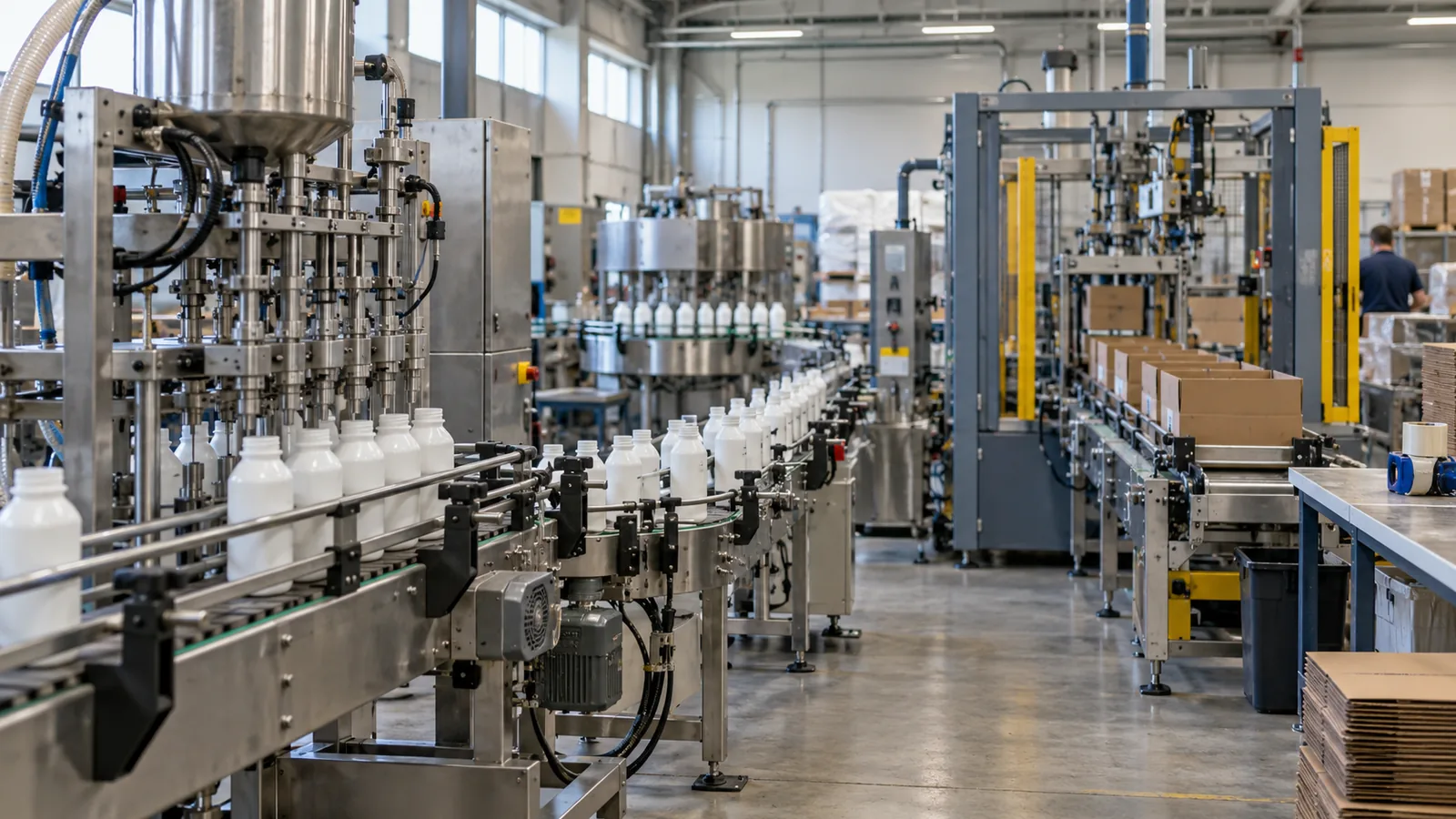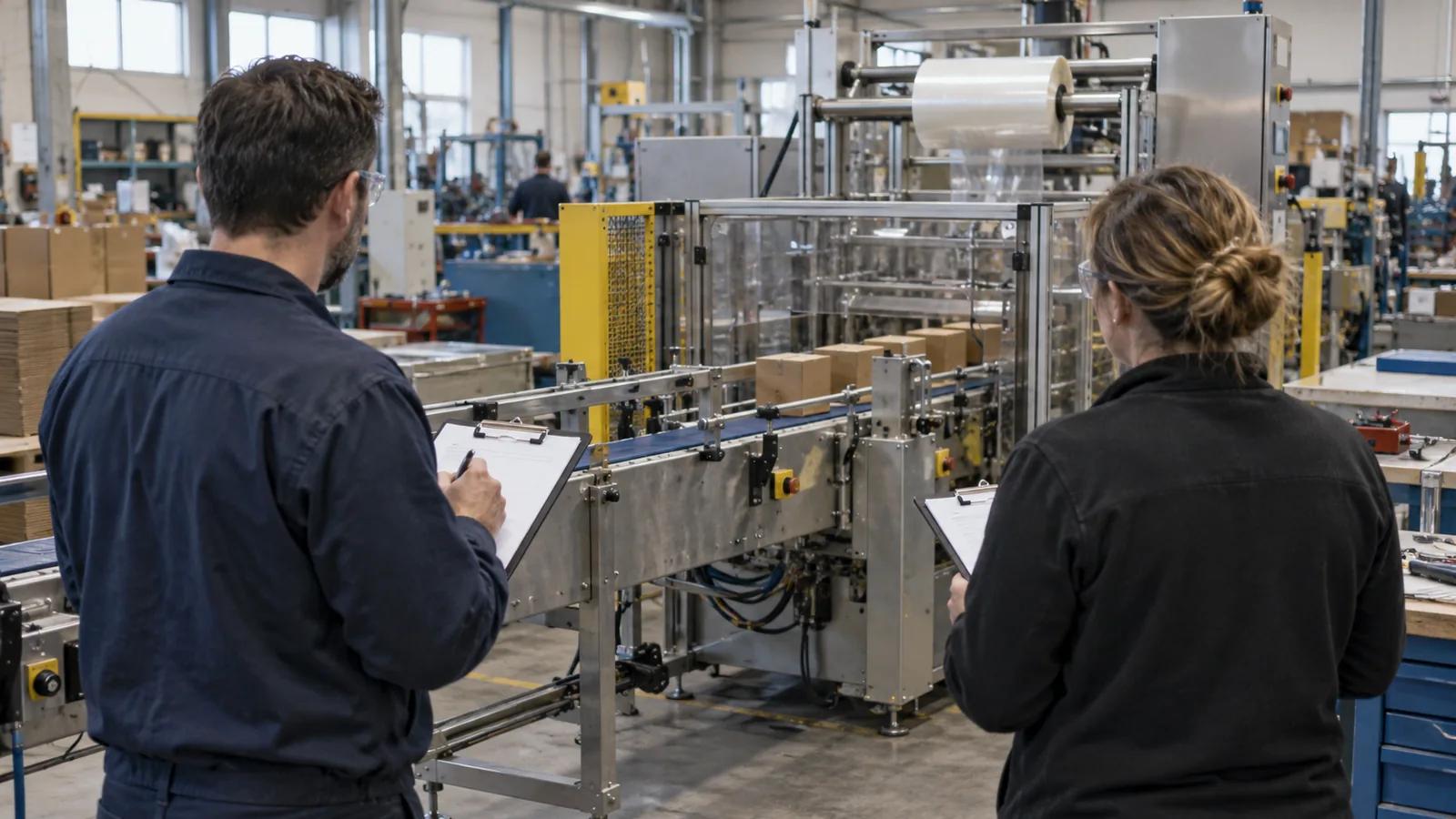
A packaging machine that ships on a factory acceptance sheet with no product name and no film name causes rework at the buyer’s dock. Record the configuration that ran, the evidence for each requirement, and every item still open before that sheet is signed.
A packaging machinery factory acceptance test should evaluate the identified purchase requirements under documented factory conditions. Define the samples, film or containers, configuration, measurement plan and acceptance rules before the test; record what was observed and what was deferred to site commissioning. This guide provides a FAT-versus-site boundary, a requirement-to-evidence matrix, packaging sample records and an open-item log.
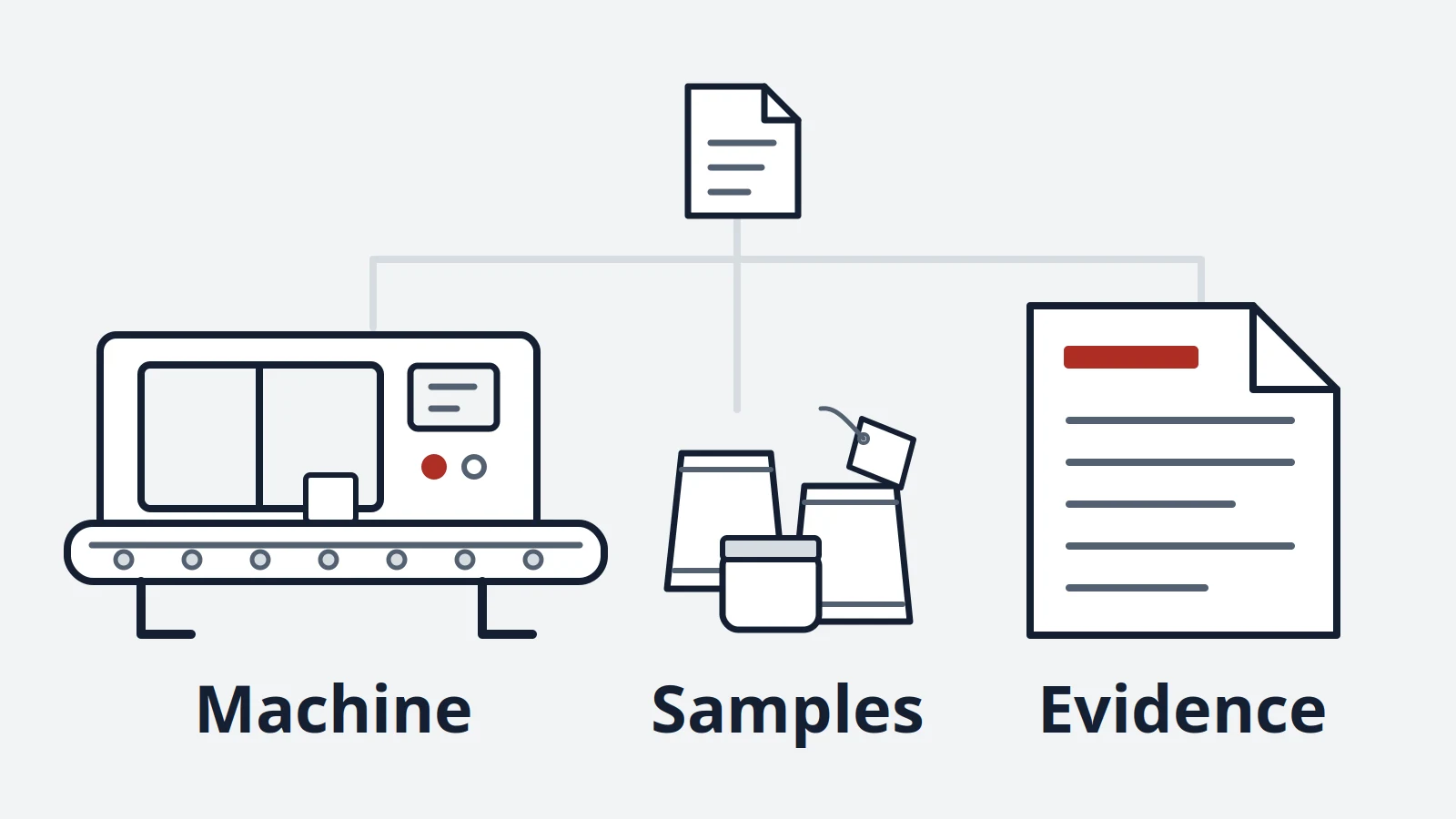
The diagram names the three records that have to stay together: the machine, the samples, and the evidence. It shows no speed, no temperature, and no pass mark.
| Input or item | Value printed on the saved page | Why it matters |
|---|---|---|
| Factory acceptance test | PMMI, 10 June 2021: discover failures, check reliability, and see how the machine handles failures. PAC, page dated 11 January 2022: usually at the place of manufacture, before shipping, against the customer’s criteria | Defines the checklist |
| Dry-cycle window | 24 hours minimum recommended (PMMI, 10 June 2021). 24 hours recommended (PMMI form/fill/seal roadmap, 13 June 2023) | A shorter window is a gap to record |
| Squeezed-window example | 6 hours, on the 10 June 2021 roadmap | The only short window that page prints |
| Package count and line speed | Not printed. Both PMMI pages say to specify how many packages and at what speed | Leave empty |
| Run-length examples on the form/fill/seal page | Two-minute stress runs; no more than five minutes for quality production runs (13 June 2023) | Durations to write into the plan, not a line speed |
| Temperature, consistency, viscosity | Not printed. PMMI refers to a product packed at a certain temperature, or with a certain consistency or rate of speed | Leave empty |
| Nozzle size | Not printed | Leave empty |
| Power (kW) | Not printed | Leave empty |
| Materials | PMMI: use the materials that will run in production. Form/fill/seal page: use the production film. PAC: test the actual product and the packaging material | A substitute material is a different row |
| Site stage | PMMI: the site test affirms the product run in the operating environment. Innova, 21 March 2024: commissioning after installation is where final adjustments and last tests happen | A factory sheet does not close a missing site condition |
Which requirements belong at FAT, and which remain for site?
PMMI’s 10 June 2021 roadmap says to include the test plan in the RFQ the buyer issues before purchase, and to state responsibilities, accountabilities, and deliverables in a measurable way. On acceptance of the factory test, that page says to look for a completed protocol, maintenance and user manuals, training materials, standard work and maintenance procedures, a recommended spare-parts list, certificates of compliance, as-built drawings, material certificates and data sheets, equipment data sheets, instrument calibration certificates, and welding-process qualifications. Those are document names. They are not a result for this machine.
The buying guides are the section that holds this checklist next to the line-scope pages. The packaging machinery section is where the machine list itself is decided before any of those documents get a signature.
Takeaway: The checklist records requirement, configuration, samples, window, and evidence. A speed cell with no printed number stays empty.
Which requirements stay at the factory, and which wait for the site?
Assign each requirement to the stage that can actually show it. PMMI and Innova describe that split in different words, so the project row has to say which account it is using.
PMMI’s 10 June 2021 roadmap says the factory test verifies the desired function of the machine. The site test affirms that the machine runs the product to specification in the operating environment. The same section says it may be difficult or even impossible to simulate production volume and product conditions in the builder’s plant, especially for more than a few minutes, and especially when the product will be packed at a certain temperature or has a certain consistency or rate of speed. The page prints none of those three values. It also says time and money go into chasing a “failure” at the builder that disappears once the machine is in production at the customer’s plant.
Innova’s pallet-line guide of 21 March 2024 says factory tests before installation simulate real operating conditions and include performance, safety, and final packaging quality, and that commissioning after installation is where final adjustments and last tests happen in the customer’s factory. That guide is a pallet wrapping, strapping, and stretch-hood project. Read it beside PMMI and write, for this purchase, which conditions the factory will use and which conditions exist only on site.
The line specification’s factory-and-site split is the upstream record. This checklist does not replace it.
| Preparation item | Buyer/supplier agreement to record |
|---|---|
| Requirement list | Purchase reference, revision and acceptance scope |
| Configuration | Machine/options, connected equipment and relevant document/software versions |
| Samples | Product lot, film/container/closure identity and handling condition |
| Test scope | Required functions, formats and available equipment |
| Conditions | Actual/required utilities, sample condition and observation boundary |
| Measurement | Quantity/units, method, instrument or measurement-chain ID, applicable status/calibration evidence reference, recorder and agreed sampling/counting |
| Acceptance rules | Project-specific criteria and who reviews them |
| Responsibilities | Preparation, operation, measurement, witness, record retention and signoff |
| Exceptions | Known substitutions, exclusions and deferred site evidence |
| Follow-up | Deviation owner, proposed action and agreed retest/review approach |
Keep proposed criteria distinguishable from approved ones. Run duration, fill tolerance, reject percentage and sampling quantity must reference the agreed project documents and responsible technical review.
For a shrink system, carry forward the product and film input record. For multi-ply barrier converting, pair the roll-to-roll thermal and solventless laminator machine guide with gravimetric 2K mixer shot tests and post-cure bond checks. For thick-product filling, use the material-condition worksheet. For sweets, carry the candy input and trial records into the FAT baseline.
Takeaway: Define what the test will mean before the equipment is demonstrated.
How should each requirement be linked to evidence?
Use one row per identified requirement and keep the actual result separate from the rule used to judge it. Include the configuration and test conditions, evidence reference, owner and deviation status.
| Requirement reference | Conditions and method | Actual evidence | Owner / decision / deviation |
|---|---|---|---|
| Configuration and supplied scope | Compare agreed baseline with tested build | Identities, versions, item list and photographs | Responsible reviewer; differences retained |
| Pack/product handling | Use identified samples in agreed arrangement | Observed entering/leaving state and exceptions | Witness/reviewer; outcome against requirement |
| Quantity or accepted output | Agreed units, observation window and counting method | Raw readings/counts and interruption record | Measurement owner; criterion reference and result |
| Finished-pack checks | Agreed sample/inspection method | Actual observations with sample identity | Product/quality reviewer; open checks separated |
| Connected interface | Actual connected or identified simulated equipment | Transfer/function observations and configuration | Integration owner; site evidence if deferred |
| Documents/accessories | Agreed deliverables and revisions | Document/item register with actual status | Handover owner; missing items recorded |
| Deferred requirement | Reason it cannot be shown at factory | Available evidence and precise missing part | Named owner; required next-stage evidence |
Use this project record structure for the actual requirements:
| Requirement ID / source revision | Agreed rule / method reference | Actual result / conditions | Evidence ID | Outcome / disposition | Owner / reviewer |
|---|---|---|---|---|---|
| Buyer/supplier to complete | Actual project criterion and measurement-chain/status reference | Actual readings/observations, not an assumed result | Raw record/sample/photo reference | Recorded result and deviation ID | Named parties and decision record |
Keep phrases such as checked or satisfactory accompanied by those fields. A photograph may establish an identified item was present; it does not automatically establish the measured performance of that item.
Every decision should have an identified requirement and evidence basis. No pass threshold or standard is implied.
Common mistake to avoid — illustrative record risk: A signed box says output checked, but the count, time window and accepted-pack rule are absent. Preserve the raw record before making the result reviewable.
Use the line output definition so single pieces, packs, groups and cases are not mixed in the same result. A catalogue headline is not the observed accepted output.
Takeaway: A test decision needs a rule, an actual result and a traceable evidence reference.
Which packaging sample checks belong in the record?
Record the packaging combination that each test actually uses and the specified result it is intended to establish. Film, product, container and closure differences should remain visible. Our matrix focuses on packaging evidence, while methods and acceptance criteria stay with the approved project plan and responsible product/equipment parties.
| Packaging task | Sample/configuration identities | Requirement and evidence to record |
|---|---|---|
| Individual wrapping | Candy/product, wrapping stock, feeder and wrapper | Agreed closure/appearance/damage checks and actual pack samples |
| Shrink wrapping | Product/group, support, film, sealer and tunnel | Required finished-pack/product checks and observed conditions |
| Filling | Product, container, filling method and quantity basis | Agreed fill result and actual measurement record |
| Closing | Container, closure and included equipment | Required closure check and identified sample evidence |
| Grouping/case handling | Individual pack, group/case and transfers | Agreed arrangement, handoff and observed exceptions |
| Coding/inspection | Pack/artwork/content references and equipment | Agreed identification/inspection outcome and retained evidence |
| Changeover | Starting/finishing format and included tasks | Defined start/end states, observed tasks/time and accepted restart evidence |
For each applicable packaging combination, complete the product-specific record rather than a generic checkbox:
| Product / film or container / closure IDs | Required result and method reference | Actual observation or measurement | Finished sample / photo ID | Reviewer / unfinished item |
|---|---|---|---|---|
| Build and documents | Is the offered build present, and are the protocol and drawings in the set PMMI names? | Does the installed scope match that baseline after reassembly? | A signed protocol with no configuration revision | Write the revision and the document list on the same row |
| Product and materials | Are the production product and the production film or container on the machine? | Which final product condition was absent at the factory? | A substitute material treated as the production result. PMMI says omitting production materials can compromise the test | Give the substitute its own row, and keep the production-material row open |
| Counted output | What unit, window, and reject rule were agreed? The speed number is not on the saved pages | Which site conditions change that count? | A machine cycle recorded as accepted packs | Name the unit. Leave speed empty until the project sheet prints it |
| Transfers | Which connections ran, and which were a temporary stand? | Which kept equipment was absent? | A temporary stand marked as the installed line | Name the owner of the joint answer on the handoff record |
| Utilities and product condition | What temporary supply was in use? Temperature and power are not printed | Do site services match the written limits? | A builder-plant run treated as the operating environment | Move volume, temperature, and consistency to the site row when the factory cannot hold them. Leave the numbers empty |
| Open items | What was not shown, and why? | Who closes it after installation and training? | A verbal promise that never enters the log | Carry observation, owner, and the next evidence forward |
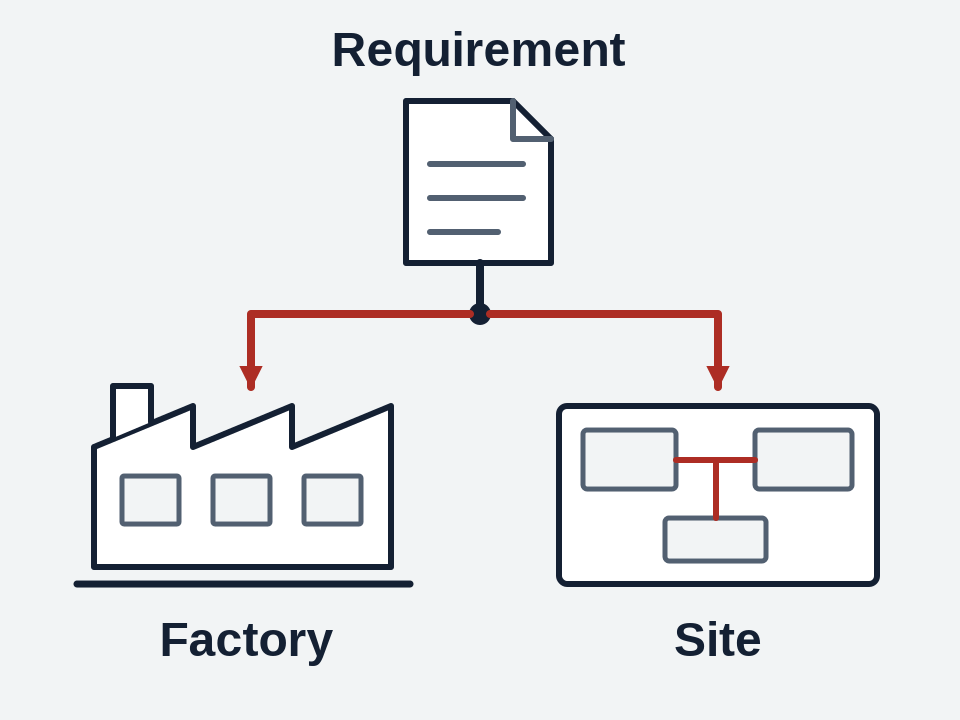
Factory and site are separate evidence stages. The drawing has no pass mark.
Release the requirement list, the configuration, the sample identities, the window, and the owners before the demonstration. PMMI says the machine will not perform as expected, and the result will not be assessable, when the criteria are missing from the contract.
| Preparation item | What to record | Source of the field |
|---|---|---|
| Requirement list | Purchase reference, revision, and who reviews the result | PMMI: measurable responsibilities and deliverables in the contract |
| Configuration | Machine, options, connected equipment, document and software revisions | The offered build, not a catalogue label |
| Samples | Product, film or container, closure, and lot or revision | PMMI and PAC: production materials, not a stand-in |
| Dry-cycle window | Hours agreed, against the 24-hour recommendation | PMMI, 10 June 2021 and the 13 June 2023 form/fill/seal page |
| Package count and speed | The project’s figures when the sheet prints them | Both PMMI pages ask for them and print neither |
| Disposal of finished packs | Where tested packs go | PMMI: specify disposal plans |
| People | Who prepares samples, who runs the machine, who measures, who witnesses, who keeps the record | PMMI and PAC: the people who will run the line, not only visiting engineers |
| Known limits | Substitutions, exclusions, and site-deferred rows | Named before the run, not after the signature |
Rule of thumb: If the dry-cycle window is below 24 hours, write the shortfall on the open-item log before anyone signs the factory sheet. PMMI’s 10 June 2021 roadmap recommends 24 hours minimum for the dry cycle. Package count and speed stay empty because that page does not print them.
For a form/fill/seal machine, the 13 June 2023 roadmap uses a different pair of durations as examples of run length to specify: two-minute stress runs, and no more than five minutes for quality production runs. Those examples sit beside its own 24-hour dry-cycle recommendation. They are not a line speed, and they do not replace the 24-hour dry-cycle field on the general roadmap. Write the duration the contract actually adopts, and label which page it came from.
PAC says basic maintenance and operation training at its factory test covers part replacement, loading packaging material, changeovers, start-up, shutdown, and safety procedures, and that a separate fee-based program can be held at the customer’s plant. This page prints no fee. Record whether training is in the factory scope, who attends, and which procedures are practiced. PMMI says the people trained should be the people who will run the line.
Common mistake: The criteria sheet arrives as a single line for “packaging speed,” and the factory report later repeats that word with no unit, no window, and no reject rule. PAC says the results mirror the criteria. A thin sheet produces a thin record.
Takeaway: Agree the window, the samples, and the owners before the run. A 24-hour recommendation is a published baseline, not a measured result from this machine.
How does each requirement stay tied to evidence?
Use one row per requirement. Keep the rule, the actual observation, and the evidence identity in separate cells. The tables below are the record structure. Limits and signatures come from the project documents.
| Requirement | Conditions and method | Actual evidence | Owner and deviation |
|---|---|---|---|
| Configuration | Compare the agreed baseline with the tested build | Identities, revisions, and photographs of the build | Reviewer; differences retained |
| Product and pack handling | Identified samples in the agreed arrangement | State of the product entering and leaving, plus exceptions | Witness; outcome against the written requirement |
| Quantity | Agreed unit, window, and counting method | Raw counts and the interruption record | Measurement owner; criterion reference |
| Finished pack | Agreed inspection method | Observations tied to a sample identity | Quality reviewer; unfinished checks left open |
| Connected equipment | The machines actually connected, or the stand that substituted | What transferred, and what was simulated | Integration owner; site row if deferred |
| Documents and accessories | The deliverables PMMI lists, plus any the contract adds | Register with status | Handover owner; missing items named |
| Deferred requirement | Why the factory cannot show it | The part that is present, and the part that is missing | Named owner and the next-stage evidence |
| Requirement ID and revision | Agreed rule | Actual result and conditions | Evidence ID | Disposition | Owner |
|---|---|---|---|---|---|
| Project to complete | The criterion and the measurement reference | Readings from the run, not a sample number from this page | Raw record, sample, or photo | Result and deviation ID | Named reviewer |
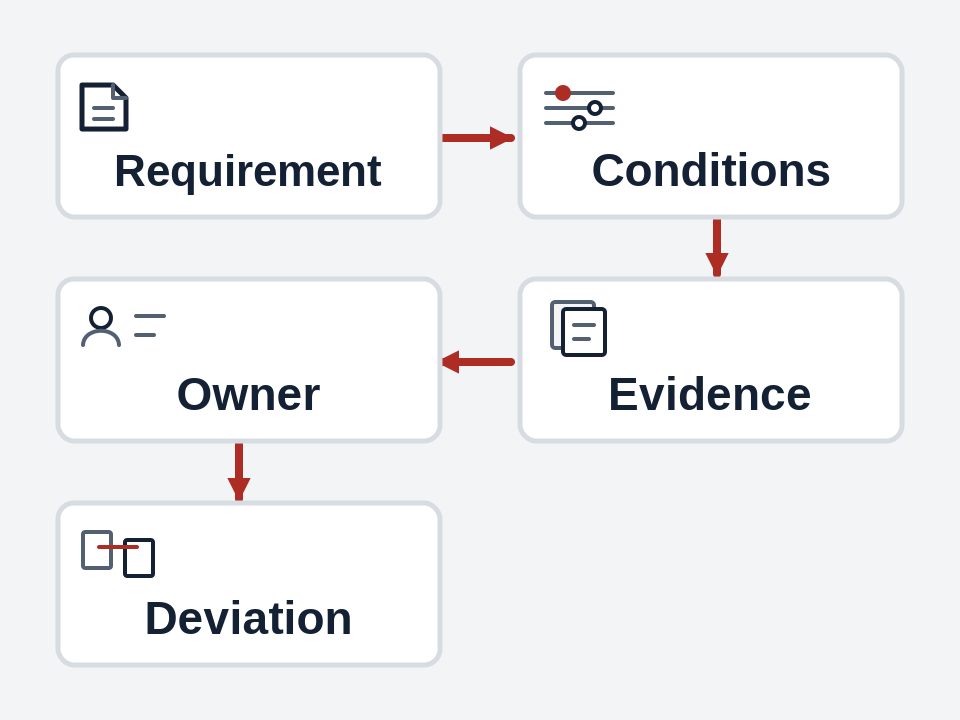
The path is requirement, conditions, evidence, owner, deviation. Empty boxes mean the project still has to fill them.
A still photograph documents that an identified component was installed, whereas sustained throughput requires a timed run log. PMMI notes that video recordings of machine runs are increasingly used alongside or prior to in-person factory acceptance tests, while buyers requiring full verification still schedule witnessed trials with operator training before shipment. PAC describes web-enabled live demonstrations for remote witnessing while defining the factory acceptance test around running actual product and packaging material against written acceptance criteria.
Match the counted unit to the output statement on the line specification. Keep a machine cycle off the same line as a finished pack, a case, or a pallet.
Takeaway: Every decision needs a rule, an observation, and an evidence identity. A video of motion is not that trio.
Which sample identities belong on the same row?
Record the combination the test actually used, and the result that combination was meant to establish. Film, product, container, and closure stay visible as separate identities.
| Packaging task | Identities to write | Evidence to keep |
|---|---|---|
| Form/fill/seal | Product, production film, and the format | PMMI’s 13 June 2023 page: use the production film. Observations it lists include fill amount, seal, cut, crushing, and leakers. Executing a fault trial stays in the supplier’s procedure |
| Shrink wrap | Product or group, support, film, sealer, tunnel | Carry the published machine pair from the heat-shrink buying guide |
| Filling, thick product | Product, container, and the condition record | The viscosity record holds the product rows. This checklist supplies no viscosity |
| Dry dose | Product and the dose method | Keep dose and weight apart, as the auger demonstration record does |
| Rotary filling | Container route and the fill check | Trial notes stay on the rotary filling page |
| Candy wrap | Piece, wrapping stock, and closure | Sample notes stay on the candy wrapping trial |
| Changeover | Starting format, finishing format, and the tasks included | Start state, end state, and the evidence that the restart was accepted |
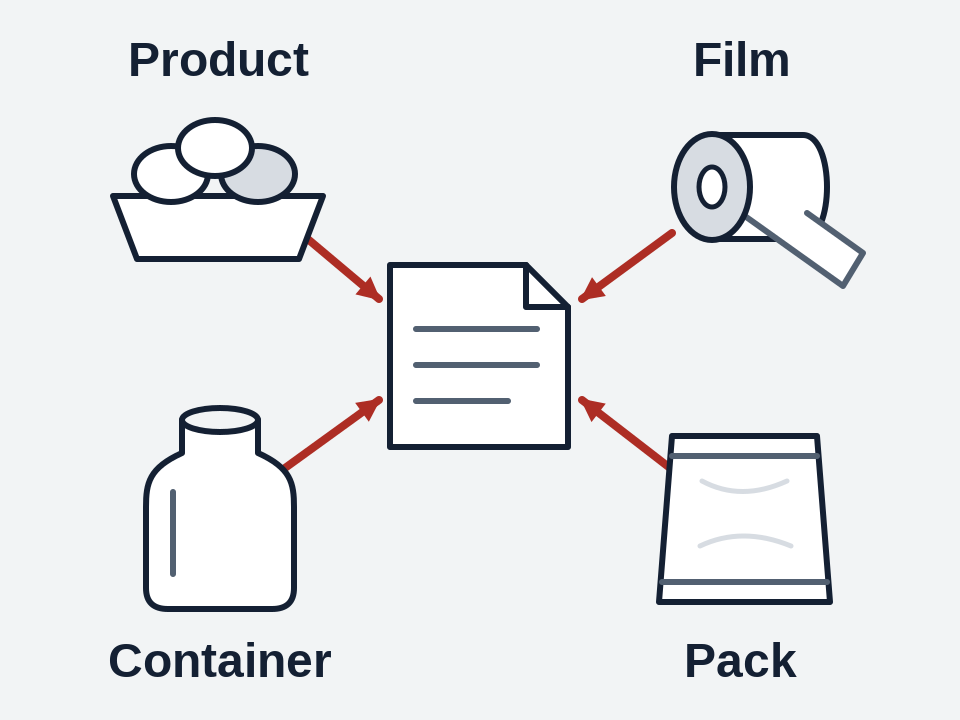
Product, film, container, and pack meet on one evidence sheet. The drawing does not grade the seal.
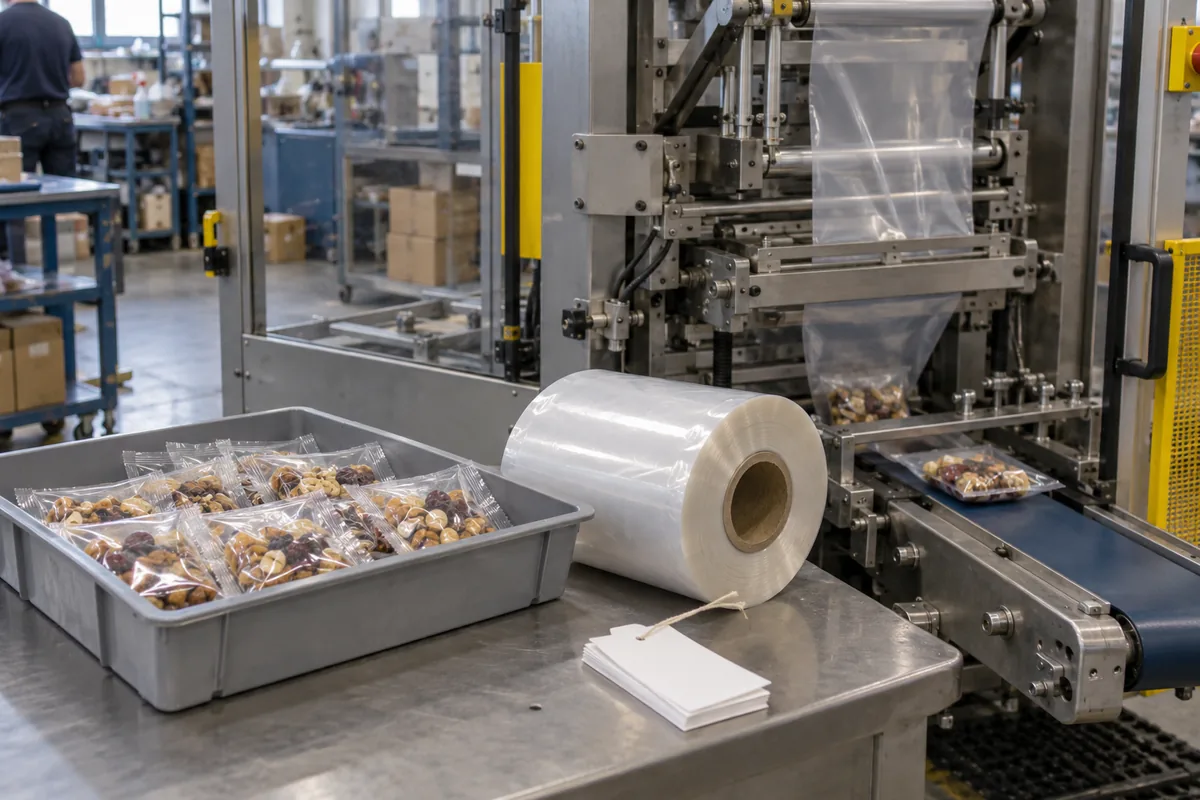
The photograph shows a film roll, filled pouches, and blank tags. The tags carry no result. It is an illustration of the items to identify, not a completed factory acceptance test.
The 13 June 2023 form/fill/seal roadmap also lists failure observations a plan can name: restart after an emergency stop, response to a blocked sensor, response when product runs out, response to a broken film web, detection of a missing date or lot code, response to a splicer fault, and a comparison of very low and very high speeds. It asks whether fill amount, appearance, seal, cut, crushing, and leakers were examined. It prints no speed, no fill weight, and no leak count. Put the project’s limits in the criterion cell. Do not copy a fault method out of this article into a machine procedure. Guarding, emergency stops, and lockout of electricity and compressed air are on PMMI’s safety list for the factory review. Those checks stay in the supplier’s safety procedure.
Takeaway: One row holds one tested combination. A neat pouch does not close a quality requirement that had its own method.
How do stops and a short window change the result?
Keep interruptions, substitute samples, manual assistance, and temporary upstream or downstream equipment in the same record as the count. Define their treatment in the measurement plan before the run.
| Event | What to write | Requirement affected |
|---|---|---|
| Interruption | Start, end, cause, and machine state | Whether that time stays inside the observation window |
| Rejected pack | Separate count and the agreed definition of a reject | Accepted output, kept apart from gross count |
| Substitute sample | Actual identity versus the required identity | The limit of the evidence, and the later run that uses the production material |
| Temporary feeder or outfeed | The stand that was used, and any manual help | The production boundary still open, and its owner |
| Changed configuration | The exact difference from the approved baseline | Whether the row needs another run |
PMMI’s 10 June 2021 roadmap says high-speed testing is hard because of the product volume it consumes, and that cutting the factory test short to protect a ship date produces longer start-ups and lost productivity. No speed and no lost-hour total are printed. The same roadmap says a brief, shallow factory test returns as a third-shift problem nine months later. Treat that sentence as the roadmap’s warning. It is not a downtime log from a named plant.
Accepted output rate = accepted count / observation hours
Neither roadmap prints an accepted-pack count or a production window in hours, so this checklist does not evaluate the rate.
Worked example: Subtract the two dry-cycle durations printed on the 10 June 2021 roadmap. Leave package count out of the line.
Unrun dry-cycle hours = 24 - 6 = 18
The 24 is that page’s minimum recommended dry cycle. The 6 is the window it uses as an example of a test squeezed too short. Enter 18 on the open-item log as unrun dry-cycle time. Do not enter it as rejected packs or as a line speed. The form/fill/seal examples of 2 minutes and 5 minutes stay off this subtraction.
What a thin test costs is time. None of the saved pages print a price:
- Eighteen hours is the unrun dry-cycle time when the six-hour example replaces the 24-hour recommendation. It is a difference of two published figures, not an invoice line.
- The third-shift problem nine months later is the 10 June 2021 warning about a brief test. Hours lost on that shift are not printed.
- Innova’s pallet-line guide of 21 March 2024 groups operating cost into maintenance, energy, packaging materials, and labor, with no amounts attached. Copy the category names onto the project budget and leave the amount cells blank.
- When the factory outfeed is a temporary stand, the installed connection remains a site row with its own owner. Put that follow-up on the schedule. Travel cost is not printed.
Takeaway: Stops, substitutes, and a short window belong on the result row. The only duration math on this page is 24 hours minus 6 hours.
What closes an open item?
Keep the original observation, the requirement it affects, and the proposed follow-up together until a named reviewer records a disposition. An item that needs site evidence moves with an owner and the check that can close it.
| Open-item field | Entry |
|---|---|
| Identity | Item ID, requirement reference, and configuration |
| Observation | Actual result or missing evidence, with the evidence reference |
| Impact | Which task or result is affected |
| Proposed action | Correction, further evidence, another factory run, or a site check |
| Owner | The party who acts and the party who reviews |
| Status | Agreed next step and current state |
| Closure | The new record and the criterion used to review it |
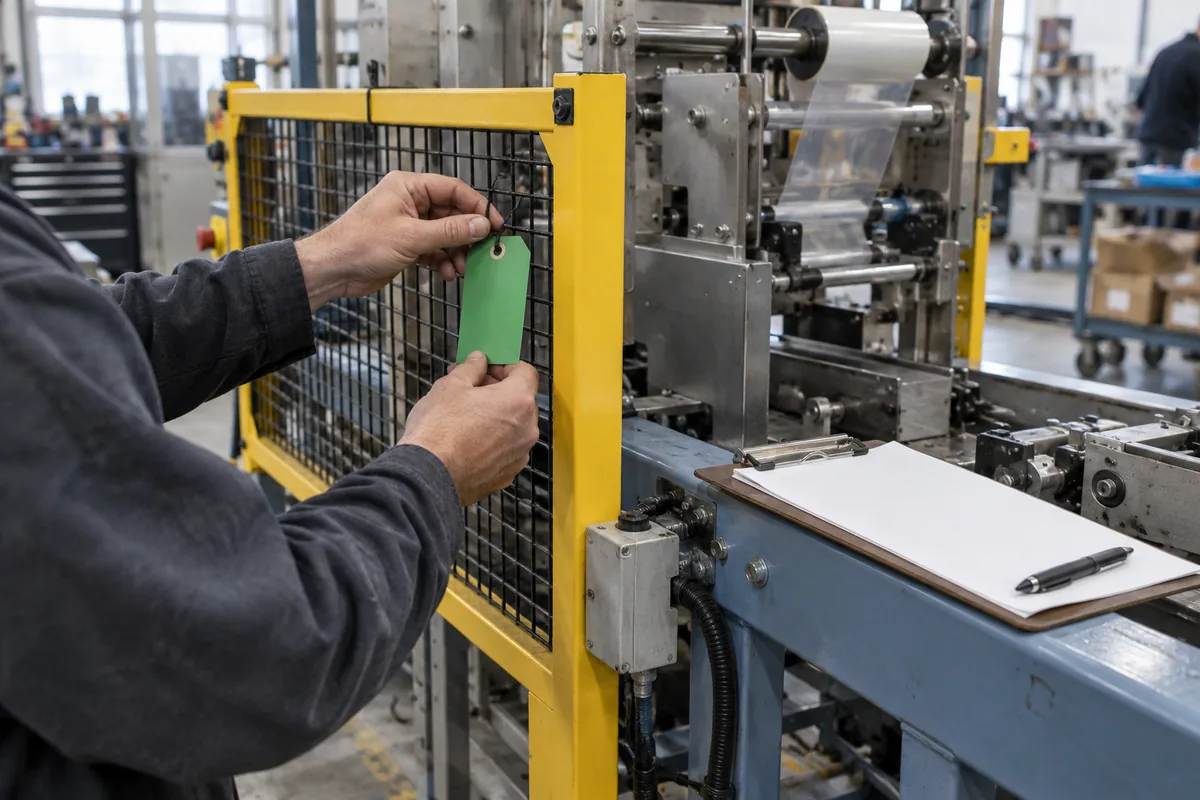
An open item retains its original observation and closure evidence.
The tag and the clipboard are blank. They mark an open item. They do not record a disposition, and they are not a shipment approval.
Innova places factory testing before installation and commissioning, then training, then maintenance plans. PMMI places training of the people who will run the line inside the factory test when training is part of that test. Write which schedule this contract uses. Do not infer a payment release or a ship release from either page.
Common mistake: An exception is described as something to fix after delivery, and then it disappears from the report. The observation, the owner, and the evidence still required have to travel with the machine.
Takeaway: Close an item with a new evidence record, or carry it forward with an owner. A blank tag is not a closed tag.
When this does not apply
The original supplier documents, contract and responsible technical/site process govern execution and release decisions. A dry run, substituted product or simulated downstream connection has a specific evidence scope; package shelf life, barrier protection, hygienic validation and final-site utility conditions require their own dedicated tests.
Takeaway: Use the published durations as durations. Leave every unprinted machine figure blank.
Method and sources
Public supplier guidance supports the factory/site and evidence distinctions:
- Innova pallet-line project stages (March 21, 2024): factory testing before installation and subsequent site commissioning in its stated project context.
- I&R Group FAT buyer checklist: public buyer checklist used for configuration, material, accessory and documentation questions.
Read the editorial policy for attribution and evidence rules.
PAC Machinery’s page carries datePublished of 11 January 2022. It supplies the place-of-manufacture description, the point that results mirror the criteria, and the mention of a one-page sheet for package size, packaging speed, and material. It prints none of those numbers.
Innova, 21 March 2024, supplies the pallet-line sequence from factory testing through commissioning, and the operating-cost categories with no amounts.
The editorial policy separates a source statement from a recommendation on this site. Update the checklist when the contract, the configuration, or one of these source pages changes.
Takeaway: The roadmaps supply the rows and the two published durations. The project register supplies every number those pages left empty.