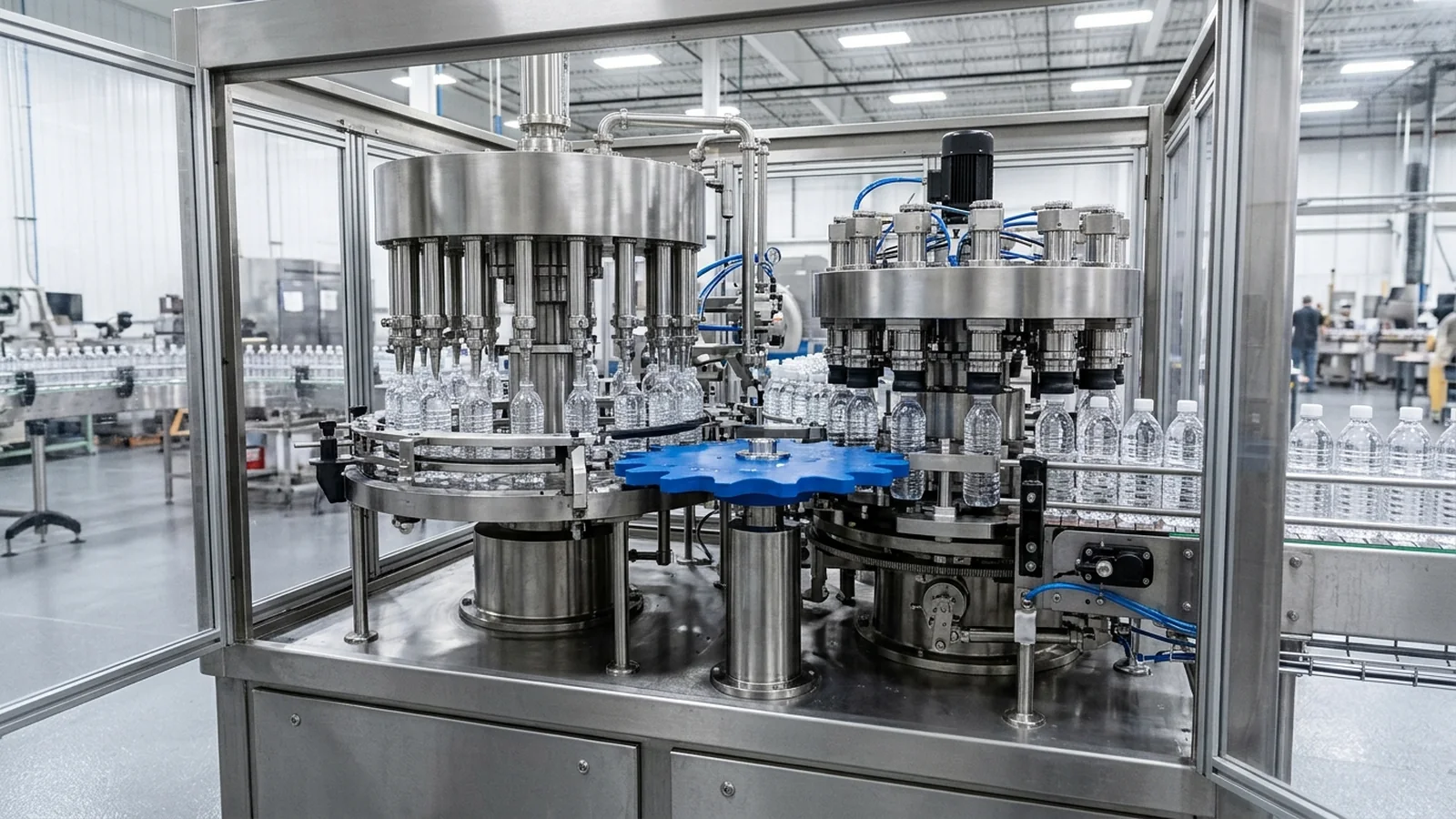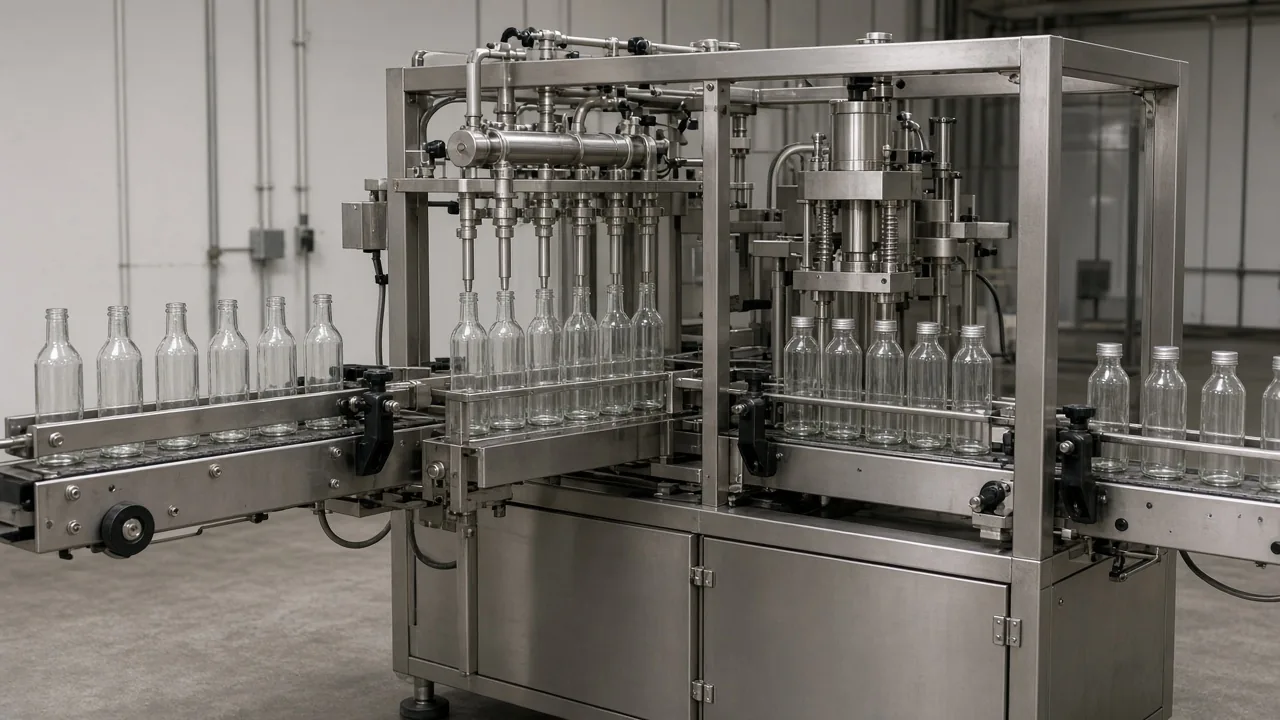
A buyer who treats the piston stroke, the scale ticket, and the liquid height as one result can accept a short fill, then pay for rework when the liquid temperature moves the volume. A volumetric filling machine doses that liquid by the volume a chamber displaces, and any figure the saved page does not print stays blank.
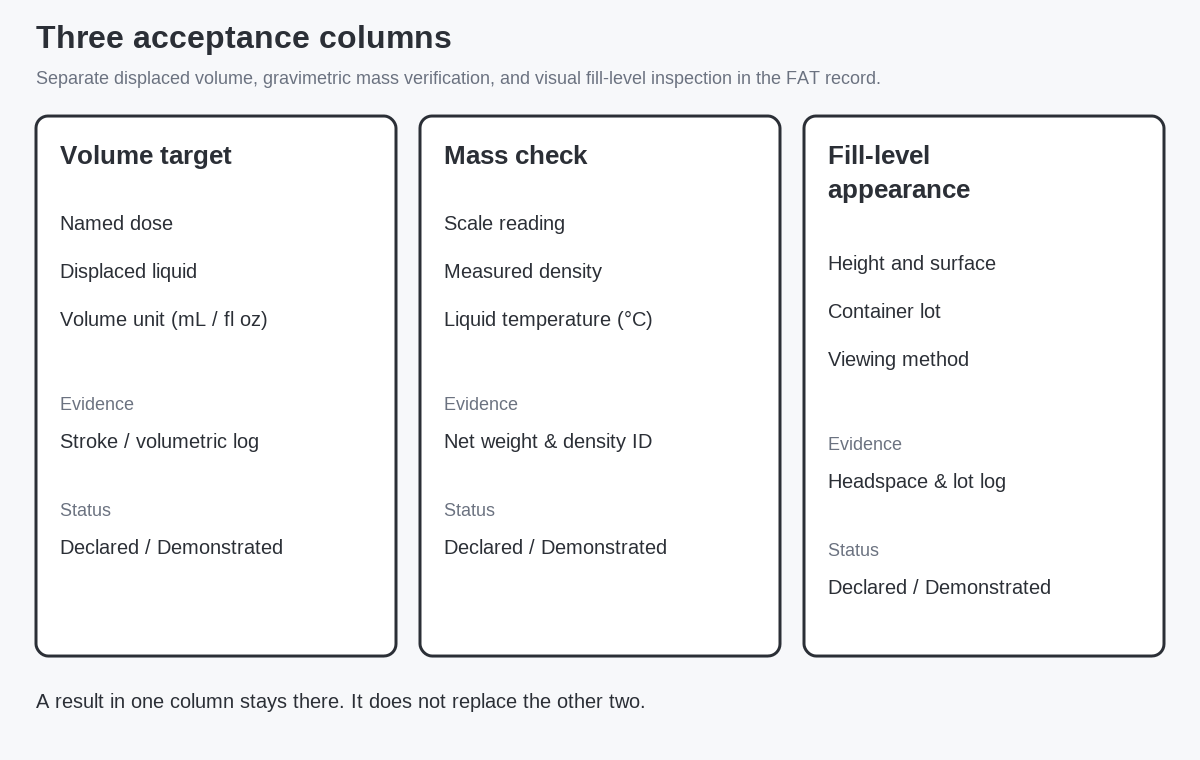
A volumetric filling machine fills by a named volume of liquid. Makwell’s explainer says the amount is “determined not by the bottle’s weight or height, but by the volume of liquid it displaces.” Ideal Pase’s volumetric-filler page says the machines “fill by volume of product.” This guide provides a three-column requirement matrix for the volume target, the mass check, and the fill-level appearance, along with a structured record for the density and temperature source, the container lot, the method, and the unit on the report.
| Input or item | Typical value or source | Why it matters |
|---|---|---|
| Dose command | Makwell, library copy fetched 8 October 2026: the fill is the volume of liquid displaced, and stroke length changes that volume. No stroke length is printed. | The setting names a volume. It does not read the bottle. |
| Cylinder list on one page | Accutek AVF12, fetched 18 October 2026: 1 oz, 8 oz, 16 oz, 32 oz, 64 oz, or 128 oz, with 29.57 mL, 236.59 mL, 473.18 mL, 946.53 mL, 1.89 L, and 3.79 L in that order. | Those sizes belong to that options line. A different machine keeps its own list. |
| Density | NIST Handbook 133 (2026), Chapter 3, section 3.1.1: density means the weight of a specific volume of liquid at a reference temperature. | A scale reading supports a volume label only after this density is on the report. |
| Temperature window | NIST Table 3-1 and note 2: hold the sample at the reference temperature ± 2 °C (± 5 °F). Other liquids, including soft drinks and bottled water: 20 °C (68 °F). | Volume changes when the liquid temperature changes. |
| Fill speed | Blank | Accutek prints “Up to 120 CPM” for the AVF12. Volumetric Technologies prints “Up to 90 Cycles per minute” on its piston page. Neither names this liquid and this pack, so neither is copied. |
| Accuracy percentage | Blank | Volumetric Technologies prints “up to +/- .25 of 1%”. Ideal Pase says the method “provides sufficient accuracy for most general filling applications” and prints no percentage. Neither is copied. |
| Motor power | Blank | Accutek prints 120 VAC, single phase, 60 Hz (220 or 240 VAC available) and air at 100 PSI / 3 CFM for the AVF12. Watts and horsepower are not printed. |
What does a volumetric filling machine set?
It sets a volume. Makwell’s library copy describes a pneumatic actuator driving a piston in a cylinder. A valve lets liquid enter from the supply and leave toward the nozzle. Changing the piston stroke changes the fill volume. The page does not print a stroke length, a bore, or a displaced millilitre, so those cells stay blank here. The sentence that is used is the definition: the dose is the volume displaced, kept apart from the bottle’s weight and height.
Accutek’s AVF12 page calls the machine an automatic volumetric piston filler and says the twelve heads dispense an accurately measured volume. The same page’s options line is where the cylinder sizes are printed. The body text pairs the ends of that range as 1 oz to 128 oz (29.57 mL to 3.79 L). The options line then lists the six ounce sizes and the six metric sizes together. Twice the printed 236.59 mL equals the printed 473.18 mL. That check uses two figures on the options line. It does not assign a mass, because the page prints no density.
ABA’s volumetric page, fetched 18 October 2026, describes double-acting positive-displacement piston pumps and offers one-gallon pumps or larger five-gallon pumps. The bottom-fill model on that page is described for half-pint cans through 5 gallon pails. Top fill and bottom fill name the nozzle path. They do not choose whether the acceptance report is in millilitres, grams, or a described liquid height.
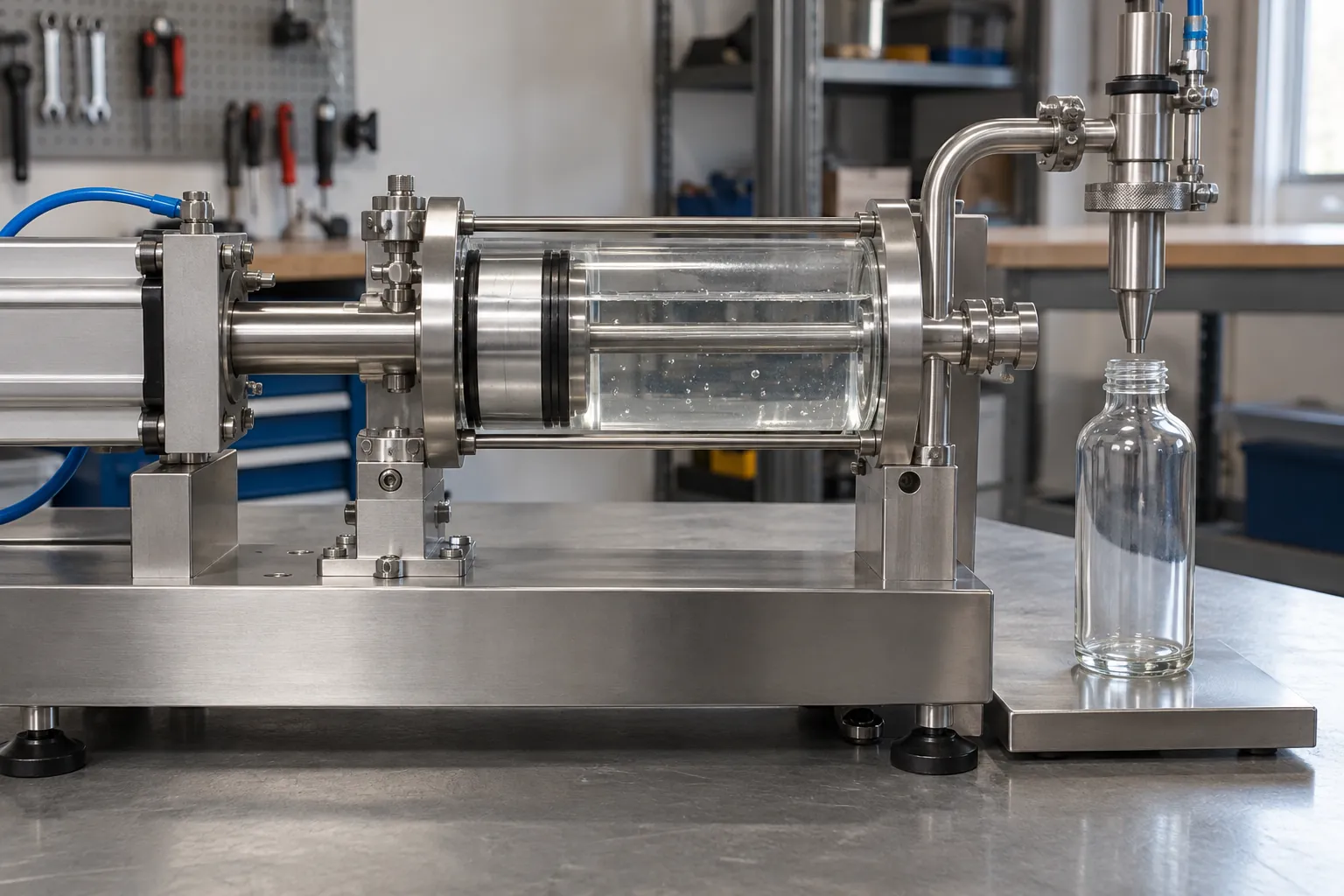
Example of a piston, cylinder, and nozzle. Not a named machine, and not a measured dose.
Takeaway: Record the stroke, the program, or the cylinder size as a volume command, then ask which unit the acceptance report will use.
Why do volume, mass, and fill level stay in separate columns?
They answer different questions. Container variation and density keep them from standing in for one another.
The volume target is the named dose, in a volume unit. The evidence is the displacement setting, or a direct volume measurement whose method is written down. NIST Chapter 3, section 3.1.1, allows a gravimetric check of a volume label when density does not vary excessively from package to package. If density varies from package to package, the handbook says to test each package with the volumetric procedures in that chapter.
A scale answers a mass question. NIST’s formula in section 3.2.2, for the case where the flask capacity equals the labeled volume, is nominal gross weight = average product density (in weight units) + average used dry tare weight. A gross reading of bottle plus liquid is not the product weight until the tare is removed. Without a density at the reference temperature, the scale result stays in the mass column.
The fill-level appearance is the height, the meniscus, the headspace, or foam. Makwell already sets the dose apart from the bottle’s height. A later lot of the same nominal bottle can hold a different internal volume, so the same displaced volume sits at a different height. Write the container lot next to any level note. Accutek lists extended-length nozzles for bottom-up filling to reduce foam. Foam changes the surface you are looking at. If you see it, record it in the appearance column.
Common mistake: Pasting a supplier’s speed line or accuracy phrase into the project specification. Accutek’s “Up to 120 CPM”, Volumetric Technologies’ “Up to 90 Cycles per minute”, and that supplier’s “up to +/- .25 of 1%” stay on those pages. The acceptance target is the dose and the unit your own record names.
Takeaway: Keep volume, mass, and fill level in separate columns. Attach a measured density to the mass column, and the container lot to the level column.
How do you turn a volume label into a scale check?
Use one matrix for each proposal. Mark “Not stated” when the document in front of you does not answer a cell. “Declared” means a document states it. “Demonstrated” means the project parties observed it and kept a record. “Needs confirmation” marks a cell that remains open prior to testing.
MAV/6 (g) = MAV (mL) × density (g/mL) / 6
Worked example. The handbook’s own example assumes packages labeled 1 L (33.8 fl oz) with an MAV of 29 mL (1 fl oz), and a measured weight of 1 L equal to 943 g (2.078 lb). The printed steps are 943 g ÷ 1000 mL = 0.943 g/mL, then 29 mL × 0.943 g/mL ÷ 6 = 4.557 g. NIST states that a 1 g scale division is smaller than 4.557 g, so that scale is suitable for the density determination in the example. The 4.557 g figure is a scale-division check for that labeled 1 L and that 29 mL MAV. It is not a filler accuracy percentage, a fill speed, or a power rating.
Takeaway: Fill each column from a named document, and mark unaddressed items for vendor verification.
Accutek’s options line does not print a density, so the mass of those cylinders stays blank. The volume check that the line does support is 2 × 236.59 mL = 473.18 mL. Those two millilitre figures are the second and third metric sizes on the options line, beside 8 oz and 16 oz. Leave ρ blank, and leave m = ρ × V blank with it.
The public pages describe a volume dose more clearly than they describe your acceptance unit. The table compares what those pages state directly against what your project record must specify.
Example of a volume check beside a separate scale. The display is blank because this page does not print a weight for the bottle.
Takeaway: Multiply a printed volume by a density from the same liquid and the reference temperature. If either number is missing, leave the mass blank.
Which failure shows up when density or temperature moves?
NIST section 3.1.1 states two mechanisms. Density that varies from package to package makes one density unfit for the whole sample. Temperature changes the volume because the liquid expands or contracts. The handbook’s illustrative pair is a liquid cleaning product at 5 L (1.32 gal) at 20 °C (68 °F) and 5.12 L (1.35 gal) at 25 °C (77 °F). NIST calls that a 2.2% change and says this extreme example is illustrative: a 2.2% volume change will not occur in normal testing. The operating limit printed in note 2 is tighter than that illustration. Hold the sample at the reference temperature ± 2 °C (± 5 °F).
| Condition | Dominant failure mode | Prevention named on the saved page |
|---|---|---|
| Makwell, volumetric-filler explainer | The fill is the volume of liquid displaced, rather than the bottle’s weight or height. Stroke length changes that volume. | Density source, container lot, method, and the unit you will accept |
| Adinath, six-head volumetric liquid filling page | Piston syringes draw and dispense the volume set on the screen. Diving nozzles fill from the bottom upward. | Project-specific accuracy acceptance limit for your liquid |
| Ideal Pase, volumetric fillers | The machines “fill by volume of product.” The page says the method “provides sufficient accuracy for most general filling applications.” | The liquid, the container, and the check that sentence is meant to cover |
| Volumetric Technologies, piston fillers | Piston fillers and depositors dispense a set amount. The catalog prints its own accuracy wording, and a customer note discusses weights. | Volume measurement protocol for your specific bottles |
| ABA, volumetric filling machines | Double-acting positive-displacement piston pumps. Net-weight fillers are listed as a separate offering. Top fill and bottom fill name the nozzle path. | Project-specific acceptance unit and container tolerances |
| Wolf Packing, accuracy comparison (published August 17, 2026) | Volumetric systems measure a fixed space. Gravimetric systems measure mass. The volumetric result is tied to consistency and density stability. | Project-specific acceptance threshold |
Rule of thumb. If the sample temperature is above or below the Table 3-1 reference by more than 2 °C, do not treat the reading as the labeled volume. For other liquids, including soft drinks and bottled water, that reference is 20 °C (68 °F). Beer in the same table is 4 °C (39.1 °F), distilled spirits are 15.56 °C (60 °F), petroleum is 15.6 °C (60 °F), and refrigerated food labeled “KEEP REFRIGERATED” is 4 °C (40 °F). Frozen food sold and consumed frozen is checked at the frozen temperature. Use the row that names the liquid.
The product’s flow behavior belongs on the viscous-liquid filling guide. Bring the liquid identity from that record into the density row here. Accutek prints a viscosity range of 1 to 20,000 cps for the AVF12. That range stays on the AVF12 page. It is not a setpoint for a different liquid.
What goes on the density and container record?
Complete each field when a verified document exists for it:
Giveaway is extra product in an accepted container. Accutek says the AVF12 reduces overfill and prints neither a gram of giveaway nor a dollar amount. Both stay blank. Do not turn “reduces overfill” into a percentage.
A scale that is too coarse hides a shortfall of a different kind. In NIST’s 1 L example, the scale division has to be no larger than 4.557 g. A coarser division cannot support that density determination. The handbook does not print a pack count or a price for the missed grams, so the run total stays blank. The 4.557 g figure stays inside that example. It is not All-Fill’s 454 g to 458 g window. That window belongs only on the auger filler guide.
Utilities are a third blank. The AVF12 page prints air at 100 PSI / 3 CFM and a supply of 120 VAC, single phase, 60 Hz. It does not print watts or horsepower, so motor power and the energy bill stay blank. Do not convert 120 VAC or 3 CFM into a kilowatt figure.
Cylinder changes stop the filler for a reason the page does not time. Six cylinder sizes are printed. Changeover minutes are not, so minutes stay blank. The handoff section of the line specification is where the filler-to-scale connection gets an owner. This page does not cover wiring.
Takeaway: Count extra product, missed shortfalls, utility draw, and changeover minutes in separate cells, and leave a cell blank when the page prints no figure.
What does the buyer record leave blank?
No cell has a default. Copy a number only from the document that prints it for this liquid, this container, and this machine.
| Field | Record |
|---|---|
| Liquid identity | Formulation & batch lot ID |
| Density source: who measured it, by what method, and where the record is kept | Pycnometer / density meter lab report ID |
| Temperature of that density measurement, and how the temperature was read | Measured product temperature (°C) |
| Density measurement status | Confirmed lab report or pending trial measurement |
| Container identity, drawing, and lot | Bottle mold drawing & supplier lot ID |
| Method: instrument or observation, and who performed it | Calibrated scale, volumetric flask, or height gauge ID |
| Unit printed on the report | mL / fl oz (volume), g / oz (mass), or mm (headspace) |
| Matrix column this report is offered for: volume target, mass check, or fill-level appearance | Designated acceptance column |
| Bottle or sample identity, and where the raw record is filed | Sample numbering & FAT log reference |
| Foam, drip, or other surface note made during the check | Meniscus / aeration observation note |
| Reviewer, unresolved evidence, and the owner of the next confirmation | QA / engineering reviewer & open action owner |
Agree the conditions before the run, as the factory-test section on what has to be written before the machine runs describes. A whole-machine trial stays on that checklist. This page supplies the measurement rows only.
A rotary label does not fill these rows. The rotary filling guide separates the container route from the metering method. Write the layout in one field and the acceptance unit in another.
Takeaway: Record density, temperature, container lot, method, and unit from verified project documents.
When this does not apply
This page covers liquid volumetric metering and the three acceptance units. For rotary versus straight-line container layout, see the rotary filling systems guide, where layout and metering are separate fields.
If the open question is how the liquid behaves under the conditions you will run, use the viscous-liquid page. For dry powders and granules, the auger filler guide separates a dry screw dose from a weight check.
Takeaway: Use the matrix to verify that the liquid measurement evidence matches the acceptance unit specified for the project.
Method and sources
This guide synthesizes public manufacturer documentation on liquid volumetric dosing and acceptance verification:
- Makwell, “What is a volumetric filler?”: defines volumetric filling by the volume of liquid displaced rather than bottle weight or height, and describes piston, stroke, and nozzle mechanics.
- Adinath, “Automatic Six Head Volumetric Liquid Filling Machine”: describes piston-syringe dosing and bottom-up diving nozzles for foam control.
- Ideal Pase, Volumetric Technologies, and ABA: manufacturer product pages illustrating positive-displacement piston fillers, benchtop and inline depositors, and top-fill versus bottom-fill nozzle paths.
- Wolf Packing, “Volumetric Vs. Gravimetric Filling: Accuracy Comparison” (published August 17, 2026): contrasts fixed-volume displacement against gravimetric mass measurement and highlights the role of product density stability.
Statements attributed to a manufacturer are that manufacturer’s description of its own equipment. The three-column matrix and density/container record are our editorial procurement framework. See the editorial evidence policy.
Related reading
Work through the matrix and the density/container record with each supplier’s documents, then continue with these guides:
- Filling and bottling research desk: the column this measurement page belongs to.
- Rotary filling systems: decide the container route separately from metering.
- Viscous-liquid filling machines: record the product sample before you interpret a fill.
- Packaging machinery FAT checklist: carry these measurement rows into a full trial record.
Takeaway: Keep the same liquid, container lot, and acceptance unit from this page through specification and the later trial.