A heat-shrink packaging purchase fails when one conveyor ceiling is copied onto a machine whose own page prints a different ceiling. Choose the shrink wrap machine pair whose pages name each other, then leave every seal size, film width, speed, and power row on the sheet that printed it.
For a factory shrink-packaging purchase, choose the required package first and evaluate the sealing and shrinking stages together using the intended product and film. An individual retail pack and a grouped distribution pack have distinct closure and handling requirements. This guide provides a scope table, product-and-film inputs, an interface record and sample checks.
| Input or item | Typical value or source | Why it matters |
|---|---|---|
| Named pair | VST1710 and VST2717 page says they match the VSA1825 (Eastey, October 18, 2026) | The sealer page itself names only “a heat tunnel” |
| VSA1825 seal and film | 18 in wide by 25 in long, packages up to 7 in tall, film width up to 24 in (Eastey VSA page) | A wider roll does not fit this sealer |
| VSA1825 conveyors and rate | 100 ft/min infeed and outfeed; 35 to 40 products per minute (Eastey VSA page) | The rate depends on product size |
| VST heater and speed | 15 kW; room temperature to 365°F (185°C); conveyor up to 100 ft/min (Eastey VST page) | This speed belongs on the page that names VSA1825 |
| Performance conveyor | Up to 67 feet per minute (Eastey Performance page and the Performance user guide) | One ceiling for the conveyors listed on that page |
| Professional conveyors | Live roller up to 67 fpm; mesh belt up to 100 fpm (Eastey Professional page; same split in the August 11, 2015 user guide) | The belt type selects the ceiling |
| Value combo | Seal 16 by 20 in; film up to 18 in; chamber 15 by 8 by 26 in; 220 VAC, 1-phase, 30 A (Eastey combo page) | One frame, and no feet-per-minute figure |
Is the requirement an individual pack or a grouped pack?
| Published machine | Baseline on that page | Dominant failure mode | Prevention |
|---|---|---|---|
| Value Series combo | 16 by 20 in seal, film up to 18 in, chamber 15 by 8 by 26 in, one 220 VAC 1-phase 30 A feed (Eastey combo page) | A 24 in film roll or a 100 ft/min schedule taken from the VSA1825 page | Fitment check against 18 in and the missing speed figure |
| VSA1825 auto L-sealer | 18 by 25 in seal, height up to 7 in, film up to 24 in, conveyors at 100 ft/min, 35 to 40 products per minute (Eastey VSA page) | A tunnel whose own page stops at 67 ft/min | Keep the VST page, which names this sealer, on the layout |
| VST1710 and VST2717 | 100 ft/min live roller, 15 kW, room temperature to 365°F, polyolefin (Eastey VST page) | Copying this 100 ft/min line onto a Performance tunnel | Leave the speed on the heading that includes both VST models |
| Performance series, including ET1610-36 | Conveyor up to 67 ft/min; ET1610-36 chamber 16 by 10 by 36 in (product page and user guide Table 1) | Scheduling the chamber at 100 ft/min | Record 67 ft/min with this family |
| Professional series | Live roller up to 67 fpm, mesh belt up to 100 fpm (Eastey Professional page) | Running a live-roller model at the mesh-belt ceiling | Write the conveyor type next to the speed |
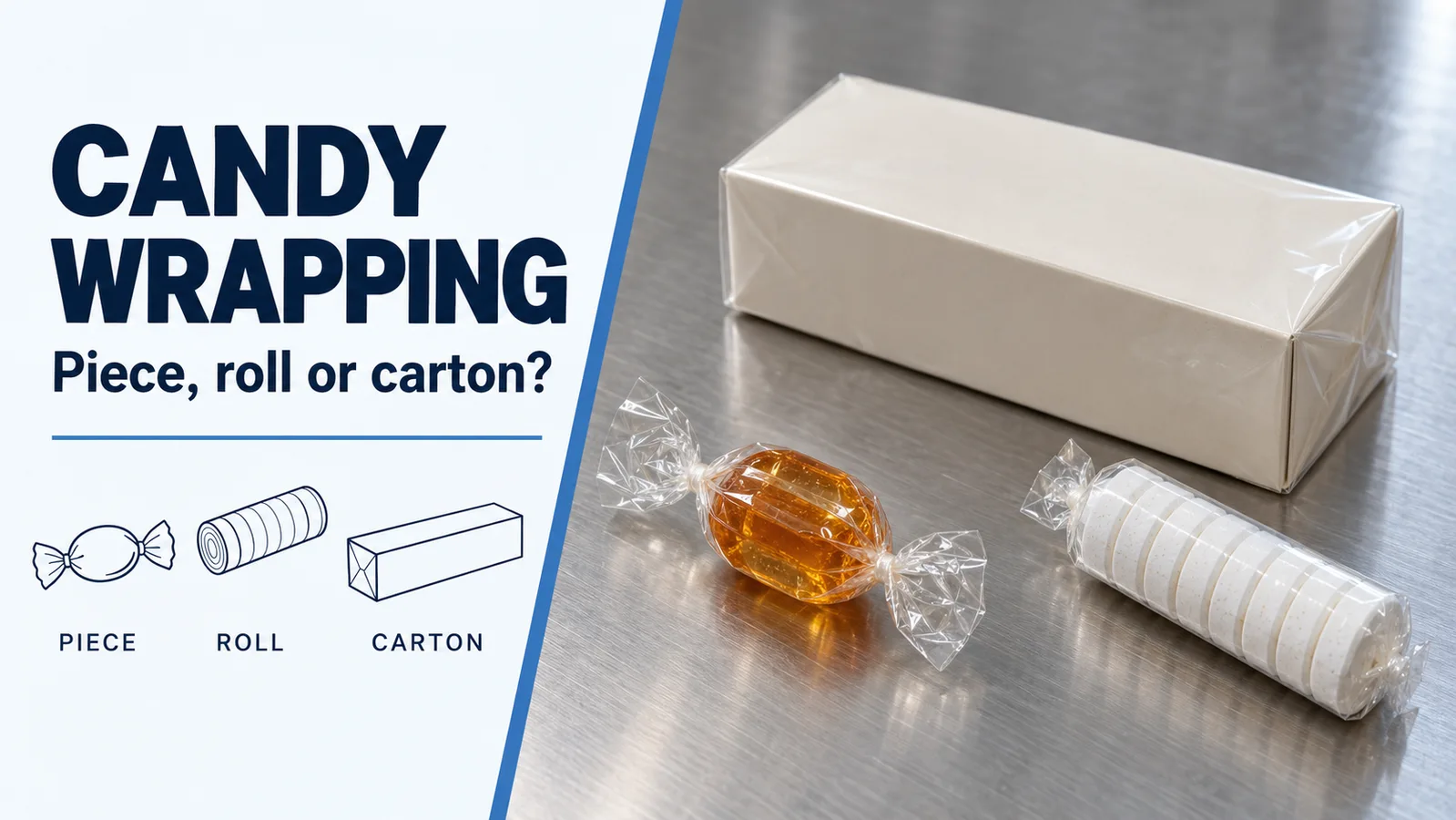
An individual sweet still needs its own wrapper. That primary wrap is a different machine, set out in the twist and flow comparison. The shrink pair starts when a finished piece or a group reaches the sealer. A bottle that is still empty belongs on the rotary filling layout. Shrink selection starts at the group, the film, and the paired pages.
Takeaway: The VST page is the one that names the VSA1825. The combo, the Performance series, and the Professional series are other baselines.
Which seal size and film width travel together?
The VSA1825 page prints an 18 inch by 25 inch seal area for packages up to 7 inches tall, and a maximum film width of 24 inches, with a maximum roll outside diameter of 12 inches. The same page says the machine seals most center-folded polyolefin and polyethylene films, and that adjustable pin perforators provide air evacuation. ProPac’s VSA1825 one-pager, copyright 2025, prints a product envelope the Eastey feature list does not: length 2.5 to 22.0 inches, width 2.5 to 16.0 inches, height 0.2 to 7.0 inches. Use the 22 inch and 16 inch limits from that one-pager, and the 18 by 25 inch seal from both the one-pager and the Eastey page.
The combo page prints a seal of 16 by 20 inches and a maximum film width of 18 inches. Its tunnel chamber is 15 inches wide, 8 inches tall, and 26 inches long. A film roll that is legal on the VSA1825 can miss the combo.
Clysar’s EVO data sheet, marked 2024-7, offers folded film in custom widths from 5 inches to 37 inches, in 1 inch steps, and flat film from 5 inches to 56 inches. Gauges are 45, 60, and 75. Folded film has half the linear footage of flat film for the same gauge and roll dimensions. A 20 inch folded width is above the combo’s 18 inch maximum and inside the VSA1825 maximum of 24 inches. A 30 inch folded width is above both maximums. Those two comparisons use the widths the sheets print. They do not assign a Clysar grade to an Eastey model.
Rule of thumb. If folded film width exceeds 18 inches and stays at or below 24 inches, the Value combo’s published maximum excludes that roll and the VSA1825 maximum still includes it, because the combo page stops at 18 inches and the VSA1825 page stops at 24 inches.
Clysar ABL, marked 2019-04, is a different polyolefin sheet: gauges 50, 60, 75, and 100, folded widths from 3 inches to 50 inches. ABL says it is designed for L-sealers and tunnels, and that it is not suited to high-speed form/fill/seal systems. ABL also says air evacuation is critical, because the lack of pinholes will not allow evacuation through the seals, and that the film may stretch and fail to perforate unless a backup roller supports the pins. The VSA1825 page lists pin perforators and does not mention a backup roller. That gap is a sample-trial item for an ABL roll, not a defect you can close from the sealer bullets alone.
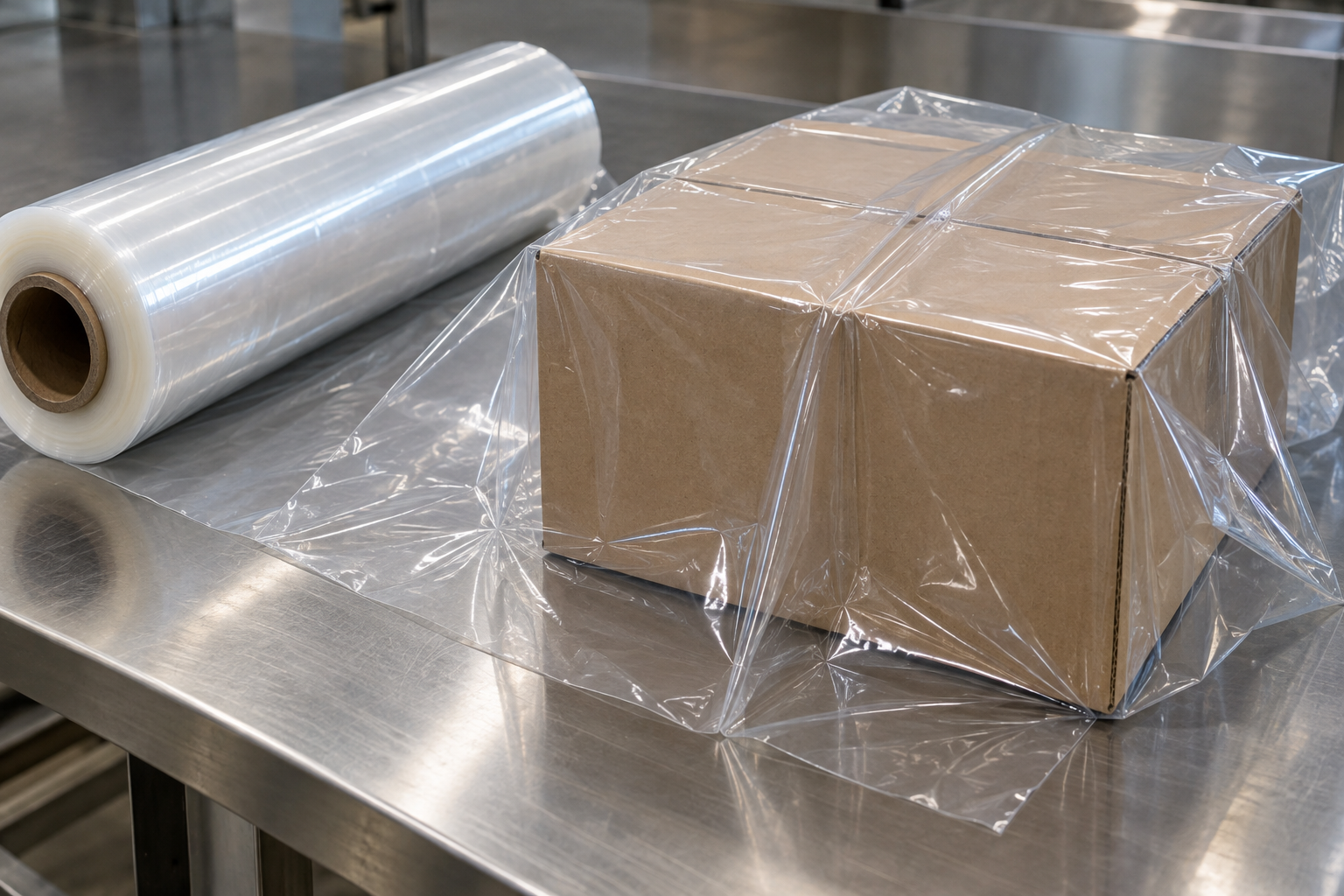
Example of clear shrink film and a loose sheet around a plain carton. Roll width is the measurement the sealer’s maximum film width has to clear.
The ESA Professional Series L-sealer user guide is another family. ESA2028T(K) prints a 28 inch front seal and a 20 inch side seal, at 220/110 V and 10/20 A, single phase. Every machine in that guide requires 3.5 CFM at 60 to 80 PSI. The VSA1825 page prints 60 to 80 PSI at a 1/4 inch NPT fitting and does not print 3.5 CFM. The 28 inch front bar stays on the ESA row.
Takeaway: Write the film width limit from the sealer page that is actually on the order: 18 inches on the combo, 24 inches on the VSA1825.
Product, film and trial identities stay connected.
t_s = (L_in / 12) / v_fpm * 60
The Performance user guide Table 1 lists ET1610-36 with a chamber 16 inches wide, 10 inches high, and 36 inches long. The same guide’s standard features, and the Performance product page, print a conveyor speed up to 67 feet per minute. The bullet that introduces the dash digits calls them the chamber length, then repeats the 8 or 10 inch height line. Table 1 and the ET1610-36 example both assign 36 to length, so the arithmetic uses 36 inches.
Worked example: t_s = (36 / 12) / 67 * 60 = 2.69 seconds. That is the pass time at the published ceiling, not a recommended setpoint. The user guide says to start the conveyor near midrange and to set temperature from the shrink-film recommendation. It does not print the midrange as a number.
The VST page prints 100 feet per minute and does not print chamber length. ProPac’s VST1710 one-pager prints a chamber 18.0 inches wide, 10.0 inches high, and 59.0 inches long, and the same 100 feet per minute. Arithmetic on that one-pager alone is t_s = (59 / 12) / 100 * 60 = 2.95 seconds. The one-pager is titled VST1710. The Eastey heading covers VST1710 and VST2717, so the 59.0 inch length stays on the VST1710 one-pager. That sheet also prints conveyor width as 18 inches (457 cm). Eighteen inches converts to 45.7 cm, so the parenthetical unit on that cell conflicts with the inch figure. The width to carry forward is 18 inches.
The combo page prints a 26 inch chamber length and no feet-per-minute figure. Residence time is not fixed by that page.
The Professional page splits the ceiling by belt: 67 fpm live roller, 100 fpm mesh. The August 11, 2015 Professional user guide repeats that split. The Performance page lists live roller and mesh and then prints one ceiling, 67 feet per minute. A mesh belt does not inherit 100 fpm from the Professional page.
The sealer, transfer and tunnel are separate scope entries.
Example of a wrapped carton moving from a sealer conveyor into a tunnel opening. Each conveyor keeps the speed printed on its own page.
At the low end of the VSA1825 range, lost seals during a stop are the rate times the minutes.
N = R * minutes
Worked example: N = 35 * 10 = 350 seals in a 10 minute stop. At the high end, N = 40 * 10 = 400 seals. The page says the rate depends on product size, so 350 and 400 are the two ends of that printed range, not a measured shift.
The line specification is where the sealer discharge and the tunnel infeed get an owner. A 100 ft/min sealer facing a 67 ft/min tunnel is an interface, even when one supplier name is on both quotes.
Takeaway: ET1610-36 at its own ceiling gives 2.69 seconds. VST1710 on the ProPac sheet gives 2.95 seconds at 100 feet per minute. The combo page does not support either number.
Which temperature belongs to the film, and which belongs to the tunnel?
The VST page prints a tunnel temperature range between room temperature and 365°F (185°C), with a 15 kW heater and adjustable temperature control. The films named on that page are polyolefin. Performance and Professional pages say those tunnels are designed to shrink most polyolefin, polyethylene, and PVC films, and they do not print a degree figure. The Performance user guide tells the operator to use the temperature recommended for the shrink-wrap material.
Clysar EVO Table 2 reports shrinkage by ASTM D1204 of 50 percent area at 102°C (216°F) for 10 minutes, for 45, 60, and 75 gauge. Shrink force by ASTM D2838, in grams per inch at 100°C, is 85, 130, and 145 for those three gauges. The sheet says these are typical data and are not limiting specifications. Storage below 32°C (90°F) is recommended. The same table’s water-vapor transmission rates are 2.1, 1.5, and 1.4 grams per 100 square inches per 24 hours. That is a transmission figure, not a waterproof claim. Clysar states that its films sold for food packaging comply with FDA 21 CFR 177.1520 for articles that contact food, except articles used for packing or holding food during cooking.
Clysar ABL Table 2 uses the same D1204 condition, 102°C for 10 minutes, and reports 65 percent area shrinkage for 50, 60, 75, and 100 gauge. The ABL narrative says the shrink temperature range starts at 285°F. That 285°F line is on the ABL sheet. It is inside the VST numeric range of room temperature to 365°F, and it is not printed on the VST page. EVO’s 50 percent and ABL’s 65 percent are two films under one lab method. They are not two readings for one tunnel setpoint.
A 10 minute lab hold and a 2.69 second tunnel pass are different exposures. The 2.69 second figure is the ET1610-36 ceiling arithmetic above. It is the pass time at 67 feet per minute, and the EVO sheet describes a 10 minute oven test.
Rule of thumb. If the temperature beside a shrinkage percent is 216°F for 10 minutes, keep it on the Clysar D1204 row. The VST controller range on the Eastey tunnel page runs from room temperature to 365°F (185°C).
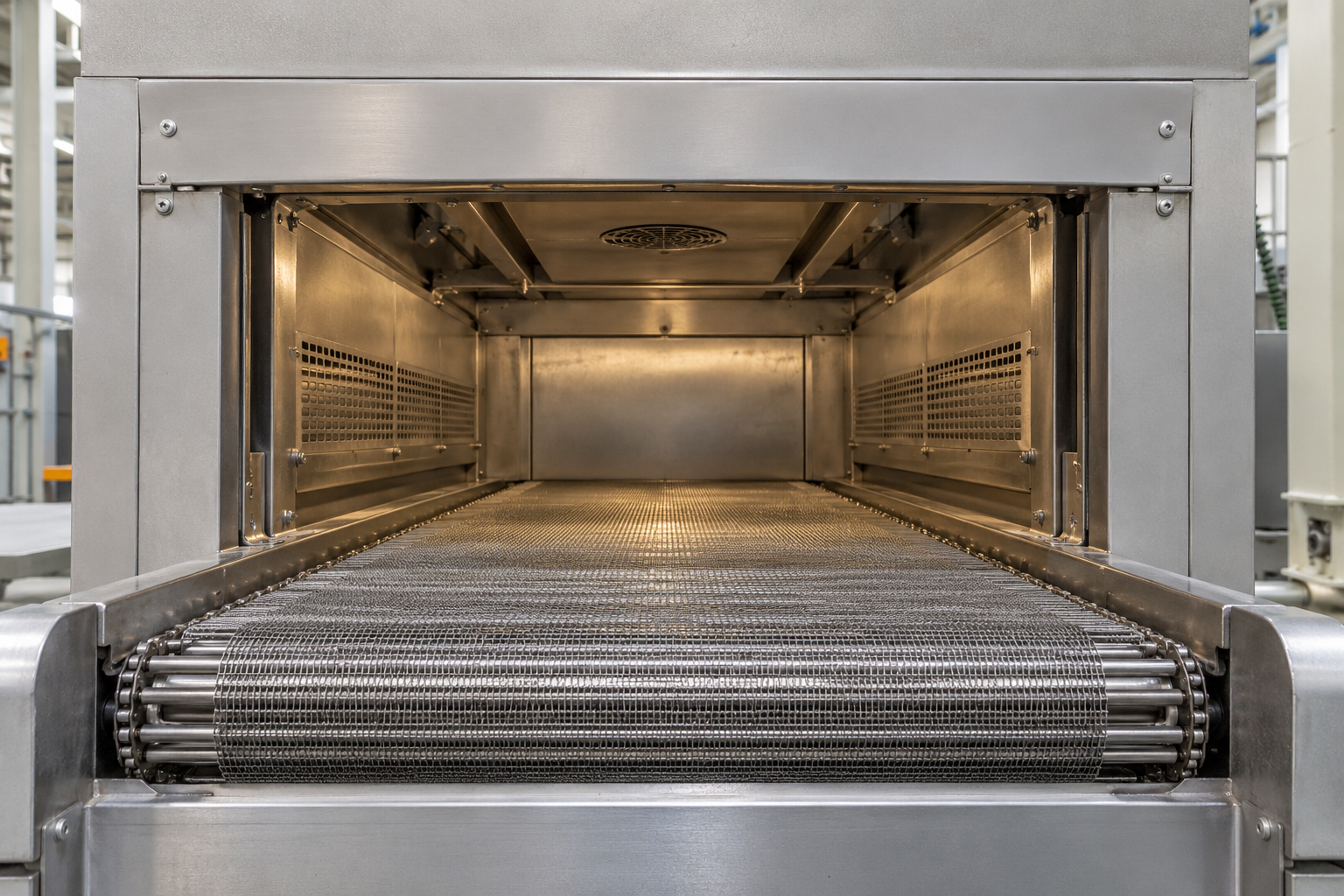
Example of an empty tunnel chamber on a mesh belt. Length and the published conveyor ceiling set the shortest pass time. The film-lab temperature stays on the Clysar table.
Takeaway: 216°F for 10 minutes stays on the Clysar tables. 365°F is the top of the VST range. 285°F is the start of the range ABL describes.
The line specification scope register provides a consistent way to compare these boundaries across a larger project. Costs can then be discussed on an identical equipment and installation boundary.
The combo page prints one connection: 220 VAC, single phase, 30 A. The VSA1825 feature list prints 60 to 80 PSI and does not print volts or amps. ProPac’s VSA1825 one-pager prints 220 V, 12 A, single phase, and a ship weight of 1,490 lb (676 kg). ProPac’s VST1710 one-pager prints 200 V, 30 A, three phase, and a 15 kW heater that the Eastey VST page also prints. The Eastey VST page does not print volts or amps. Adding 12 A to 30 A produces a number no fetched page prints.
The Performance user guide disagrees with itself. Table 2 lists V1 as 220 V, 40 A, single phase, and V2 as 220 V, 25 A, three phase. The model-number paragraph on the next page says V1 means 220 V, 5 A, single phase, that all models are available at 110 V, 5 A, single phase, and that only single phase is offered. Appendix titles then show an ET1610-36/48 schematic at 220 V, 40/50 A, or 480 V, 20/25 A, single phase, and another at 220 V, 25 A, three phase. The product page says 220 V, single phase or three phase, and prints no ampere row. Keep each of those rows on the line that printed it. A factory acceptance test, or a sample trial on the actual nameplate, is what retires the conflict.
The Professional product page says 220 V three phase is standard, with some models available at 480 V three phase. It also lists an optional heavy-duty conveyor motor of 1/2 HP. That option is a conveyor motor. It is not the 15 kW heater on the VST page.
Heater nameplate energy uses the 15 kW figure from the VST page.
E_kWh = 15 * hours
Worked example: a 10 minute interval at that nameplate is E_kWh = 15 * (10 / 60) = 2.5 kWh. The page does not say the heater draws 15 kW for every minute it is on. The 2.5 kWh figure is the nameplate for that interval. It is not a measured bill, and it has no currency amount.
On the same EVO roll, a 3 inch core and a 9.5 inch outside diameter hold 11,660 feet at 45 gauge and 7,000 feet at 75 gauge (Table 1). The difference is 4,660 feet. If a buyer assigns 2 feet of film to each pack, that assumption yields 5,830 packs from the 45 gauge roll and 3,500 packs from the 75 gauge roll. The 2 feet is the buyer’s allowance for this arithmetic. Clysar does not print a footage per pack.
Those lost seals, the heater nameplate, and the shorter roll are the account this evidence supports. The FAT checklist is where a trial replaces 2.69 seconds, 350 seals, and 2.5 kWh with accepted packs, a recorded setpoint, and a nameplate reading. The buying-guides desk is the wider procurement record around that trial.
Takeaway: The combo is one 30 A, single-phase feed. The 12 A sealer row and the 200 V, 30 A, three-phase tunnel row live on separate ProPac sheets. The Performance guide prints 5 A, 40 A, and 25 A in different places.
When this does not apply
This guide covers shrink wrapping of products or product groups; shrink-sleeve labeling requires separate applicator and steam/radiant tunnel specifications. A proposed support, material or group arrangement that differs from the production requirement needs its own evaluation. Project-specific hygiene, food-contact and protection requirements belong with the product owner and relevant suppliers.
Supplier manuals, material documentation and qualified site procedures govern operation and installation.
Takeaway: Use the tables to define a testable purchase, then obtain project-specific technical instructions.
Method and sources
Public manufacturer documents underpin the selection factors:
- Jochamp automatic shrink-wrap selection guide: manufacturer discussion of product, film, sealing and shrink-system selection.
- Jochamp shrink-system product discussion: manufacturer description of process stages.
- EDL equipment-specification checklist (April 14, 2015): retained for its input and scope questions.
The editorial policy explains attribution and evidence standards. Revisit the brief when the product, film or configuration changes.
Takeaway: Public guidance identifies the buying questions; the specific offer and trial supply the answers.
Related reading
- Candy wrapper selection — define an individual wrap before specifying a grouped pack.
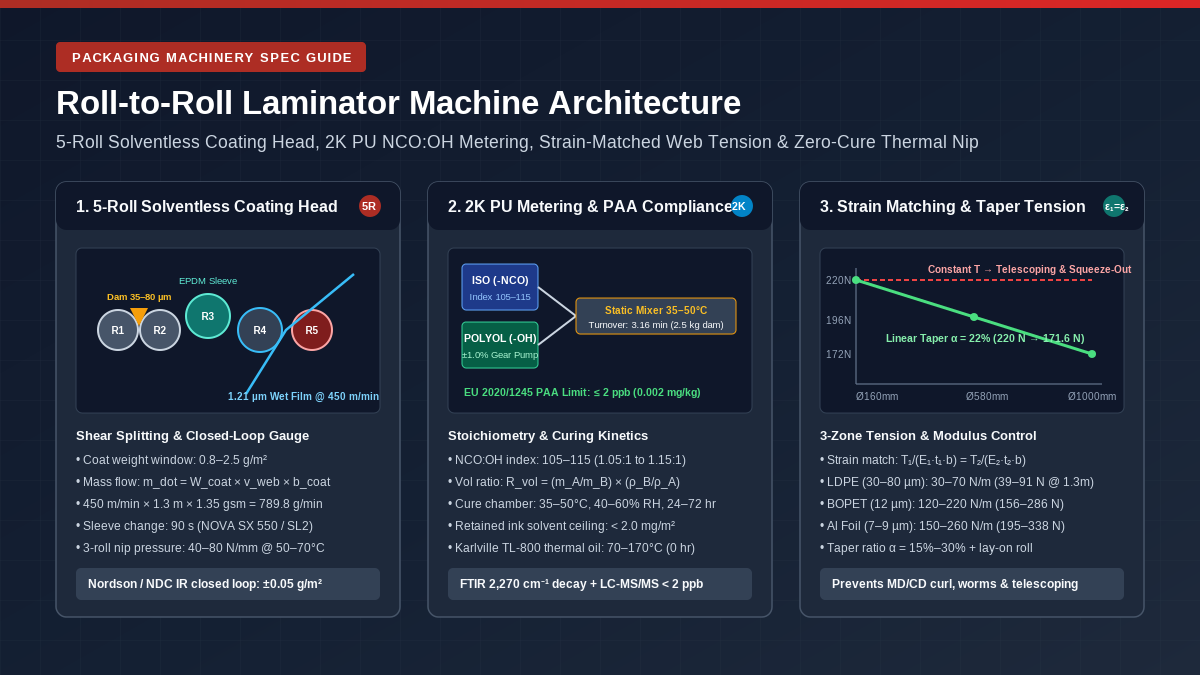
- Roll-to-roll thermal and solventless laminator machine guide — compare 5-roll solventless barrier lamination and zero-cure thermal nips for primary flexible packaging webs.
- Complete packaging-line specification — allocate the transfer and downstream responsibilities.
- Packaging machinery FAT checklist — record the acceptance evidence and missing site checks.
Takeaway: Keep the same pack reference across primary wrapping, shrink packaging and acceptance.