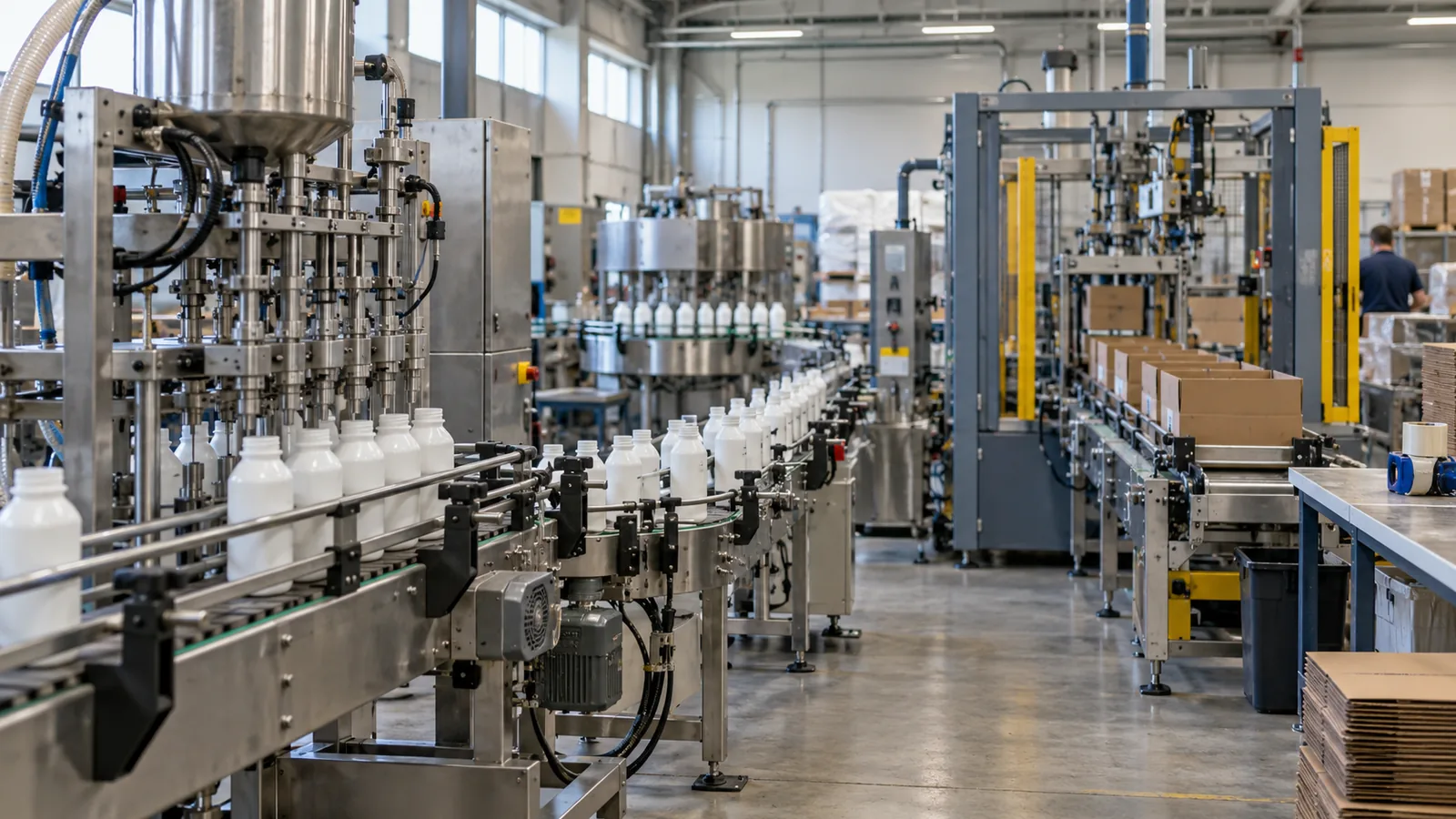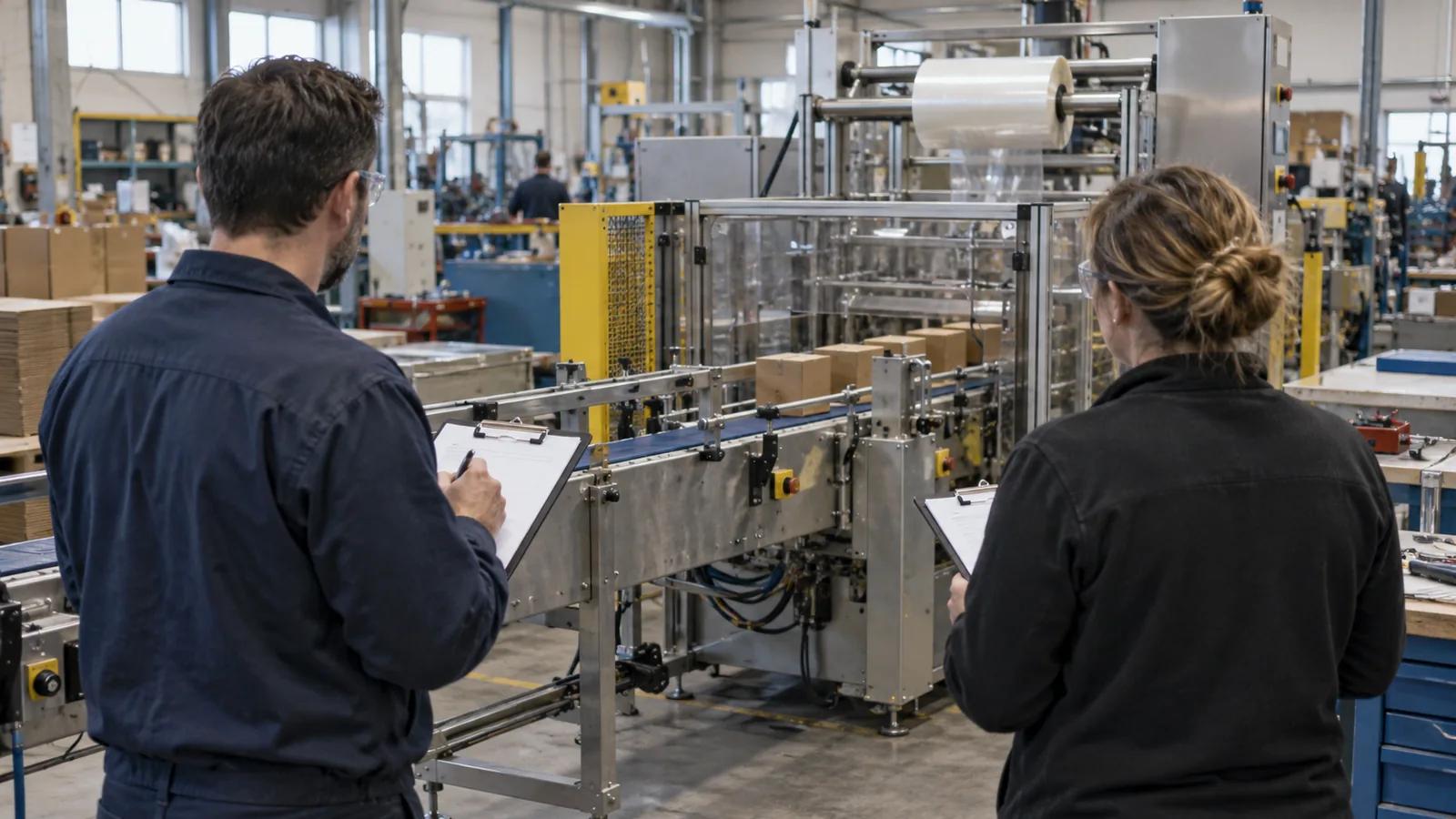
Pricing a filler against a full line wastes the comparison and leads to rework when the missing capper, labeler, or treatment plant arrives as a second invoice. A bottling machine cost is comparable only after both quotes name the same scope, and a money cell stays blank unless the saved page prints that figure for the named machine.
A bottling quote is comparable only when both offers name the same machines, and Accutek’s July 27, 2026 article puts an unnamed automatic line at five figures, minimum. That line needs a filler, a capper, a labeler, and a conveyor, plus shipping and potentially setup. King Machine joins rinsing, filling, and capping, and its CGF table prints heads, a 500 ml rate, and kilowatts with no price column. Specialty Equipment prints 100 ml to 30 L, calls capping optional, and gives Tigris, Amazon, and Scaldis separate windows and rates. Steelhead joins wash, fill, and cap on one Ultra frame. JNDWater’s 5-gallon guide names treatment, blowing, filling, labeling, packaging, and palletizing. Dollar estimates that do not sit on a model row stay on the page that printed them.
| Input or item | Typical value or source | Why it matters |
|---|---|---|
| Quote boundary | Accutek, July 27, 2026: filler, capper, labeler, and a conveyor | A filler-only offer is a different list |
| Fill window | Specialty, October 18, 2026: 100 ml to 30 L. Tigris to 30 L. Scaldis to 10 L. Amazon 1.5 to 7 gallon | The container picks the row |
| Capping | Specialty: optional, with separate capper cards. King and Steelhead: on the same frame as filling | Optional is not already in the price |
| Named-machine price | Blank | The CGF table and the Specialty cards print no dollar figure |
| Named-machine speed | Blank on the offer | A printed rate stays on the model row that shows it |
| Named-machine power | Blank on the offer | King prints kilowatts on each CGF row. The other saved pages print none for these names |
| Accuracy | Blank | Specialty prints no percentage. A project write-up is not a catalog cell |
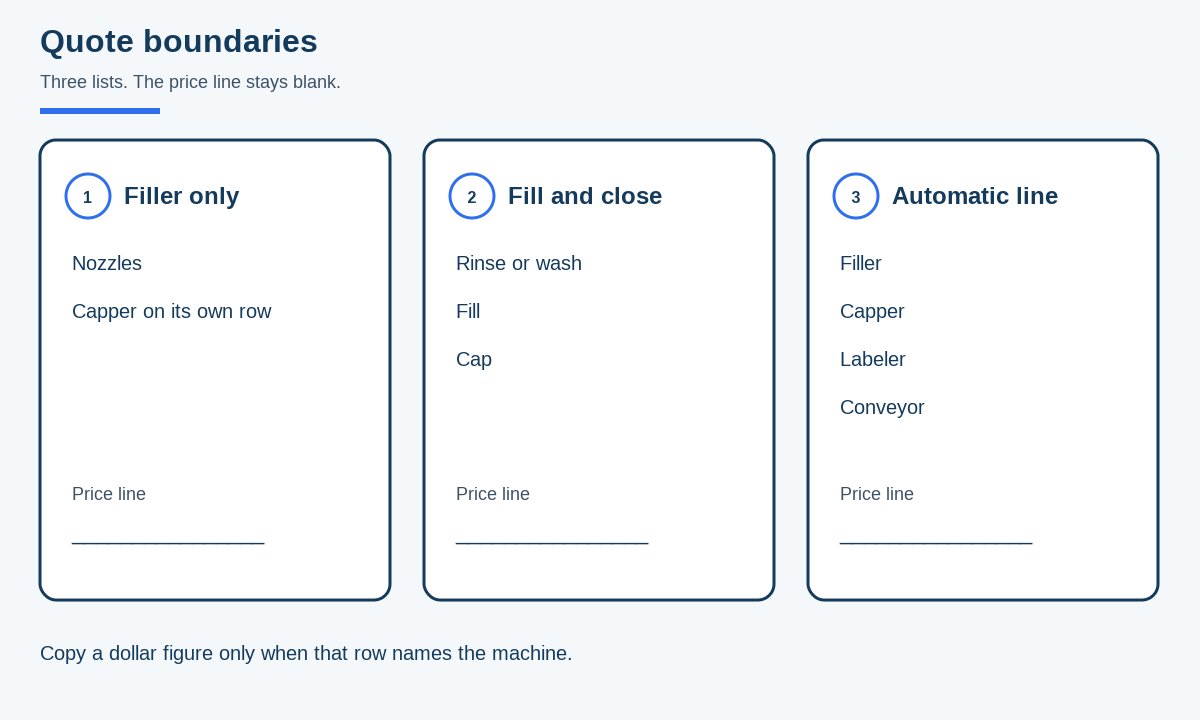
Three lists a quote can price. The price line on each list stays blank until a saved row names the machine and prints the figure.
The buying guides desk is the column for this record. When the open question is how many filling heads and capping heads share one frame, use the monoblock filling guide. This page stays with the list the offer prices.
What boundary is the quote pricing?
The boundary is the machine list. A filler, a fill-and-close group, and an automatic line are three lists, and only the matching list can sit beside another offer.
Accutek’s article, dated July 27, 2026, assumes a plant starting with no machines. A basic bottling line needs, at the very least, a filling machine, a capper, a labeler, and either a long conveyor or a series of shorter connected conveyors. The buyer pays for the machines, the shipping, and potentially setup. The article calls that likely the cheapest automatic setup aside from buying the machines used, and it separates that line from a semi-automatic tabletop arrangement. Its FAQ says semi-automatic machines can be used, and it separates that arrangement from the production rate of a completely automatic line. One FAQ item asks what a 100 bottles-per-minute line would cost and answers with a dollar estimate for rotary machinery. That estimate stays on Accutek’s page. It does not name Tigris, Scaldis, Amazon, a CGF model, or an Ultra model.
Specialty Equipment’s bottle-filling page, fetched October 18, 2026, describes fillers for lubricants, oils, personal healthcare and beauty products, sauces, and household products. The opening sentence states a window of 100 ml to 30 L, also written as 3.5 oz to 7 gallons, in 1 to 14 filling heads, up to 100 bottles per minute, for flowmeter and piston fillers. Capping systems are optional. That 100 bottles-per-minute line is the opening sentence. It is not the rate printed on a single model card below it.
King Machine’s category page defines a water filling machine as rinsing, filling, and capping for purified water, mineral water, and drinking water. A separate paragraph describes blowing, filling, and capping as one combined machine. The sales paragraph also names a bottle labeling machine for a complete line, which is outside the rinse-fill-cap definition. The FAQ lists water treatment, bottle blowing, filling, and packaging equipment in a complete bottled-water solution.
Steelhead’s page, fetched the same day, says wash, fill, and cap run from a single Ultra frame for 3–5 gallon lines. The navigation lists Ultra 75, Ultra 150, Ultra 250, and Ultra 350 as their own pages. This saved page does not print a rate beside those four names.
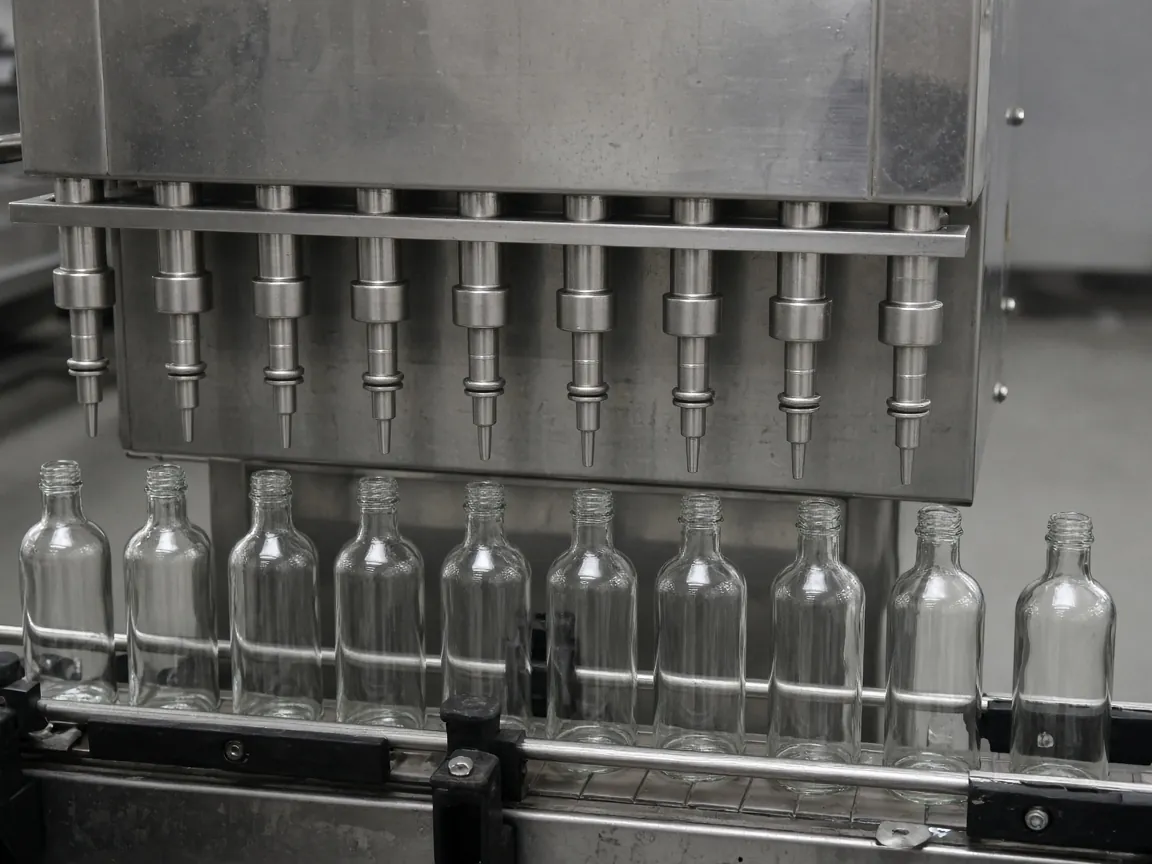
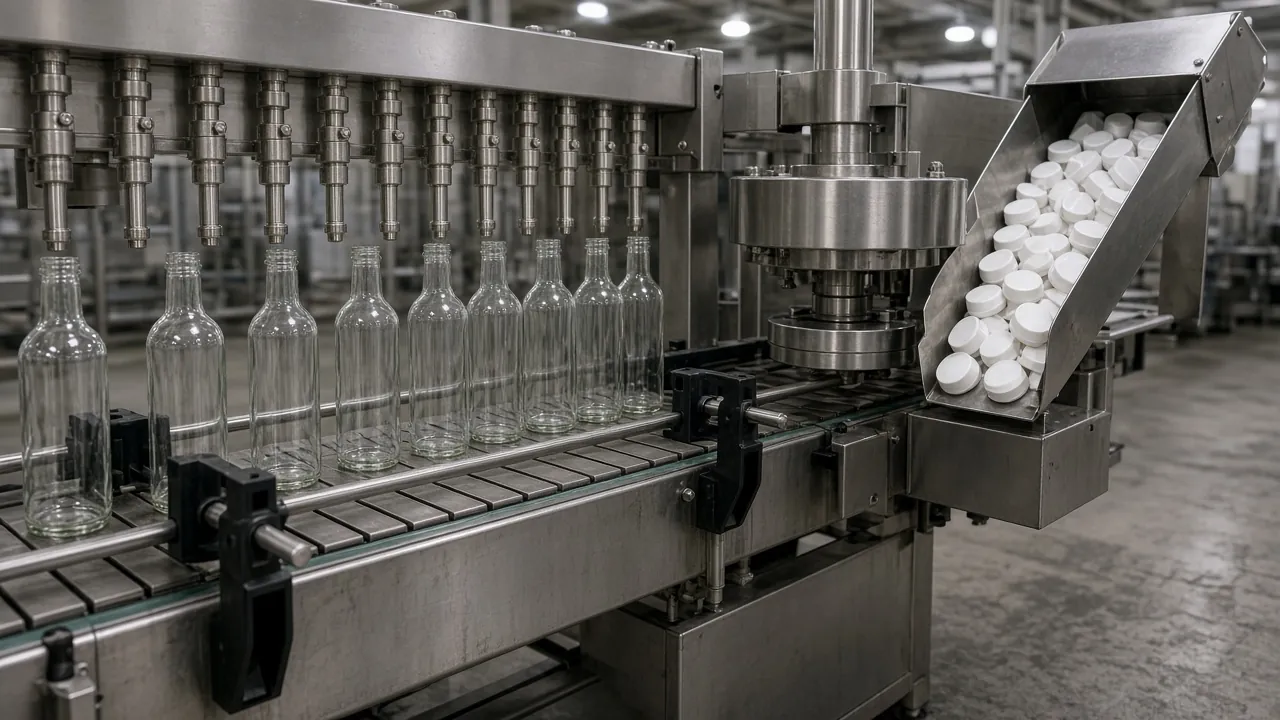
Example of fill nozzles over open bottles. The photo does not show a capper, a labeler, or a price.
Rule of thumb: If container volume exceeds 10 L, the Scaldis filler row does not cover it. Scaldis prints 100 mL (3.5 oz) to 10 L (2.5 gallons). Tigris prints 100 mL to 30 L (7 gallons). Amazon prints 1.5 to 7 gallon. Leave the money cell blank. Specialty prints no dollar figure on those cards.
Takeaway: Name the boundary in the first row of the record before any rate or watt moves across.
Which printed row belongs with the named machine?
The row is the one that prints the model name. A rate, a kilowatt, or a dollar figure stays there. The buyer cells further down stay blank until the offer names that same machine.
| Specialty name, October 18, 2026 | Window or hardware the card prints | Rate the card prints | Price |
|---|---|---|---|
| Opening sentence, not one model | 100 ml to 30 L, 1 to 14 filling heads, flowmeter and piston | Up to 100 bottles per minute | Blank |
| Tigris filler | 100 mL (3.5 oz) to 30 L (7 gallons), volumetric | Up to 1,800 bottles/hour | Blank |
| Amazon | 1.5 to 7 gallon, net weight | Up to 600 bottles/hr | Blank |
| Scaldis filler | 100 mL (3.5 oz) to 10 L (2.5 gallons), volumetric | Up to 6,000 bottles/hr | Blank |
| Scaldis capper | Star wheel, integrated cap sorter, servo driven closing head | Up to 3,000 bottles per hour/50 bottles per minute | Blank |
| Tigris capper | Integrated cap sorter and elevator, servo driven closing head | Up to 1300 bottles per hour/21 bottles per minute | Blank |
The opening sentence is not a seventh model. Do not paste “up to 100 bottles per minute” onto Tigris, Amazon, or Scaldis. Amazon is a net-weight card. Tigris and Scaldis fillers are volumetric cards. The acceptance unit for a dose belongs on the volumetric filling guide.
A paired ceiling uses only the hour figures printed for the two names on the same offer.
paired ceiling (bottles/hour) = min(filler bottles/hour, capper bottles/hour)
Worked example. The Tigris filler prints up to 1,800 bottles/hour. The Tigris capper prints up to 1300 bottles per hour. min(1800, 1300) = 1300. The filler ceiling does not replace the capper ceiling. The same capper line also prints 21 bottles per minute. 1300 divided by 60 does not equal 21, so this page does not pick a third number. The Scaldis capper is the contrasting case: 3000 / 60 = 50, and the card prints 50 bottles per minute. Those two Scaldis numbers agree. Specialty still prints no dollar figure, so both money cells stay blank.
King Machine labels the next table “Partial Products Main Technical Parameter.” Product titles elsewhere on the page, including names that are not in this table, stay on those titles.
| Model | Washing heads | Filling heads | Capping heads | Production | Power | Price |
|---|---|---|---|---|---|---|
| CGF14-12-4 | 14 | 12 | 4 | 4000B/H (500ml) | 3kw | Blank |
| CGF18-18-6 | 18 | 18 | 6 | 8000B/H (500ml) | 3kw | Blank |
| CGF24-24-8 | 24 | 24 | 8 | 8000B/H (500ml) | 5kw | Blank |
| CGF32-32-10 | 32 | 32 | 10 | 15000B/H (500ml) | 6kw | Blank |
| CGF50-50-12 | 50 | 50 | 12 | 20000B/H (500ml) | 11kw | Blank |
| CGF72-72-15 | 72 | 72 | 24 | 42000B/H (500ml) | 18.5kw | Blank |
| CGF100-100-20 | 100 | 100 | 30 | 60000B/H (500ml) | 22kw | Blank |
Every production cell is marked (500ml). A 5-gallon bottle is outside that parenthetical. The same table prints a weight and an overall dimension on every row. Those strings are not prices, and they are not copied here.
CGF72-72-15 prints 24 capping heads. The model string ends in 15 and the capping cell prints 24. Leave the buyer cap-head cell blank until the offer chooses one of those two printed numbers. Do not average 15 and 24.
Head count is not a rate. On CGF14-12-4, filling heads / capping heads = 12 / 4 = 3. The page does not print the seconds those four capping heads need, so that time stays blank. The same row prints 4000B/H (500ml) and 3kw. CGF18-18-6 also prints 3kw, with 8000B/H (500ml). The shared 3kw does not move the 4000 rate across. CGF24-24-8 prints the same 8000B/H (500ml) with 5kw. The shared rate does not make the power equal.
JNDWater’s 5-gallon guide, fetched October 18, 2026, prints no separate article date in the body used here. Its type bands are for 5-gallon machines, not for the CGF 500 ml cells.
| Type name on that guide | Rate band printed | Price |
|---|---|---|
| Semi-automatic machines | Under 100 bottles per hour | Blank |
| Fully automatic linear fillers | 200-500 bottles per hour | Blank |
| Rotary automated systems | 500-1500+ bottles per hour | Blank |
| Dual-channel configurations | 3-gallon and 5-gallon on one platform. No rate in that paragraph | Blank |
The linear band ends at 500 and the rotary band starts at 500. An offer that only says 500 bottles per hour has not chosen a type. JNDWater’s price section prints a dollar range, percentage comparisons, and a payback window. No model name sits on those lines. Those figures stay on that page.
Steelhead’s body prints two bands that are not tied to Ultra 75, Ultra 150, Ultra 250, or Ultra 350: single-operator systems at 75-250+ BPH, and high-speed lines at 600-1200 BPH. The price cell for each Ultra name stays blank because this page does not print one. The page does print a 24 month warranty on every system, and it lists installation, manuals, parts, and support in the same partner sentence as the machines.
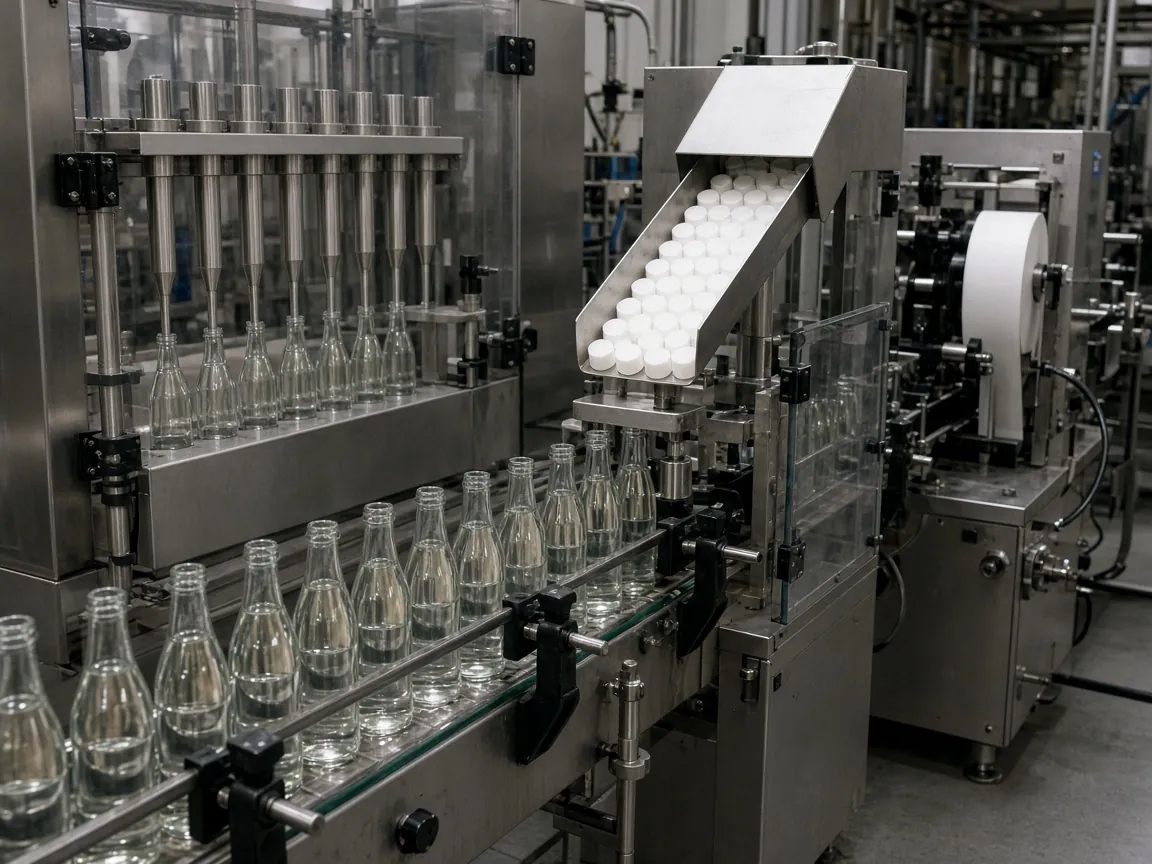
Example of nozzles, a cap chute, and a label roll on one conveyor. The photo does not name the machines in a quote.
Common mistake: Pasting 8000B/H (500ml) from CGF18-18-6 onto CGF24-24-8 and keeping 3kw, or pasting Accutek’s unnamed estimate into a CGF price cell. The rate, the kilowatts, and the absent price each stay on their own row.
Takeaway: Transcribe the window, the rate, and the power from the same model row, and leave price blank when that row has no dollar figure.
Which failure shows up when a row is assumed?
The failure is a station or a figure the order treated as included. The prevention is the sentence on the page you are holding, written onto the offer before the second invoice shows up.
| Scope someone assumed | Dominant failure mode | Prevention on the saved page |
|---|---|---|
| Filler priced as the automatic line | The capper, labeler, and conveyor arrive as rework | Accutek names those four items as the minimum. Write each included or absent |
| Capping treated as included on a Specialty-style offer | Bottles leave open | The page says capping systems are optional and prints separate capper cards |
| Model suffix used as the cap-head count | CGF72-72-15 is built or quoted with 15 capping heads | The cell prints 24. Leave the buyer cell blank until the offer chooses |
| 3kw copied across every 3kw row | CGF14-12-4’s 4000B/H (500ml) is treated as CGF18-18-6 | Both rows print 3kw. The rates differ. Keep each pair together |
| Water treatment or bottle blowing on an oil filler | A plant the Specialty page does not name is in the price | King, JNDWater, and Steelhead name treatment for water. Specialty’s liquid list does not |
| A 500 ml CGF rate used for a 5-gallon bottle | The line is planned on the wrong container | Every CGF production cell prints (500ml). JNDWater’s bands are the 5-gallon types |
A whole-machine trial of the named row belongs on the FAT checklist. A printed ceiling is not the accepted output until that record exists.
Takeaway: Write included, optional, or absent for each station, and keep a disagreeing pair of numbers unresolved.
Which costs are one-time, ongoing, or conditional?
Sort the named item before the two offers sit side by side. The class comes from the way these pages talk about the item. The amount stays blank.
Accutek’s hidden-factors section says the sticker price is not the final one and uses the words total cost of ownership for costs after the machine is in place. The examples are labor, parts sourcing, and downtime when a cheaper machine breaks, plus a service warranty, training, later service calls, and cleaning so the product is not contaminated. The FAQ names customizations, training, installation, and possible later maintenance and repair. Shipping is named with the machines. Setup is named as potentially setup. The recoup answer names the business, what it sells, how much of it, and how quickly, and it prints no formula. This page adds none.
Steelhead puts installation, manuals, parts, and support in the same partner list as machines, supplies, water treatment, and robotics. The 24 month warranty is a duration on that page, not a dollar figure. JNDWater’s price-factor list names automation level, production capacity, materials of construction, component quality, and customization. It says 316L stainless steel increases cost, and it names Siemens and Mitsubishi as examples of components that also increase cost. The extra features it names are CIP, nitrogen flushing, and dual-container operation for 3-gallon and 5-gallon bottles. Specialty’s page lists “Clean-In-Place Functionality” under the filler group, and Steelhead’s accessory menu lists clean-in-place systems as their own item. An offer still has to say whether CIP is included.
Water treatment, bottle making, nitrogen flushing, and dual-container operation show up on the water pages. Specialty’s page, for the liquids it names, does not list them. Leave those rows conditional.
Who owns the handoff between machines is a different record. Use the packaging line specification for that owner. This page keeps the spend class.
Open rows on Accutek’s minimum list are the arithmetic of the boundary, not a price.
open rows = 4 - 1
Worked example. Accutek’s minimum automatic line names four machines: filler, capper, labeler, and a conveyor. An offer that names only the filler shares 1 of those 4. open rows = 4 - 1 = 3. Those three rows are still open, so the offers are not the same boundary. Both money cells stay blank. Do not fill them with Accutek’s unnamed estimates.
Takeaway: Mark the class from the page that named the item, and leave the amount for a row that actually prints it.
What goes on the two-offer record?
Use one row per item. A blank cell means the document in front of you has not answered it. “Blank” in the tables above means the public page did not print that figure for the named machine.
| Item | Class on the pages above | Offer A | Offer A document | Offer B | Offer B document |
|---|---|---|---|---|---|
| Boundary: filler, fill and close, or automatic line | Set this before the other rows | ______ | ______ | ______ | ______ |
| Product and container, including the fill window | Specialty cards differ. JNDWater’s dual-container note is 3 gallon and 5 gallon. CGF rates are (500ml) | ______ | ______ | ______ | ______ |
| Named model | One-time, only when the offer prints the name | ______ | ______ | ______ | ______ |
| Price for that model | Blank until that row prints a dollar figure | ______ | ______ | ______ | ______ |
| Speed for that model | Blank until that row prints a rate | ______ | ______ | ______ | ______ |
| Power for that model | Blank until that row prints kilowatts or another power unit | ______ | ______ | ______ | ______ |
| Accuracy | Blank. No percentage on the Specialty cards or the CGF table | ______ | ______ | ______ | ______ |
| Capping | One-time. Conditional where Specialty calls it optional | ______ | ______ | ______ | ______ |
| Labeling | One-time on Accutek’s basic line. Separate from King’s rinse-fill-cap definition | ______ | ______ | ______ | ______ |
| Conveyor or turntable | One-time on Accutek’s basic line. A turntable is an extra there | ______ | ______ | ______ | ______ |
| Rinse or wash | Conditional. Named for King Machine water machines and Steelhead’s Ultra frame | ______ | ______ | ______ | ______ |
| Bottle making | Conditional. Named when the page includes blowing | ______ | ______ | ______ | ______ |
| Water treatment | Conditional. Drinking-water pages only | ______ | ______ | ______ | ______ |
| Nitrogen flush or CIP | Conditional. Named on JNDWater’s feature list. Specialty lists CIP as a group line | ______ | ______ | ______ | ______ |
| Shipping, setup, installation, training | One-time where Accutek or Steelhead names them | ______ | ______ | ______ | ______ |
| Service, parts, cleaning, warranty | Ongoing. Accutek’s total-cost examples, Steelhead’s parts and support, 24 month warranty | ______ | ______ | ______ | ______ |
If the liquid is one of Specialty’s named products and the question is how the sample behaves, use the viscous-liquid guide and keep that behavior out of the price cells. Layout, straight or circular, stays on the rotary filling systems guide. JNDWater’s rotary band is a 5-gallon type name, not a layout method.
Common mistake: Treating a 5-gallon water plant and a small-bottle oil filler as one price range because both pages say bottling. Write the product and the container on the second row, then compare only the rows both offers name.
Takeaway: Leave each offer cell blank until that offer names the item, the option, or the absence.
When this does not apply
Capsule filling, including the question about a semi-automatic capsule filler, is outside this record. The pages read here are liquid bottle and water-plant pages.
A company startup budget, including profit and the cost of starting a water bottling business, is outside this record. Accutek’s recoup answer prints no formula, and this page adds none.
Drinking-water regulations are outside this record. JNDWater’s Hong Kong write-up mentions drinking-water standards, and Steelhead’s page says its equipment is built to meet FSMA requirements and ANSI 169 sanitation standards. This guide uses those pages for the equipment list and leaves the legal reading on the standards.
The station count inside one frame stays on the monoblock filling guide. This page does not turn a fill-and-close group into a head count.
Takeaway: Use the boundary table and the blank record for two liquid-bottling offers that can be lined up on the same product and container.
Method and sources
Fetched October 18, 2026. The October 11, 2026 cached SERP for “how much does a bottling machine cost?” is the ranking list used for contrast. Marketplace and listing pages in that SERP print asking prices. Those prices are not specifications for the named machines below, and they are not copied here. Statements attributed to a manufacturer are that manufacturer’s description of its own page. The boundary classes, the blank record, and the decision to leave a money cell empty are editorial. See the editorial evidence policy.
- Accutek, “The Cost of an Automatic Bottling Line,” dated July 27, 2026, fetched October 18, 2026. Used for the four-machine minimum, shipping and potentially setup, the extra machines, the total-cost examples, the semi-automatic distinction, and the phrase “five figures, minimum.” Dollar estimates on that page, including the answer to the 100 bottles-per-minute question, are not copied. The library copy fetched October 6, 2026 agrees on that scope.
- King Machine, water filling machine category, fetched October 18, 2026. Used for the rinse-fill-cap definition, the blowing-filling-capping paragraph, the separate labeling sentence, the FAQ list, and the partial CGF table, including CGF72-72-15 with 24 capping heads. Weights, dimensions, and product titles outside that table are not copied.
- Specialty Equipment, bottle filling systems, fetched October 18, 2026. Used for the product list, the opening window and the 1 to 14 heads line, the Tigris, Amazon, and Scaldis cards, optional capping, and the two capper cards. Amazon now prints 1.5 to 7 gallon and up to 600 bottles/hr. No dollar figure is printed on these cards.
- Steelhead, 5-gallon bottling equipment page, fetched October 18, 2026. Used for wash, fill, and cap on one Ultra frame, the 3–5 gallon heading, the two body rate bands, the 24 month warranty, the partner list, and the separate Ultra model links that do not print rates on this page. Customer counts are not used.
- JNDWater, 5-gallon water filling guide, fetched October 18, 2026. Used for the plant components, the four type names and their rate bands, the price-factor names, the 316L and Siemens or Mitsubishi sentences, and the dual-container note. The dollar range, the percentages, the payback window, and the Hong Kong project measurements are not copied.
Related reading
Line up the two offers on the record, then continue with the page that answers the next question:
- Buying guides: the column this budget page belongs to.
- Monoblock filling machines: count filling heads and capping heads when the quote is one frame.
- Packaging line specification: assign the handoffs this cost record does not cover.
- Volumetric filling machines: keep the dose unit out of the price cells.
- Packaging machinery FAT checklist: carry the named row into a trial record.