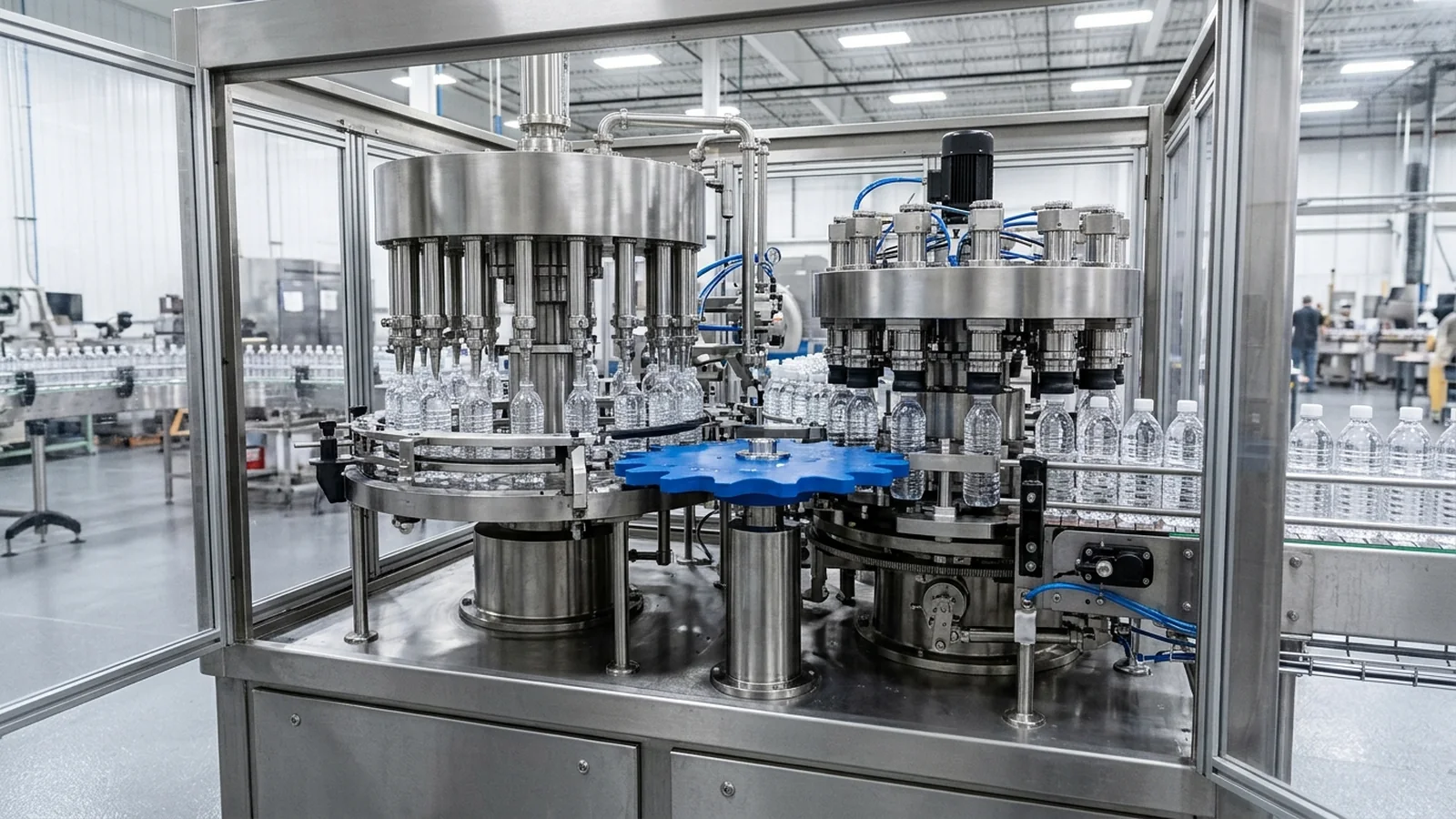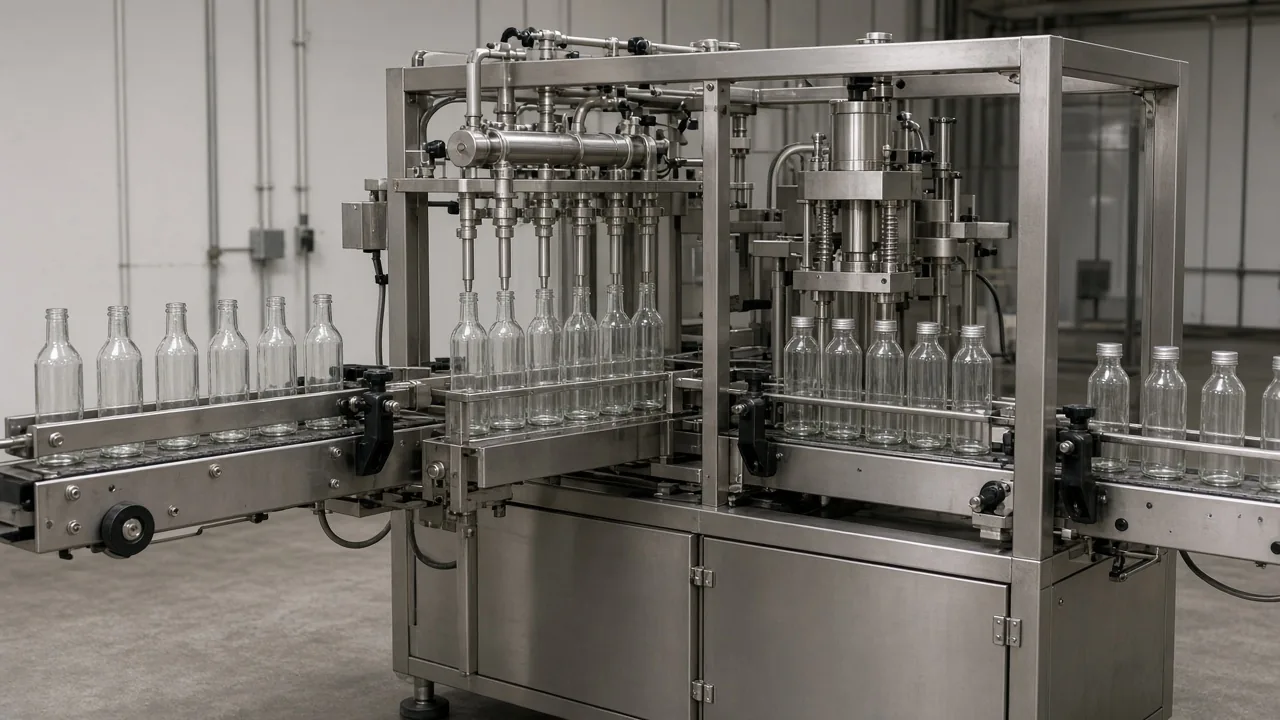
A monoblock filling machine combines bottle filling and closure application on a single unified frame. Auxiliary stations—such as plug or stopper insertion, air or nitrogen purging, integrated labeling, and driven turntables—vary widely across models and manufacturers. Treat those stations as separate line-item checks in every supplier quotation rather than assuming they ship with the core fill-and-cap chassis.
Browse the machine catalog and the filling and bottling section to compare monoblock designs with standalone filling methods.
What is a monoblock filling machine?
In liquid packaging, a monoblock filling machine consolidates at least two synchronized packaging operations—almost always liquid filling and capping—onto one mechanical base. Consolidating those stations eliminates exposed transfer conveyors between filling and sealing, reduces floor-space requirements, and simplifies container synchronization at higher speeds.
Across industrial equipment builders, the term covers both compact two-station filler-cappers and broader multi-station frames:
- Paxiom / WeighPack offers a double-step monoblock liquid bottle filling and capping system rated up to 80 bottles per minute on a single frame.
- Adinath builds monoblock liquid filling and capping units (including its AMBF series) in both linear and rotary carousel-style layouts where bottles travel through filling and sealing stations inside one unified machine.
- Filamatic defines a monobloc as a fully automated, integrated liquid filling machine capable of combining multiple operations—filling, capping, stoppering, over-capping, and labeling—depending on line requirements.
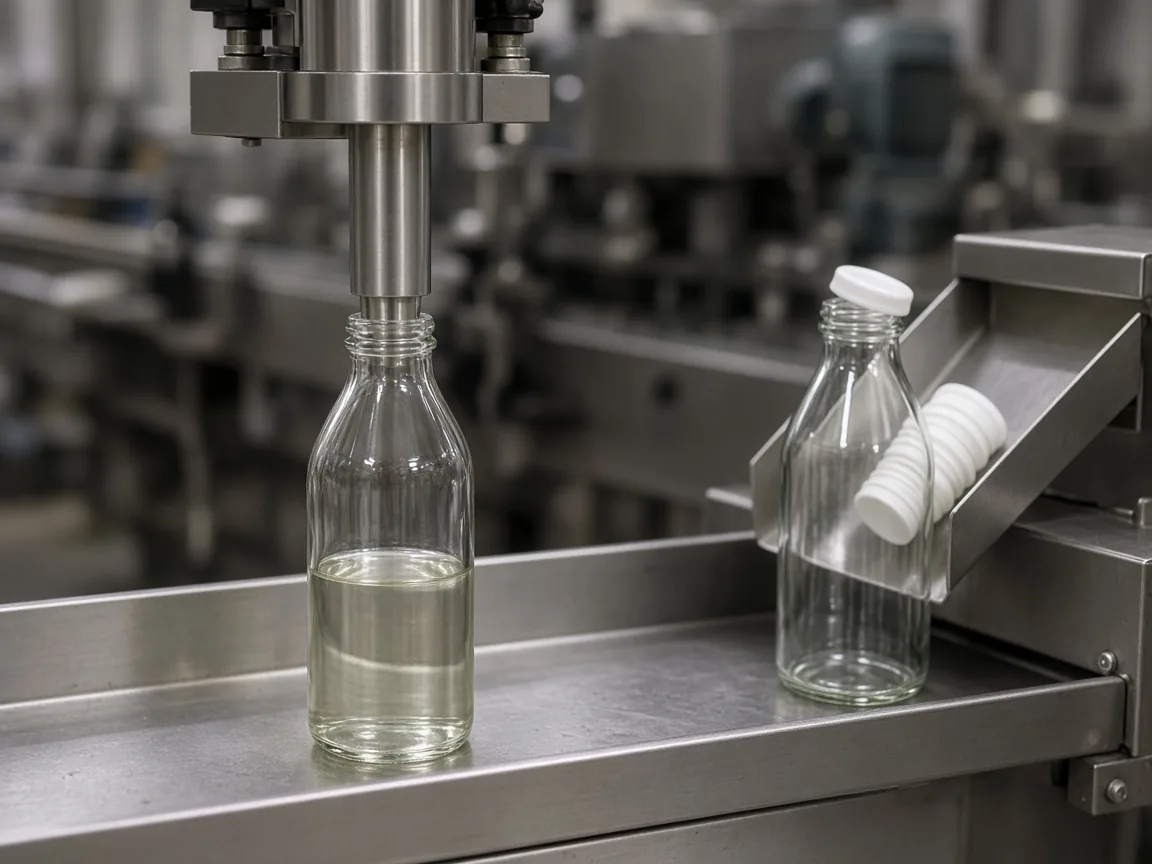
Filling nozzles and closure placement operate as synchronized stations on the same frame.
For circular turret transport and indexing mechanics, see the guide to rotary filling systems.
What does a filling machine do before capping and labeling?
In a standard bottling line, product is drawn from a holding tank and metered into empty containers at the filling station before containers proceed to capping, labeling, and case packing. On oxygen-sensitive beverage or pharmaceutical lines, the filler may also inject a small dose of inert gas—commonly nitrogen or carbon dioxide—into the container headspace right before capping to displace oxygen.
Once sealed, containers move to labeling. In regulated pharmaceutical manufacturing, 21 CFR 211.130 requires written procedures ensuring that correct labels, labeling, and packaging materials are used for drug products. Paragraph (b) specifically governs the identification and handling of filled containers held in unlabeled condition before downstream labeling so individual containers, lots, or partial lots are not mislabeled—an important operational factor when choosing between an integrated fill-cap-label monoblock and a separate downstream labeler.
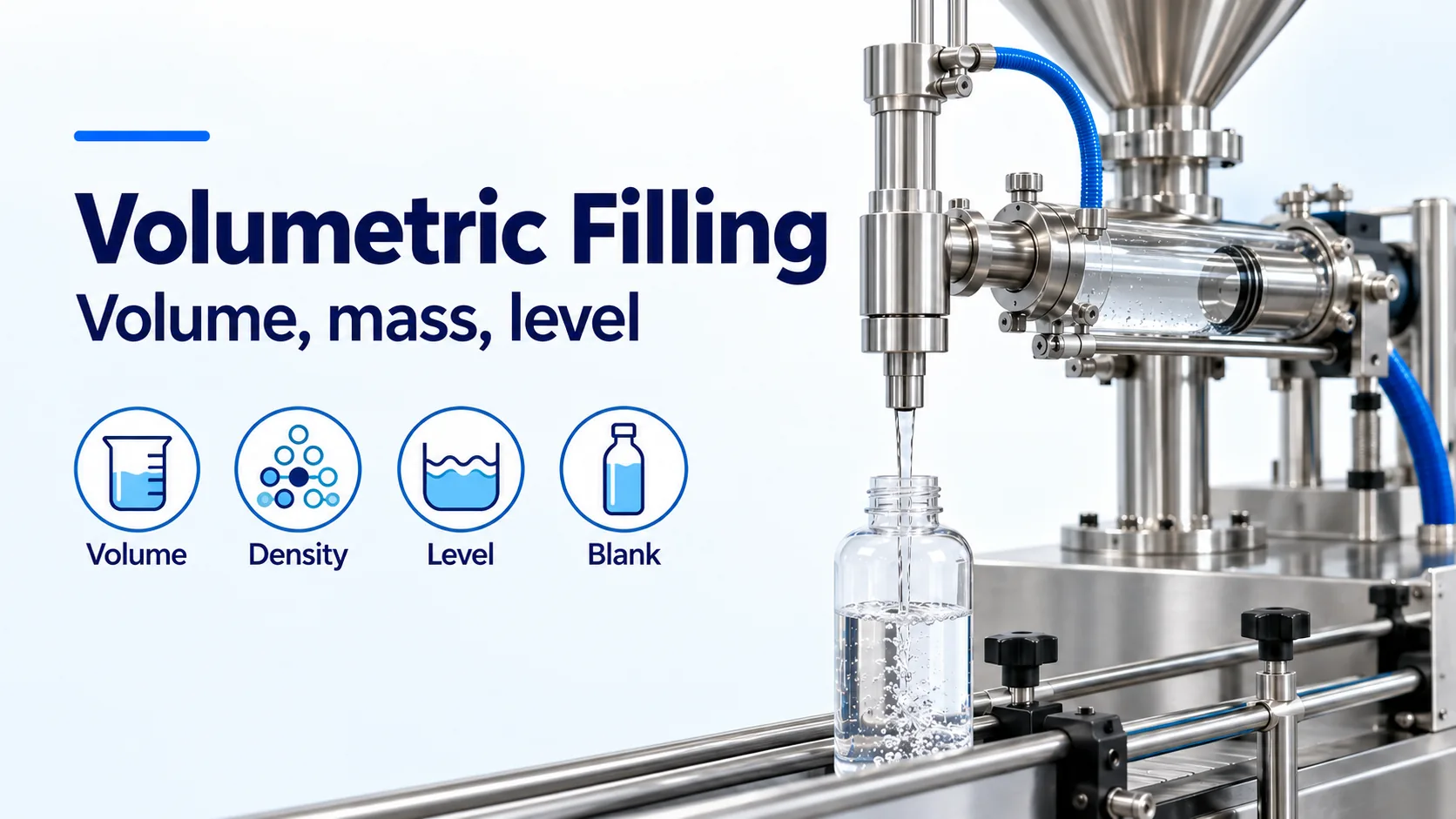
For how volumetric dosing compares with checkweighing and fill-level inspection, review the volumetric filling measurement guide.
Standard vs. optional stations on a monoblock filling machine
Filling and capping form the baseline across nearly all monoblock liquid machines, whereas plug insertion, gas purging, labeling, and rotary accumulation tables depend on container closure design and line layout. Comparing representative manufacturer configurations shows where standard scope ends and optional engineering begins:
| Station / Function | Paxiom / WeighPack Monoblock | Adinath AMBF Series | ZONESUN Integrated Monoblock |
|---|---|---|---|
| Filling | Standard, up to 80 bottles/min | Standard; 2, 4, or 8 filling heads (up to 120 bottles/min depending on configuration) | Standard, synchronized with capping and labeling |
| Capping | Standard; double closing head for plastic or aluminum caps | Standard; 1 or 4 capping heads for ROPP/screw caps (rotary builds also support droppers and pumps) | Standard, paired with filling and labeling |
| Plug or stopper insert | Optional (dropper or rubber-stopper insertion device on request) | Optional / closure-dependent (rotary models accommodate droppers and pumps; confirm plug station in quote) | Optional; confirm in RFQ |
| Air or nitrogen purge | Optional (blowing and/or nitrogen purging stations on request) | Optional; confirm in RFQ | Optional; confirm in RFQ |
| Labeling | Downstream by default (confirm if integrated labeler is required) | Downstream (filled and capped bottles exit ready for labeling or packing) | Included on integrated fill-cap-label configurations |
| Conveyor and feed | Standard; infeed and outfeed belts driven by a single motor | Standard stainless slat conveyor (850–900 mm height); infeed/outfeed turntables available with individual drives | Confirm conveyor layout and drive scope in RFQ |
Paxiom / WeighPack monoblock configuration
The Paxiom / WeighPack monoblock pairs a double-step filling station with a double closing head built for plastic or aluminum caps. Buyers needing inner plugs or controlled headspace can add a dropper or rubber-stopper insertion device as well as air-blowing or nitrogen-purging stations on request. The chassis uses an aluminum core clad in stainless steel panels, and a single motor drives both the infeed and outfeed stainless conveyor belts with adjustable container guides.
Adinath AMBF monoblock configuration and GMP construction
Adinath’s AMBF monoblock platform combines a stainless steel base frame, piston or syringe dosing pumps, filling needles, and a stainless steel slat conveyor into a compact single-operator unit. Depending on liquid viscosity and container geometry, rotary builds can be configured with volumetric, piston, flow meter, gravity, or peristaltic filling heads, along with diving nozzles for foam-free filling and “No Bottle – No Filling / No Capping” interlocks.
All liquid-contact parts are fabricated from AISI 316 stainless steel with quick-removal access for cleaning, while the exterior machine structure uses AISI 304 stainless steel for GMP-compliant pharmaceutical, food, and cosmetic environments. For regulated drug products, FDA CGMP regulations under 21 CFR Part 211 establish minimum controls for manufacturing, processing, and packing facilities, and 21 CFR 211.113 requires validated written procedures for aseptic and sterilization processes whenever a product purports to be sterile.
For liquid rheology and nozzle selection across thin and viscous formulations, see the viscous-liquid filling guide.
ZONESUN fill-cap-label monoblock scope
When floor space is tight or containers are unstable on long transfer conveyors, multi-station monoblock designs—such as ZONESUN’s integrated filling, capping, and labeling architecture—bring labeling directly onto the synchronized frame. Combining all three operations minimizes manual container handling between sealing and labeling, which supports higher line efficiency and stricter contamination control in pharmaceutical and personal-care production.
How do filling-head and capping-head counts differ by model?
Throughput scales primarily with the number of filling heads and capping heads on the turret or indexing rail, though capping head count does not always rise one-to-one with filling head count. Comparing the three standard Adinath AMBF models illustrates how head counts, motor power, and floor footprint scale across output tiers.
Example specification matrix: Adinath AMBF 2, AMBF 4, and AMBF 8
| Specification | AMBF 2 | AMBF 4 | AMBF 8 |
|---|---|---|---|
| Baseline production output | Up to 30 bottles/min | Up to 60 bottles/min | Up to 100 bottles/min |
| Filling heads | 2 | 4 | 8 |
| Capping heads | 1 | 1 | 4 |
| Bottle diameter | 25 mm to 85 mm | 25 mm to 85 mm | 25 mm to 85 mm |
| Capping type | ROPP / Screw | ROPP / Screw | ROPP / Screw |
| Cap size | 18 mm to 55 mm | 18 mm to 55 mm | 18 mm to 55 mm |
| Standard filling range | 15–120 ml or 30–250 ml | 15–120 ml or 30–250 ml | 15–120 ml or 30–250 ml |
| Syringe fill range | 15–120 ml, 30–250 ml, or 250–500 ml | 15–120 ml, 30–250 ml, or 250–500 ml | 15–120 ml, 30–250 ml, or 250–500 ml |
| Fill accuracy | ±1% depending on liquid (single dose) | ±1% depending on liquid (single dose) | ±1% depending on liquid (single dose) |
| Electrical supply | 440 VAC 3-phase / 220 VAC 1-phase (50 Hz) | 440 VAC 3-phase / 220 VAC 1-phase (50 Hz) | 440 VAC 3-phase / 220 VAC 1-phase (50 Hz) |
| Drive power | 2.5 HP | 4 HP (2.5 HP on select configurations) | 5.5 HP |
| Conveyor height | 850–900 mm adjustable | 850–900 mm adjustable | 850–900 mm adjustable |
| Overall dimensions (L × W × H) | 2,200 × 950 × 1,550 mm approx. | 2,600 × 1,250 × 1,550 mm approx. (2,400 mm L on compact build) | 3,500 × 1,250 × 1,550 mm approx. |
| Approximate floor footprint | 2.09 m² | 3.25 m² (3.00 m² on 2,400 mm build) | 4.38 m² |
The main drive uses an AC motor and gearbox regulated by an AC variable frequency drive (VFD), paired with a hollow-shaft conveyor drive. Because monoblock frames rely on synchronized starwheels, guides, and capping chucks for fast changeover, confirm tooling scope early using the monoblock filler-capper changeover guide.
Why catalog specs vary across AMBF configurations—and what to verify
Published specifications for a single monoblock family frequently vary across linear, rotary, and regional configurations, so treat catalog figures as reference baselines until the supplier issues a certified general-arrangement drawing and proposal:
- Rated output vs. real line speed: While the baseline AMBF table rates AMBF 2, 4, and 8 at up to 30, 60, and 100 bottles/min, alternative AMBF listings cite 30–60 bottles/min for AMBF 2, 60–100 bottles/min for AMBF 4, and up to 120 bottles/min maximum across round, oval, flat, or square bottles. Actual throughput always depends on liquid viscosity and foaming behavior, bottle diameter and height, neck opening, and target fill volume.
- Fill-volume envelope: General rotary application notes mention bottles from 5 ml to 1,000 ml, whereas standard syringe assemblies stop at 250–500 ml. Any project outside 15–500 ml requires written confirmation of pump displacement and cycle speed.
- Power, footprint, and turntables: AMBF 4 appears in manufacturer listings at either 2.5 HP or 4 HP and with an overall frame length of either 2,400 mm (3.00 m²) or 2,600 mm (3.25 m²). Adding optional infeed and outfeed turntables with individual drives, operator access aisles, and 1,550 mm machine height clearance further expands the required bay area beyond the bare chassis footprint.
- Accuracy and compliance verification: The published ±1% single-dose fill accuracy is liquid-dependent. Buyers shipping packaged goods into regulated markets should tie factory acceptance testing to NIST Handbook 133-2026 net-content compliance procedures, and pharmaceutical lines must establish statistically grounded in-process specifications consistent with 21 CFR 211.110.
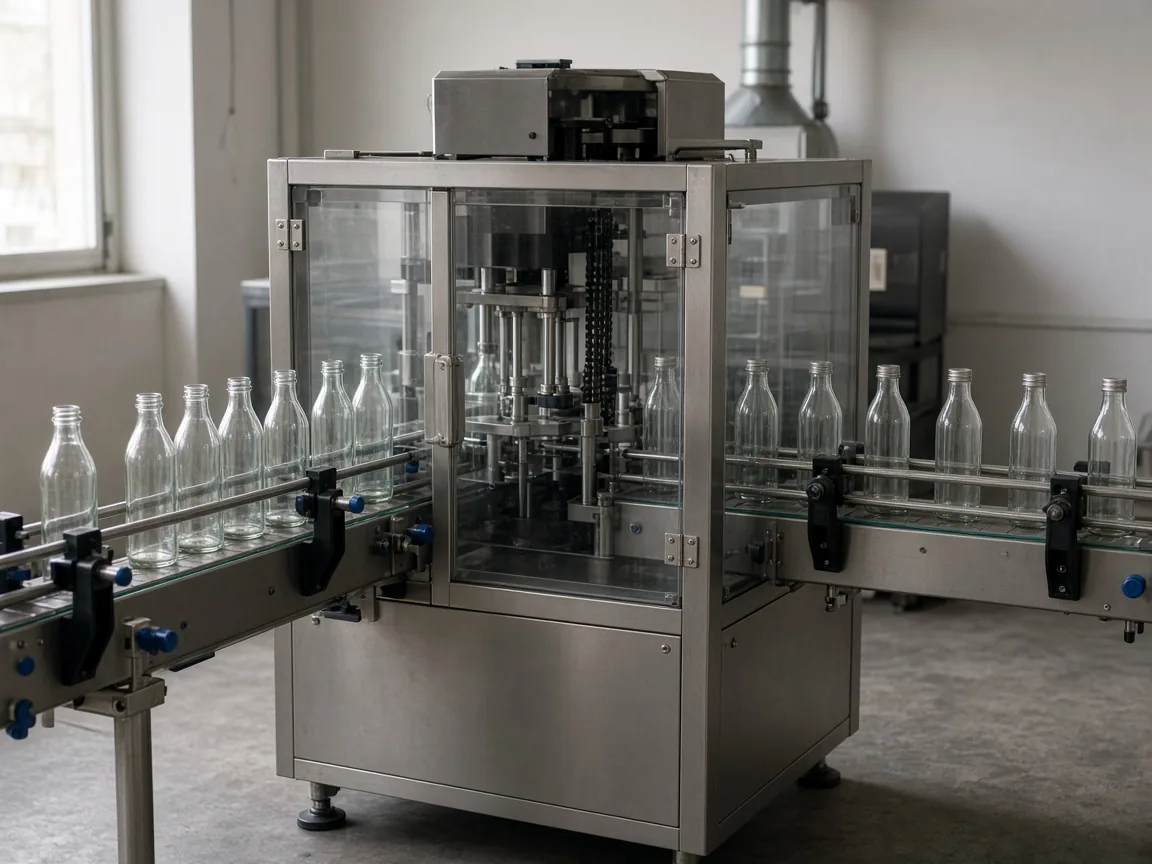
Open bottles enter on the infeed conveyor and exit capped on the outfeed belt.
What should the supplier confirm on this frame?
Before signing off on a monoblock purchase order, confirm both station scope and safety guarding in writing. Under OSHA 1910.212, machine guarding—such as interlocked barrier enclosures, two-hand controls, or electronic safety devices—must protect operators from point-of-operation hazards, ingoing nip points, and rotating assemblies so no part of an operator’s body can enter the danger zone during operation. Revolving drums, barrels, or container turrets must be enclosed by guards interlocked with the drive mechanism so rotation stops if a door is opened.
Use the checklist below to lock down scope across competing monoblock quotes:
| Station / Function | What to confirm in the supplier quote |
|---|---|
| Filling | Exact pump principle (piston, peristaltic, flow meter, gravity), filling-head count, and verified output for your liquid viscosity and fill volume |
| Capping | Supported closure types (screw, ROPP, press-on, dropper, pump), capping-head count, and torque-control method |
| Plug or stopper insert | Whether dropper, inner plug, or rubber-stopper insertion is included on the frame and whether vibratory feeders are supplied |
| Purge | Whether air-rinsing, ionized air blowing, or nitrogen headspace purging stations are included |
| Labeling | Whether labeling is integrated on the monoblock chassis or handled by a separate downstream machine |
| Conveyor and feed | Whether one motor drives both conveyors, conveyor height range, and whether individually driven infeed/outfeed turntables are included |
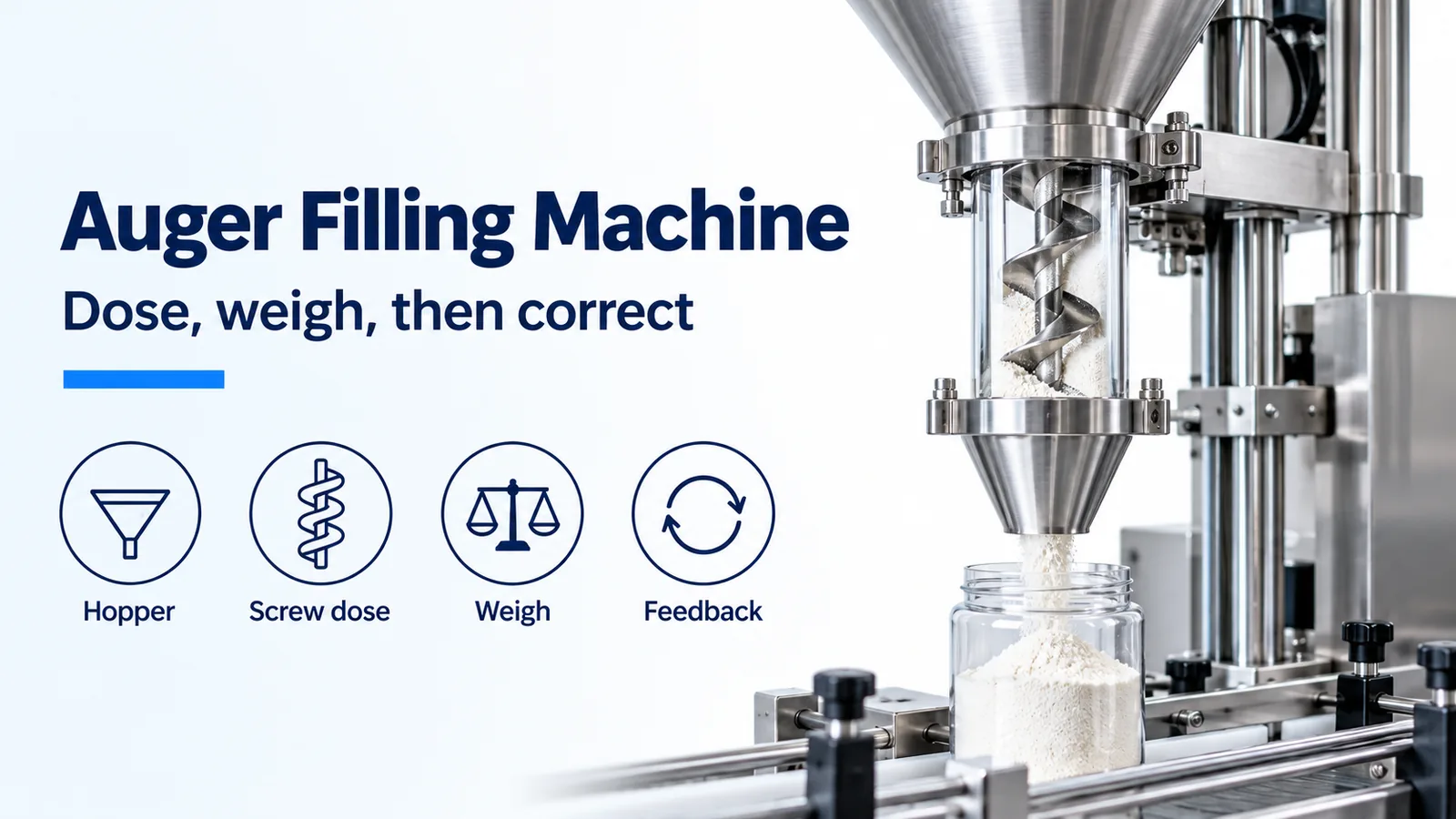
For upstream and downstream equipment boundaries across a full bottling room, see the complete packaging line specification. If your project doses dry powders rather than liquids, review the auger filler dosing and weight verification guide.