A buyer who treats the screw setting as weight verification can accept a line that only rejects packs, then pay for rework when later doses never change. An auger filling machine doses dry powder or granules by turning a helical screw inside a tube under a hopper. The weight check and any correction of later doses are separate functions, and a figure stays blank when the saved page does not print it.
An auger filling machine is a dosing machine for powders and granules: product flows from a hopper into a rotating screw, and the screw’s turning delivers a quantity into the container below. That setting commands a dose; it does not, by itself, measure the dose. Whether the pack is then weighed, where, on what basis, and whether a reading rejects the pack or changes later doses are configuration questions. This guide provides a function-evidence matrix, a comparison of what public supplier pages state, and a same-material demonstration record.
| Input or item | Typical value or source | Why it matters |
|---|---|---|
| Dose command | Wolf, 24 April 2026: a helical screw in a tube moves a controlled volume. Bulk density sets how much product fills each flight. | The setting tells the screw how to turn. It does not read the pack. |
| Weight verification | NIST Handbook 133 (2026), introduction: net weight is the commodity exclusive of wrapping materials. The handbook tests the finished package against the declared net content. | A jar-on-scale reading still needs a tare before it is net product. |
| Feedback | All-Fill, 22 August 2018: checkweighers are sold with and without feedback. In the cited example, a trend signal adjusts auger revolutions. | A reject station and a dose correction are different purchases. |
| Accept window in one cited example | All-Fill, same article: a 454 g fill, low 454 g, high 458 g, on a servo auger model SHA-SV-600 with a PW-12 checkweigher. | Those grams belong to that example. They are not an accuracy percentage. |
| Straight-auger overall length | All-Fill accessories page, 8 April 2014: straight augers 13-1/8 in overall length, used with a straight funnel 5-9/16 in overall length, for free-flowing powders such as granulated sugar, salt, and bread crumbs. | Lengths printed for that tooling style. Auger diameter is not printed, so diameter stays blank. |
| Fill speed | Blank | Wolf’s page prints catalogue speed sentences. They do not name this powder and pack, so they are not copied. |
| Accuracy percentage | Blank | Wolf’s page prints accuracy percentages without this product and pack. They are not copied. |
| Auger diameter | Blank | Neither saved OEM page prints a diameter. |
| Motor power | Blank | Wolf’s page prints an agitator-motor rating. It does not name the offered machine, so power stays blank. |
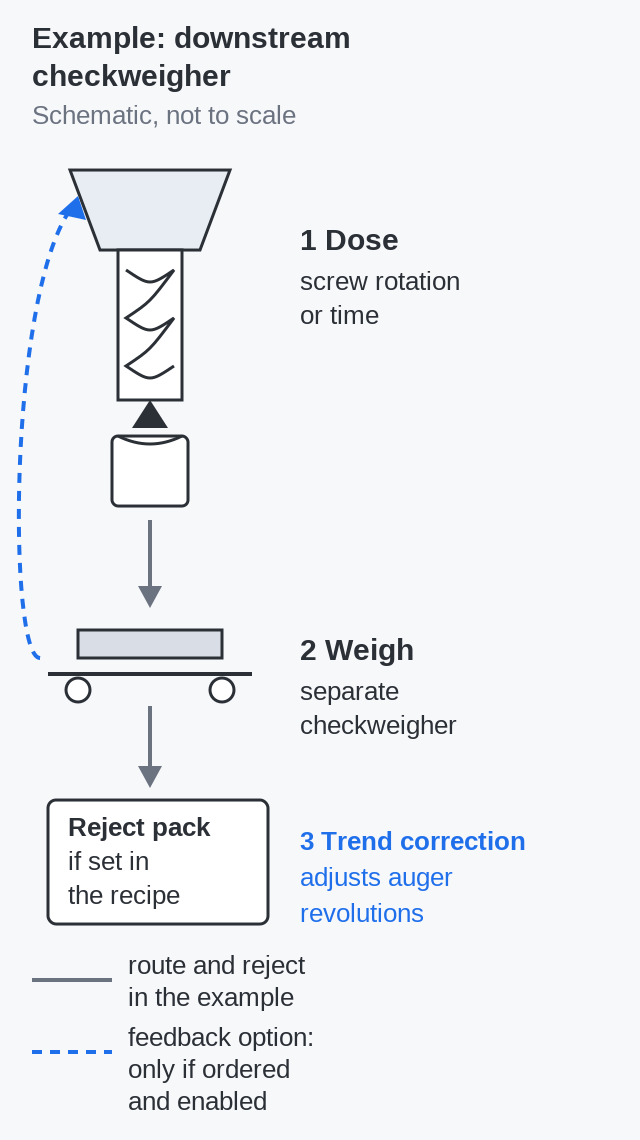
Based on All-Fill’s 22 August 2018 example. The dashed correction exists only when feedback is ordered, connected, and enabled.
The filling and bottling desk is the section home for this record. Use it when the auger is one station in a wider filling scope, then come back to the dose, weigh, and feedback rows.
How does an auger filling machine dose dry product?
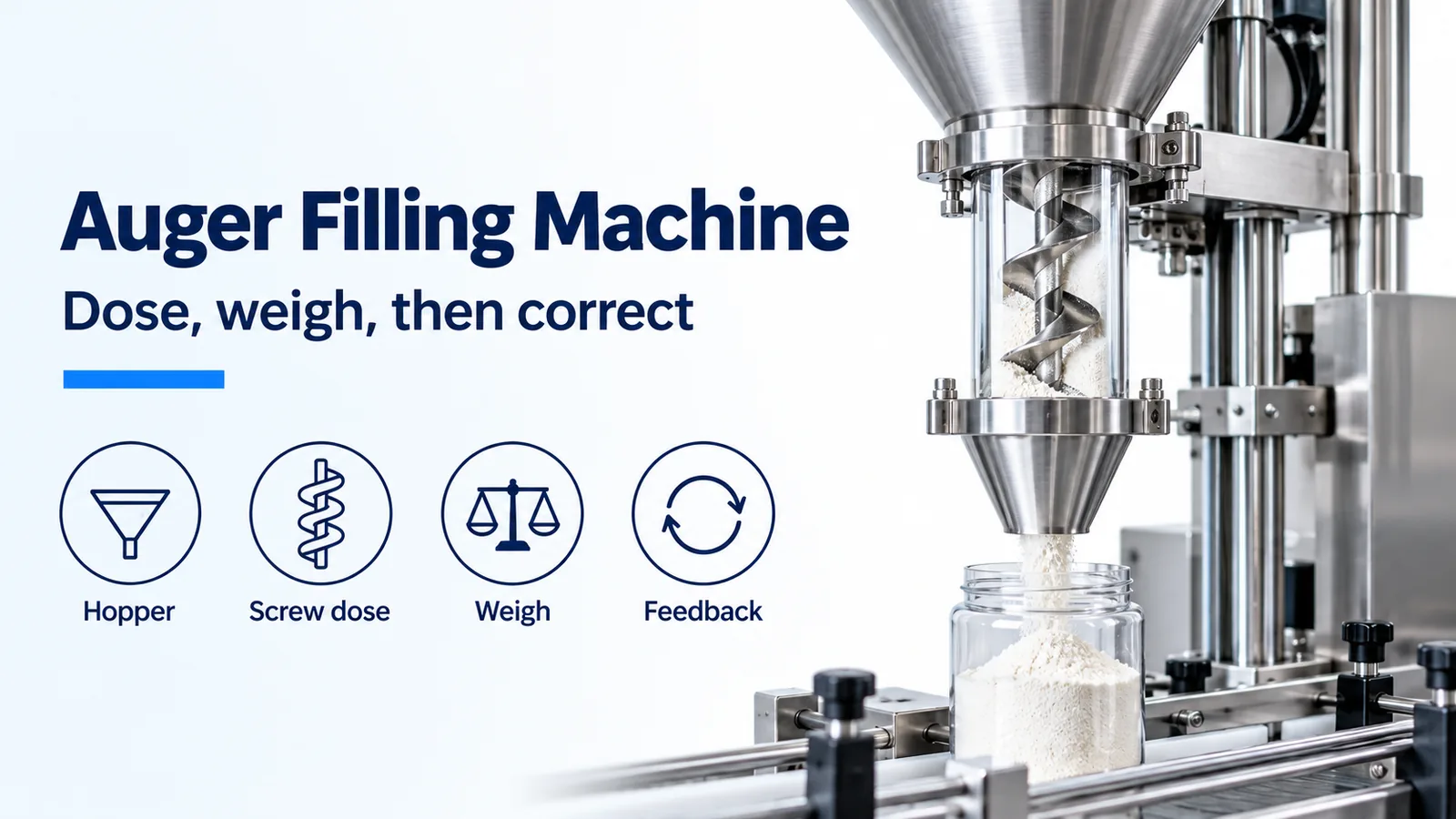
Wolf’s 24 April 2026 page describes the dose as a helical screw rotating inside a cylindrical tube. Product flows from the hopper, through the auger, and into the container below. Controls manage rotation, fill timing, and cutoff. Six parts form the machine on that page: the hopper, an agitator in the hopper, the auger, a variable-speed drive, those controls, and product-contact parts that are typically stainless steel. None of the six is a scale.
The same page says the screw moves a controlled volume. Mass then follows the powder that enters each flight. Aeration typically lowers density and causes underfills when it is not controlled. Density has to stay stable from hopper to discharge for the dose to stay stable. That is a volumetric command. It does not prove that a weighing step was ordered, and it does not rule one out.
All-Fill’s accessories page of 8 April 2014 splits tooling into free-flowing (straight) and non-free-flowing (self-feeding). Straight augers at 13-1/8 in overall length are the style it names for granulated sugar, salt, and bread crumbs, used with a slow-speed or flake-blade agitator, a straight funnel at 5-9/16 in overall length, a collector funnel, and a spinner plate. Without the spinner plate, free-flowing product passes through the auger and funnel. The page prints those overall lengths. It does not print an auger diameter, so the diameter cell stays blank.
A gram figure typed on an operator screen is still a command until a device and a location are named. The volume, mass, and fill-level guide keeps a scale reading in the mass column for liquid fillers. The same split applies here: the screw sets a volume, and the pack weight is a different column.
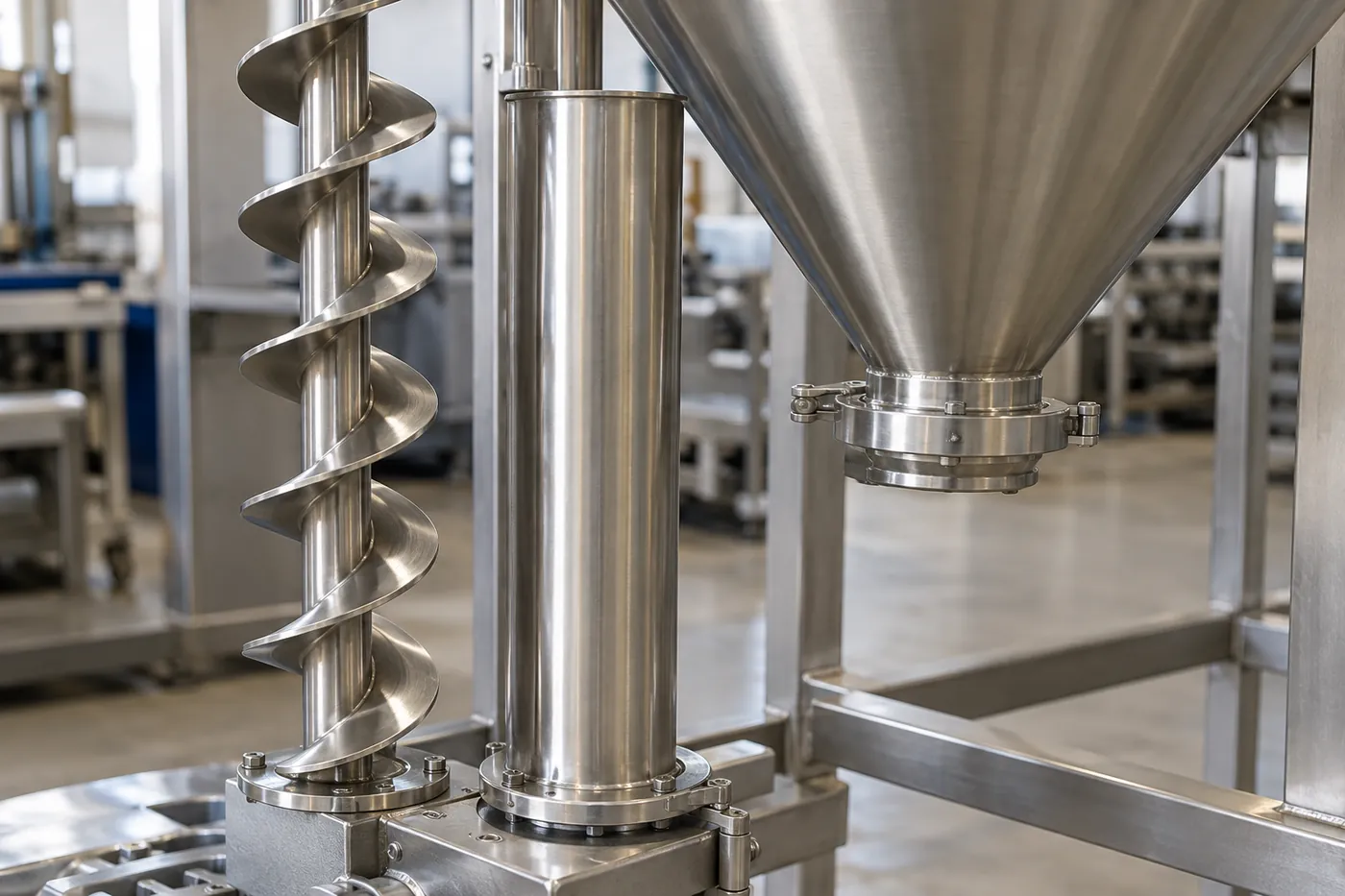
Example of screw, tube, and hopper hardware. Not a named machine, and not a measured dose.
Takeaway: Treat the revolution, time, or cutoff setting as a dose command, then ask where the pack is weighed.
Where do the dose, the weight check, and feedback split?
They are three functions. Dose actuation turns the screw. Weight verification reads a pack. Feedback uses readings to change a later dose. All-Fill’s 22 August 2018 article walks through one configured example: an Alpha PW-12 checkweigher with a model SHA-SV-600 automatic auger whose auger is servo driven. The operator sets an accept window. In the example, a 454 g fill uses a low of 454 g and a high of 458 g. A single pack outside that window does not start a feedback correction. The recipe can still push that pack aside as a reject. The checkweigher looks for a weight trend. The operator sets a number of feedback ignore samples and a weight range to evaluate. When the trend runs high or low, the checkweigher sends a correction that adjusts auger revolutions.
The same article states that the checkweighers are sold with and without the feedback capability, so feedback has to be requested. For fill-by-weight auger applications, All-Fill says checkweigher feedback is not needed and is often still used as a final confirmation. Fill-by-weight is a different arrangement: the weighing device is part of the fill and its reading ends the dose. If a proposal claims that arrangement, name the device and how the reading stops the screw.
| Arrangement | Dominant failure mode | Prevention named on the saved page |
|---|---|---|
| Volumetric screw dose while bulk density moves | The screw still delivers a volume, so the mass in the pack moves with density. Wolf states that aeration lowers density and causes underfills. | Keep density stable from hopper to discharge. Wolf points to checkweigh feedback when variability exceeds what volumetric filling alone will hold. |
| Free-flowing powder with no spinner plate | Product passes through the auger and funnel. All-Fill, 8 April 2014. | Spinner plate, with the funnel-to-plate spacing set for that tooling. |
| Bridging | Product forms an arch above the auger and flow stops. Wolf, 24 April 2026. | Hopper agitator. Wolf also names mechanical blades or pneumatic flow aids for the arch. |
| Checkweigher ordered without feedback | Off-weight packs are only rejected, and only when the recipe says so. Later doses do not change. All-Fill calls this the traffic cop. | Have feedback included on the order when later doses must change. All-Fill says the option is sold separately. |
| One pack outside the example window | A single outlier does not start a revolution correction, so a trend can continue. | Trend samples, plus a reject for that pack when the recipe pushes it aside. |
Common mistake: Reading “checkweigher included” as automatic correction of later doses. In All-Fill’s description, the reject and the feedback signal are separate, and feedback is ordered on its own.
The correction signal crosses from the weigher to the filler. The handoff section of the line specification is where that interface gets an owner. This page does not cover wiring or the program.
Rule of thumb. If one pack weight is above 458 g or below 454 g in All-Fill’s 454 g example, that pack does not start a revolution correction. The checkweigher looks for a trend. The pack can still leave the line as a reject when the recipe is set that way. If the quotation never states that feedback was ordered, treat the weigher as a reject station.
Takeaway: Put dose, measurement, and correction on separate rows, and fill each row from a named document.
Wolf adds that humidity, aeration, degradation, head pressure and agitation all affect bulk density, and that density must stay stable from hopper to discharge for accurate dosing. It also describes flow problems by name: bridging, where product arches above the auger; rat-holing, where product flows only from the centre; flooding from excess aeration; and segregation by particle size or density. These are the manufacturer’s descriptions of mechanisms; the magnitude of the effect on a specific formulation must be measured during sample trials.
Wolf names five properties that matter most: bulk density, particle size, cohesion, moisture content, and electrostatic charge. Humidity, aeration, degradation, head pressure, and agitation all affect bulk density. Because the screw moves a volume, a density change changes the weight in the pack at the same revolution count.
Wolf also names the flow failures: bridging, an arch above the auger; rat-holing, flow only from the center; flooding from excess aeration; dusting; and segregation by particle size or density. Cohesive powders compact, stick, and bridge. Free-flowing granules fill the flights and discharge cleanly once the tooling is calibrated. Those are mechanism descriptions. The page does not print how large the weight shift is for an unnamed powder, so this guide prints no shift.
Wolf’s sizing example says a machine set up for 50 g fills cannot efficiently run 5 g sachets. That pair is Wolf’s illustration of dose range. It is not a speed, an accuracy percentage, a diameter, or a power figure, and it is not the target for a different product.
Record the lot beside every reading. Wolf tells the buyer to ship representative best-case and worst-case batches, to document fill weights, cycle times, and feeding issues, and to define pass or fail before the test starts. A reading from one lot does not stand for a lot stored or aerated differently.
Takeaway: Write the powder lot and its condition next to the reading, or the reading cannot be compared with the next lot.
How do you compute the commanded mass?
For a volumetric screw dose the displacement relation is:
m = rho * v * n
m is the mass the screw is expected to deliver. rho is the bulk density of the lot. v is the volume per revolution taken from the tooling drawing. n is the commanded revolution count. The relation follows from Wolf’s statement that the screw moves a controlled volume and that bulk density sets the mass in each flight. It is not a catalogue accuracy claim.
Worked example. All-Fill’s 22 August 2018 page does not print rho, v, or n for the SHA-SV-600 example. It prints a 454 g target with a low of 454 g and a high of 458 g. The high limit sits above the target by 458 g - 454 g = 4 g. The low limit in that example is the target itself, so the printed window allows no underweight and 4 g of overweight. Leave rho, v, n, auger diameter, fill speed, accuracy percentage, and motor power blank. That saved page does not print them.
| Function or claim | Exact source or configuration | What the source actually states | Where and what is measured | Effect on the dose or pack | Evidence still required | Status |
|---|---|---|---|---|---|---|
| Dose actuation or setting | Named document and offered configuration | Rotation, time or quantity command and its stated basis | Record only if a weight measurement is identified | Actuator or setting action, if stated | Configuration-specific function description | Declared / demonstrated / not stated / needs confirmation |
| Weight-terminated fill, if claimed | Named weighing device within the filling station | Stated fill-by-weight function only | Location, gross or net basis, packaging and tare handling | How the reading ends the dose | Device identity, method and raw readings | Same status options |
| Weight measurement or verification | Named weighing device and its position in the line | Stated weighing function only | Location, gross or net basis, packaging and tare handling | Display, log, reject or control action, only if evidenced | Measurement method and raw readings | Same status options |
| Automatic feedback correction | Named filler, controller and weighing device | Stated return signal and correction target | Reading and sampling basis, and timing | What changes, for which later doses, with feedback enabled | Enabled setting, connection and action record | Same status options |
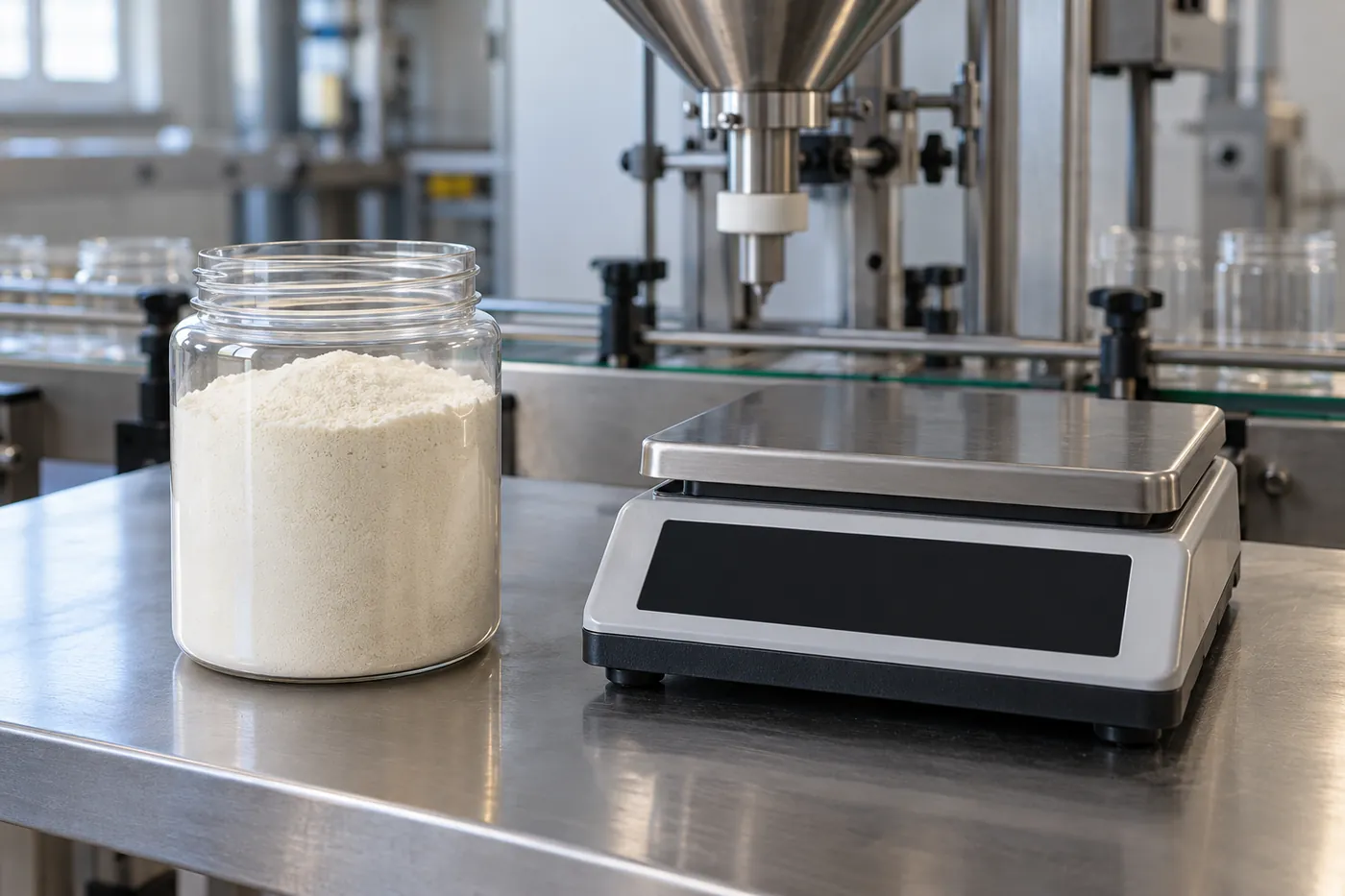
Example of a separate scale beside a filled jar. The display is blank because this page does not print a weight for the jar.
Takeaway: Multiply density, volume per revolution, and revolutions only when the drawing and the lot record print all three. Otherwise leave m blank.
What hidden cost sits in giveaway, rejects, and a missing spare?
Giveaway on an accepted pack is the weighed net minus the target net. In All-Fill’s example, a pack at the high limit carries 4 g more product than the 454 g target. The run total is 4 g times the number of accepted packs that sit at that high limit. The article says a shift of a few hundred fills can bring the average back to the programmed target once feedback is working. It does not print a pack count, so the run total stays blank. Do not turn “a few hundred” into a rate, and do not convert 4 g into an accuracy percentage.
Rejects are a second loss. All-Fill says an out-of-window pack can be pushed aside when the recipe is set that way, and that this single pack does not start a correction. Product in the rejected pack is not the same loss as the 4 g still inside an accepted pack.
Tooling changes stop the filler for a different reason. All-Fill treats the screw, funnel, and spinner as the parts that have to match the product. Wolf says changeover time should fit the schedule and does not print a duration, so minutes stay blank. Wolf’s spare-parts passage uses a failed auger with a four-week lead time as the case that stops production. If the quotation does not print a spare lead time, leave that cell blank. Wolf’s four-week figure stays on Wolf’s page as an illustration, not as a promise for the machine on the order. No price belongs in this ledger.
Takeaway: Count extra grams on accepted packs separately from rejected packs, and leave the pack count blank until the line log prints it.
What does the buyer record leave blank?
Wolf’s test advice is to run the actual material, to include best-case and worst-case batches, and to fix pass or fail before the run. The blank record below ties each reading to the lot, the pack, the dose mode, the measurement point, and the feedback state. No cell has a default. Copy a number only from the document that prints it for this configuration.
Takeaway: Quote the supplier’s words, then list the measurement and feedback facts the words leave out.
What should a same-material demonstration record keep?
Wolf advises testing with your actual material, shipping representative best-case and worst-case batches, documenting fill weights, cycle times and feeding issues, and defining pass/fail criteria before testing begins. The record template below ties each reading to the lot, pack, dose mode, measurement point and feedback state that produced it.
Acceptance criteria, sample quantities and measurement methods belong to the project parties:
| Field | Record or evidence reference |
|---|---|
| Supplier, offered machine and configuration, document revision | Project configuration reference |
| Product identity, batch or lot, sample source and condition | Representative sample lot ID |
| Container or pack identity and its preparation or handling | Approved pack drawing & lot ID |
| Target quantity, units and basis (volume, net product weight or other stated basis) | Specified target & engineering unit |
| Dose command or mode, and the tooling and configuration actually fitted | Installed auger screw & funnel ID |
| Weight-measurement location, instrument or method ID and its status evidence | Scale / checkweigher asset & calibration ID |
| Packaging and tare handling, and how the measurement basis is determined | Tare method (gross vs. net-weigh) |
| Agreed sampling conditions, observation window and criteria reference | FAT protocol section reference |
| Sample or pack identity, actual reading, units and raw-record location | Logged weight dataset reference |
| Feedback option, connection and enabled or disabled state | PLC feedback loop status |
| Documented correction target, action and time, with the associated pack or dose | Revolution adjustment log |
| Reject, display or log action, recorded separately from correction | Reject diverter log |
| Material or feeding changes and deviations actually observed | Hopper agitation / bridging log |
| Reviewer, outcome, unresolved evidence and assigned owner | Witness sign-off & action owner |
Agree the conditions before the run, as the factory-test section on what has to be written before the machine runs describes. If the demonstration uses a temporary scale in place of the line weigher, record that substitution the way the section on stops and a short window handles a result that was not produced on the final interface. Feedback shown on borrowed equipment is not yet shown on the weigher you will install.
Semi-automatic, automatic, and rotary labels do not fill the weight rows. Wolf assigns automatic fillers to continuous lines running thousands of units per shift and semi-automatic fillers to smaller runs. It does not define rotary. The rotary filling guide separates the container route from the metering method. Write the layout label in one field and the three weight functions in the others.
Takeaway: A blank cell means the saved page did not print the figure. It does not mean the machine lacks the part.
What do the ranking pages leave unresolved?
The cached search-result file for “what is an auger filling machine” (United States, English, desktop, fetched 5 October 2026) opens with manufacturer pages. Five of those pages were fetched again on 18 October 2026 and saved with this rewrite. They are a map of what the results emphasize. They are not the source of the dose, window, or net-content statements above.
Adinath’s food-powder page states a 250 g to 1,000 g filling range and treats a CE mark as a safety attestation. It does not print the powder, the pack, or the test behind either statement, so neither figure is copied onto the buyer record. AMS’s A-100 page mixes dry products and liquids in one machine description and prints an accuracy average and a fill-size span. Those figures stay on that page. Tops’s page is a startup procedure for power and air. It does not say where the pack is weighed. Dahe’s page discusses how far to automate the filler and points the reader to a sales desk. Amar’s page prints a model row that includes fill speed, an accuracy band, and a power supply. Those cells stay on Amar’s page. None of the five separates the screw command, the weigh point, and optional feedback, and none tells the reader to leave a figure blank when the page does not print it.
Takeaway: Use the ranking pages to see what a product page tends to skip, then fill the record from the OEM and handbook pages that do print the function.
When this does not apply
This page covers dry powders and granules dosed by an auger, and the separate question of how a weight check relates to that dose. It does not cover liquid or paste filling. The viscous-liquid filling guide holds the product record for those paths. It does not cover capsule filling, cleaning, installation, or servicing. Those steps stay in the supplier’s documents and the site procedure.
It also stops short of whole-machine acceptance. The packaging machinery FAT checklist holds the full requirement-to-evidence record. This page supplies the dosing and weight rows only. A guaranteed weight result has to be written by the supplier for the named configuration and the named product. NIST Handbook 133’s introduction frames official net-content checks of finished packages. It is not an auger setpoint procedure, and the saved introduction does not print sampling counts.
Wolf’s catalogue sentences on fill speed, accuracy percentage, and agitator motor power, and Amar’s model row on speed, accuracy, and power, remain on those pages. They are not transferred here.
Method and sources
This guide synthesizes public manufacturer documentation on auger dosing, powder flow mechanics, and checkweigher feedback control:
- Wolf Packing, “Auger Filler Applications: Powders, Granules, and Difficult-to-Flow Products” (published April 24, 2026). Used for the working principle, material properties and testing advice.
- All-Fill, “Filler/Checkweigher Feedback: The Basics”. Used for its configured feedback example and its statement that feedback is ordered as an option.
- Auger Enterprise, powder-fillers.com (November 30, 2019), VTops and Allpack: manufacturer pages compared to illustrate how public catalog pages describe dosing and weighing terminology, including VTops’s note on container positioning.
Statements attributed to a manufacturer are that manufacturer’s description of its own example or equipment. The matrix, record layout and “not stated” assessments are our editorial procurement framework. See the editorial evidence policy for how we handle supplier sources.
Related reading
Work through the function-evidence matrix and the demonstration record above with each supplier’s documents, then continue with these guides:
- Filling and bottling research desk — compare filling methods before narrowing to auger dosing.
- Packaging machinery FAT checklist — carry the dose and weight rows into a full acceptance record.
- Complete packaging line specification — name the owner of the filler-to-weigher interface.
- Rotary filling systems — decide the container route separately from metering.
Takeaway: Carry the same lot, pack and three-function record from this page into specification and acceptance.