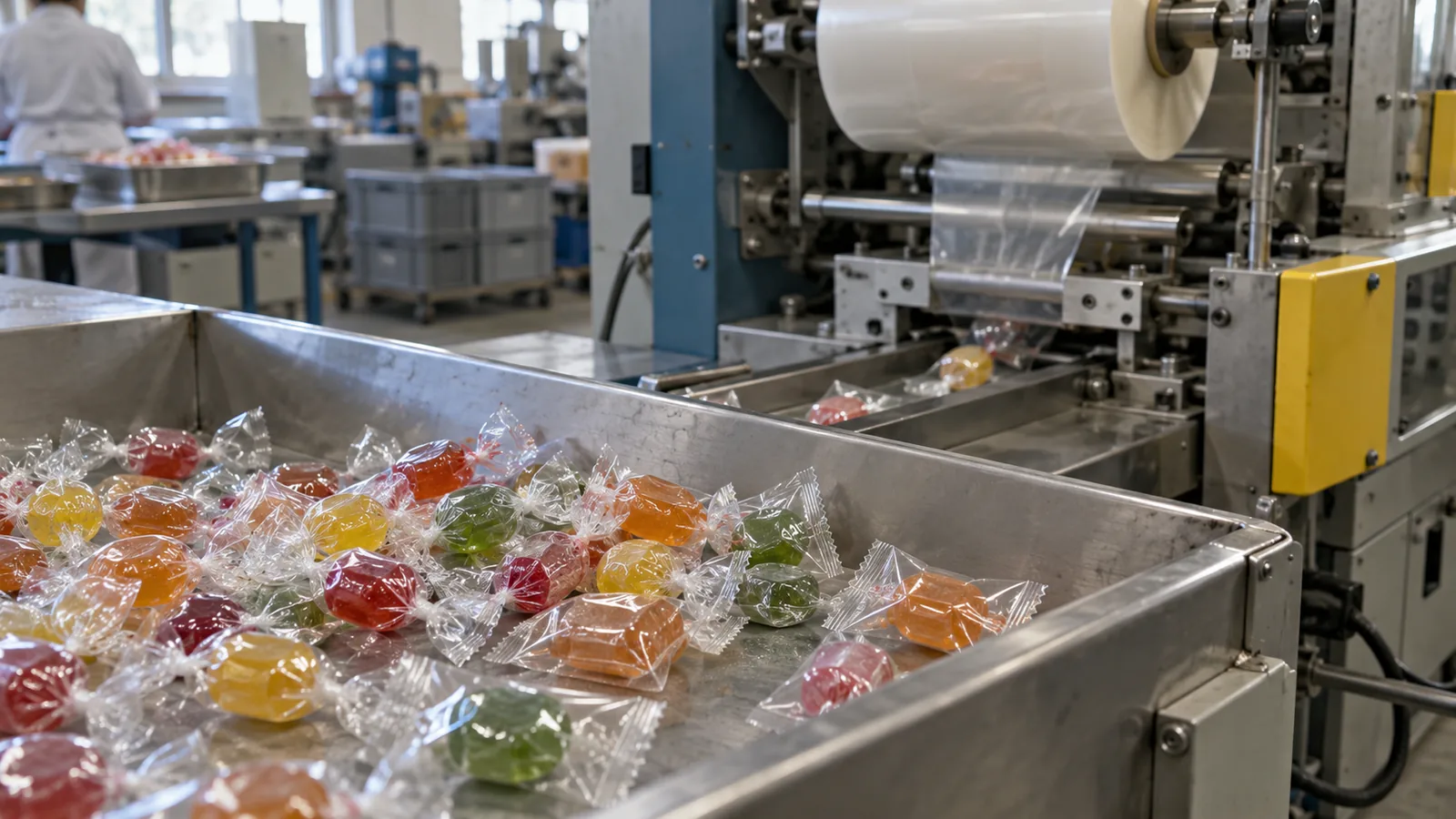
A candy wrapping machine encloses individual hard sweets, toffees, or confectionery bars in either mechanical twisted ends or heat-sealed pillow flow packs. Select twist wrapping for preformed hard or chewy pieces (for example, 330–550 pieces per minute on mid-range units like the Latini CW-600 single/double twist, scaling above 1,000 pieces per minute on high-speed rotary lines), and horizontal pillow flow wrapping for moisture-sensitive bars or multipacks requiring sealed seams verified under ASTM F88/F88M-23.
Automatic candy packing lines wrap hundreds to thousands of pieces in minutes while eliminating direct hand contact with food. Matching the machine family to the finished closure, piece envelope, film barrier, and sustained shift efficiency prevents film waste, crushed sweets, and underperforming trials. For broader line context across primary and secondary equipment, browse the packaging machinery hub.
How do twist and pillow candy wrapping machines compare?
Twist wrappers grip preformed sweets mechanically by twisting one or both film tails, whereas horizontal pillow wrappers form a longitudinal fin seal and transverse end crimps around each piece or bar. Because the forming heads, film mechanics, and sealing tooling differ completely, closure geometry fixes the machine architecture before speed or brand selection begins.
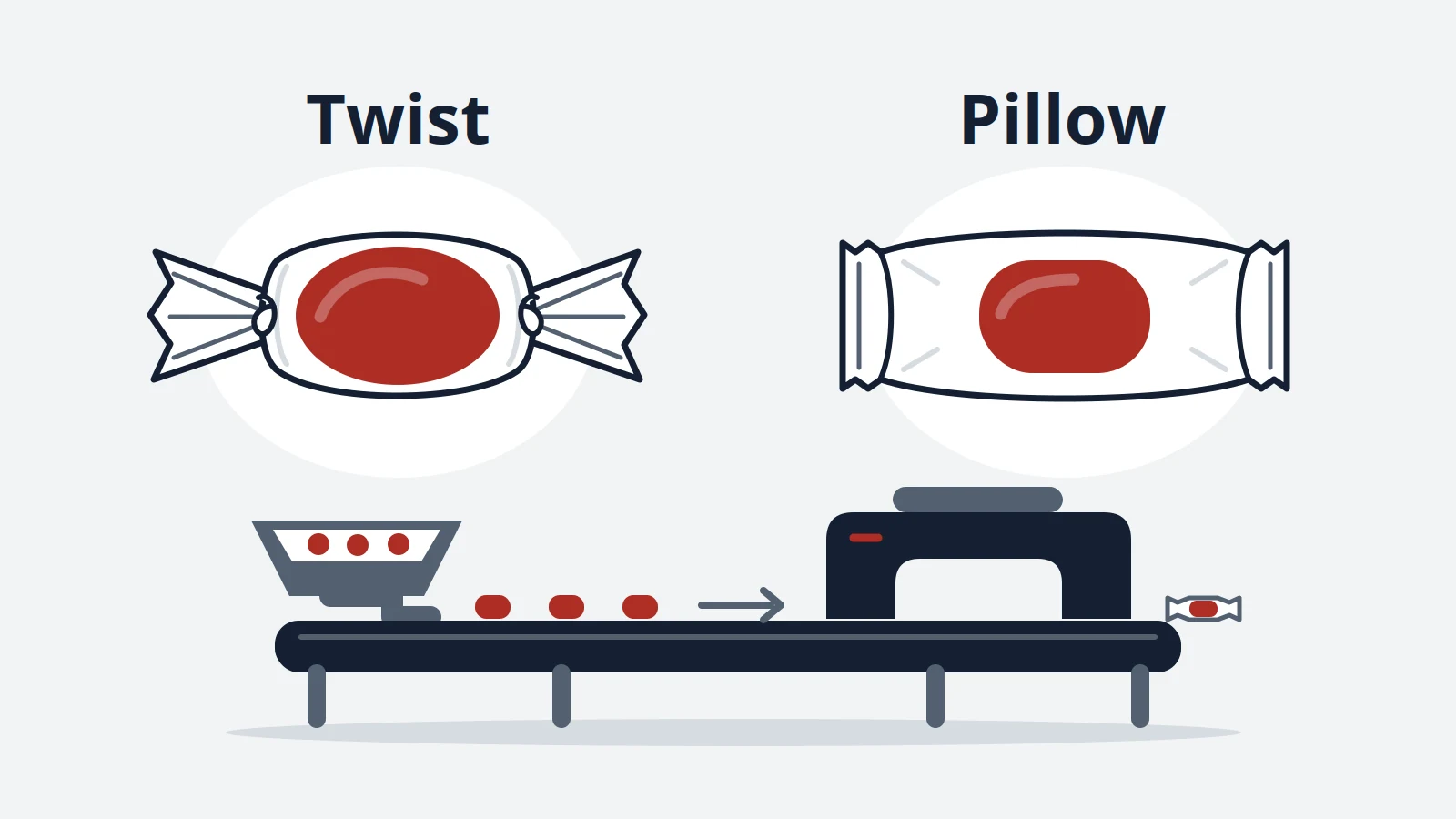
Across published confectionery equipment data, HonorPack groups primary wrapping into five main styles: single twist, double twist, roll wrapping, fold wrapping, and pillow wrapping. Comparing concrete manufacturer specifications side by side exposes how throughput, power load, floor footprint, and film compatibility shift between twist and pillow platforms.
| Machine or platform | Wrapping format | Rated speed | Piece / machine envelope | Power, mass & key drive features | Named films or sealing modes |
|---|---|---|---|---|---|
| Latini CW-600 | Double twist or single twist | Up to 550 pcs/min double, 330 pcs/min single (up to 600 / 350 peak) | Machine: 2200 × 1300 × 1325 mm (87 × 51 × 52 in) | 1.5 kW base (+1.0 kW optional hot air); 860 kg net (1,900 lb) | Continuous printed cellophane, wax paper, PVC, CPP, HM, BOPP |
| Eurowrap 450 | Double twist | 450 to 500 pcs/min (up to 30,000 units/hour) | Piece: 12 × 6 mm to 32 × 26 × 20 mm; machine: 2150 × 1200 × 1600 mm | 380 V, 50 Hz, 2.2 kW; approx. 900 kg; servo film feed | Servo-controlled outer wrapper with photocell registration |
| HonorPack pillow wrapper | Horizontal pillow flow wrap | Up to 500–800 pcs/min depending on piece size | Individual sweets, toffees, and chocolates (verify footprint per frame) | Servo-driven with vertical stop-protection jaws (power/mass per frame) | PET, OPP, plastic, paper, metalized film |
| Theegarten-Pactec FPC6 | Horizontal flow wrap | 100 m/min compact web speed; flying splice up to 150 m/min | Compact high-speed frame with integrated rear control cabinet | Automated flying-splice unwinding (20 to 30 min reel intervals) | Cold seal, heat seal, cut-seam welding, water-soluble film, preheated paper and mono-materials |
| HonorPack fold wrapper | Block fold wrap | 80 to 150 pcs/min | Large chocolate blocks and ice cream blocks | Dual-layer sealing in one pass (power/mass per block frame) | Aluminum foil heat sealing and composite film folding |
Every row above pairs output directly with its closure method and mechanical footprint. A twist wrapper such as the Latini CW-600 draws 1.5 kW of base power (plus an optional 1.0 kW hot-air unit) and weighs 860 kg net (1100 kg gross), whereas high-speed horizontal flow wrappers add heated or cold-seal jaw assemblies, longitudinal fin wheels, and high-speed film splicing to sustain continuous barrier sealing.
Which candy dimensions and film materials fit each machine class?
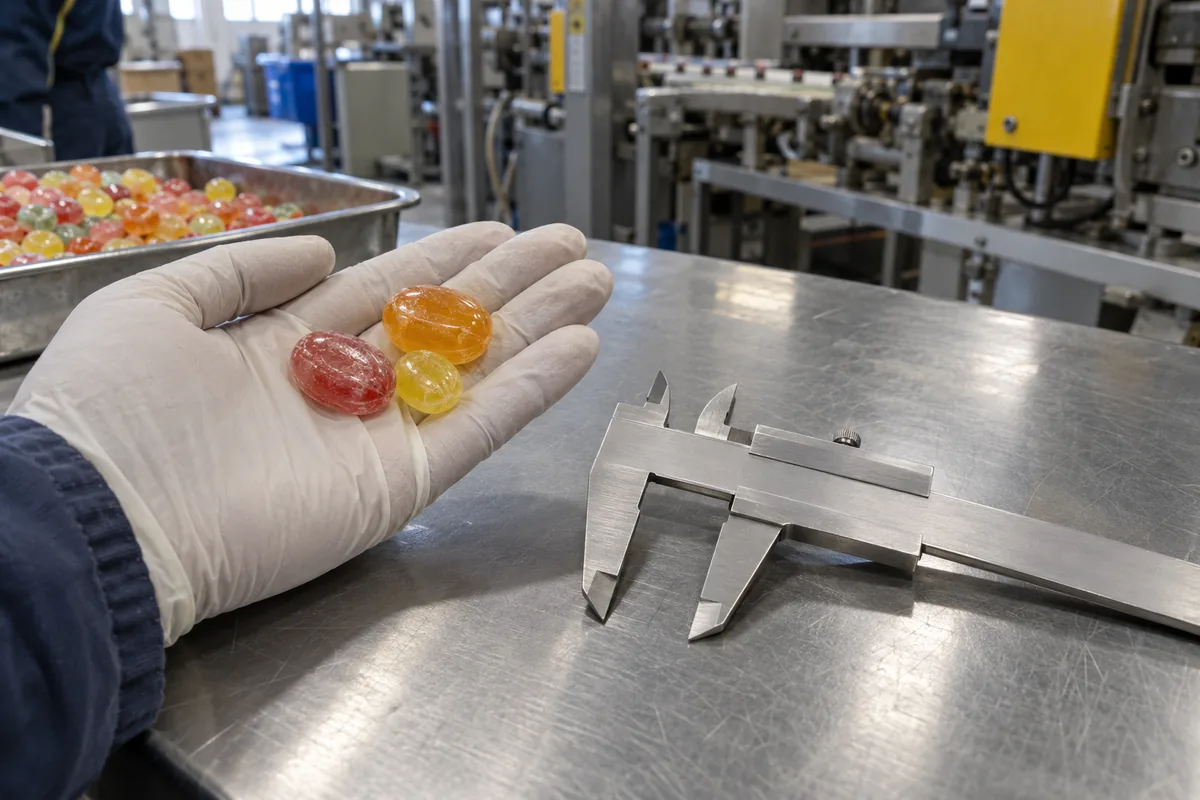
Measure candy length, width, and height across full production lots before requesting quotes, because piece geometry dictates both feeding plates and forming boxes. Pair those measurements with the exact film substrate and sealing chemistry so deadfold retention or heat-seal activation matches the wrapper hardware.
Piece size envelopes and forming-box limits
Twist wrappers index individual sweets into pockets sized tightly around the piece profile. On the Eurowrap 450 double-twist machine, published candy limits span 12 x 6 mm at the lower end up to 32 x 26 x 20 mm at the upper end, fed from a large plate equipped with two brushes. Pieces falling outside a rotary head’s pocket band either double-feed, jam, or leave tails too short to lock cleanly.
Horizontal flow wrappers handle longer bars and wider multipacks, yet still enforce strict forming-box boundaries. In horizontal candy-bar wrapping, a machine configured around a 35 mm wide bar performs poorly when asked to wrap a 90 mm multipack without installing a new forming set and reconfiguring the infeed. Treating forming shoulders and change parts as explicit line items prevents late tooling surprises when SKU assortments expand.
Film substrates, moisture barriers, and sealing heat
Film mechanics separate twist wrapping from pillow flow wrapping just as sharply as piece size. Traditional twist wrappers run regenerated cellulose film (cellophane), wax paper, PVC, CPP, HM, and BOPP. Cellophane offers low permeability to air, oils, greases, bacteria, and liquid water while remaining biosourced, compostable, and biodegradable. However, uncoated cellophane is highly permeable to water vapor unless coated with a moisture-barrier layer such as nitrocellulose lacquer, which is one reason petrochemical films like BOPP and BoPET captured large confectionery share on lower film cost.
Pillow flow wrappers join compatible thermoplastic or coated layers through heat sealing, cold sealing, or cut-seam welding. Reliable thermal bonds require controlled time, temperature, and pressure across clean sealing surfaces. Constant-temperature hot bar sealers frequently apply release surfaces such as Teflon films to stop molten polymer from sticking to heated tooling. For heat-sensitive chocolate or emerging sustainable webs, platforms such as the Theegarten-Pactec FPC6 pair cold sealing and cut-seam welding with an integrated preheating section that stabilizes sensitive paper and recyclable mono-materials alongside water-soluble films.
| Wrapping format | Representative films | Key barrier or sealing behavior | Primary defect risk if mismatched |
|---|---|---|---|
| Single or double twist | Cellophane, wax paper, PVC, CPP, HM, BOPP | Uncoated cellophane blocks air, oils, and liquid water but requires nitrocellulose lacquer for water-vapor protection | Loose or untwisted tails, torn film, or moisture pickup on hygroscopic hard candy |
| Heat-sealed pillow flow wrap | PET, OPP, BOPP, metalized film, coated paper, mono-materials | Thermoplastic sealant layers fuse under controlled time, temperature, and pressure; hot bars use release layers such as Teflon | Scorched film on line stops, weak fin seams, or product melted by excess jaw heat |
| Cold-seal or specialty flow wrap | Cold-seal coated webs, preheated paper, recyclable mono-materials, water-soluble films | Forms closures with reduced or zero jaw heat transfer to heat-sensitive confectionery | Adhesive contamination, misaligned cut registration, or inconsistent seam bonding |
How do rated wrapping speeds translate into real shift output?
Catalogue speed figures represent peak mechanical cycles under ideal uniform product feed, not net sellable packs per shift. Discount mechanical rates by real overall equipment effectiveness (OEE), reject counts, and SKU changeover minutes before sizing line capacity.
Reconciling headline speeds with model specification rows
Manufacturer specifications often quote both an ideal peak figure and a conservative continuous rating for the same frame—for instance, Latini’s CW-600 lists up to 550 pieces per minute for double twist and 330 pieces per minute for single twist in its engineering specification table (versus 600 and 350 pieces per minute in headline summaries), while HonorPack pillow wrappers range from 500 to 800 pieces per minute depending on piece profile.
High-output flow wrappers also rate performance by linear film web speed rather than piece count alone. The Theegarten-Pactec FPC6 achieves compact-footprint web speeds of 100 meters per minute and uses flying-splice unwinding to swap depleted film reels—normally required every 20 to 30 minutes—at web speeds up to 150 meters per minute without slowing the line. On rotary double-twist platforms such as Eurowrap 450, the 450 to 500 pieces per minute range equates to up to 30,000 units per hour before line stops or splices are deducted.
Shift-capacity, reject, and changeover calculation
Horizontal flow-wrapping production math shows why a machine rated at 200 packs per minute delivers markedly lower net shift output when frequent SKU changes and cleaning stops intervene. Consider a bar line running at 180 packs per minute across 7.5 operating hours per shift:
- Theoretical shift capacity: 180 packs per minute multiplied across 7.5 operating hours equals 81,000 packs per shift.
- Practical output at 82% OEE: Applying a measured overall equipment effectiveness score of 82% reduces usable shift output from 81,000 packs down to approximately 66,420 packs.
- Hourly scrap accumulation: On a slower 120 packs per minute run, a rejection rate of 2% produces approximately 144 rejected packs during a single hour, compounding film loss and manual rework.
- Weekly changeover loss: Running two 35-minute SKU changeovers per shift removes 350 minutes (5.8 hours) of production across a five-day single-shift week—and running eight 35-minute changeovers across four bar sizes removes 280 minutes (4.7 hours) in a single shift alone.
Running this arithmetic on your own SKU count and shift hours reveals whether paying for quick-change forming sets, recipe memory, or flying-splice unwinds recovers more usable packs than buying a higher headline speed.
What feeding, controls, and guarding belong in the purchase boundary?
A wrapper quotation covers only the stations explicitly named between the incoming candy handoff and wrapped discharge. Specifying automatic feeders, no-product-no-film sensors, washdown ratings, and operator guarding in writing prevents surprise scope gaps during installation.
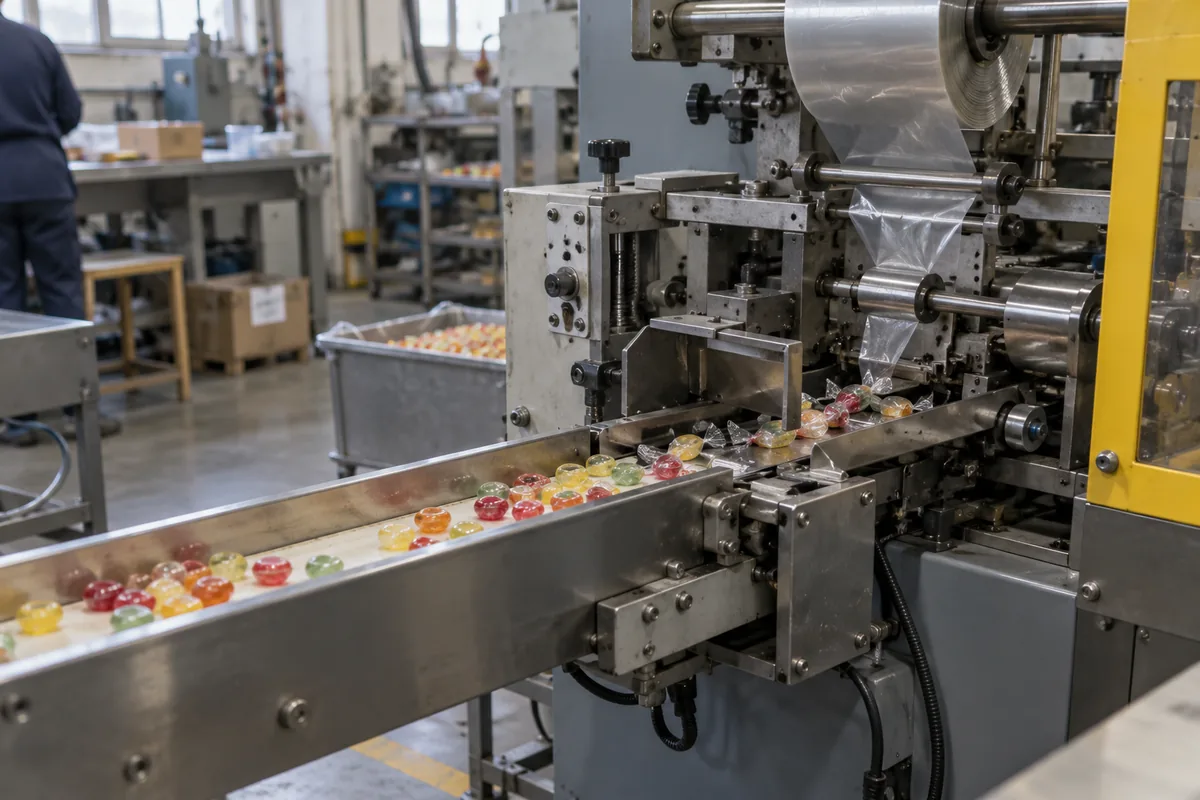
Infeed and discharge hardware vary widely across standard machine offers. Latini includes a discharge conveyor and a no-sweet-no-paper mechanism on CW-600 to prevent wasted film on empty pockets, but lists both photo-electric print registration and automatic hopper feeding with a product distribution conveyor as optional extras. Eurowrap 450 uses a large feeding plate with two brushes and discharges wrapped sweets downward through a chute, combining servo-controlled paper take-off with a built-in photocell for outer print alignment. On heat-sealed pillow wrappers, HonorPack incorporates a stop-protection design that automatically opens the vertical sealing mechanism whenever the machine stops, preventing film burn damage and restart scrap.
Plant hygiene and operating climate also drive mechanical specification. General packaging machinery selection criteria emphasize matching enclosures, motors, and control cabinets to cold-room operation or periodic high-pressure chemical washdowns, alongside maintainability, floor space, energy load, and line integration. When integrating upstream cooling belts, metal detectors, checkweighers, or downstream cartoners, assign every mechanical transfer and interlock signal explicitly using a complete packaging line specification and coordinate sensor ownership across your automation controls scope.
Operator protection is a mandatory acceptance gate on high-speed rotary jaws, twist grippers, and film unwind rollers. Under OSHA 1910.212, fixed candy wrappers require:
- General hazard guarding: One or more guarding methods protecting operators from point-of-operation hazards, ingoing nip points, and rotating parts under 1910.212(a)(1).
- Point-of-operation exclusion: Guards designed and constructed to prevent any part of the operator’s body from entering the danger zone during the operating cycle under 1910.212(a)(3)(ii).
- Interlocked revolving enclosures: Drive-interlocked enclosures on revolving drums, barrels, or feeding containers so rotation cannot occur unless the guard is in place under 1910.212(a)(4).
- Fixed machine anchoring: Secure floor anchoring on fixed-location machinery to prevent walking or shifting at speed under 1910.212(b).
Which seal tests and sample-trial checks verify a candy wrapper before acceptance?
Visual inspection alone cannot confirm hermetic protection or repeatable opening force on pillow flow packs. Pair pre-shipment candy trials with standardized quantitative seal tests and agreed reject-counting rules so supplier proposals are judged on measured pack quality rather than brochure claims.
For flexible heat-sealed or cold-sealed candy packs, ASTM F88/F88M-23 defines quantitative peel-strength testing across laboratory or commercial seals, measuring separation force and identifying the specimen failure mode. Buyers typically set a lower seal strength limit to assure closure integrity and, where seals are intended to be peeled open by the user, an upper seal strength limit to restrict opening force. Because tail-bending angle alters measured pull force, ASTM F88 recommends holding one fixture method constant across a test series: Technique A (unsupported tails), Technique B (hand-supported at a 90 degree perpendicular angle), or Technique C (rigid alignment plate supporting the stiffer tail with the flexible tail folded 180 degrees over the seal).
Complement strip-peel testing with whole-package integrity verification. Pressurized burst testing under ASTM F1140 measures failure pressure and locates weak points, while creep testing holds internal pressure at roughly 80% of the minimum burst pressure over a set duration to detect slow seam separation. For pinhole and channel leaks, ASTM D3078 submerges packs under vacuum to spot bubble emission or dye ingress once vacuum releases. Lock these test methods, candy lot identities, and acceptance tolerances into your packaging machinery FAT checklist prior to shipping sample film and product.
| Verification item | What to fix before the sample trial | Measured acceptance evidence |
|---|---|---|
| Product sample identity | Candy lot, shape, surface state, and caliper-measured length, width, and height | Signed dimensional check confirming fit inside the quoted size band |
| Closure and film roll | Exact film grade, barrier coating (such as lacquered cellophane or coated OPP), and sealing mode | Retained wrapped packs plus film roll lot sheet |
| Feeding and options | Quoted infeed plate, distribution conveyor, print-registration photocell, and stop-protection jaws | Continuous run showing zero manual hand-feeding unless explicitly scoped |
| Seal strength and leaks | Agreed ASTM F88/F88M-23 fixture (Technique A, B, or C), ASTM F1140 burst/creep target, or ASTM D3078 leak check | Quantitative peel force range, failure mode, and leak-test pass counts |
| Sustained output and rejects | Target speed, elapsed run window, stop logging, and defect definitions | Presented pieces, rejected pieces, net accepted packs per minute, and film splice behavior |
| Safety and utilities | Voltage, frequency, kW load, floor footprint, and OSHA 1910.212 interlocked guarding checks | Electrical nameplate check and verified guard-interlock stop test |
When should buyers use roll, fold, or carton overwrapping instead?
Single-piece twist and pillow wrappers cover individual sweets, not grouped rolls, oversized chocolate blocks, or loaded retail cartons. Step into specialized secondary or multi-piece wrappers whenever the finished pack combines multiple candies or pairs an inner barrier with an outer paperboard sleeve.
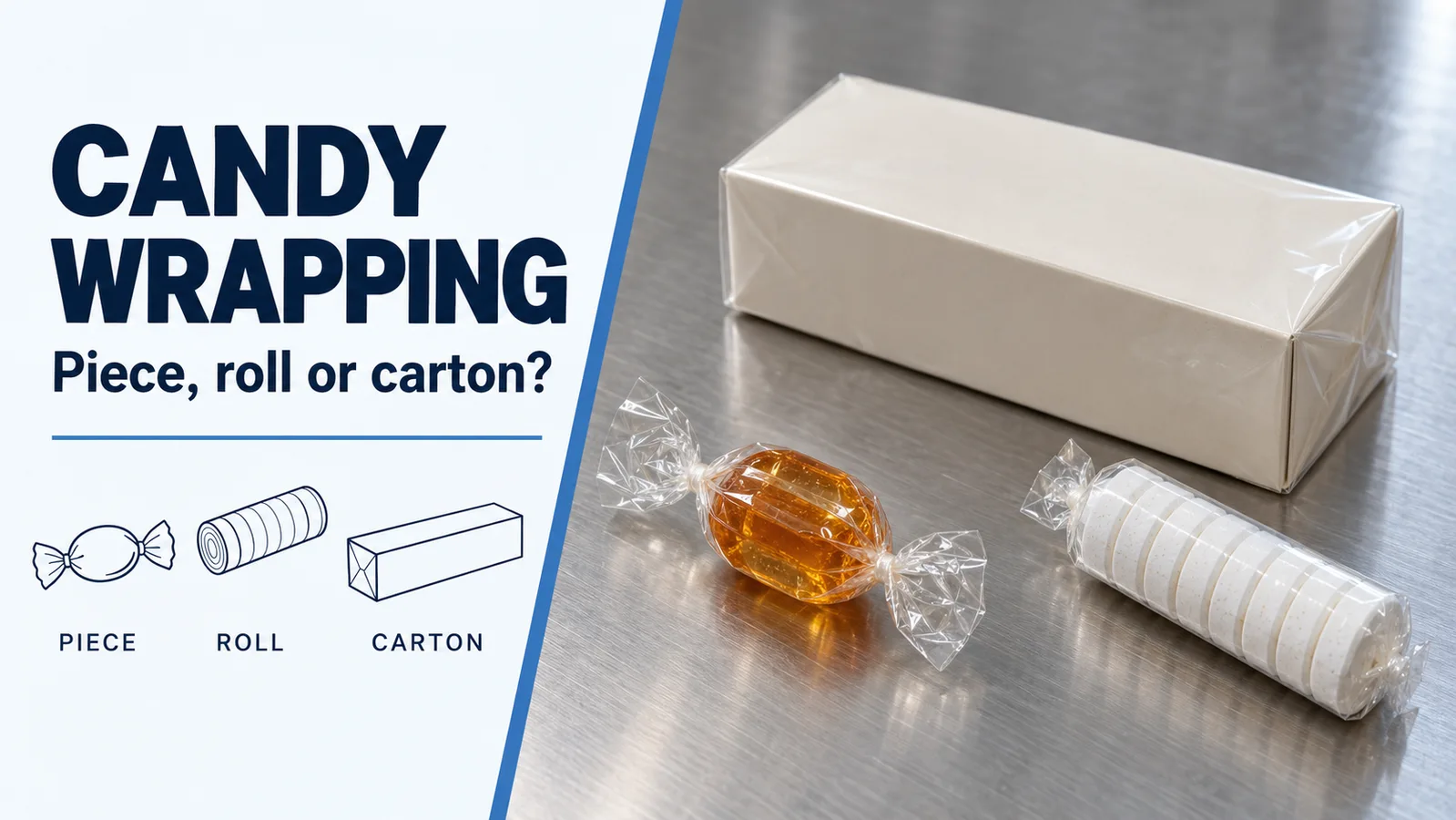
HonorPack’s confectionery taxonomy separates these adjacent formats clearly. Roll wrapping places cylindrical sweets in a row inside one shared primary wrapper rather than enclosing each piece separately. Fold wrapping targets large chocolate blocks and ice cream blocks, folding aluminum foil or composite film cleanly around sharp edges at published rates of 80 to 150 pieces per minute. When retail presentation requires dual-layer protection—heat-sealed inner aluminum foil plus folded pre-cut cardboard—dedicated chocolate cartoning systems run at 60 to 100 pieces per minute through multi-station linkage.
If your shortlist mixes single-piece twist machines, grouped mint rolls, and outer-film cartoners, compare incoming pack geometry and line capacity using the candy overwrapping versus individual twist wrapping guide. Defining whether bare candy, a primary roll, or a loaded carton enters the infeed keeps every supplier quoting the same packaging stage.