Selecting an industrial roll-to-roll laminator machine by peak mechanical speed alone causes transverse worming, core telescoping, bond delamination, and food-contact rejects when converting thin barrier films at full line velocity. Specify a roll laminating machine around four engineering parameters: the 5-roll solventless coating head shear ratio and closed-loop infrared coat-weight control (0.8 to 2.5 g/m²), two-component polyurethane (2K PU) gravimetric-to-volumetric NCO:OH metering accuracy (±1.0%), three-zone strain-matched web tension with linear rewind taper (15% to 30%), and curing chamber kinetics versus zero-cure thermal nips.
Converting teams evaluating web equipment across our packaging machinery hub and equipment buying guides hub choose between 100%-solids solventless lamination (375 to 600 m/min with 24 to 72 hours of heated curing) and roll-to-roll thermal extrusion-tie lamination (100 m/min with 0-hour curing for immediate slitting). When an under-specified flexible packaging laminator ramps from 50 m/min to 450 m/min without vector drive compensation across its metering rolls, hydrodynamic forces lift wet polyurethane film weight out of tolerance, causing edge bleed or primary aromatic amine (PAA) migration above the European Union 2 ppb (0.002 mg/kg) food-contact limit.
| OEM Model & Platform | Architecture | Web Width | Max Speed | Max Reel Ø & Mass | Coating / Bonding Mechanism | Target Scope & Changeover |
|---|---|---|---|---|---|---|
| Nordmeccanica Simplex SL | Compact shaftless 2-ply solventless (plus e800) | 1,100–1,300 mm (800 mm e800) | 375 m/min | Unwind/Rewind Ø 850 mm | 5-roll solventless head with AC vector drives (0.8–2.5 g/m²) | Short-to-medium run film-to-film barrier webs |
| Nordmeccanica Super Simplex SL / SL HD | Flagship 2-ply shaftless solventless laminator | 1,300–1,500 mm (1,600–1,800 HD) | 450 m/min | Ø 1,000 mm (1,000 kg) | 5-roll head (steel R1/R2, sleeve R3, chrome R4, nip R5) + water heating | Industry standard for PET/Al/PE, BOPP/Met-BOPP, and BOPA/PE |
| Nordmeccanica Duplex SL 450 / 600 HD | Non-stop turret 2-ply solventless laminator | 1,100 / 1,500 / 1,800 mm | 450–600 m/min | Ø 1,000–1,200 mm flying-splice turrets | High-speed 5-roll head with dynamic speed-ramp compensation | Multi-shift film/foil converting without reel-change stops |
| Nordmeccanica Triplex SL One-Shot | Single-pass 3-ply dual-station solventless | Up to 1,500 mm | 450 m/min | 3 unwinds Ø 1,000 mm; Rewind Ø 1,200 mm | Dual 5-roll stations + dual World Mixer SL 2K dispensers | One-pass PET/Al/PE or BOPP/Met-BOPP/PE triplex laminations |
| BOBST NOVA SX 550 | Modular 3-column plug-and-play solventless | 1,030 / 1,330 / 1,530 mm | 450 m/min | Up to 1,500 kg reel mass | 5-roll head with tool-less transfer sleeve + 3-roll laminating nip | 90 s sleeve swap; 15 min job changeover; handles 6.3–7 µm Al foil |
| BOBST VISIONLAM 800 / MASTERLAM 1000 | Multi-technology heavy-duty laminating line | 1,030–1,530 mm (up to 1,750 mm) | 450–600 m/min | Heavy-duty shaftless or turret stands | Interchangeable cartridges: 5-roll solventless trolley, gravure, flexo | Retort pouches, cold-seal confectionery, and wide barrier webs |
| Comexi SL2 / SL2 Evolution / SL2 MB | Servo-motorized solventless laminator | 1,330 or 1,530 mm | 500 m/min (400 on MB) | Ø 1,000 mm shaftless stands | Motorized 5-roll head, carbon-fiber sleeves, Closed Loop IR gauge | Automated gap setting and optical coat-weight trim (under 2 min swap) |
| Comexi ML2 Evolution | Modular multi-process laminator and coater | 1,330 or 1,530 mm | 450 m/min | Turret or shaftless stands | Solventless Trolley (under 1 min sleeve change), gravure, flexo | Barrier coatings, matte/gloss varnishes, and 3-roll high-pressure nip |
| Karlville TL-800 Pack Ready | Zero-cure roll-to-roll thermal laminator | 300–800 mm | 100 m/min | Unwind Ø 800 mm; Rewind Ø 1,000 mm (1,000 kg) | Hot oil drum (70°C–170°C) + EVO glycol chiller (30°C–70°C) | HP Indigo 20000 / 25K digital webs; 0-hour cure for immediate slitting |
| Karlville COMBI Pack Ready / LM-SL | Dual-mode Thermal + Solventless laminator | 300–800 mm (650–1,300 LM-SL) | 100 m/min Thermal; 400 m/min SL | Ø 800–1,000 mm shaftless stands | 5-roll solventless head + Bi-2 geared mixer + IR gauge + thermal nip | Hybrid plants needing 0-hour thermal turnaround and low-cost 2K PU |
1. Solventless vs. Thermal vs. Multi-Technology Laminator Architectures
Choosing between a 5-roll solventless roll laminating machine, a zero-cure thermal laminator, and a multi-process line depends on run length, barrier structure, and slitting schedule. Align upstream press widths and downstream slitter or pouch-machine handoffs using our complete packaging line specification guide.
Dedicated 5-Roll Solventless Laminators (375 to 600 m/min)
Solventless lamination applies 100%-solids polyurethane at 0.8 to 2.5 g/m² without VOC ovens. Eliminating the drying tunnel lets a solventless laminator machine such as the Nordmeccanica Super Simplex SL, BOBST NOVA SX 550, or Comexi SL2 fit a compact footprint and cut energy draw by 65% to 75% versus solvent-based gravure lines:
- Standard 2-Ply Shaftless Lines: Run at 375 to 500 m/min across 1,030 to 1,530 mm (1,800 mm on Super Simplex SL HD) with Ø 850 to 1,000 mm reels (1,000 to 1,500 kg). The BOBST NOVA SX 550 installs on a flat slab without foundations.
- Turret Duplex & One-Shot Triplex Lines: The Nordmeccanica Duplex SL 450 and 600 HD add Ø 1,000 to 1,200 mm flying-splice turrets for non-stop 600 m/min operation. For three-ply barrier webs (
PET / Al Foil / PEorBOPP / Met-BOPP / PE), the Nordmeccanica Triplex SL One-Shot pairs two 5-roll heads and two 2K mixers on a 1,500 mm, 450 m/min frame, bonding three layers in one pass and saving a 24-hour intermediate cure.
Roll-to-Roll Thermal Laminators for Zero-Cure Turnaround (100 m/min)
Digital presses (HP Indigo 20000 and 25K at 762 mm width) produce short runs that cannot wait 24 to 72 hours in a curing room. The Karlville TL-800 Pack Ready Thermal Laminator (300 to 800 mm width, 100 m/min) melts an extruded thermoplastic tie layer over a 70°C to 170°C thermal-oil drum and quenches it on an EVO glycol-chilled roll (30°C to 70°C). Because bonding is physical, curing time is 0 hours, allowing immediate slitting and pouching with zero isocyanate monomer and zero PAA risk. The Karlville COMBI Pack Ready combines a 100 m/min thermal nip and a 400 m/min 5-roll solventless head on one frame.
Rule of thumb — thermal vs. solventless crossover: Specify a thermal laminator machine (or dual-mode COMBI) for runs under 3,000 to 5,000 linear meters requiring same-shift pouching; specify a 400 to 500 m/min 5-roll solventless laminator above 5,000 linear meters, where lower 2K PU adhesive cost per square meter outweighs the 24-to-48-hour curing hold.
Takeaway: Match the laminating head to your curing clock: 5-roll solventless units lead 400 to 600 m/min barrier production, while 70°C to 170°C thermal-oil nips deliver 0-hour-cure digital converting.
2. Five-Roll Solventless Coating Head Mechanics and Closed-Loop IR Control
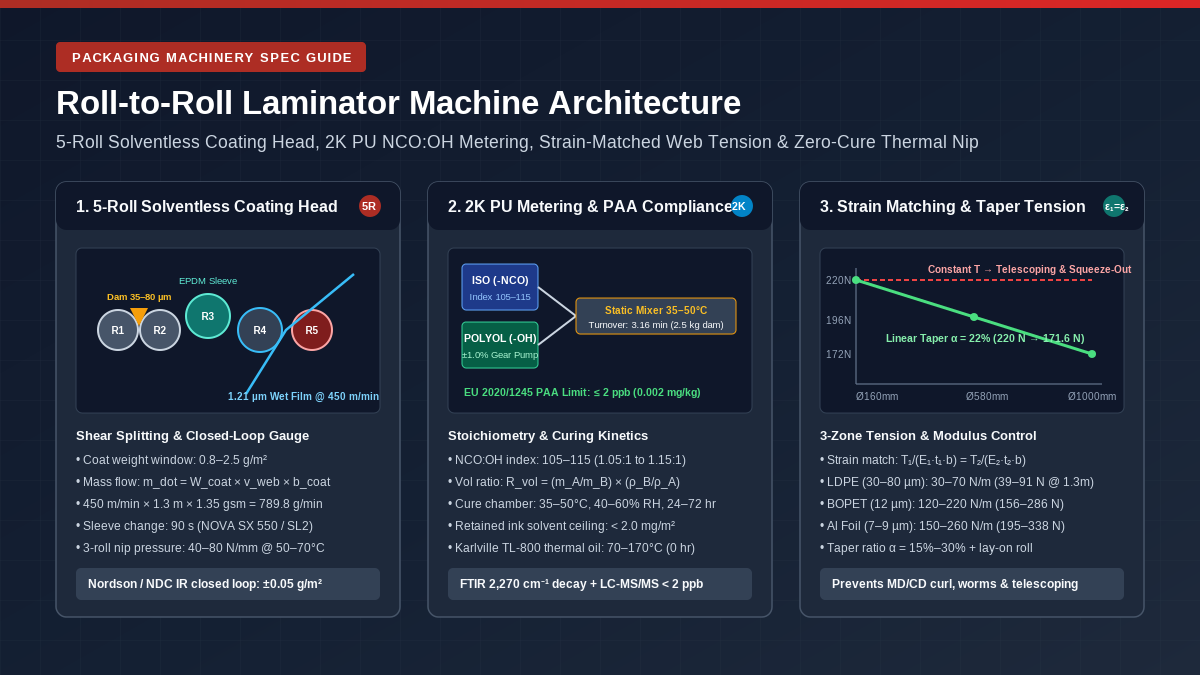
A solventless flexible packaging laminator shears a 100%-solids polyurethane film down to 0.8 to 1.8 g/m² (0.7 to 1.6 µm wet thickness) using a five-roll differential-speed stack (R1 to R5) followed by a three-roll heated laminating nip.
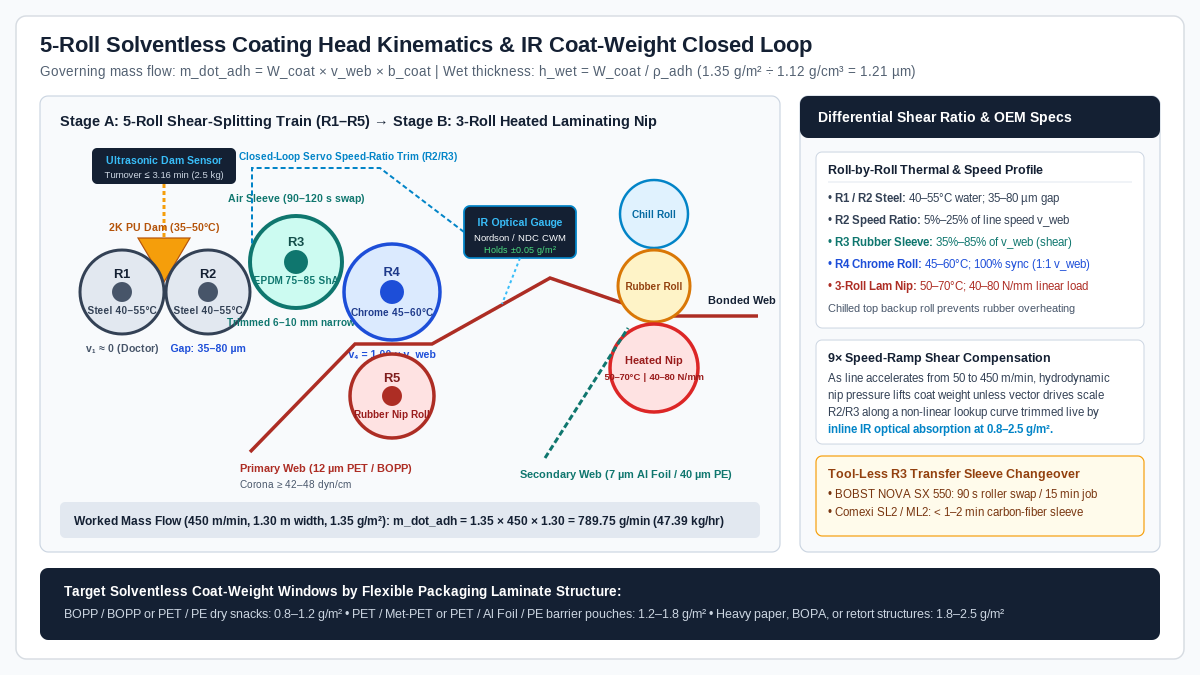
Roll-Train Kinematics and Differential Shear Splitting (R1 to R5)
Each roll in the five-roll train controls a specific rheological stage:
R1andR2(Hard-Chromed Steel Metering Rolls): Heated by 40°C to 55°C tempered water circuits, stationary/slowR1and low-speedR2(5% to 25% of web speed) hold the adhesive puddle dam across a micrometer or servo gap of 35 to 80 µm.R3(EPDM / NBR Elastomer Sleeve Transfer Roll): Mounted on an air mandrel (75 to 85 Shore A),R3runs at 35% to 85% of web speed, shearing adhesive offR2. TheR3sleeve is trimmed 6 to 10 mm narrower than the web (b_coat = b_web - 8 mm) to keep adhesive off nip edges. On the BOBST NOVA SX 550 and Comexi SL2 / ML2 Evolution, sleeves change in 60 to 120 seconds.R4(Chromed Steel Application Roll): Heated to 45°C to 60°C and driven at 1:1 synchronous speed (v_4 = v_web) with the primary web, splitting the film to sub-2 µm without misting.R5(Rubber Backing Roll) and 3-Roll Laminating Nip:R5transfers the wet film onto the primary web, which then enters the three-roll laminating nip—a 50°C to 70°C heated chrome drum, rubber pressure roll, and top chilled steel backup roll—joining the secondary web under 40 to 80 N/mm linear nip load.
Governing Mass-Flow Equation and Speed-Ramp Compensation
Adhesive mass flow rate (m_dot_adh, in g/min) to the R1/R2 dam is governed by coat weight (W_coat, in g/m²), web speed (v_web, in m/min), and coated width (b_coat, in m), while wet thickness (h_wet, in µm) divides W_coat by mixed density (ρ_adh, in g/cm³):
m_dot_adh = W_coat × v_web × b_coat | h_wet = W_coat / ρ_adh
Worked example — mass flow, wet thickness, and puddle turnover at 450 m/min: Laminating 12 µm BOPET to 7 µm Aluminum Foil on a Nordmeccanica Super Simplex SL at v_web = 450 m/min, coated width b_coat = 1.30 m, target coat weight W_coat = 1.35 g/m², and mixed PU density ρ_adh = 1.12 g/cm³:
- Mass flow rate:
m_dot_adh = 1.35 × 450 × 1.30 = 789.75 g/min(47.39 kg/hr). - Wet film thickness:
h_wet = 1.35 / 1.12 = 1.21 µm. - Puddle residence time: Holding a
2,500 g(2.50 kg) dam via the ultrasonic sensor yields a turnover timet_res = 2,500 / 789.75 = 3.16 minutes, staying below the 4-to-6-minute gel threshold.
During a 9× speed ramp from 50 to 450 m/min, hydrodynamic nip forces shift coat weight unless an inline IR optical gauge (Nordson / NDC CWM / NM 9000 or Comexi Closed Loop) measures urethane absorption after R4/R5 and trims the R2/R3 servo ratio in closed loop to ±0.05 g/m².
Takeaway: Specify independent servo/vector drives on R2, R3, and R4 with closed-loop IR optical trim so a 50 to 450 m/min speed ramp holds coat weight within ±0.05 g/m².
3. Two-Component Polyurethane Meter-Mix Dispensing and EU 2020/1245 PAA Safety
Solventless lamination reacts an isocyanate prepolymer (Component A, -NCO, typically MDI-based) with a polyol coreactant (Component B, -OH). Because cross-linking completes inside the wound reel, off-ratio dosing causes delamination and toxic amine migration.
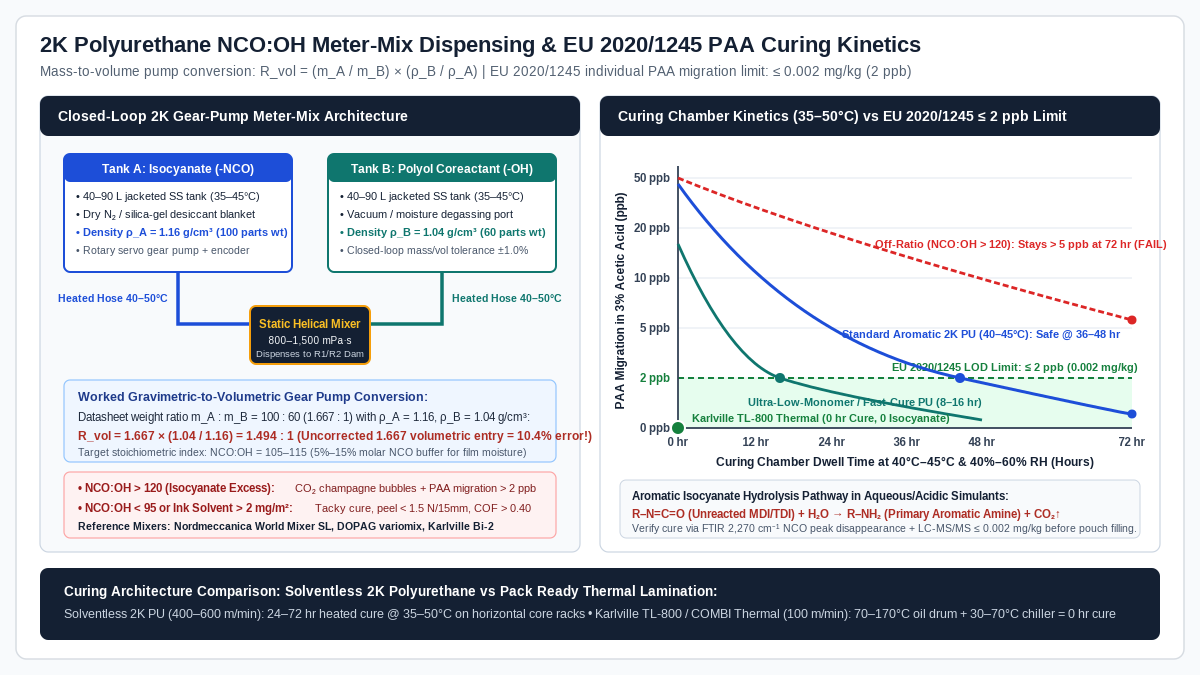
Stoichiometric NCO:OH Index and Gravimetric-to-Volumetric Pump Conversion
Meter-mix dispensers—such as the Nordmeccanica World Mixer SL (40 L and 90 L heated stainless tanks), DOPAG variomix, and Karlville Bi-2 geared mixer—target an NCO:OH stoichiometric index of 105 to 115 (1.05:1 to 1.15:1 molar ratio). That 5% to 15% isocyanate excess compensates for moisture adsorbed on BOPA, paper, or corona-treated PET/PE and ambient humidity (40% to 65% RH).
Datasheets state mix ratios by mass (m_A : m_B), whereas rotary gear pumps displace by volume (R_vol), requiring density conversion (ρ_A and ρ_B at 40°C):
R_vol = (m_A / m_B) × (ρ_B / ρ_A)
Worked example — gravimetric-to-volumetric pump conversion: For a datasheet weight ratio of 100 : 60 (m_A / m_B = 1.667 : 1) with isocyanate density ρ_A = 1.16 g/cm³ and polyol density ρ_B = 1.04 g/cm³:
- Volumetric pump ratio:
R_vol = 1.667 × (1.04 / 1.16) = 1.494 : 1. - Uncorrected HMI error: Entering
1.667 : 1into a volumetric controller overdoses isocyanate by+11.6%(10.4%stoichiometric shift), pushing theNCO:OHindex above122.
Curing Room Kinetics and EU 2020/1245 Primary Aromatic Amine (≤ 2 ppb) Compliance
Unreacted monomeric aromatic isocyanates (4,4'-MDI or 2,4-TDI) diffusing through the food-contact sealant layer (LDPE or CPP) hydrolyze with aqueous food simulants (3% acetic acid) into carcinogenic Primary Aromatic Amines (PAAs) and CO₂:
R–N=C=O + H₂O → R–NH₂ (Primary Aromatic Amine) + CO₂
Under Commission Regulation (EU) 2020/1245, individual listed PAAs must not exceed 0.002 mg/kg (2 ppb) in food simulant (≤ 0.01 mg/kg or 10 ppb sum of unlisted PAAs).
| Off-Ratio / Process Condition | Chemical Mechanism | Laminate Defect | Corrective Specification |
|---|---|---|---|
NCO:OH Index Above 120 (Isocyanate excess or missing density conversion) |
Unconsumed monomeric MDI migrates into PE sealant and reacts with moisture | PAA migration above 2 ppb (0.002 mg/kg) on LC-MS/MS; CO₂ “champagne bubbles” on Al Foil / Met-PET |
Calibrate gear pumps within ±1.0% via gravimetric shot test; enter R_vol; cure at 40°C–45°C until FTIR 2,270 cm⁻¹ NCO peak decays |
NCO:OH Index Below 95 (Polyol excess or wet tank) |
Hydroxyl excess terminates chains early; free polyol plasticizes bond | Tacky cure; T-peel below 1.5 N/15 mm; pouch seal delamination; slip scavenging spikes COF above 0.40 | Hold NCO:OH at 105–115; blanket tanks with dry nitrogen or silica-gel breathers |
| Retained Ink Solvent Above 2.0 mg/m² (Ethanol / ethyl acetate / propanol) | Alcohol solvents consume -NCO faster than polyol, starving cross-linking |
Sticky ink bleed and zero bond over heavy print coverage | Verify press dryer retained solvent below 2.0 mg/m² via GC headspace; boost NCO:OH by +5 on heavy white ink |
| Puddle Residence Above 6 Minutes (Wide ultrasonic level band) | PU polymerizes in the 35°C–50°C dam; viscosity exceeds 3,000 mPa·s |
“Orange-peel” mottle, haze, and gel streaks across clear windows | Narrow ultrasonic level band so 1.5–2.5 kg dam turns over every 2.5 to 4.0 minutes |
Rule of thumb — curing chamber specification: Suspend solventless reels horizontally on core racks in a forced-air chamber at 35°C to 50°C (40°C to 45°C for barrier foil) and 40% to 60% RH for 24 to 72 hours, releasing lots only after FTIR (2,270 cm⁻¹) and LC-MS/MS verify PAA ≤ 2 ppb.
Takeaway: Hold 2K gear pumps within ±1.0% using density-corrected R_vol (NCO:OH 105–115), keep retained ink solvents below 2.0 mg/m², and verify ≤ 2 ppb PAA compliance under EU 2020/1245.
4. Three-Zone Web Tension Strain Matching and Rewind Taper Mechanics
Bonding a high-modulus carrier film (Zone 1) to a low-modulus sealant web (Zone 2) without elastic strain matching causes post-nip curl, transverse worms (“tunneling”), and neck-in.
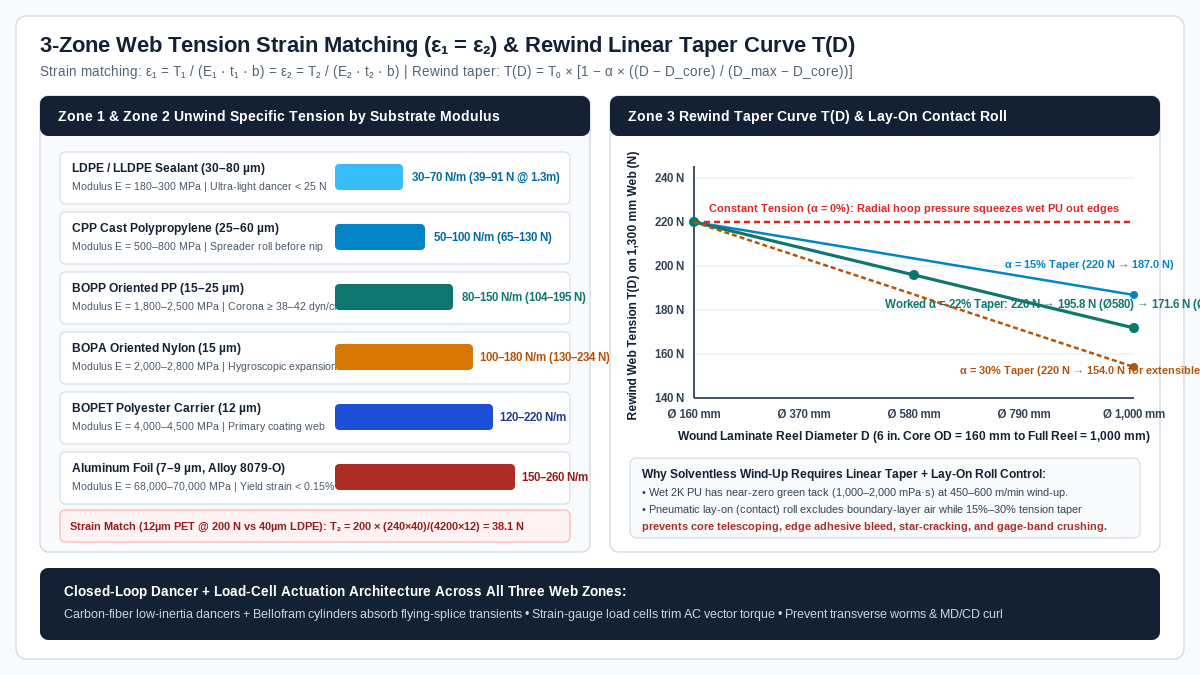
Elastic Strain-Matching Physics (ε_1 = ε_2) Across Unwind Zones
To prevent curl and tunneling, longitudinal elastic strain (ε_1) of the primary web must equal longitudinal strain (ε_2) of the secondary web at the nip:
ε_1 = T_1 / (E_1 × t_1 × b) = ε_2 = T_2 / (E_2 × t_2 × b)
where T_1, T_2 are total tensions (N), E_1, E_2 are tensile moduli (MPa), t_1, t_2 are gauges (mm), and b is web width (mm).
Worked example — strain-matching 12 µm BOPET to 40 µm LDPE: Laminating 12 µm BOPET (t_1 = 0.012 mm, E_1 = 4,200 MPa) to 40 µm LDPE (t_2 = 0.040 mm, E_2 = 240 MPa) across b = 1,300 mm at primary tension T_1 = 200 N (153.8 N/m):
- Primary carrier strain:
ε_1 = 200 / (4,200 × 0.012 × 1,300) = 0.00305(0.305%). - Matched
LDPEtension (ε_2 = 0.00305):T_2 = 200 × (240 × 0.040) / (4,200 × 0.012) = 38.1 N(29.3 N/m). Running40 µm LDPEat110 N(0.88%strain) stretches the polyethylene2.9×further than theBOPET; after the nip,LDPEelastic snap-back shears the wet PU (1,000 to 2,000 mPa·s) and lifts transverse worms across the web.
| Substrate & Gauge | Modulus E (MPa) |
Specific Tension (N/m / N/cm) |
Force @ 1,300 mm (N) |
Dancer & Web-Handling Priority |
|---|---|---|---|---|
LDPE / LLDPE (30–80 µm) |
180–300 MPa | 30–70 N/m (0.3–0.7 N/cm) | 39–91 N | Carbon-fiber dancer (below 25 N minimum) + short span before nip |
CPP (25–60 µm) |
500–800 MPa | 50–100 N/m (0.5–1.0 N/cm) | 65–130 N | Low-inertia Bellofram dancer + spreader roll before nip |
BOPP (15–25 µm) |
1,800–2,500 MPa | 80–150 N/m (0.8–1.5 N/cm) | 104–195 N | Match strain to secondary web; corona treat ≥ 38–42 dyn/cm |
BOPA Nylon (15 µm) |
2,000–2,800 MPa | 100–180 N/m (1.0–1.8 N/cm) | 130–234 N | Hygroscopic; stabilize nip wrap and moisture against corner curl |
BOPET (12 µm) |
4,000–4,500 MPa | 120–220 N/m (1.2–2.2 N/cm) | 156–286 N | Primary carrier web; high axial stiffness resists coating pull |
Al Foil (7–9 µm, 8079-O) |
68,000–70,000 MPa | 150–260 N/m (1.5–2.6 N/cm) | 195–338 N | Yield strain below 0.15%; vector drive + load-cell trim |
Zone 3 Rewind Linear Taper Tension (T(D)) and Lay-On Contact Roll
Because wet solventless PU has near-zero green tack at wind-up, constant tension (T = const) builds radial hoop pressure that squeezes adhesive out the edges and telescopes inner wraps over the 152.4 mm (6 in.) core. Specify a linear tension taper (α = 0.15 to 0.30, or 15% to 30% reduction) from core diameter (D_core) to full reel diameter (D_max):
T(D) = T_0 × [1 − α × ((D − D_core) / (D_max − D_core))]
Worked example — rewind tension taper (Ø 160 mm to Ø 1,000 mm): With initial core tension T_0 = 220 N, D_core = 160 mm, D_max = 1,000 mm, and α = 0.22 (22% taper):
- At
D = 580 mm(50% buildup):T(580) = 220 × [1 − 0.22 × ((580 − 160) / (1,000 − 160))] = 220 × 0.89 = 195.8 N. - At
D_max = 1,000 mm(full reel):T(1,000) = 220 × (1 − 0.22) = 171.6 N, paired with a contoured pneumatic lay-on roll (1.5 to 3.5 N/mm) to exclude boundary air.
Takeaway: Pair low-inertia carbon-fiber dancers (below 25 N threshold) with strain-gauge load cells to enforce ε_1 = ε_2, and run a 15% to 30% linear rewind taper (T(D)) with a lay-on roll to prevent telescoping and adhesive bleed.
5. Factory Acceptance Testing (FAT) and Downstream Converting Integration
Structure builder trials using our packaging machinery FAT checklist so multi-substrate test runs, gravimetric mixer checks, and site curing validations are tracked separately:
- Downstream Flow-Wrap & Twist-Wrap Consumption: High-speed wrappers covered in our candy wrapping machine guide require stable
COF(0.18 to 0.28). Off-ratio PU (NCO:OHbelow95) scavenges erucamide slip additives, spikingCOFabove0.40. - Shrink Tunnel vs. Barrier Laminate Specs: Keep laminated barrier gauges (
12 µm PET / 7 µm Al / 50 µm PEbonded at50°C–70°Cnip) distinct from polyolefin shrink-film residence times in our heat-shrink packaging machines buying guide. - Inline Laser Scoring: Coordinate web tension stability (
±1.0 N) and encoder sync for easy-open pouch scoring with our industrial laser engraving and marking machine selection guide.
Five-Point FAT Verification Protocol
- Gravimetric 2K Mixer Shot Test (
±1.0%): Weigh three 60-second static-mixer shots at40°Cto verify density-correctedR_volaccuracy within±1.0%. - Speed-Ramp Coat-Weight Stability (
50 to 450+ m/min): Run12 µm PET / 7 µm Al Foil(1.35 g/m²) and20 µm BOPP / 40 µm LDPE(1.10 g/m²) from50 m/minto rated speed, confirming±0.05 to ±0.08 g/m²uniformity via gravimetric strips and the inline IR gauge. - Curl and Tunneling Check: Cut
100 mm × 100 mmsquares from outer, middle, and core wraps; verify flat lay (curl radius≥ 50 mm) and zero transverse worming. - Sleeve Changeover Clock (
≤ 15 Minutes): VerifyR3sleeve swap (≤ 90 to 120 secondson NOVA SX 550 or Comexi SL2) and automated wash-up. - Post-Cure T-Peel & PAA Release: After 24 to 48 hours at 40°C to 45°C, verify T-peel strength (
≥ 2.5 to 4.5 N/15 mm), FTIR2,270 cm⁻¹NCO decay, and LC-MS/MS migration≤ 0.002 mg/kg(2 ppb) per EU 2020/1245.
Takeaway: Separate factory mechanical checks (±0.05 g/m² speed-ramp coat weight, ±1.0% mixer dosing, and 90-second sleeve swaps) from post-cure lab clearance (T-peel and ≤ 2 ppb PAA migration).
Frequently Asked Questions
How does a 5-roll solventless laminator control coat weight at 0.8 to 1.8 g/m² during speed ramps?
A 5-roll solventless head pre-meters 100%-solids polyurethane through a heated 35 to 80 µm steel gap (R1/R2 at 40°C to 55°C), shears the film via an EPDM sleeve (R3 at 35% to 85% web speed), and transfers it onto a synchronous chromed roll (R4 at 100% web speed). During a 50 to 450–600 m/min ramp, an inline infrared (IR) sensor measures urethane absorption and trims the R2/R3 servo ratios in closed loop to hold ±0.05 g/m².
When should a converter choose a roll-to-roll thermal laminator over a 5-roll solventless laminator?
Choose a roll-to-roll thermal laminating machine such as the Karlville TL-800 Pack Ready (300 to 800 mm width, 100 m/min, 70°C to 170°C oil drum plus 30°C to 70°C glycol chiller) for digital runs under 3,000 to 5,000 linear meters requiring 0-hour curing for immediate slitting. Choose a 400 to 600 m/min 5-roll solventless laminator (Nordmeccanica Super Simplex SL, BOBST NOVA SX 550, or Comexi SL2) above 5,000 linear meters where lower liquid 2K PU cost per square meter outweighs the 24-to-72-hour curing hold.
Why does entering a weight mix ratio into a volumetric 2K adhesive pump cause PAA migration failures?
Datasheets state 2K polyurethane ratios by mass (m_A / m_B), whereas gear pumps dose by volume (R_vol = (m_A / m_B) × (ρ_B / ρ_A)). With isocyanate density ρ_A = 1.16 g/cm³ and polyol density ρ_B = 1.04 g/cm³, a 100 : 60 (1.667 : 1) weight ratio requires a 1.494 : 1 volumetric ratio. Entering 1.667 : 1 without density correction overdoses isocyanate by more than 10%, leaving unreacted MDI that hydrolyzes into primary aromatic amines (PAAs) above the EU 2020/1245 limit of 0.002 mg/kg (2 ppb).
What causes transverse tunneling (worms) when laminating BOPET or BOPP to extensible LDPE film?
Transverse tunneling occurs when extensible 30 to 80 µm LDPE (E = 180 to 300 MPa) is unwound at higher elastic strain (ε_2) than rigid 12 µm BOPET (E = 4,000 to 4,500 MPa). After the nip, over-stretched LDPE contracts against wet polyurethane (1,000 to 2,000 mPa·s), buckling the carrier film into transverse ridges. Prevent tunneling by matching strain (ε_1 = ε_2) using a low-inertia dancer (30 to 70 N/m on LDPE).
How much rewind tension taper is required on a solventless flexible packaging laminator?
Specify a 15% to 30% linear tension taper (α = 0.15 to 0.30) from the 152.4 mm (6 in.) core to full 1,000 mm reel diameter (T(D) = T_0 × [1 − α × ((D − D_core) / (D_max − D_core))]) with a pneumatic lay-on roll. Because uncured PU remains liquid during wind-up, constant tension squeezes adhesive out the edges and telescopes inner wraps.