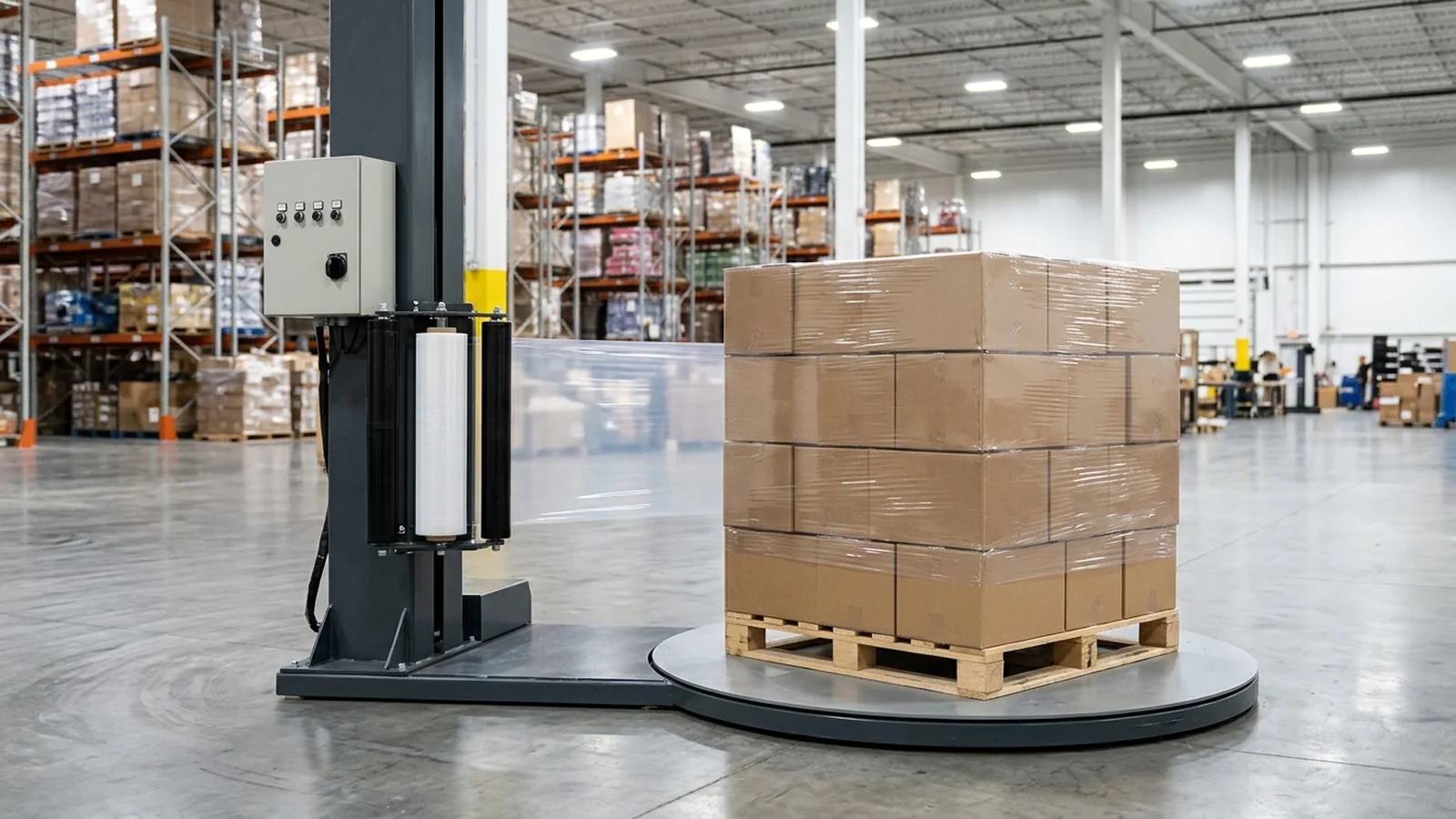
A turntable stretch wrapper places a palletized load onto a round or octagonal steel deck that rotates the pallet past a vertical mast carrying the film roll. As the carriage travels up and down the mast, powered rollers elongate the film before it contacts the load, and the film’s elastic recovery locks the stacked tiers into a single unit load. When a pallet is too light, top-heavy, or fragile to spin without shifting—or heavier than a practical rotating bearing deck—a rotary-arm or rotary-ring wrapper keeps the pallet stationary and orbits the film carriage around it instead.
Selecting the right end-of-line wrapper within a broader packaging machinery layout starts with separating unitizing methods across the line. Stretch wrap relies on mechanical tension and elastic recovery at ambient warehouse temperatures, whereas loose polymer hoods or sleeves contracted by heated air belong in our heat-shrink packaging machines buying guide. Upstream tier pattern, column stacking, and slip-sheet placement—covered in our palletizer machine buying guide—directly determine how much rotational speed a pallet can tolerate once it reaches the wrapper.
How automatic and semi-automatic turntable stretch wrappers work
Both semi-automatic and automatic turntable wrappers generate containment force through the same two-stage mechanical path: differential pre-stretch inside the mast carriage followed by controlled payout tension between the carriage and the rotating pallet corners. Commercial machine-grade stretch films typically elongate roughly 500% at break and are stretched 100% to 300% (up to 400% on dual-motor carriages) during application so elastic recovery squeezes the load inward after wrapping.
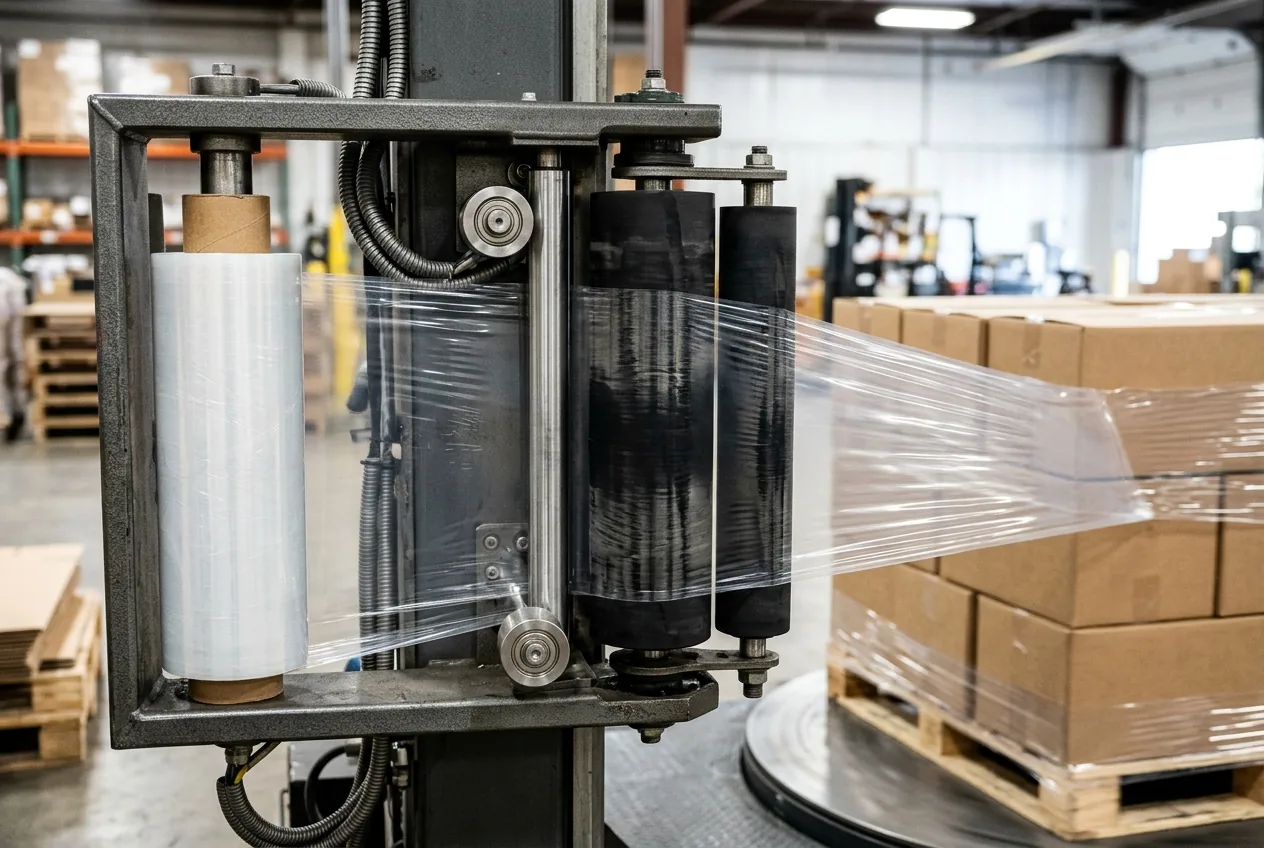
Across mainstream semi-automatic and automatic turntable designs, standard powered pre-stretch sits between 200% and 250%: Lantech’s Q300 and Wulftec’s SMH-HVY ship with 200% standard pre-stretch (with 100%–300% ratio gearing available), Lantech’s conveyorized Q-Automatic uses 225% standard pre-stretch, Jores Technologies’ E-STR-1500-P sets 250% powered pre-stretch, and Robopac’s Rotoplat 708 drives two independent carriage motors adjustable from 150% to 400% directly from the HMI.
A rectangular pallet pulls film faster as each corner sweeps past the mast than when a flat side faces the carriage. Standard semi-automatic turntables cap deck rotation at 12 RPM (1–12 RPM on the Lantech Q300; 5–12 RPM on the Robopac Rotoplat 708), whereas conveyorized automatic turntables (15 RPM on the Lantech Q-Automatic) and heavy-duty ring-gear decks (up to 16 RPM on the Wulftec SMH-HVY) spin faster. Active wrap-force feedback options—such as Lantech’s Power Roller-Stretch Plus film delivery system or Robopac’s load-cell corner compensation—sense those cyclic tension spikes and modulate roller payout in real time. Buyers specify active tension control either when running turntables above 12 RPM or when wrapping crush-sensitive cartons and light loads that would deform under fixed corner tension.
An automatic turntable keeps the same rotating-deck physics as a semi-automatic unit while adding PLC-sequenced powered roller or chain conveyors to index the pallet onto the deck, a pneumatic or mechanical clamp to hold the leading film tail, an automatic hot-wire or blade cutter, and a wipe-down arm or tail-sealing unit so no operator approaches the turntable between cycles.
Takeaway: Semi-automatic and automatic turntables share identical pre-stretch and rotating-deck mechanics; automation adds conveyor indexing plus automatic film clamping, cutting, and tail wipe-down.
Turntable load limits: deck weight, pallet diagonal, and rotational stability
Sizing a turntable stretch wrapper requires checking three independent mechanical boundaries—bearing-deck mass capacity, pallet horizontal diagonal, and rotational load stability—rather than checking pallet weight alone.
1. Bearing-deck weight capacity and slab loading
Standard low-profile semi-automatic turntables carry 1,587 to 2,000 kg (3,500 to 4,400 lb) on a caster-supported or ring-bearing steel plate:
- Entry to mid-range decks: Jores Technologies’ E-STR-1500-P is rated to 1,587 kg (3,500 lb); Lantech’s Q300, Lantech’s conveyorized Q-Automatic, and Wulftec’s high-profile WSMH-150-S are rated to 1,814 kg (4,000 lb); Robopac’s standard Rotoplat 708 is rated to 2,000 kg (4,400 lb) with a 2,495 kg (5,500 lb) heavy-duty option.
- Heavy-duty structural turntables: Machines built around structural steel frames and pinion-and-ring-gear drives—such as Wulftec’s SMH-HVY—push rotating-deck capacity to 3,629 kg (8,000 lb).
When checking mezzanine or suspended-slab floor loading, keep dynamic pallet capacity separate from the wrapper’s own dead weight (for example, roughly 748 kg / 1,650 lb shipping mass on a stand-alone Lantech Q300, versus 3,289 kg / 7,250 lb on a conveyorized Q-Automatic). Low-profile smooth-top decks sit roughly 75–85 mm off the slab and accept electric walkie jacks or forklifts via a bolt-on steel ramp; where hand pallet jacks must load without pushing up an incline, recessed floor-level pit mounts (offered on 1,651 mm / 65 in and 1,829 mm / 72 in decks) bring the turntable flush with the warehouse floor.
2. Pallet diagonal and oversized-deck RPM derating
Because the pallet rotates in place, the governing horizontal dimension is the pallet diagonal—not pallet length or width alone—so all four corners clear the vertical mast with proper film-entry geometry:
- A standard North American 1,219 × 1,016 mm (48 × 40 in) pallet has a 1,587 mm (62.5 in) diagonal, fitting cleanly inside the 1,829 mm (72 in) recommended load diagonal of a standard 1,651 mm (65 in) round turntable (used on both the Lantech Q300 and Robopac Rotoplat 708).
- Heavy-duty octagonal high-profile tables such as the Wulftec SMH-HVY (1,295 mm / 51 in octagonal support table) clear up to a 2,083 mm (82 in) load diagonal, while standard wrap height spans 2,032 mm (80 in) on most North American masts with 2,794 mm (110 in) extended-mast options (standard on the Rotoplat 708).
- Oversized-deck speed derating: Outward centrifugal acceleration at the pallet corner grows linearly with corner radius and with the square of rotational speed. When oversized skids, doors, or windows require stepping up from a 1,651 mm (65 in) deck to an optional 1,829 mm (72 in) or 2,438 mm (96 in) turntable, maximum rotation speed must come down—on Lantech’s Q300, selecting the 2,438 mm (96 in) turntable caps maximum speed at 8 RPM instead of 12 RPM.
3. Center of gravity and load-toppling boundaries
A pallet weighing only 120 kg sits far below any deck’s weight rating yet can still fail on a turntable if unbonded tiers slide or tip during rotational acceleration. Empty PET or HDPE bottles, tissue cartons, tall mixed-SKU e-commerce pick pallets, and slick polymer bags without high-friction tier sheets experience peak shear at start-up, braking, and 10–15 RPM steady rotation.
Variable-frequency drives with soft-start/soft-stop ramps and pneumatic or electric top hold-down platens stabilize moderately light column-stacked loads on a turntable. However, whenever rotational inertia would still shift tiers—or when loads exceed 2,000–3,629 kg (4,400–8,000 lb)—keep the pallet stationary and switch to a rotary-arm or rotary-ring wrapper.
Selection boundary: Choose a turntable when pallets are cohesive, weigh up to 1,814–2,000 kg (or up to 3,629 kg on heavy-duty ring-gear decks), and fit a 1,829–2,083 mm (72–82 in) diagonal at 8–15 RPM. Switch to a stationary-load wrapper whenever loads are very light and unbonded, top-heavy, irregularly overhanging, or heavier than your deck rating.
Semi-automatic vs automatic wrappers and what “floor capacity” means
Plant teams frequently assume that hitting 40 pallets per hour forces a jump from a semi-automatic turntable to a conveyorized automatic line. Published ratings across manufacturers show substantial overlap in that middle band:
- Stand-alone semi-automatic turntables wrap 25–35 loads/hr on the Lantech Q300, up to 40 loads/hr on the Robopac Rotoplat 708, and up to 55 loads/hr on Wulftec’s WSMH-150-S and SMH-HVY (depending on wrap height, revolution count, and forklift staging).
- Semi-automatic rotary-arm wrappers hit the exact same standalone throughput without conveyors: up to 40 loads/hr on the Lantech SL400 and Wulftec WRT-125, and up to 50 loads/hr on the four-legged Wulftec WRT-200.
Real-world semi-automatic output is usually bottlenecked by operator travel rather than carriage speed. Adding an automatic film cut-off option trims roughly 30 seconds of dismount labor per pallet, and remote lanyard or forklift-cab start switches save up to two minutes of driver handling per load. You step up to a conveyorized automatic wrapper when pallets discharge continuously from an upstream case sealer or palletizer, or when forklift operators must drop and go without leaving the cab.
Why rotary-arm spec sheets list load weight as “floor capacity” or “unlimited”
When comparing turntables against rotary-arm (straddle) wrappers, buyers often encounter “floor capacity” (on Lantech’s SL400) or “unlimited” (on Wulftec’s WRT-125 and WRT-200) in the maximum load-weight row. On a floor-loaded semi-automatic rotary-arm machine, the pallet rests directly on the concrete warehouse floor with no turntable bearing, ramp, or machine frame underneath it while an overhead arm orbits at 12–15 RPM (for example, a 15 RPM arm sweeping a 2,280 mm / 90 in wrap zone around a 1,931 mm / 76 in recommended load diagonal on the SL400). Because the wrapper carries zero pallet weight, maximum load mass is governed strictly by your concrete floor slab and your forklift or pallet jack rating.
That rule changes once you conveyorize a rotary-arm wrapper: in an automatic straddle line, a stationary roller or chain conveyor supports the pallet inside the wrap zone, so maximum pallet weight reverts to the conveyor structural rating—such as 136 to 2,268 kg (300 to 5,000 lb) on Wulftec’s conveyorized WCRT-175 automatic rotary-arm wrapper (rated up to 60 loads/hr at 15 RPM).
Documenting electrical, pneumatic, and floor-space differences early prevents utility surprises in your complete packaging line specification. Stand-alone semi-automatic turntables and rotary arms generally run on single-phase branch circuits with zero compressed air—such as 120 V, 14–20 A single-phase on North American Q300, Rotoplat 708, SMH-HVY, and WRT-200 units (or 220 V, 16 A in 50 Hz regions) and 208–240 VAC, 20 A single-phase on the SL400—while occupying a larger floor footprint on straddle frames (4,801 × 3,810 × 3,073 mm / 189 × 150 × 121 in on the SL400 versus 3,048 × 1,727 × 2,489 mm / 120 × 68 × 98 in on the Q300). Conveyorized automatic wrappers typically step up to 480 V three-phase power (400 V three-phase in Europe) plus clean dry plant air—such as 85–142 L/min at 4–6 bar (3–5 CFM at 55–80 psi) on the Lantech Q-Automatic—to actuate tail clamps, reach arms, and hot-wire cutters.
Takeaway: Semi-automatic rotary arms carry no pallet weight on the machine—leaving floor-loaded mass limited only by the slab and lift truck—whereas automatic wrappers add three-phase conveyor drives, pneumatic clamp/cut hardware, and conveyor weight limits.
Typical specifications and load boundaries across stretch wrapper architectures
Beyond turntables and rotary arms, two ring-based architectures handle either high-speed inline palletizing or long horizontal profiles:
- Rotary-ring (horizontal ring) pallet wrappers keep the pallet stationary on an inline conveyor while a balanced horizontal ring carrying one or two film carriages orbits around the load and travels vertically. Eliminating pallet rotation and cantilevered arm inertia lifts inline throughput from up to 80 loads/hr on Robopac’s Genesis Futura 40 and up to 110 loads/hr on the Genesis Futura HS to up to 150 pallets/hr on the Acmi Vortex 500 and up to 160 pallets/hr on dual-carriage high-speed lines.
- Orbital (vertical ring) stretch wrappers orient the rotating ring vertically and pass long, narrow, or flat products—lumber bundles, pipe, aluminum extrusions, doors, moldings, or carpet rolls—horizontally through the eye of the ring on infeed and outfeed conveyors.
| Wrapper Architecture | What Moves | Typical Max Load Weight | Typical Load Envelope / Diagonal | Wrap / Ring Speed | Typical Throughput | Primary Buyer Trigger |
|---|---|---|---|---|---|---|
| Standard semi-auto turntable (e.g., Jores E-STR-1500-P, Lantech Q300, Robopac Rotoplat 708) | Deck spins pallet past vertical mast | 1,587–2,000 kg (3,500–4,400 lb); up to 2,495 kg (5,500 lb) HD | 1,651 mm (65 in) deck; 1,829 mm (72 in) diagonal; 2,032–2,794 mm (80–110 in) height | 1–12 RPM (8 RPM on 2,438 mm / 96 in oversized deck) | 25–40 loads/hr | Compact footprint and lowest capital cost for cohesive, uniform pallet loads |
| Heavy-duty / automatic turntable (e.g., Wulftec SMH-HVY, Lantech Q-Automatic) | Ring-gear or conveyorized deck spins pallet | 1,814 kg (4,000 lb) conveyorized up to 3,629 kg (8,000 lb) heavy-duty | 2,057–2,083 mm (81–82 in) diagonal; 2,032–2,336 mm (80–92 in) height | 15–16 RPM (with active tension control) | 40–55+ loads/hr | Heavy dense skids on forklifts, or inline conveyorized lines handling stable pallets |
| Semi-auto & auto rotary arm (e.g., Lantech SL400, Wulftec WRT-200 & WCRT-175) | Overhead arm orbits stationary pallet | Floor/forklift limit when floor-loaded; ~2,268 kg (5,000 lb) on conveyorized models | 1,931–2,083 mm (76–82 in) diagonal inside ~2,280 mm (90 in) arm zone; 2,032–2,794 mm (80–110 in) height | 12–15 RPM arm speed (0 RPM pallet rotation) | 40–60 loads/hr | Very light, top-heavy, fragile, wet/washdown, or ultra-heavy loads that cannot spin |
| Automatic rotary ring (e.g., Robopac Genesis Futura 40/HS, Acmi Vortex 500) | Horizontal ring orbits & travels vertically around still pallet | Governed by inline pallet conveyor rating | Standard 48 × 40 in and Euro pallets up to ~2,000+ mm wrap height | Balanced ring drive, single or dual film reel | 80–160 pallets/hr | High-speed automated beverage, tissue, or CPG palletizing lines |
| Orbital horizontal wrapper | Vertical ring spins around horizontally conveyed product | Governed by horizontal belt/roller conveyor | Ring eye diameter matched to bundle cross-section; continuous length | Ring RPM matched to linear conveyor feed | Continuous linear feed | Long profiles (doors, timber, pipe, extrusions, rolls) rather than upright pallets |
Takeaway: Match machine kinematics to load physics first—turntables for stable pallets within deck weight and diagonal limits, rotary arms for unstable or floor-bearing loads at moderate rates, rotary rings for 80–160 pallet/hr inline lines, and orbital rings for long horizontal bundles.
Stretch film materials and ASTM D4649-20 selection scope
In warehouse terminology, pallet wrap refers to the stretchable polymeric film itself, whereas a stretch wrapper is the machine that pre-stretches and dispenses it. Most industrial pallet wrap is extruded from linear low-density polyethylene (LLDPE) copolymerized with higher alpha-olefins—specifically hexene or octene—which raise elongation at break and puncture resistance on sharp pallet stringers and case corners compared with basic butene-grade films.
When writing film specifications alongside wrapper procurement, ASTM D4649-20 (Standard Guide for Selection and Use of Stretch Wrap Films) establishes the standard industry framework:
- Application scope (Sections 1.1 and 4.1): Covers user selection, specification, and application of stretch film materials for unitizing, reinforcing, and palletizing loads in indoor environments, including warehouses and closed transport containers.
- Outdoor exclusion (Section 1.1): Standard ASTM D4649-20 guidance does not cover uncovered outdoor yard storage; loads exposed to direct sunlight or weather require UV-stabilized film formulations, opaque top sheets, or alternative weatherproof unitizing verified directly with the film supplier.
- Unit convention (Section 1.2): ASTM D4649-20 designates inch-pound units (such as film gauge in mils and width in inches—commonly 20 in / 500 mm machine rolls) as standard, with parenthetical SI values provided as mathematical conversions.
Takeaway: Pair powered pre-stretch ratios (typically 200%–300%) with hexene- or octene-based machine-grade LLDPE specified under ASTM D4649-20 for indoor unitizing, and verify UV or top-sheet requirements separately if pallets stage outdoors.
Machine guarding and floor anchoring around rotating turntables
A rotating steel turntable, an ascending mast carriage, and an orbiting straddle arm all introduce mechanical shear, nip, and impact zones governed in US facilities by OSHA 29 CFR 1910.212 (2024 CFR text) and packaging-machinery safety standard ANSI/PMMI B155.1-2023:
- Rotating parts and nip points — 1910.212(a)(1) & (a)(3)(ii): Machine guarding must protect operators and nearby pedestrians from hazards created by rotating parts, ingoing nip points (pre-stretch rollers, mast lift chains/belts, and the clearance gap between a rotating deck and a fixed loading ramp), and automatic cut/clamp mechanisms, keeping any part of the body out of the danger zone during the operating cycle. Accepted methods include physical barrier guards, interlocked perimeter fencing, safety light curtains, and laser area scanners.
- Guard mounting — 1910.212(a)(2): Guards must be affixed to the machine where possible—or anchored to the surrounding floor where machine attachment is impractical—and engineered so the guard itself introduces no pinch or trip hazard. Note that
1910.212(a)(4)(interlocked enclosures for revolving drums, barrels, and containers) applies to enclosed mixing vessels rather than open pallet turntables. - Floor anchoring — 1910.212(b): Machines designed for a fixed location must be securely anchored to the concrete slab so dynamic braking torque or incidental forklift contact cannot walk or shift the mast or straddle legs.
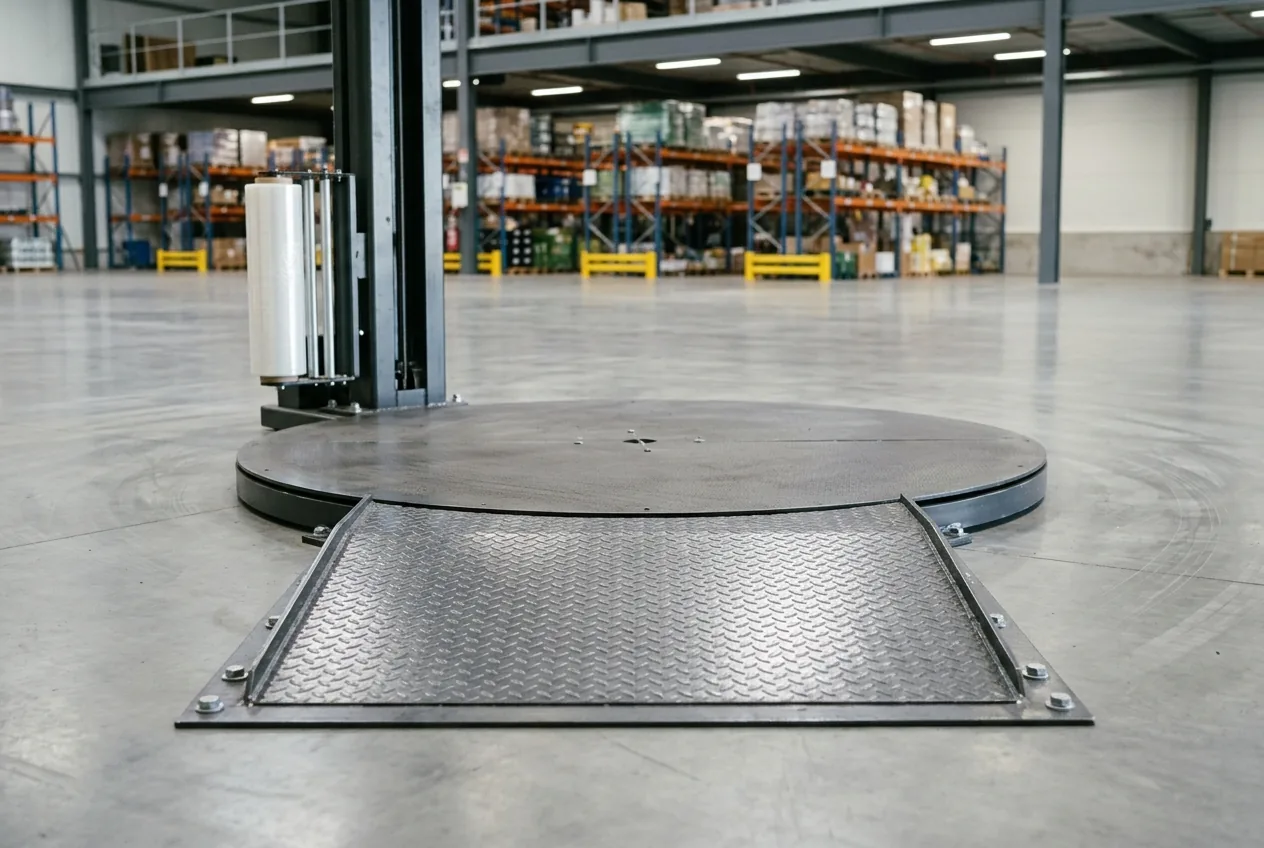
On stand-alone semi-automatic turntables loaded directly by forklifts or pallet jacks, manufacturers minimize exposed pinch points through enclosed motors and wiring, polycarbonate pre-stretch roller covers with safety interlocks, anti-fall mast locks, and pressure-activated safety plates under the film carriage. On wide-sweep rotary-arm wrappers and conveyorized automatic lines, standard safeguarding expands to physical wrap-zone shields or full perimeter caging, muted infeed/outfeed light curtains, cycle start alarms and visual beacons, and rear-mounted HMI panels positioned outside the arm path—all of which should be tested under fault conditions in your packaging machinery FAT checklist.
Takeaway: Anchor fixed turntable bases, ramps, and rotary-arm frames into the concrete slab per 29 CFR 1910.212(b), and verify carriage anti-crush stops, roller interlocks, and wrap-zone perimeter guarding against ANSI/PMMI B155.1-2023 before commissioning.
Buyer selection checklist: stability, load envelope, and line integration
Use these eight engineering checks to finalize wrapper architecture and RFQ parameters before comparing supplier quotes:
- Load stability at operating RPM: If stacked tiers are very light, top-heavy, slick, or unbonded and would shift at 8–12 RPM even with a soft-start VFD or top platen, specify a stationary-load rotary-arm or rotary-ring wrapper rather than a turntable.
- Maximum pallet weight vs. support surface: Keep pallets within 1,587–2,000 kg (3,500–4,400 lb) on standard semi-automatic turntables, step up to a 3,629 kg (8,000 lb) ring-gear turntable for dense heavy skids, or use a floor-loaded rotary-arm wrapper where pallet weight rests directly on the warehouse slab. On any conveyorized wrapper, verify the conveyor’s structural weight rating separately.
- Pallet diagonal and speed derating: Calculate maximum pallet diagonal (pallet length and width corner-to-corner, including overhang) against the wrapper’s recommended diagonal (typically 1,829 mm / 72 in on a 65 in deck), and budget for lower cycle speeds (such as 8 RPM on a 2,438 mm / 96 in oversized deck) when wrapping wide or long skids.
- Maximum wrap height: Confirm whether a standard 2,032 mm (80 in) mast clears your tallest pallet including pallet stringer height, or specify a 2,794 mm (110 in) extended mast up front.
- Loading method (ramp vs. pit vs. conveyor): Choose a bolt-on loading ramp for counterbalanced forklifts and powered walkies, a recessed floor-level pit mount where manual hand pallet jacks load low-profile decks, or powered roller/chain conveyors for inline automation.
- Throughput vs. operator labor: Do not buy an automatic wrapper solely because volume reaches 35–40 pallets/hr; buy conveyorized automatic film attach, cut, and tail wipe-down when upstream palletizing is automated or when keeping drivers in the forklift cab justifies three-phase power and plant air.
- Utilities and floor footprint: Confirm single-phase (120 V or 208–240 V) airless operation for stand-alone units versus 400–480 V three-phase power plus 4–6 bar (55–80 psi) compressed air and perimeter caging clearances for automatic cells.
- Guarding, anchoring, and film trials: Require concrete anchor-bolt drawings, carriage obstruction stops, roller-gate interlocks, and muted conveyor light curtains per OSHA 29 CFR 1910.212 and ANSI/PMMI B155.1-2023, and validate containment force with your actual indoor LLDPE film roll per ASTM D4649-20 during acceptance testing.