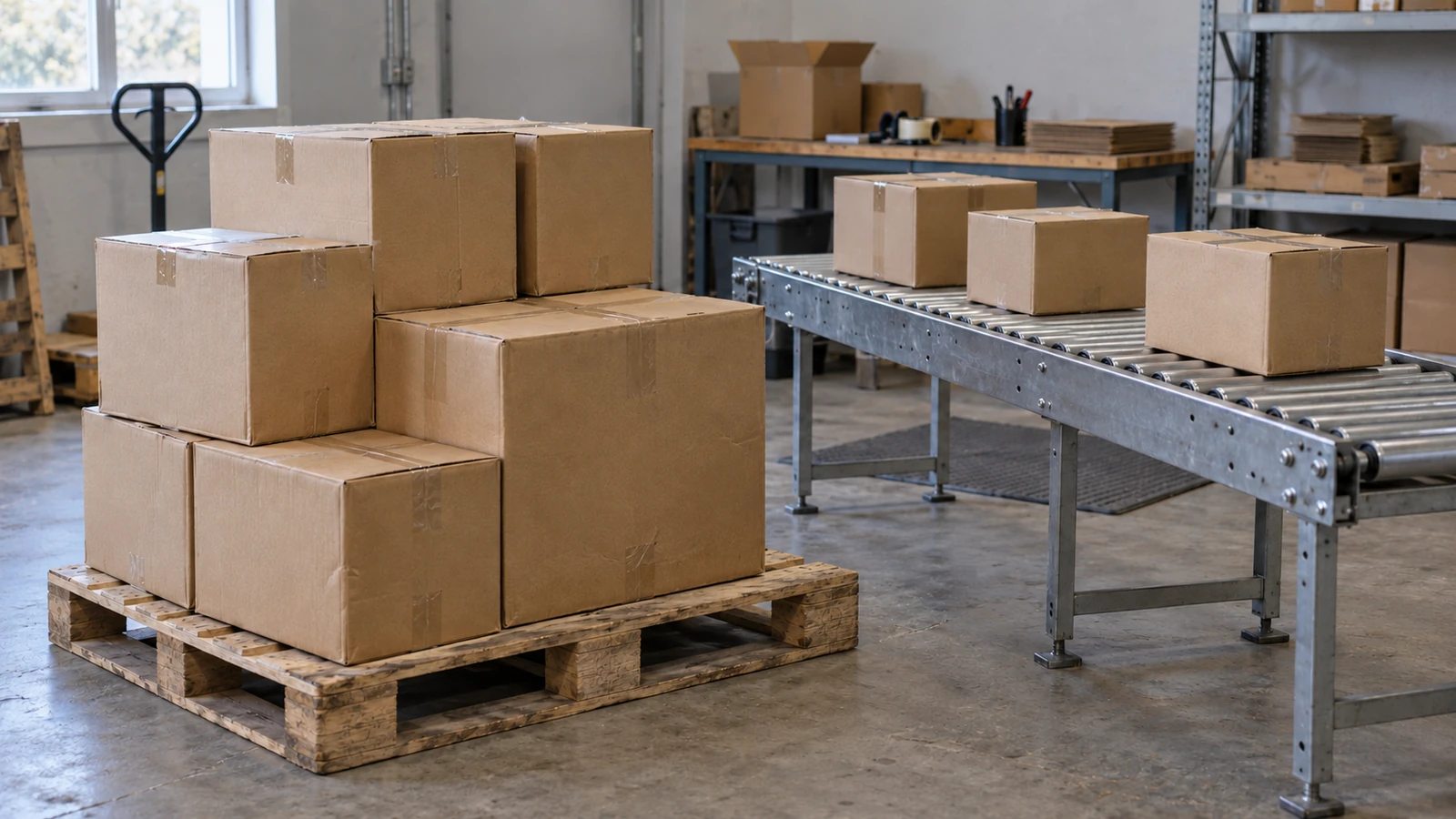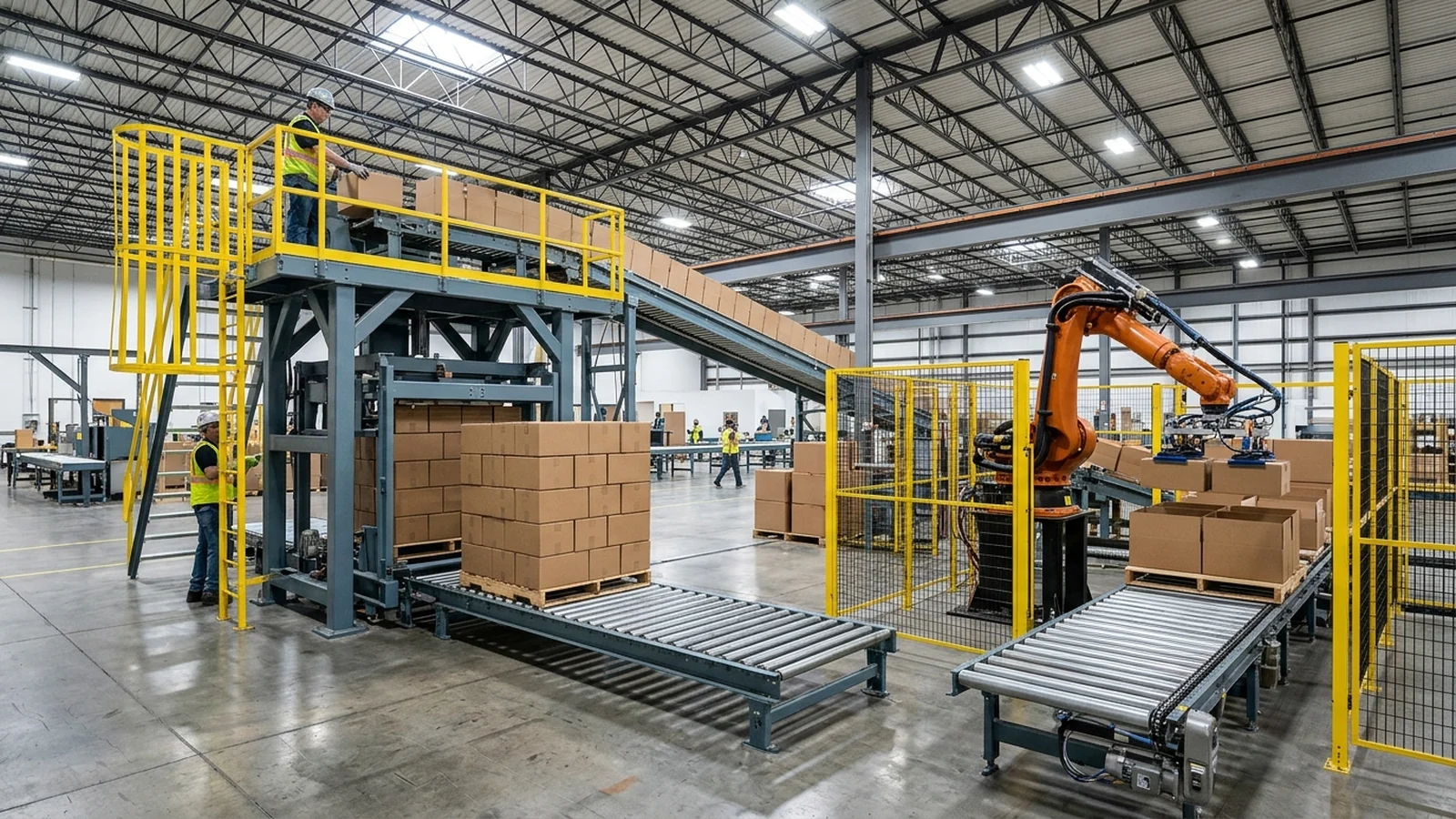
Selecting an industrial palletizer machine requires verifying layer-push versus pick-and-place cycle rates, net wrist payload after end-of-arm tooling deduction, empty-pallet and slip-sheet dispensing cycles, and safeguarded floor space to prevent unplanned downtime and package damage. Choosing the wrong palletizing architecture causes conveyor bottlenecks, dropped loads, or costly floor rework across our material handling guides—distinct from timber nailing systems in our automatic wood pallet making machine scope guide and used pallet machines purchase evidence guide—and this guide compiles published speeds, payloads, tooling rules, and safety standards to support a complete packaging line specification and a packaging machinery factory acceptance checklist.
Palletizing System Architectures: Throughput, Floor Space, and Payback Boundaries
Before issuing a request for quotation for a palletizing machine, project teams should compare how centralized systems, end-of-line articulated robots, collaborative workcells, and conventional pushers divide production rate, footprint, and capital recovery time. In Robotiq’s palletizing comparison, Robotiq Lean Palletizing workcells typically offer the fastest ROI, with a payback period of 1 to 2 years (1–2 years), whereas centralized systems have a payback period of 4–7 years.
Quick-Specs Reference: Published Palletizer Architecture Benchmarks
The table below compiles published throughput ranges, floor space requirements, and capacity boundaries across primary palletizing machine architectures.
| Palletizer Architecture | Published Throughput & Line Capacity | Published Footprint, Payload & Payback Scope |
|---|---|---|
| High-Speed Conventional Case Layer Palletizer | nVenia's T-Tek conventional layer palletizers are designed for uniform, high-volume production and deliver up to 200 cases/min for maximum throughput. | Scott Technology's NexPal 200HL palletizes 35 cases per minute by using a side-mounted rotating row pusher that allows case infeed and layer formation to occur simultaneously. |
| High-Level vs Low-Level Push-Type Bag Palletizers | Concetti's high-level push-type palletizer reaches a maximum speed of up to 2,700 b/h (depending on the number of bags per layer) and handles workable bag weights up to 50 kg. | Concetti's low-level push-type palletizer reaches a maximum speed of up to 1,000 b/h (depending on the number of bags per layer) and handles workable bag weights up to 50 kg. |
| Multi-Line Industrial Robotic Palletizing Cell | nVenia's Arpac Brand Robotic Palletizer Model ranges from a one-line in/one-line out configuration up to a four-line in/four-line out configuration, handling cases, trays, bundles, and bags at rates up to 60 pieces per minute. | Columbia/Okura states that articulated robotic palletizers can palletize up to four lines at once and pick up to 25 cases per minute, with its robotic palletizing systems operating 99.5% of the desired time. |
| Centralized vs End-of-Line Robotic & Cobot Matrix | In Robotiq's palletizing comparison table, throughput in cases/min is 30–80 for centralized palletizers, 25–60 for robotic (EOL) palletizers, 8–15 for cobot palletizers, 6–12 for in-a-box palletizers, 8-15 for Lean Palletizing workcells, and 4–6 for manual palletizing. | In Robotiq's palletizing comparison table, required floor space footprint is 400–1000+ sq ft for centralized palletizers, 250-600 sq ft for robotic (EOL) palletizers, 100–200 sq ft for cobot palletizers, and 80–150 sq ft (80-150 sq ft) for in-a-box and Lean Palletizing workcells. |
Selecting between a manual palletizer station, a collaborative cell, an industrial robot, or a dedicated layer machine depends on how many lines converge at the pallet station. Single high-speed lines discharging uniform cases or bags continuously favor layer-forming machines that transfer an entire squared layer at once, whereas multi-line or frequent-changeover operations favor robotic pick-and-place cells.
Conventional Layer Palletizers: High-Level vs Low-Level Trapdoor and Cross-Stacking Mechanics
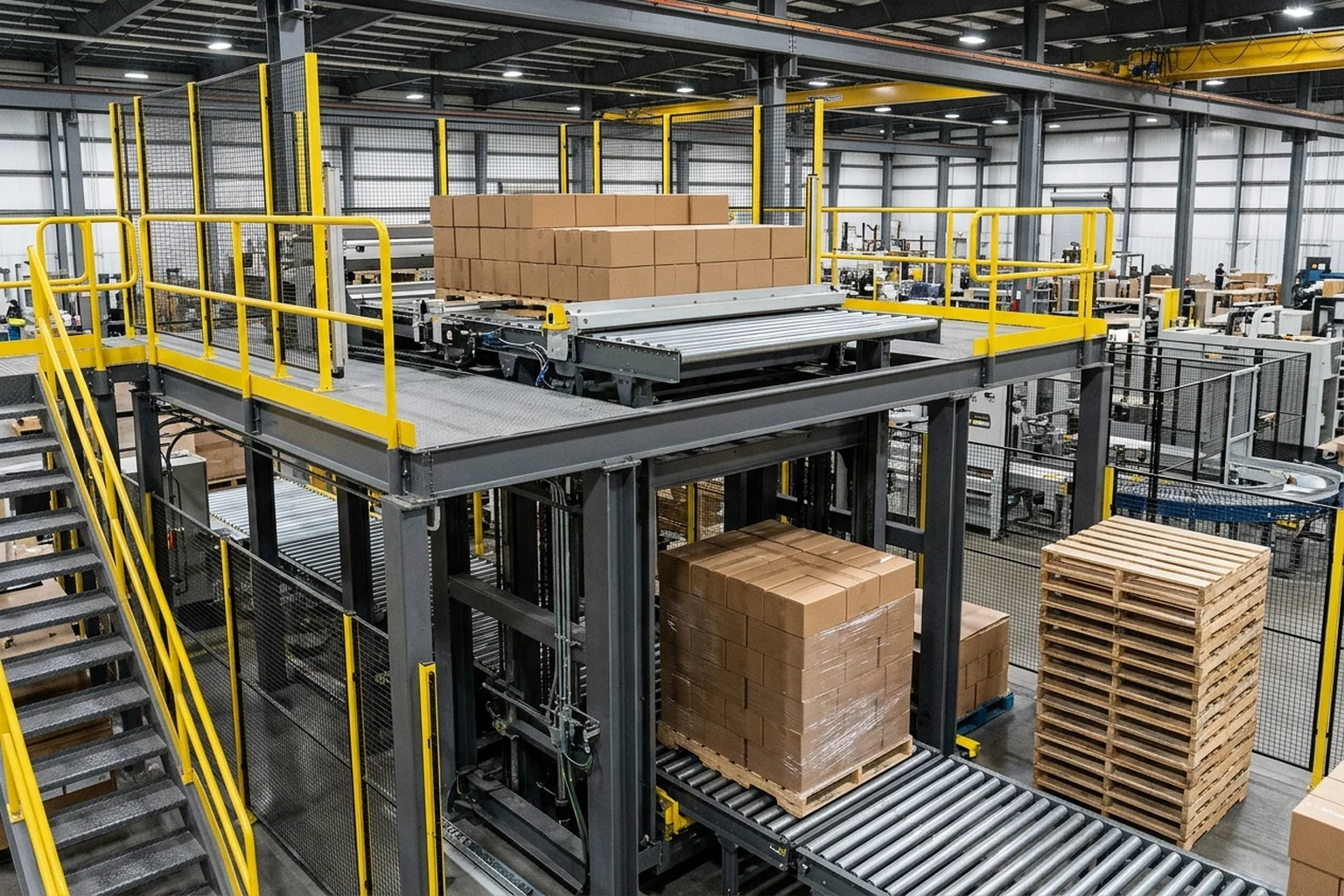
In Concetti’s conventional palletizer machine designs, the high-level push-type palletizer uses a rigid high-level case palletizer with a vertical sliding frame that holds the pallet being formed, while the low-level push-type palletizer uses a rigid structure with a vertical sliding frame that sustains the trapdoor mechanism. In Concetti’s high-level push-type palletizer, when the last row completes the layer, a pusher shifts the entire layer over two sliding trapdoors that centrally unload the layer, which is then compacted on all four sides before the doors open to unload the layer onto the pallet and the frame lowers by the thickness of one layer. Concetti’s high-level push-type palletizer accommodates minimum pallet dimensions of 800 x 1200 mm, maximum pallet dimensions of 1100 x 1300 mm, a maximum palletized load height of 2000 mm (including pallet height), and a maximum full pallet weight of 2000 kg. Concetti’s high-level push-type palletizer includes a treading platform to access the elevated parts of the machine, an empty-pallet magazine, an evacuation roller conveyor, and a full-pallet parking roller conveyor.
In Concetti’s low-level push-type palletizer, a pusher conveys the completed layer at low level onto a trapdoor incorporated on the mobile frame, which then raises to the height of the pallet being formed, compacts the layer on all four sides, unloads it, and descends back to the row-formation roller conveyor height. Concetti’s low-level push-type palletizer accommodates minimum pallet dimensions of 800 x 1200 mm, maximum pallet dimensions of 1100 x 1400 mm, a maximum palletized load height of 2000 mm (including pallet height), and a maximum full pallet weight of 2000 kg.
nVenia’s VPC Model Conventional Palletizer arranges bags into patterns through sliding and rotating movements at up to 30 bags per minute, then presses the pallet against the sliding table’s bottom for layer stability and alignment.
nVenia’s VPC Model Conventional Palletizer includes 500 programmable menus, handles 10-110 lbs. bag weights on 460V, 3Ph, 60Hz electrical power, and supports standard 48“x32” and industrial GMA & CHEP 40“x48” pallet sizes.
nVenia’s VPB/VPB-K Model Cross Stacking Palletizer uses a rotary head to feed up to 25 bags per minute, includes 500 adjustable programs, and handles 10-110 lb bag weights on 460V, 3Ph, 60Hz electrical power.
nVenia’s VPG Model Cross Stacking Palletizer uses a specialized gripper to cross-stack up to 15 bags per minute, offers 500 freely adjustable programs, and handles 10-110 lb bag weights on 460V, 3Ph, 60Hz power. BW Flexible Systems’ SYMACH 3500S push-type conventional palletizer merges the Thiele Master 3500 with the SYMACH platform, using a stacking cage to contain bags within specified dimensions and prevent product overhang, plus an HMI supporting 12 languages.
Industrial Robotic, Gantry, Single-Column, and Collaborative Palletizing Cells
Multi-line packaging bays and mixed-pattern operations rely on articulated robotic palletizer cells, Cartesian gantry or single-column bag robots, and collaborative robot stations.
nVenia’s Arpac Brand Robotic Palletizer Model includes as standard a 10’ infeed conveyor, an automatic pallet dispenser with a 10 pallet magazine, a 60“ pallet build station conveyor, an integrated turntable stretch wrapper rated up to 45 loads/hour, and a 60“ pallet discharge conveyor.
nVenia’s Arpac Brand Robotic Palletizer Model uses an Allen-Bradley CompactLogix PLC and PanelView Plus 1000 10 inch color HMI as standard, with optional 80kg, 100 kg, 160 kg, 190 kg, 300 kg, 500 kg, or 800 kg 4 & 5 axis robots.
In robotic bag palletizing, entry-level five-axis cells and high-speed four-axis cells differ in kinematics, controller generation, riser height, and bags-per-minute ratings.
nVenia’s Hamer Brand Basic (Entry-Level) Robotic Bag Palletizer (an RPM Palletizer System) typically includes an MPL 100 II 5 axis 100KG robotic arm, a DX200 robot controller, a 28“ robot riser, and ANSI/RIA safety protocols.
nVenia’s Hamer Brand Basic Robotic Bag Palletizer is rated for 16-18 bags per minute with 60 FPM Chain Driven Live Roller (CDLR) speeds, 460VAC 3 Ph 60 Hz power, 2-10 CFM @ 80 PSI (design dependent) air, 60 lbs max bag weight, 55 lbs (25 kg) End of Arm Tooling weight, standard 48“ x 40“ pallets, and an 18“ CDLR top-of-roller pass height.
nVenia’s Hamer Brand Fully Automatic Robotic Bag Palletizer (RPM) typically includes a PL 190/100 4 axis 100KG robotic arm, YRC1000 robot controller, 18“ robot riser, and 18“ CDLR top-of-roller pass height, with options including a 10 meter robot master control cable and a YX1000 chiller for high temperature installations.
nVenia’s Hamer Brand Fully Automatic Robotic Bag Palletizer operates at a palletizing rate of 24-27 bags per minute with 460VAC 3 Ph 60 Hz electrical power, 2-10 CFM @ 80 psi (design dependent) compressed air, 60 lbs maximum bag weight, and 60“ maximum pallet height.
nVenia’s Hamer Brand High Speed Robotic Bag Palletizer is rated at 24-27 bags per minute for 60“ maximum pallet height and 60 lbs maximum bag weight, requiring 380-480VAC 3 Ph 60 Hz electrical power and 2 CFM @ 80 psi compressed air.
Columbia/Okura’s dynaPAL industrial robotic palletizers handle applications up to 350 kg across three models: dynaPAL Lite (50 – 100 kg load capacity, up to 12 individual picks per minute), dynaPAL (100 – 160 kg, up to 28 individual picks per minute), and dynaPAL HD (160 kg+, up to 8 individual picks per minute).
Manufacturers also build Cartesian gantry robots, turn-arm palletizers, single-column floor-level robots, and portal bag-in-box systems. Concetti’s gantry robot palletizing system operates on four Cartesian axes with a maximum speed of 600 b/h, workable bag weights up to 30 kg, pallet dimensions from 800 x 1200 mm to 1100 x 1400 mm, maximum palletized load height of 2000 mm, and maximum full pallet weight of 1500 kg. Concetti’s turn-arm (robotic arm) palletizer operates on 4 axes with a maximum speed of 1200 b/h (1200 bags/hour), workable bag weights up to 50 kg (110 lbs), pallet dimensions from 800 x 1200 mm to 1100 x 1500 mm, maximum palletized load height of 1800 mm, and maximum full pallet weight of 2000 kg. Concetti’s single-column robot palletizer reaches a maximum speed of 500 b/h, handles workable bag weights from 1 to 50 kg, and accommodates pallet dimensions from 800 x 1200 mm to 1100 x 1500 mm with a maximum palletized load height of 1800 mm and maximum full pallet weight of 2000 kg. Concetti’s PS-4A/15S-P portal-type robotic palletizer for bag-in-box packaging uses vacuum suction gripping heads with vertical movement and achieves a production capacity of up to 1400 bags/hour (1400 sacchi/ora). ELCAT Food Technology offers three levels of robotic palletizing automation, ranging from compact Cartesian systems with manual pallet handling to fully automated six-axis cells with automatic pallet supply, positioning, and discharge.
Collaborative Robot Cells: Payload Mode Coupling and Reach Verification
Buyers evaluating a collaborative robot palletizer—analyzed in detail in our companion guide on cobot palletizer payload mode and reach—must check whether the maximum wrist payload and the maximum horizontal reach apply simultaneously or belong to separate operating modes. For the FANUC CRX-30iA collaborative palletizer, FANUC pairs a 30 kg maximum wrist load capacity with a 1,756 mm faceplate reach, and expands reach to 1,889 mm only when the 25 kg payload mode is selected; J6 allowable moment is 32.0 N·m. For the FANUC CRX-30iA, published repeatability is ±0.05 mm per ISO 9283, maximum speed is 1,000 mm/s collaborative and 2,000 mm/s high speed, robot mass is 135 kg, enclosure rating is IP67, and wrist load m = m_case + m_tool + m_fittings produces J6 moment M = m × 9.81 × d. Applied Manufacturing Technologies (AMT, a FANUC Level V Authorized System Integrator) built its collaborative palletizing solution around the FANUC CRX-30iA robot—citing a single summary line of 30 kg payload, 1,889 mm reach, and IP67 rating, where 1,889 mm applies to the 25 kg payload mode rather than a simultaneous 30 kg operating point—using built-in sensors monitoring joint torque and amperage to detect human contact.
Palletization Calculator Logic: Wrist Payload Deduction and End-of-Arm Tooling Selection
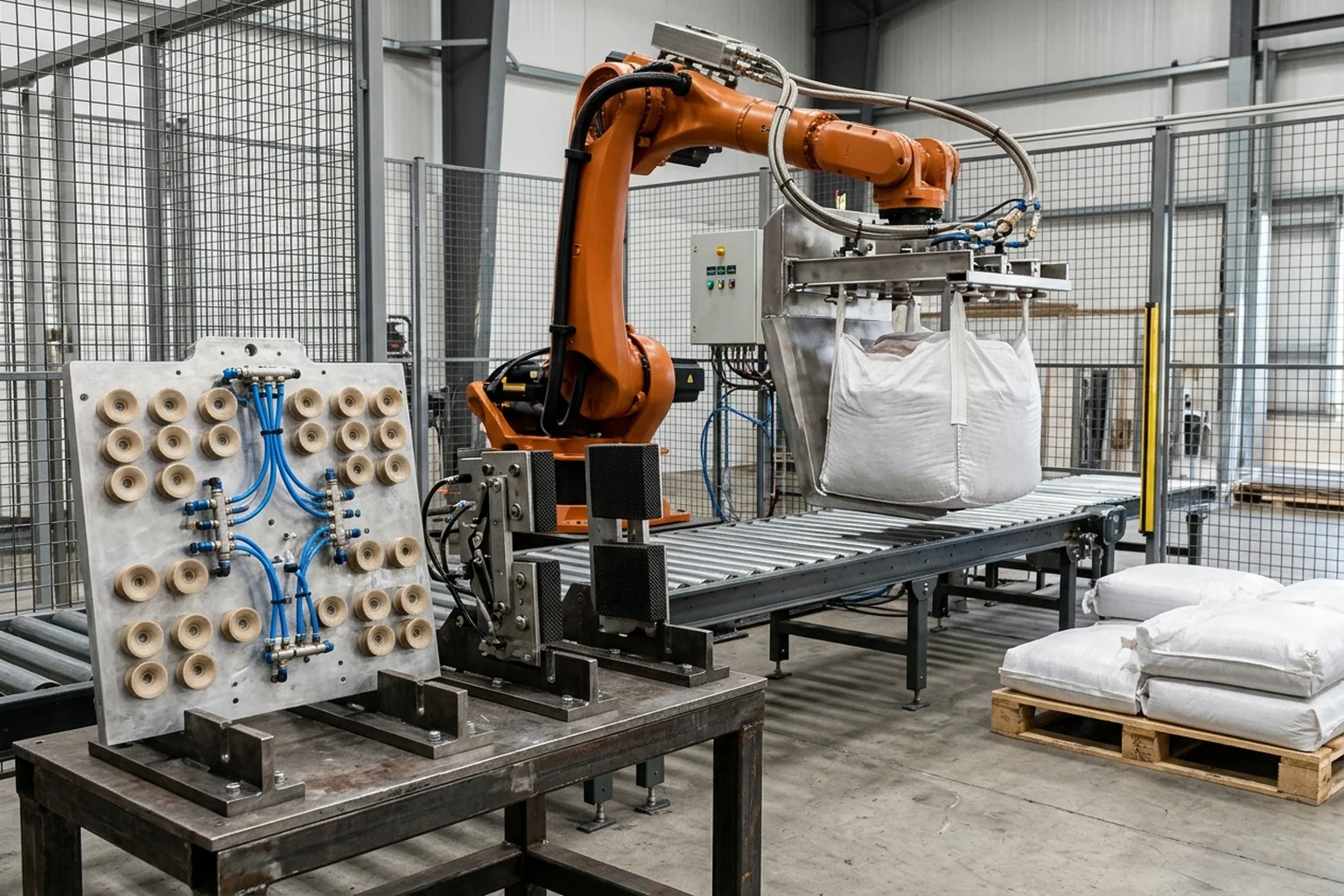
In the FANUC CRX-30iA palletization calculator check, robot sizing adds the case, end-of-arm tool, and fittings mass to the wrist load (m = m_case + m_tool + m_fittings) before checking wrist capacity limits. In nVenia’s Arpac Brand Robotic Palletizer Model, the standard 5-Axis 80kg (176lb) palletizing robot accommodates products weighing up to approximately 100 lbs.
Published End-of-Arm Tooling Categories and Application Limits
According to Brenton Engineering (ProMach), robotic palletizing End-of-Arm Tools (EOATs) fall into three basic categories—Vacuum, Clamp, and Fork—with vacuum-based EOATs divided into Venturi and dense array types.
| Tooling Family | Actuation & Air Supply Architecture | Published Package Scope, Weight Ceiling & Kinematic Trade-Offs |
|---|---|---|
| Venturi Vacuum Tooling | According to Brenton Engineering, Venturi vacuum EOATs use the plant's compressed air system, grip one or two cases at a time for low to moderate speeds and simple pack patterns, and are suited for lighter, sturdy regular slotted cases (RSCs) weighing up to 30 pounds. | According to Brenton Engineering, Venturi vacuum EOATs utilize the plant's compressed air system, so air hoses and air prep systems will have to be in place, are the least expensive of the options, and are ideal for lighter, yet sturdy RSCs weighing up to 30 pounds, gripping one or two cases at a time. |
| Dense Array Vacuum Tooling | According to Brenton Engineering, dense array vacuum EOATs rely on a matrix of small vacuum cups with their own compressed air generator for greater air flow, are typically used on RSCs reaching up to 50 pounds, can palletize multiple rows of cases per cycle, and support variation in pack patterns with zones of cups programmed to operate during any given lift. | According to Brenton Engineering, corrugated board porosity impacts vacuum EOAT effectiveness, frequent cleaning of corrugated dust off the vacuum cups is part of routine maintenance, and high acceleration does not work well with vacuum tools. |
| Clamp Tooling | According to Brenton Engineering, clamp-based EOATs can be operated by either pneumatic actuators or servo electric actuators and accelerate faster than vacuum tools for higher overall speed. | According to Brenton Engineering, clamp-based EOATs (operated by pneumatic or servo electric actuators) lift by exerting side pressure, accelerate faster than vacuum tools for higher overall speed, and can be used for packaging other than RSCs, including shrink-wrapped bundles and display-ready cases. |
| Bottom-Support Fork & Multi-Function Tooling | According to Brenton Engineering, fork-style EOATs provide bottom support plus top and side stability for bags or display cases for which neither vacuum nor clamps may be suited; forks are the largest, heaviest, and priciest EOATs, can palletize an entire row per cycle, require the most space, and may require a heftier robot due to their weight and size. | nVenia's Hamer Brand End of Arm Tooling (EOAT) options include single or multiple pick Bag Clamps (fixed size, manually adjustable, or servo/automatically adjustable), Case Grip, multiple pick Fork Style, Vacuum, and Multi-function EOAT combining pallet pick/place, slip-sheet pick/place, auto tool change, and auto height sensor. |
Peripheral Pallet and Slip-Sheet Dispensers, Safeguarding Space, and Pre-Shipment Verification
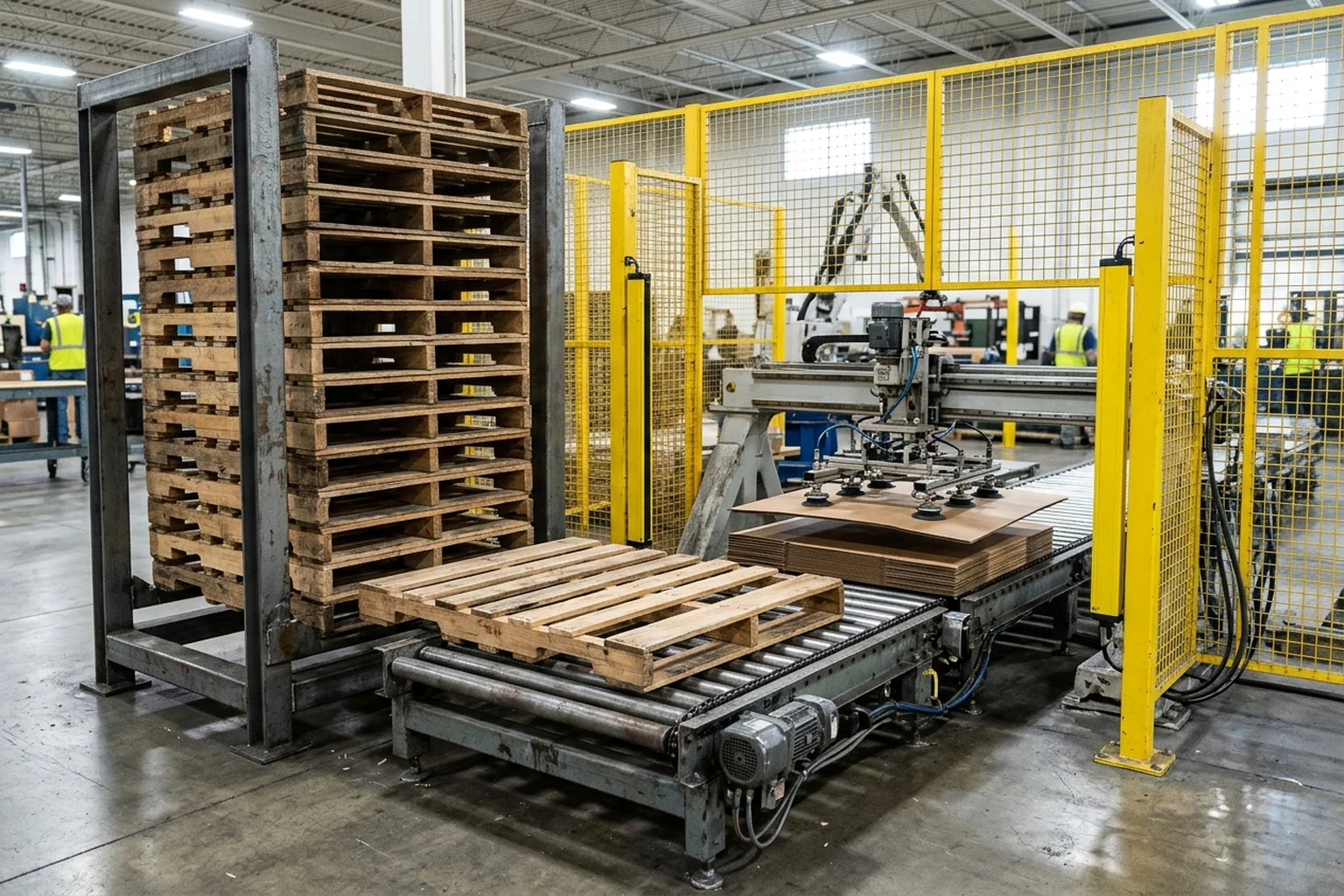
Dedicated motor-driven dispensers keep high-speed palletizers cycling continuously on product layers.
nVenia’s Hamer Brand Pallet Dispenser is a motor-driven system with a 15 pallet storage magazine (built with a 4“ structural steel tube frame and 1/4“ cross braces), air bag pallet side capture, and a 1.5 HP TEFC motor that dispenses 2+ pallets per minute straight-through or at a 90 degree orientation.
nVenia’s Hamer Brand Pallet Dispenser requires 230 / 460VAC 3 Ph electrical power and 10 CFM @ 80 psi compressed air, handling 2 or 4-way GMA and CHEP pallets with published dimensions of Width 30“ to 48“, Length 30“ to 48“, and Height 4.5’ to 5.5’.
In its standard features list, nVenia’s Hamer Brand Pallet Slip Sheet Dispenser uses a bottom table pneumatic lift, vacuum pick-and-place cups, and a 1/3 hp TEFC motor-driven carriage on a 1/4“ structural tube steel frame to deliver 2 cycles/sheets per minute, handling sheets up to 48“x 48” and up to a 10“ stack.
In its standard specs table, nVenia’s Hamer Brand Pallet Slip Sheet Dispenser requires 230/460VAC 3 Ph (1.56A/0.78A) power and 15 CFM maximum @ 80 PSI compressed air, handling clay-coated paper, double-faced corrugated cardboard, cardboard, or plastic slip sheets from 32 mil (0.032 in) to 250 mil (0.25 in) thick, up to 48“x48” size, with a spec-sheet capacity of an approx. 6“ stack up to 250 lb.
In concrete production facilities, Columbia systems pull empty production pallets out of the production loop temporarily and place a pallet in one of six stationary stacks (600-900 pallets total); with these systems, adding and removing pallets can be automated. Since 2008, a Columbia customer in the UK has been operating a 600 pallet system that runs 1400mm x 700mm pallets (Columbia Machine, May 2020).
Safeguarding Space, Collaborative Modes, and Robot Safety Standards
Specifying floor space for a robotic palletizer or cobot cell requires accounting for the safeguarded perimeter and consensus safety standards. OSHA states that there are currently no specific OSHA standards for the robotics industry; related General Industry (29 CFR 1910) regulations include 1910.22 (General requirements, under Subpart D Walking-Working Surfaces), 1910.95 (Occupational noise exposure), 1910.147 (The control of hazardous energy / lockout/tagout), and 1910.212 (General requirements for all machines, under Subpart O Machinery and Machine Guarding). In the U.S., ANSI/RIA R15.06-2012 (Industrial Robots and Robot Systems - Safety Requirements, covering robot manufacture in Part 1 and system integration/installation in Part 2) is the U.S. National Adoption of ISO 10218-1,2:2011, while CSA Z434 is the Canadian National Adoption. Supplemental U.S. robotics consensus documents cited by OSHA include ANSI/ISO 12100-2012, RIA TR R15.306 (Task-Based Risk Assessment Methodology), RIA TR R15.406 (Safeguarding), RIA TR R15.506 (Applicability of R15.06-2012 for Existing Industrial Robot Applications), RIA TR R15.606 (Collaborative Robot Safety, U.S. National Adoption of ISO/TS 15066:2016), RIA TR R15.706 (User Responsibilities, 2019), RIA TR R15.806 (Testing Methods for Power & Force Limited Collaborative Applications), ANSI/UL1740-2019, B11.0, and B11.20. OSHA cites ISO/TR 20218-1 (Safety Design for End-effectors) for managing end-of-arm tooling (EOAT) to maintain human safety in collaborative or non-collaborative industrial environments, and ISO/TR 20218-2 for Safety Design for Manual Load/Unload Stations (MLUS).
According to the OSHA Technical Manual (OTM Section IV, Chapter 4), even low-energy robots with payloads as low as 6-1/2 pounds or 3 kilograms can be used in dangerous applications, and Figure IV-3 defines four robot application zones: maximum space (1), restricted space (2), operating space (3), and safeguarded space (7). Under OSHA OTM Section IV Chapter 4, a collaborative robot application operating in automatic mode uses Speed and Separation Monitoring (SSM), Hand-Guided Controls (HGC), and/or Power and Force Limited (PFL) technology, while Safety-rated Monitored Stop (SMS, also called a Category 2 Stop under NFPA 79-2017) is not used alone and must be used in conjunction with SSM, HGC, and/or PFL. Under ISO 10218-2:2011 and RIA 15.06 Clause 5.11.5.5 (cited in OSHA OTM Section IV Chapter 4), Power and Force Limited (PFL) robot applications must evaluate quasi-static and transient contact pressure and force limits using Tables A.1 and A.2 in Annex A of RIA TR15.606, and prevent contact with sensitive body regions (face, temples, and throat) per RIA TR R15.606-2016. The 2025 update to ISO 10218-2 (ISO 10218-2:2025) incorporates the former ISO/TS 15066, specifying in informative Annex M a maximum permissible quasi-static force of 140 N for hands and fingers in Power and Force Limiting (PFL) collaborative applications, while Robotiq tested its Hand-E gripper following the methodology outlined in Annex N using a damped spring assembly to replicate bio-fidelic hand, finger, and lower-arm conditions.
Robotiq’s Hand-E adaptive gripper has a maximum gripping force of 185N, which can be configured within the recommended 140 N threshold to align with ISO TS 15066 collaborative safety guidelines.
Line Utility Interfaces and Factory Acceptance Dry-Cycle Verification
End-of-line integration requires aligning utilities, state handoffs, and dry-cycle testing with upstream packers and wrappers. In complete packaging line specifications, EDL cites 460/480 VAC, 3-phase, 60 Hz electrical supply and 90 psi compressed air as typically preferred utilities, while OMAC PackML is adopted by ISA as ISA-TR88.00.02-2022 (TR88.00.02) and Weihenstephan Standards contain 440 data points across all WS domains and define over 150 machine classes. PMMI’s factory acceptance test (FAT) roadmap recommends a minimum 24 hours dry-cycle window, contrasting with a 6 hours squeezed-window example that leaves 18 hours of unrun dry-cycle time. Compare related drive and robot cell checks in our variable frequency drive versus soft starter guide and our industrial MIG welding machine and robotic cell guide.
Step-by-Step Buyer Verification Procedure Before Issuing a Palletizer Request for Quotation
When preparing a complete packaging line specification or scheduling trials with our packaging machinery factory acceptance checklist, follow this sequence:
- Define shipping units and layer patterns: Record case or bag dimensions, weights, board porosity or bag behavior, layer patterns, and load heights across all lines.
- Select layer-push versus pick-and-place architecture: Choose a conventional layer palletizer for dedicated uniform lines, or specify a robotic cell for multi-line consolidation.
- Deduct end-of-arm tooling mass from robot payload: Require itemized vacuum, clamp, or fork tooling weights and verify wrist moment at maximum reach.
- Separate product picks from pallet and sheet cycles: Confirm whether empty pallets and slip sheets use standalone dispensers or multi-function robot tooling.
- Map restricted, operating, and safeguarded zones: Verify layout drawings, pass heights, perimeter guarding, and risk assessment responsibilities.
- Lock utilities, state handoffs, and dry-cycle hours: Specify electrical power, compressed air supply, line interlocks, and pre-shipment dry-cycle duration.
Sources
- nVenia — Arpac, Hamer, and T-Tek Conventional and Robotic Palletizer, End-of-Arm Tooling, and Dispenser Technical Data
- Concetti — High-Level, Low-Level, Gantry, Turn-Arm, Single-Column, and Portal Palletizer Technical Data
- Columbia/Okura and Columbia Machine — Industrial Robotic Palletizer and Concrete Production Automation Data
- Brenton Engineering — Choosing the Right End-of-Arm Tool for Robotic Palletizing
- BW Packaging — Conventional Palletizer Stacking Cage and Platform Specifications
- Robotiq — Palletizing Architecture Comparison Matrix and Collaborative Gripper Force Documentation
- Packaging Strategies and Applied Manufacturing Technologies — Collaborative Palletizing System Integration
- Scott Technology and Elcat Food Technology — Case Layer Pusher and Multi-Level Robotic Palletizing Documentation
- Occupational Safety and Health Administration — Industrial Robot Systems Technical Manual and Consensus Safety Standards
- Industrial Machines Finder — Collaborative Palletizer Payload, Complete Packaging Line, and Factory Acceptance Engineering Guides