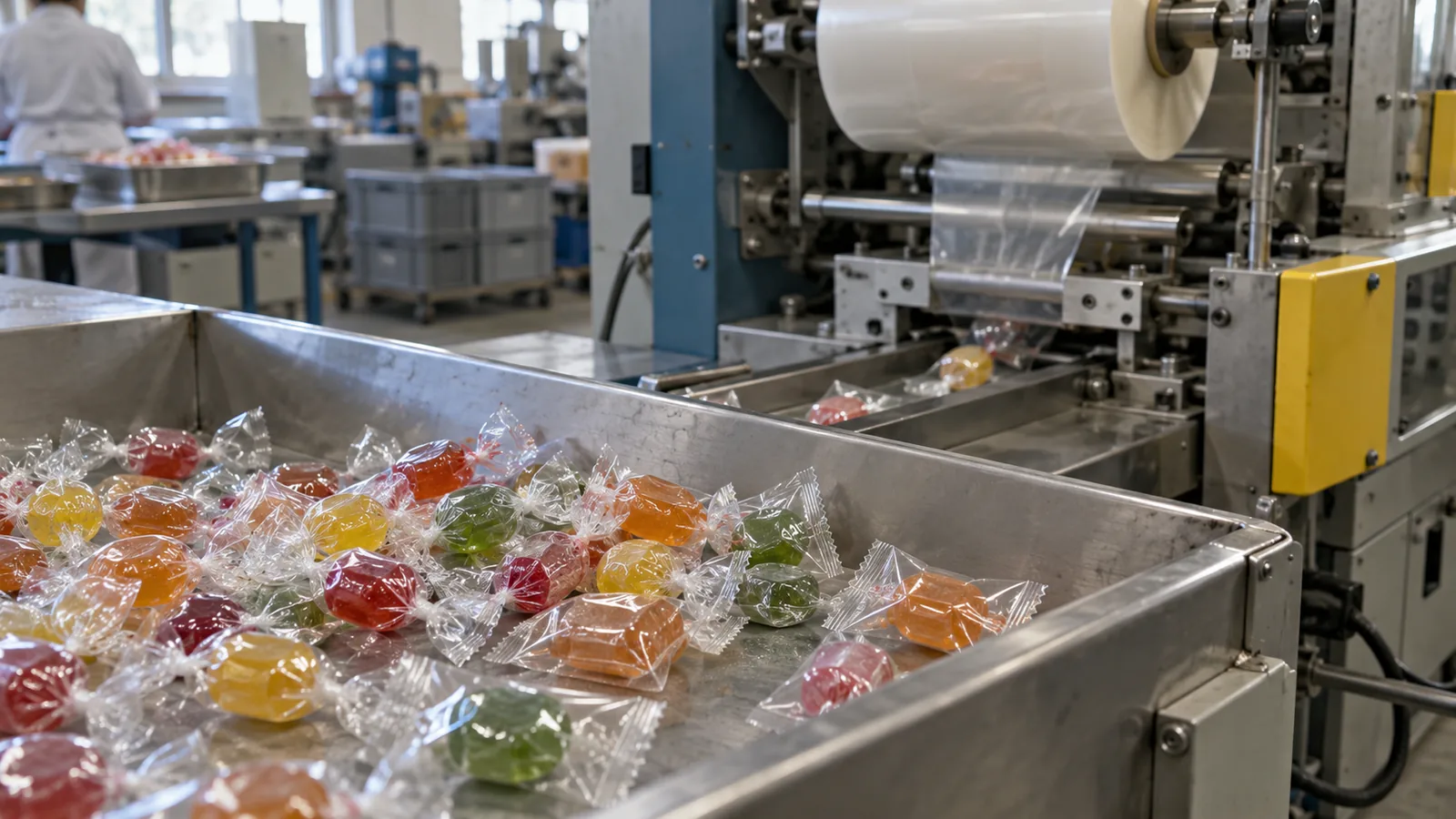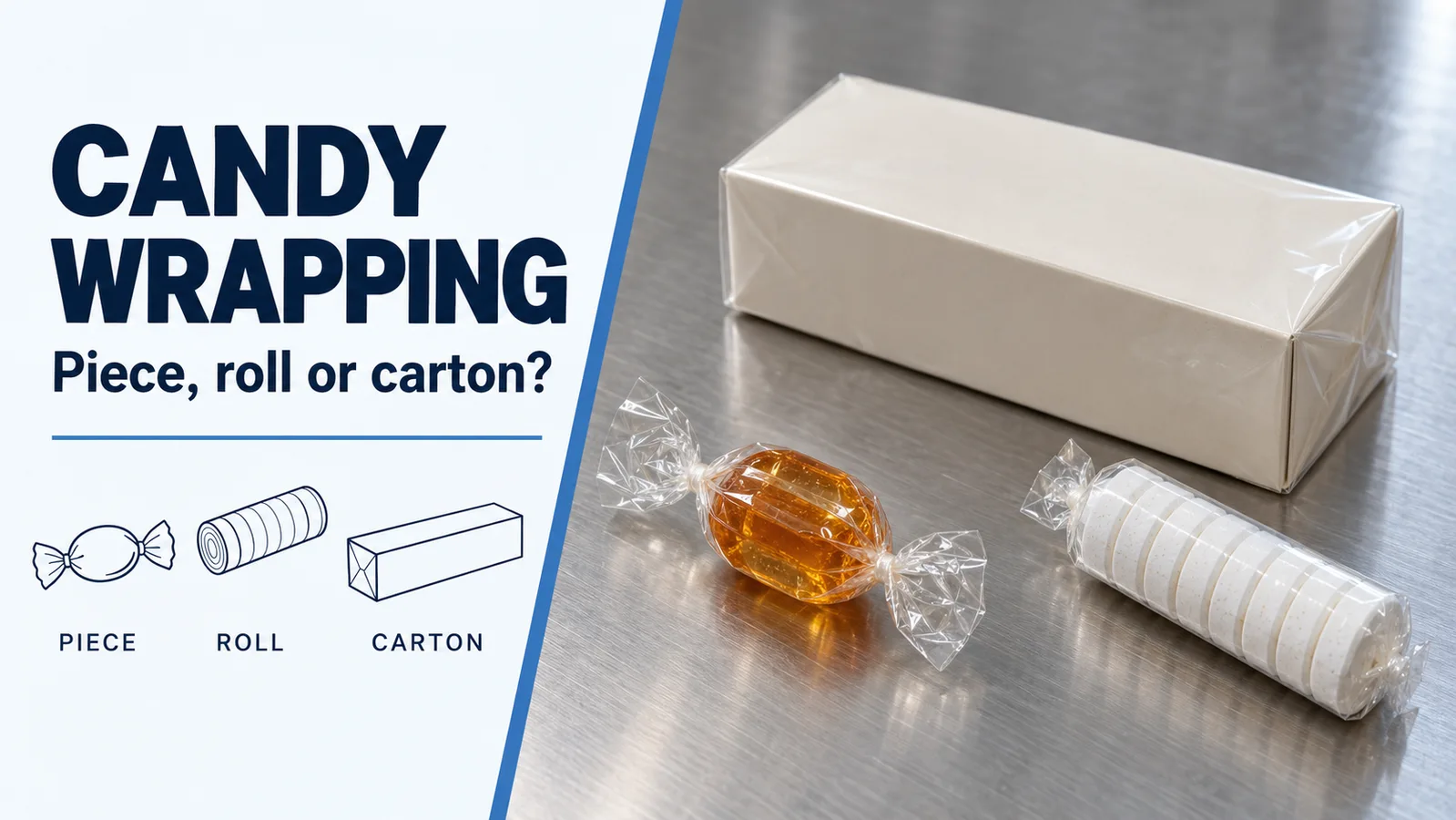
For loaded candy cartons, candy overwrapping machinery folds and seals an outer web around the pack; a single-piece twist wrapper closes a wrapper around each individual sweet. Choose between them by the object entering the machine and the finished pack leaving it. A candy roll wrapping machine adds a third possibility: several pieces grouped inside one primary wrapper.
If your equipment shortlist contains all three, start with a pack drawing. The comparison below separates product contact, closure, feeding and output units, then provides a checklist for comparing the equipment scope. For the wider equipment map, see our packaging machinery guides.
| Input to establish | Record from your product or pack | Why it changes the choice |
|---|---|---|
| Incoming state | Individual sweet, grouped pieces, loaded carton or carton bundle | Identifies the wrapping job and feed arrangement |
| Finished closure | Twisted tails, roll closure or folded carton overwrap | Determines the film-handling and closure process |
| Material and contact | Exact film grade and the layer touching the candy | Separates product-contact requirements from outer-wrap requirements |
| Required output | Accepted pieces, rolls, cartons or bundles per minute | Makes the upstream and downstream rates comparable |
What enters the wrapper: a candy, a roll or a carton?
The packaging layer follows the contact and pack structure. Wrapping a loaded carton is an outer-pack operation. Wrapping an individual sweet is primary packaging. Grouping unwrapped candies into a roll can also produce a primary pack, even though several pieces leave together.
| Decision dimension | Individual double-twist wrapper | Candy roll wrapper | Loaded-carton overwrapper |
|---|---|---|---|
| Incoming object | Individual preformed sweet | Pieces arranged into the required roll | Loaded carton, supported tray or specified bundle |
| Leaving pack | One sweet with a twist at each end | Several pieces enclosed as one roll | An outer film wrap around the carton or bundle |
| Product-contact question | Which wrapper layer touches the sweet? | Are pieces bare, or already individually wrapped? | What primary packaging is already inside the carton? |
| Closure to specify | Twist position and retained closure | Roll seam and end-closure design | Longitudinal seam and folded end closures |
| Feed boundary | Singulation, orientation and piece transfer | Feeding, counting and grouping | Carton transport and any bundle collation |
| Acceptance focus | Retained twists and candy condition | Correct grouping and completed closure | Fold placement, sealed overlaps and carton condition |
Package Machinery’s Guide to Wrapping Consumer Product describes overwrapping as a web folded around a carton, tray or bundle, with a long seam and tucked, folded ends. Its broader wrapping categories also include direct-product applications. Describe the actual carton duty in the specification rather than using “overwrapper” as a universal synonym for secondary packaging.
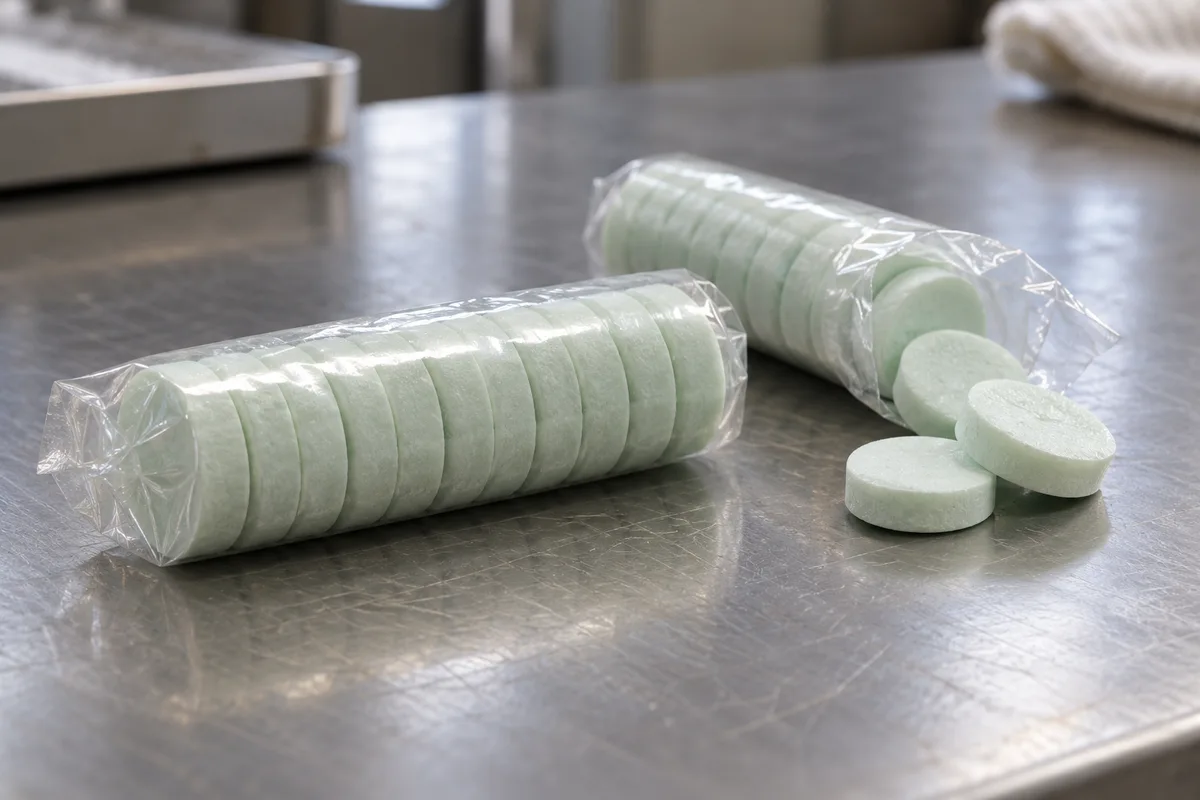
For a concrete primary-pack example, Theegarten-Pactec’s EK4 datasheet identifies double-twist wrapping of individual preformed sweets. LoeschPack’s Packaging Chewing Gum and Confectionery brochure places its RPM and RPM-S roll systems under primary packaging and separately describes downstream display cartoning. A roll is therefore a pack format, not proof that the product already has an inner wrapper.
If each sweet needs its own wrapper, begin with an individual candy wrapping machine specification. For the choice between individual twist and pillow closures, use the individual candy twist and pillow wrapping guide. If the input is a loaded display carton, begin with the carton geometry and outer-wrap closure instead.
Which closure and film properties matter?
Select the closure and exact film grade together. Fold wrapping needs a web that can be controlled around the pack and closed within the machine cycle. Twist wrapping needs a material that retains the formed closure. Film stiffness and twist retention answer different questions.
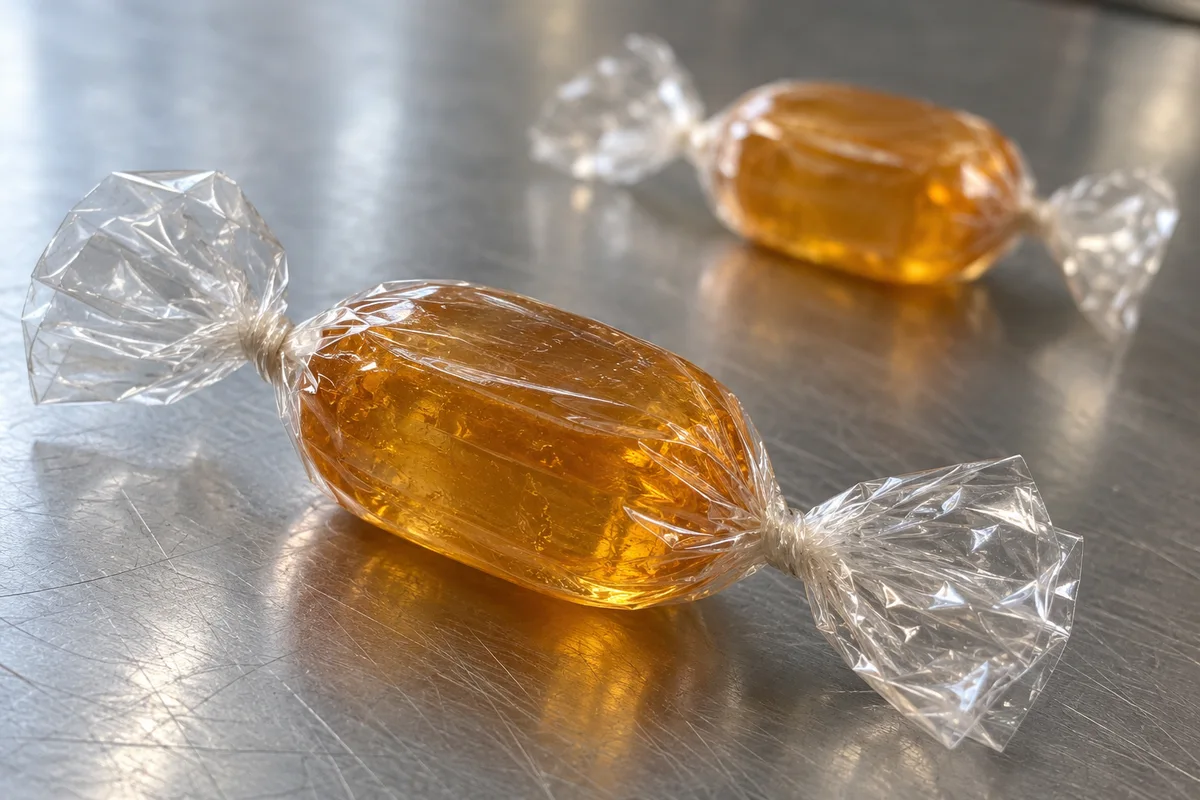
A twist must remain formed after release
The twisted neck holds the wrapper close to the candy; the film tails extend beyond it. In its confectionery film guidance, Futamura identifies natural deadfold, controlled slip and anti-static behavior among relevant properties of its NatureFlex films. Deadfold describes the material’s ability to retain a formed fold or twist.
Use that property as a trial criterion: after wrapping and the intended downstream handling, inspect whether the twists remain closed, whether the film tears and whether the candy is marked or sticks to the wrapper. Record the actual candy condition and film grade used. Slip and static performance address film handling; candy release needs its own observation with the product sample.
An envelope overwrap needs supported folds and compatible seals
A carton supplies faces and edges around which the web is tucked and folded. The resulting package has a longitudinal overlap and end folds. Package Machinery’s guide connects wrapping-material selection with stiffness, the faces being sealed, and the sealing time and temperature available in the cycle.
Specify the seam position and required end closure on the pack drawing. Pair that drawing with the exact film grade, coating, thickness and sealing-face information. During the trial, inspect the longitudinal overlap and both ends, including fold alignment, incomplete seals and carton deformation. A material description such as “clear film” leaves these decisions unresolved.
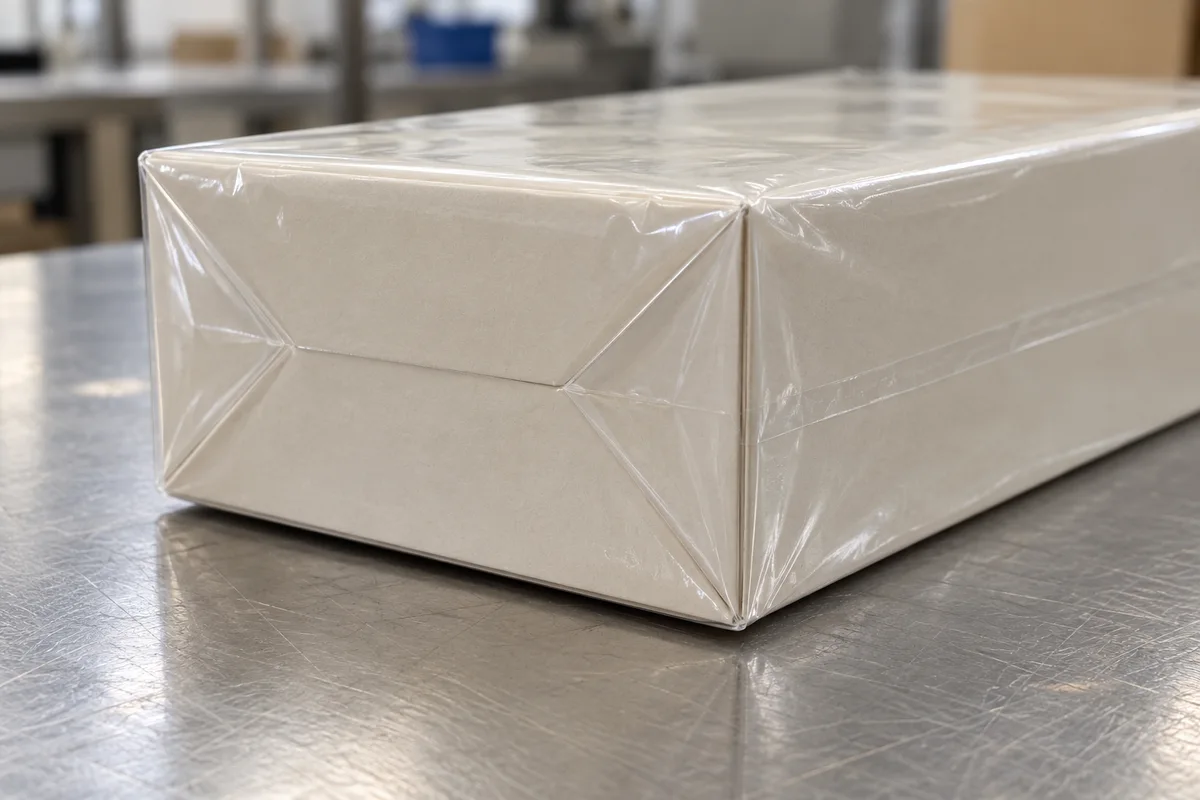
Selection rule: when the required output is a fully enclosed carton, specify full overwrap and its closure locations. A band around the pack is a different output: it leaves faces exposed. LoeschPack’s distinction between fold wrapping and band wrapping illustrates why the finished-pack drawing belongs in the purchase scope.
Where do feeding, counting and cartoning belong?
Assign every change in product state to a named machine or supplied function. Individual-piece feeding, roll formation and carton transport require different handoffs. The fact that a wrapper can close the required pack does not define how product reaches its infeed.
For a route that puts individually wrapped candies into cartons and then overwraps them, the sequence is:
Individual wrapping → counting and carton loading → loaded-carton transfer → optional bundle collation → outer wrapping.
For primary rolls, replace the first portion with product feeding, grouping and roll wrapping, then specify whether the rolls go into display cartons. LoeschPack describes product-specific vibratory feeding for roll applications and belt feeding for breakage-sensitive products; feeder selection follows the actual product and format.
At each handoff, identify the arriving orientation, pitch or grouping, allowed accumulation, reject route and transfer owner. Include the stop, full and starved signals, plus the restart sequence. An accumulation section also needs a product-handling limit: how much contact or pressure can the accepted pack tolerate during a stop?
These boundaries affect the purchase scope. Compare included feeding and grouping equipment, format parts, cartoning, transfer conveyors, collation, controls integration and changeover work alongside the wrapper. For a responsibility matrix, use the machine-to-machine handoff specification.
How do pieces per minute become cartons or bundles per minute?
Convert each stage to the same finished-pack unit before comparing capacity. A piece rate, a roll rate and an overwrapper’s pack rate measure different outputs. Use sustained accepted rates for the selected candy, film and pack recipe when balancing the line.
For the count-packed route above, define:
| Symbol | Meaning | Unit |
|---|---|---|
| q | Accepted wrapped-candy output | Pieces/minute |
| n | Wrapped candies in each carton | Pieces/carton |
| c | Accepted loaded-carton output | Cartons/minute |
| g | Cartons in each overwrapped bundle | Cartons/bundle |
| w | Accepted overwrapper output | Bundles/minute |
The finished-output upper bound is:
Q ≤ min(q ÷ (n × g), c ÷ g, w), in bundles/minute.
The first term converts individual candies into bundle equivalents. The second converts loaded cartons. The smallest term limits sustained output, even if the other machines can run faster. This relationship assumes the listed serial route, fixed counts and sufficient capacity at the intervening transfers. Feeding interruptions and other line constraints can reduce the achieved rate further.
For a roll line, include the actual pieces per roll and rolls per carton in the conversion. For weight-filled cartons, use the filling basis and measured output for that recipe. Keep catalogue maximum speeds separate from accepted sustained rates: a maximum for one model and product cannot establish the running capacity of the whole line.
Check free storage and backlog recovery
A buffer accommodates a temporary difference between incoming and outgoing rates. During a complete downstream stop, with constant continuing inflow r units/minute for t minutes, the required free holding capacity is:
Bfree ≥ r × t, in the same units as the incoming packs.
Use free positions at the start of the interruption, not the buffer’s total installed capacity. Locate the buffer on the line drawing so that pieces, rolls and cartons cannot be confused.
If downstream production continues at a reduced rate, storage fills at the positive difference between inflow and outflow. After the interruption, the downstream section needs spare capacity, or upstream production must slow, to clear the backlog. If sustained downstream output is below sustained inflow, storage eventually fills regardless of buffer size.
Procurement boundary checklist
Complete this record with the actual product, pack drawing and sample film before comparing offers. Carry the same record into the trial so the offered functions and accepted output can be checked together.
| Record | What to specify | Evidence to retain |
|---|---|---|
| Product and pack state | Candy shape and dimensions, incoming condition, count, orientation and finished pack | Product samples and incoming/outgoing drawings |
| Packaging layer | Every wrapper or carton already present; which material touches the candy | Pack cross-section or opened reference pack |
| Closure | Double twist, roll closure, full envelope overwrap or band; seam and end locations | Approved finished-pack sample |
| Film | Exact grade, coating, thickness, slip/static information and fold or twist properties; sealing faces where relevant | Film datasheet and roll identity; application-specific food-contact documentation for contact layers |
| Supply boundary | Feeding, counting, grouping, cartoning, collation, conveyors, accumulation and rejects | Equipment list with an owner for every transfer |
| Performance | Accepted output unit, pack counts, trial duration, treatment of stops and selected format | Counts of presented, rejected and accepted packs over the agreed period |
| Changeover and restart | Required formats, parts to change, transfer settings and stop/restart sequence | Demonstration record for the agreed format change and interruption |
| Pack quality | Twist retention or seal completion, film integrity, candy condition and carton condition | Agreed acceptance criteria and retained samples |
For a single sweet with twisted tails, select and evaluate the piece-feeding and twist-closure system. For a grouped primary roll, specify grouping and roll closure. For an already loaded carton, specify the envelope overwrap and the loaded-pack handoff. Those three descriptions give suppliers a concrete packaging task and give you comparable boundaries for their proposals.
Technical sources
- Package Machinery — Guide to Wrapping Consumer Product. Wrapping terminology, pack geometry, fold closures and material/sealing considerations.
- Theegarten-Pactec — EK4 datasheet. Individual preformed-sweet double-twist application and feeding suitability.
- LoeschPack — Packaging Chewing Gum and Confectionery. Primary roll wrapping, product feeding, fold/band wrapping and downstream display cartoning.
- Futamura — Food Packaging, confectionery and chocolate sections. Deadfold, slip, static and application-specific film properties.
The capacity and buffer equations express pack-count and flow conservation for the stated line conditions. Use the checklist to record the recipe and accepted rates needed to apply them.