Treating 32,000 cartons per hour as installed output wastes the aisle a tight plant cannot rebuild. The SIG Neo aseptic carton fillers in the October 1, 2026 release are Neo XSlim 32 Aseptic at 32,000 SIG XSlimBloc cartons per hour and Neo Midi 15 Aseptic at 15,000 SIG MidiBloc or MidiFit cartons per hour.
SIG’s October 1, 2026 announcement identifies separate single-serve and multi-serve carton machines. For a space-constrained plant, the useful next step is to match the pack schedule to the proposed configuration and define which area the capacity comparison includes. This review provides a published-versus-missing matrix and a practical record for resolving the layout decision.
Use the filling and bottling desk to keep this sleeve-carton project separate from bottle and jar fillers.
Which announced machine covers the carton list?
XSlim 32 covers SIG XSlimBloc single-serve cartons, up to nine sizes on one machine. Midi 15 covers two multi-serve formats, SIG MidiBloc and SIG MidiFit, with three sizes on each. A count of sizes is not a list of millilitres. The October 1 release prints the counts and the family names, and it leaves the individual volumes for the configuration drawing.
| Published machine | Standard engineering baseline | Dominant failure mode | Prevention |
|---|---|---|---|
| Neo XSlim 32 Aseptic | 32,000 XSlimBloc cartons/hour, nine sizes (SIG, October 1, 2026) | Particles in the air at bottom sealing and pre-folding on the open sleeve | SIG Neo Shield sterile airflow, stated at up to 95% particle removal during those steps |
| Neo Midi 15 Aseptic | 15,000 MidiBloc or MidiFit cartons/hour, three sizes per format (SIG, October 1, 2026) | A third carton family loaded onto a two-format machine | Fitment check: every SKU is MidiBloc or MidiFit before the 15,000/hour rating is used |
| Directory card titled SIG Neo | Design speed 18,000 packs/hour, three volumes (filling-technology page, fetched October 17, 2026) | Pasting this card onto an XSlim 32 or Midi 15 layout | Keep the October 1 model name on the drawing. 32,000 / 18,000 = 16/9, which is not 4/3 |
Use the filling and bottling desk to distinguish this carton project from other container-filling tasks. The product-condition worksheet helps organize product inputs alongside aseptic-process validation and carton compatibility checks.
SIG’s filling-technology page says its standard machines fill liquid dairy, plant-based beverages, non-carbonated soft drinks, and liquid food, and that particulates up to 25 mm use special food structures and filling machines. The October 1 release does not repeat that product list or the 25 mm figure for XSlim 32 or Midi 15. Record the actual product on the viscosity worksheet, and keep volume, mass, and fill level as separate acceptance units on the volumetric filling page.
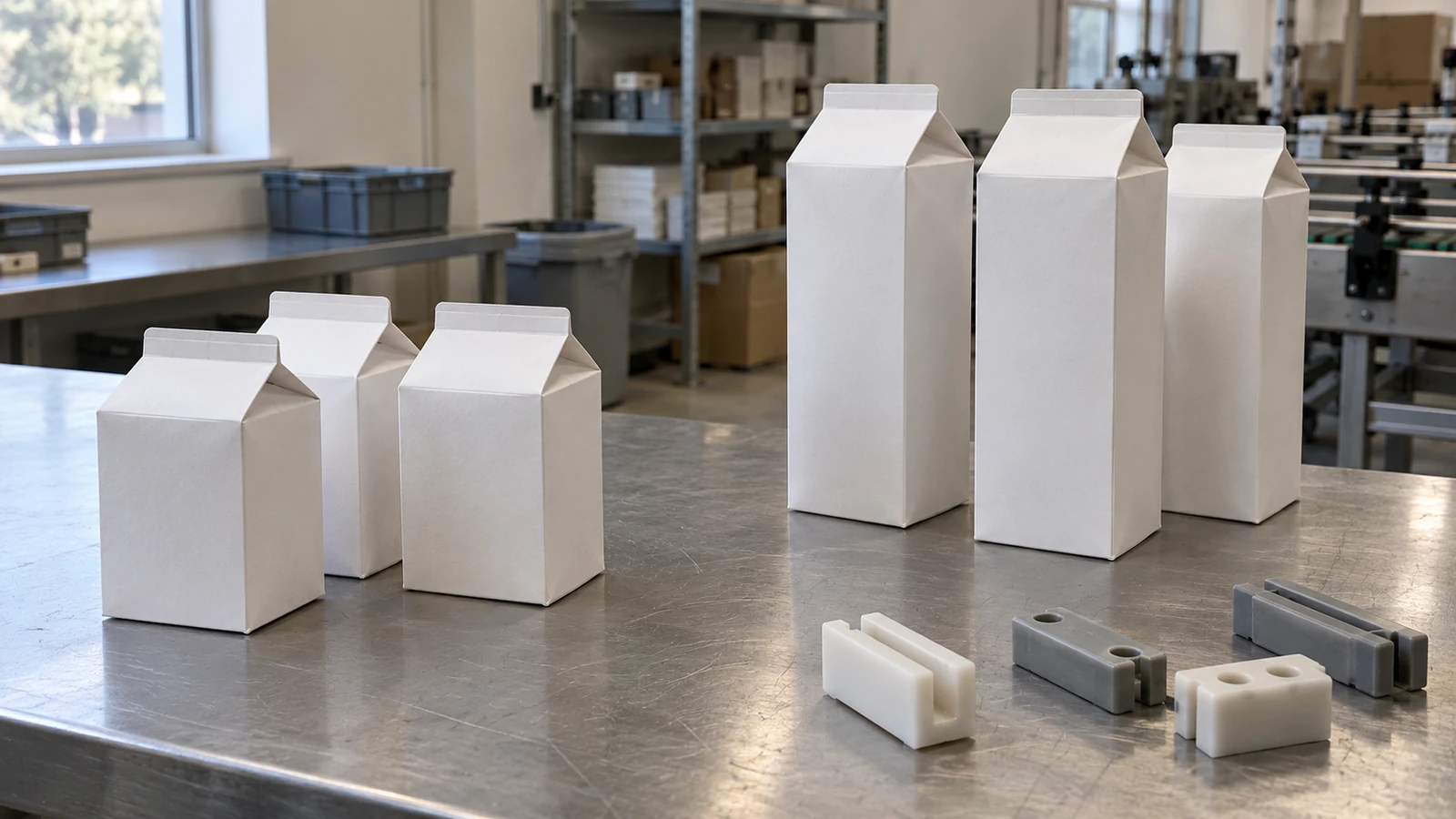
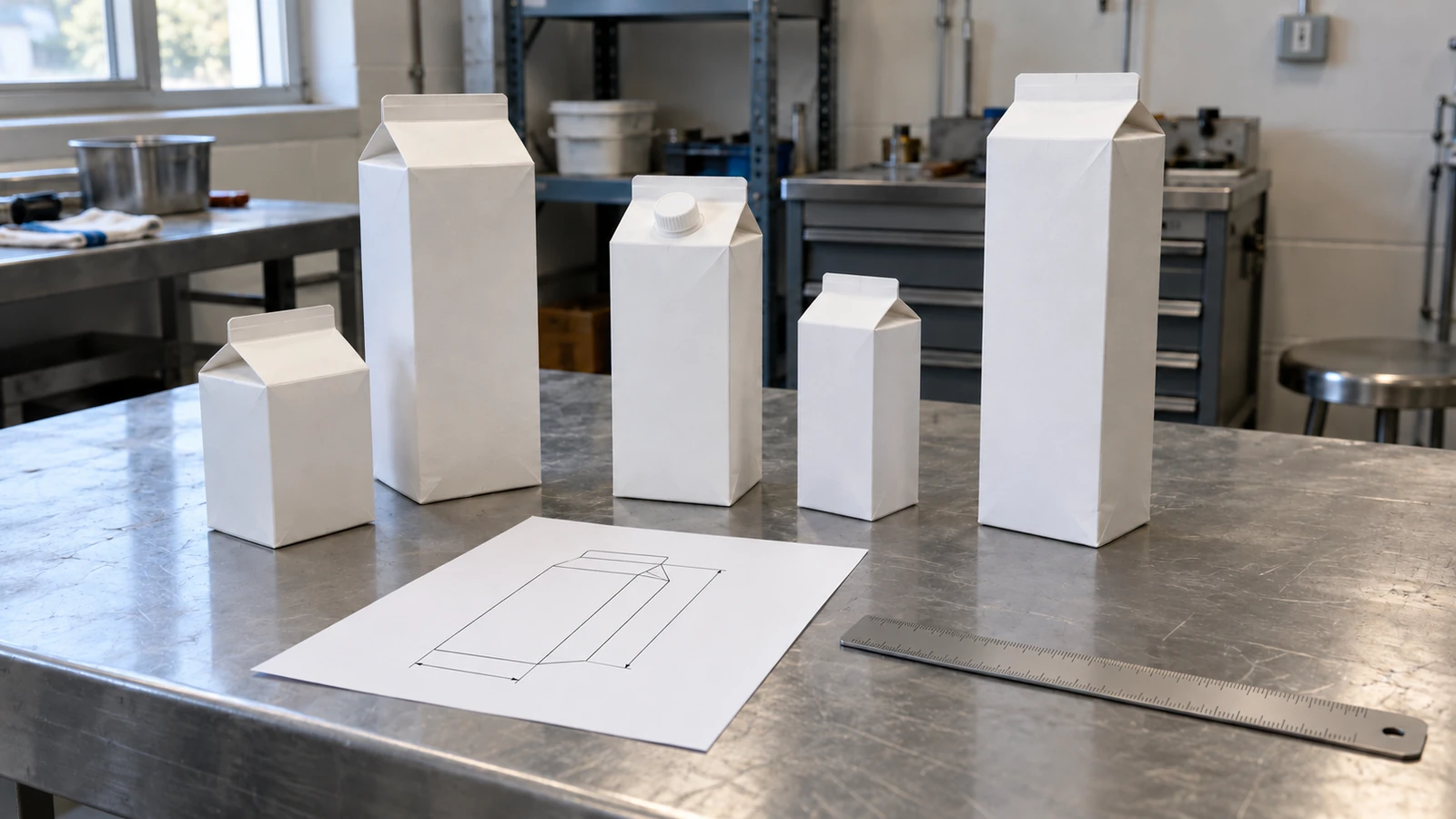
Example of shorter cartons and taller cartons on one bench. Use the split as a stand-in for a single-serve list beside a multi-serve list.
SIG describes a one-third increase in output and output per square meter, without naming the baseline in the launch text. Its current equipment directory lists Smile 24 at 24,000 packs/hour and standard medium-size aseptic machines at up to 12,000 packs/hour.
| Directory comparison | Published rating difference | What it establishes |
|---|---|---|
| Announced XSlim 32 rating (32,000/h) vs. published Smile 24 rating (24,000/h) | +8,000 cartons/h (+33.3% relative to Smile 24) | Numerical ratio under the Smile 24 baseline |
| Announced Midi 15 rating (15,000/h) vs. published medium-size standard maximum (12,000/h) | +3,000 cartons/h (+25.0% relative to 12,000/h) | Numerical ratio under the 12,000/h directory baseline |
These directory comparisons use the launch and directory linked in Sources; matched formats and configurations must be verified with the supplier.
R_base = R_new * 3/4
Common mistake: A matching numerical ratio is treated as proof of the manufacturer’s baseline. Verify the exact reference configuration, carton format, and footprint boundary SIG used for the comparison.
The filling-technology page, fetched October 17, 2026, publishes 24,000 packs/hour in three places: the line “up to 24,000 packs per hour,” the small-size standard range “12,000 or 24,000 packages per hour,” and SIG Smile at “24,000 Packs / hour.” The Smile 24 package-finder page from the same fetch repeats 24,000 packs per hour, six tracks, SmileSmall volumes of 180 ml, 200 ml, 220 ml, and 250 ml, and SmileBig volumes of 200 ml, 250 ml, 300 ml, 330 ml, and 350 ml. Smile is a different carton family from XSlimBloc. The 24,000 figure is the published rate that satisfies the one-third equation for XSlim 32. SIG prints it for those other machines. The October 1 text does not name Smile as the comparison.
Medium-size standard machines on that page are listed at up to 12,000 packs per hour, with up to five volumes and up to three formats. The step from 12,000 to Midi 15’s 15,000 is 25%, because (15,000 - 12,000) / 12,000 = 0.25. Large-size standard machines are listed at up to 9,000 packs per hour. 15,000 / 9,000 = 5/3, a two-thirds increase, so 9,000 is not the one-third baseline either. The 11,250 packs/hour figure required by Midi 15’s one-third claim does not appear on the fetched page.
Rule of thumb. If required single-serve output exceeds 24,000 packs/hour under the same counting boundary, prioritize Neo XSlim 32 for an SIG XSlimBloc schedule, because 32,000 × 3/4 = 24,000 and 24,000 packs/hour is the highest rate on the fetched filling-technology page.
Rule of thumb. If a multi-serve comparison uses the medium-size ceiling of 12,000 packs/hour, record a 25% step to 15,000, because (15,000 - 12,000) / 12,000 = 0.25. Apply the one-third claim to Midi 15 only after SIG names a baseline of 11,250 packs/hour.
| Area to identify | Buyer record | Supplier response to obtain |
|---|---|---|
| Equipment outline | Available area and obstructions | Configuration-specific outline drawing |
| Operation and maintenance access | Existing site access constraints | Required working/access areas and document references |
| Carton and consumable supply | Material movement and replenishment route | Proposed supply arrangement and ownership |
| Product and services | Existing utilities and process boundaries | Required interfaces and auxiliaries |
| Filled-carton discharge | Receiving equipment and transfer point | Proposed connection and unresolved site work |
What floor boundary keeps output per square meter honest?
Output per square meter rises by one-third only when the area in the denominator stays the same. Christoph Wegener, SIG’s Chief Markets Officer, said on October 1, 2026 that many producers have reached the physical limits of their existing plants, and that Neo fillers add capacity inside those factories. The release still publishes no square-meter number.
q = R / A
When A_new = A_old, q_new / q_old = R_new / R_old. A one-third rate gain with equal area is the ratio 4/3.
Worked example: assume the installed area grows by a factor of 1.2 while the rate ratio stays 4/3. Then q_new / q_old = (4/3) / 1.2 = 10/9, an 11.1% gain in output per square meter. The 1.2 factor is an assumed area growth for the arithmetic, not a SIG measurement. Sleeve infeed, maintenance access, and the discharge conveyor are the usual reasons that factor shows up on a drawing. SIG says the new machines keep the compact footprint plants know from its standard fillers. The drawing has to show whether those three zones sit inside that footprint.
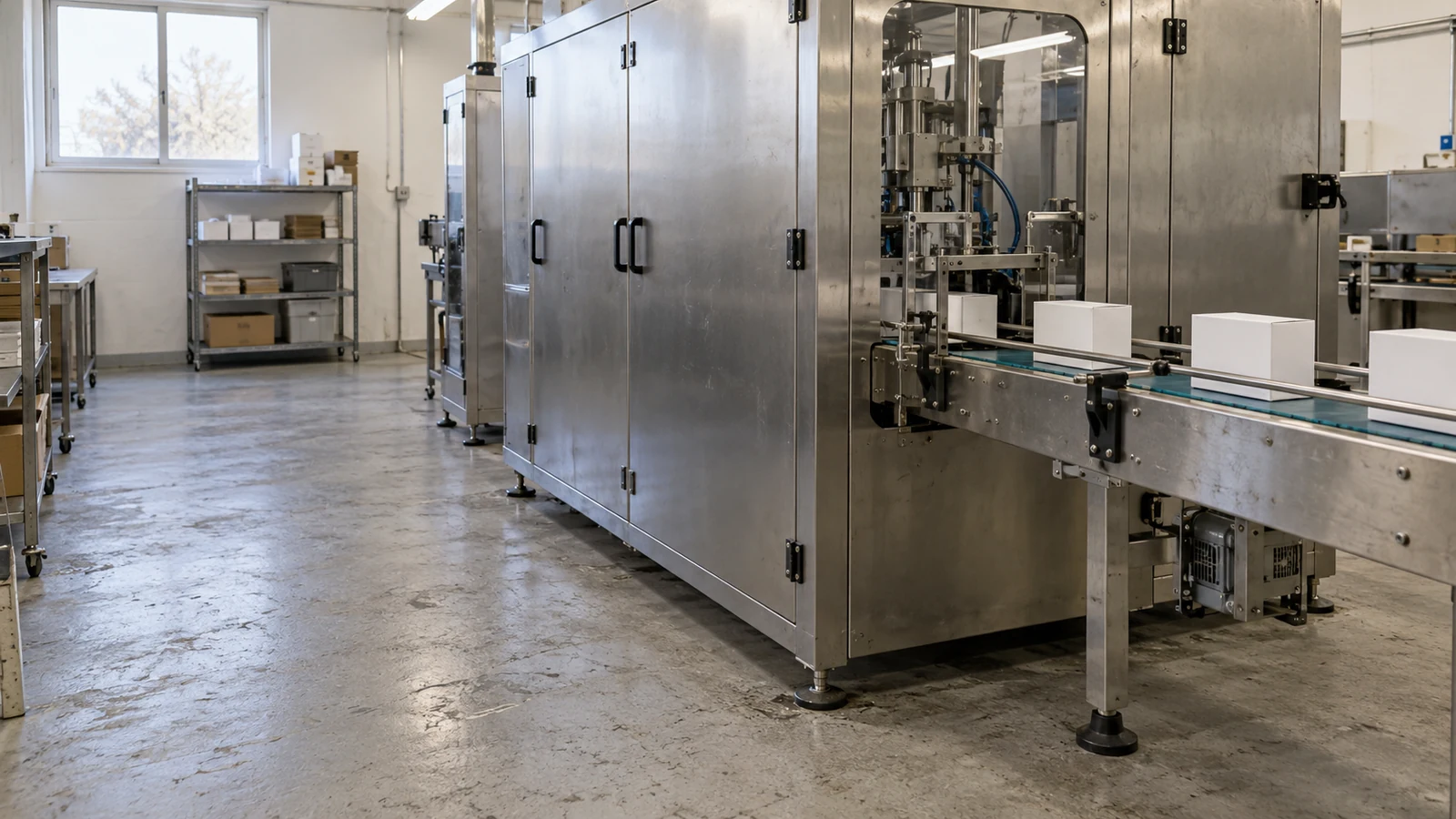
For each proposed change, record the old and new pack references, the change tasks, the condition at which timing begins and the criterion for accepted production to resume. Keep cleaning, replenishment and any downstream adjustment visible where applicable. A changeover label should not hide tasks assigned to another party.
The line specification is where each transfer gets an owner. Compare the retained layout and the proposed layout on that same boundary.
Takeaway: One installed boundary, used for both arrangements, is the only area figure that can carry the one-third claim.
How much rated output do changeovers and waste remove?
Each size or format change, taken at the 15-minute bound SIG published, removes 8,000 rated cartons from an XSlim hour and 3,750 rated cartons from a Midi hour. The waste ceiling removes a further 160 XSlim cartons or 75 Midi cartons from a rated hour.
SIG’s bound is “less than 15 minutes” and “without changing any machine parts.” Use 15 minutes as the ceiling of that statement, so C = 15/60 hour = 0.25 hour. Use 0.5% as the ceiling of “less than 0.5%,” so w = 0.005. Foregone rated cartons at the changeover ceiling are R × 0.25. That is 32,000 × 0.25 = 8,000 for XSlim 32, and 15,000 × 0.25 = 3,750 for Midi 15. Cartons at the waste ceiling are R × 0.005, which is 160 and 75.
G = R * (1 - w) * (T - n * C)
Worked example: R = 32,000 cartons/hour, w = 0.005, T = 8 hours, n = 2 size changes, C = 0.25 hour. Run time is 8 - 2 × 0.25 = 7.5 hours. G = 32000 * 0.995 * 7.5 = 238,800 cartons. Sleeve replenishment, a product change, and a downstream reset sit outside C unless the configuration drawing puts them inside the 15-minute bound.
| Decision question | Evidence to obtain | Decision supported |
|---|---|---|
| Does the proposed configuration cover the pack list? | Written SKU/configuration answer and exceptions | Retain or remove the candidate |
| Does it fit the installed boundary? | Reviewed layout including auxiliaries and access | Continue site planning or revise scope |
| Can surrounding stages accept the proposed output? | Joint interface response and trial plan | Identify the actual capacity question |
| What is available in the United States, and when? | Current location-specific supply and support statement | Build a project schedule with stated conditions |
| What is the investment scope? | Itemized offer, exclusions and responsibilities | Compare proposals on the same boundary |
Takeaway: Count changeovers at 15 minutes and waste at 0.5% until a trial replaces both ceilings.
What downstream station absorbs the extra cartons?
The extra cartons have to leave the filler. If the reference rate that satisfies XSlim 32’s one-third equation is 24,000 packs/hour, the gap is 32,000 - 24,000 = 8,000 cartons/hour. A discharge conveyor, case packer, or palletizer sized to the lower rate becomes the stop. Until that station is counted, the filler rating stays a machine rating.
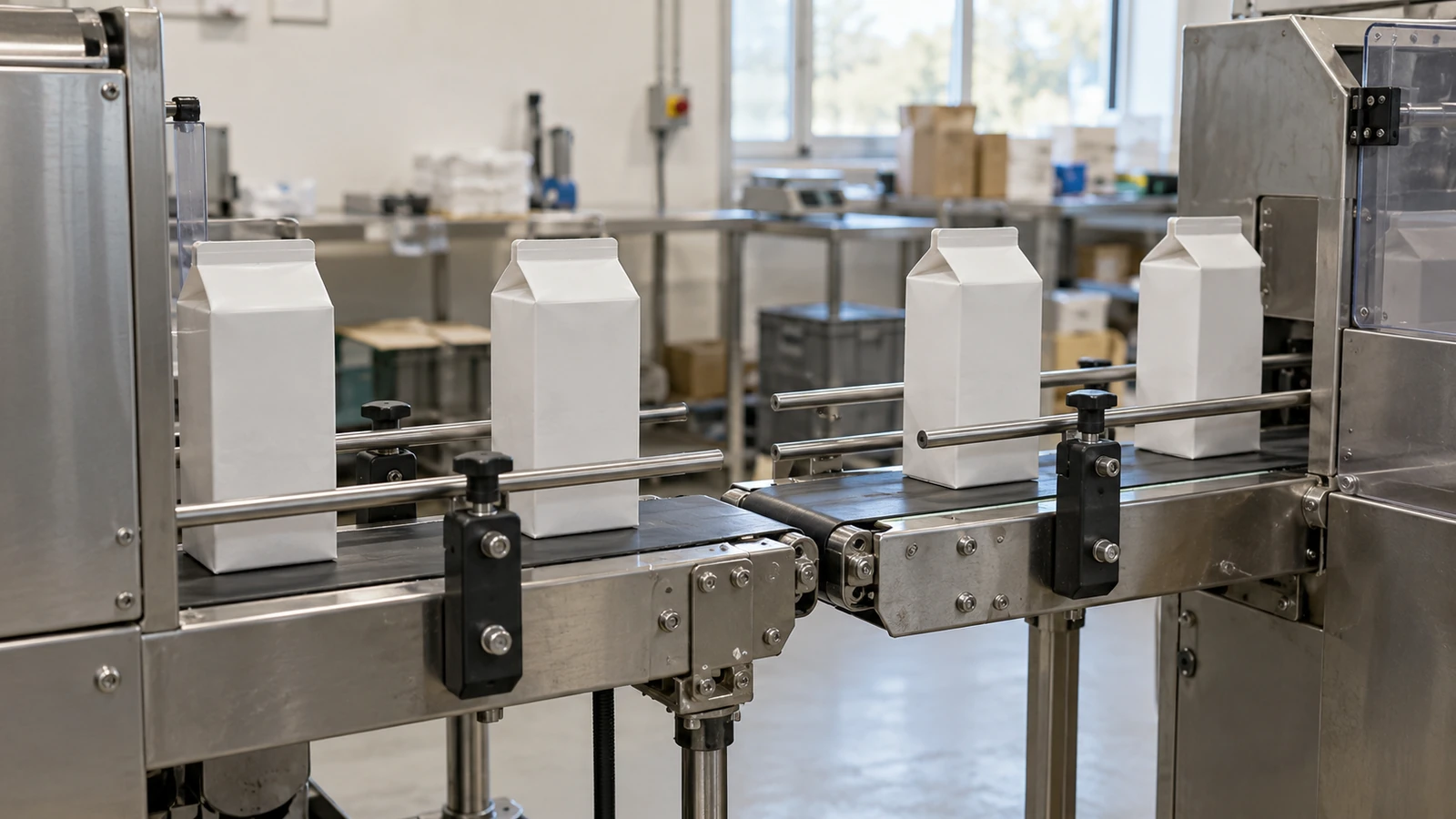
Example of filled cartons leaving one section and entering the next. That transfer is where a filler rating meets the downstream station.
Write the downstream limit on the cobot palletizer scope review when the cell is a palletizer, and on the packaging machinery desk when the next machine is case packing or another secondary step. The buying guides desk holds the open items that still need an owner. A fitment check closes the carton family. A sample trial closes the product. A factory acceptance test closes the counted cartons under the agreed boundary.
Takeaway: Reserve aisle space after the discharge station has a rated capacity for the extra cartons.
When this does not apply
This page is a floor-space check on published filler ratings. Sterilization setpoints, a shelf-life claim, and a delivery date sit outside it. The October 1 release and the filling-technology page fetched on October 17, 2026 do not state those three items for XSlim 32 or Midi 15.
Method and sources
This review draws on SIG’s October 1, 2026 Neo announcement and published carton-filling directory. Announced specifications are manufacturer statements; the planning registers are editorial frameworks for buyer verification. Our editorial policy explains the distinction between published claims and verified application results.
Takeaway: Keep the manufacturer’s statement, our arithmetic and the project evidence separate.