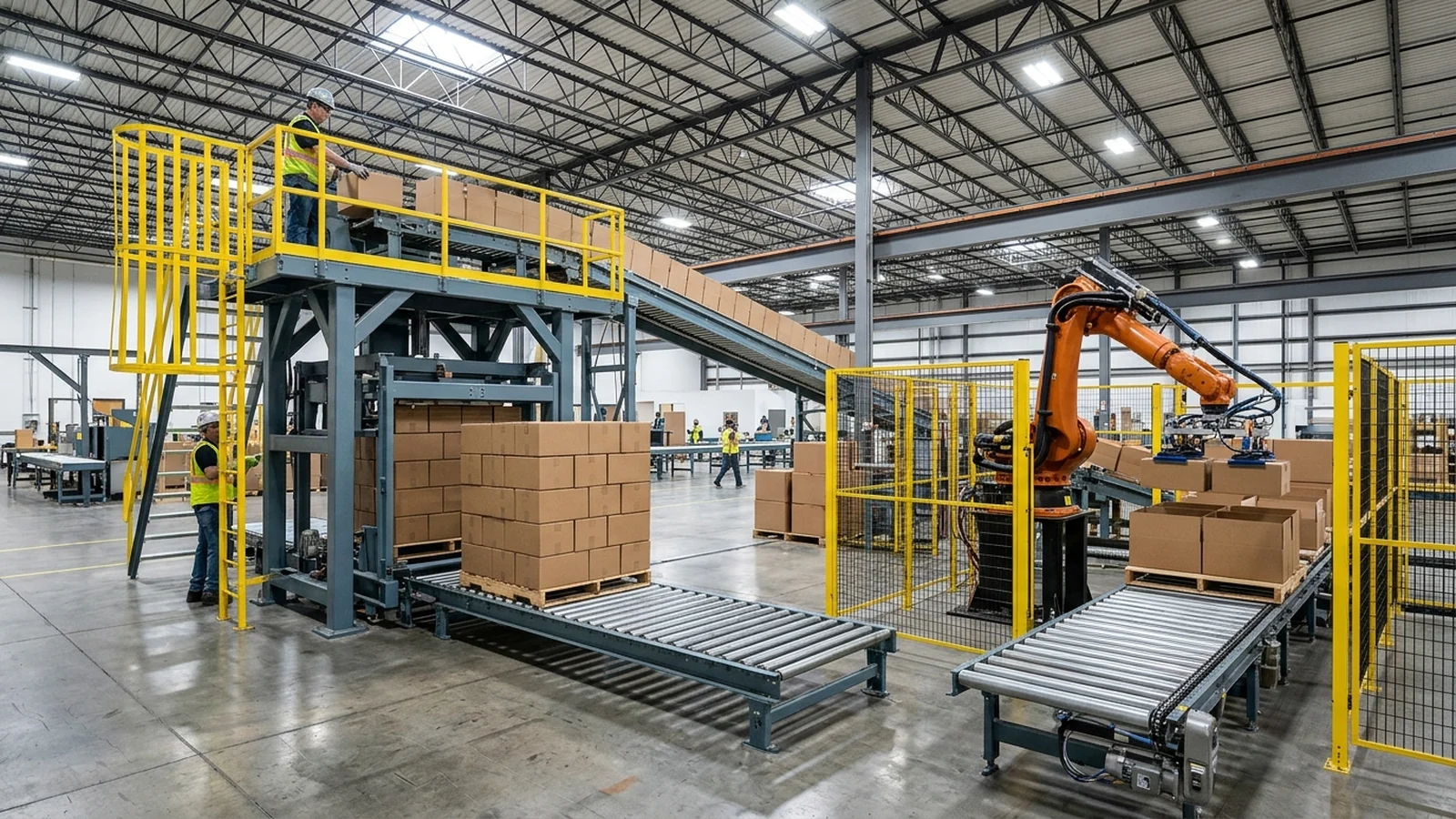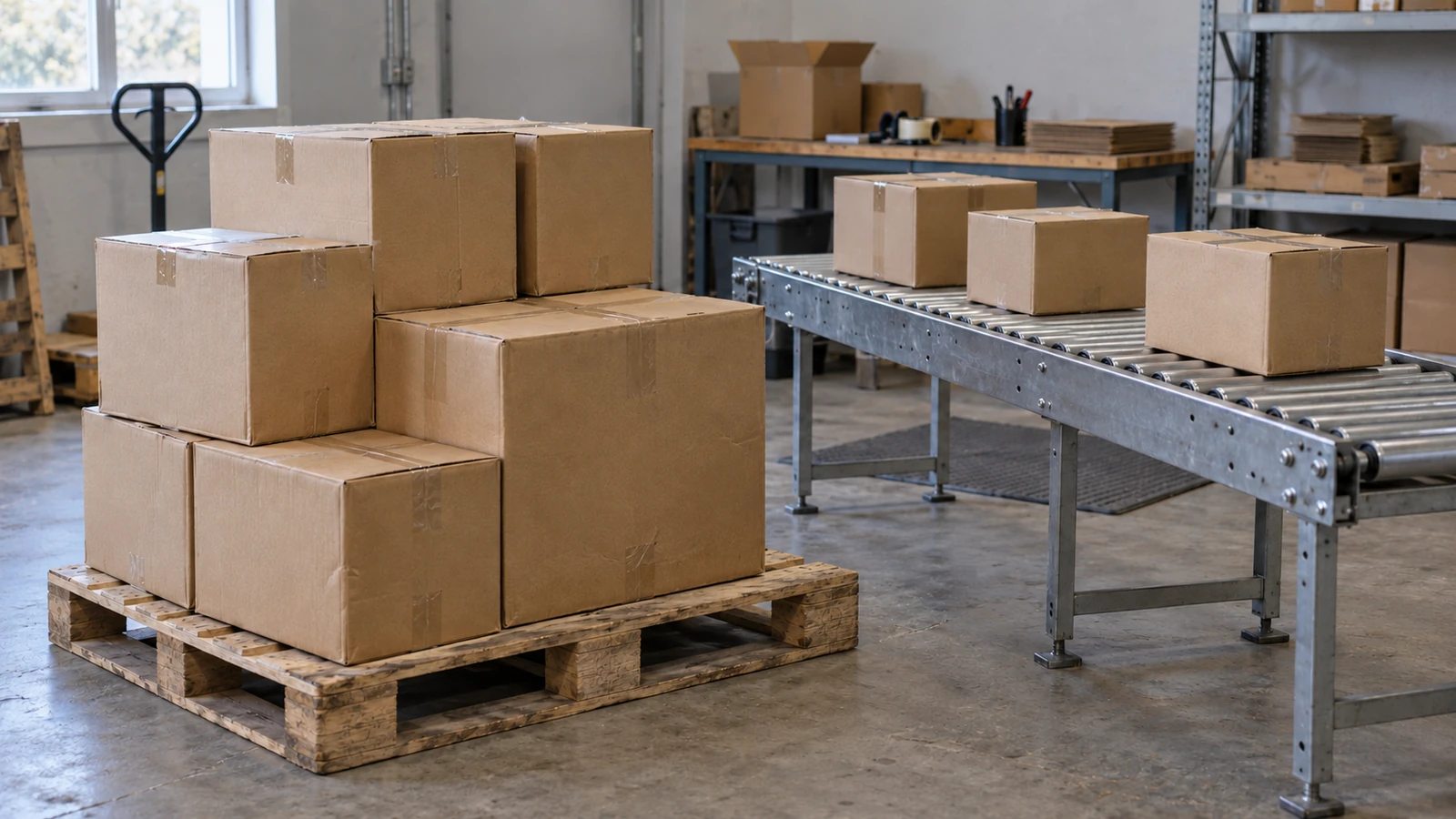
Pairing the CRX-30iA’s 30 kg wrist load with its 1,889 mm reach damages the load check before the first case is placed. For a FANUC CRX-30iA palletizer, use 30 kg with the 1,756 mm faceplate reach, and use 1,889 mm only when the 25 kg payload mode is selected. The 2026 brochure and the CRX-30iA datasheet attach that longer reach to the 25 kg mode.
AMT’s September 25, 2026 supplier-submitted announcement describes a FANUC CRX-30iA-based palletizing solution starting at $120K and claims typical payback in less than a year. A thorough purchase review identifies the loaded tool, selected robot mode, actual case task, interface scope and achievable net savings. The records below turn a headline starting price into engineering questions for an itemized proposal.
- 30 kg stays with 1,756 mm.
- 1,889 mm stays with the 25 kg mode.
- J6 allowable moment is 32.0 N·m in the brochure and the datasheet.
- J4 and J5 moments differ between those two FANUC documents.
- The 40 kg wrist-down option has no reach in the product-page block that states it.
What payload and reach does FANUC publish?
Use the mode pair in the brochure table and the datasheet, and treat a single “30 kg, 1,889 mm” line as incomplete. Both documents list max load capacity at the wrist as 30/25 kg and reach as 1,756/1,889 mm. Footnote 4 on the brochure, and the asterisk on the datasheet, say the operating space is expanded when the 25 kg payload mode is selected. The palletizing paragraph in the same brochure uses the other half of the pair: an enhanced 30 kg payload and a 1,756 mm reach.
| Item | Published value and source | Why it matters |
|---|---|---|
| Standard pairing | 30 kg at 1,756 mm, brochure 14 April 2026 and datasheet 14 June 2024 | Shorter envelope, higher wrist load |
| Expanded pairing | 25 kg at 1,889 mm in the 25 kg mode, same documents | Far corner uses the lower load |
| Reach datum | From the faceplate; datasheet says end of flange | A tool offset consumes envelope |
| Product-page summary | 30 kg and 1,889 mm on one line, fanucamerica.com, 17 October 2026 | Reads as one operating point |
| CRX site summary | 30 kg and 1,756 mm, crx.fanucamerica.com/crx-30ia, same day; prose says 25-30 kg and 1,756 mm | This page does not print 1,889 mm |
| Wrist-down option | 40 kg on the product page, no reach in that block | Leave it off the 1,889 mm envelope |
| Repeatability | ±0.05 mm, ISO 9283, brochure and datasheet | Faceplate figure, not stack height |
| Published speed | 1,000 mm/s collaborative, 2,000 mm/s high speed | Maxima, not a case rate |
| Robot mass | 135 kg | Mounting load, not payload |
| Motion range | J1 360°, J2 360°, J3 540°, J4 380°, J5 360°, J6 450° | Same on the datasheet and both web spec blocks |
| Supply and ambient | 100-120 VAC and 200-240 VAC on both PDFs; 0 to 45 °C in the brochure | Cell utilities, not a cycle time |
The brochure introduction says these collaborative robots are ISO 10218-1 and ISO 13849-1 certified, and that they can work without external safety devices in accordance with risk assessment. That is a robot-series statement. It does not approve a particular palletizing layout. Body, wrist, and J3 arm are listed IP67 on the brochure, the datasheet, and the product page. IP67 is the enclosure rating in those tables.
The material handling desk is the section frame for this end-of-line move: case in, finished load out.
Takeaway: Write the mode next to the reach before you call a pallet corner covered.
Which failure mode shows up at the pallet corner?
The first miss is usually a grip point that the selected mode does not cover, or a wrist moment the mass check never saw. Catalog speed is a later problem. It becomes a failure mode when the cell copies 1,000 mm/s or 2,000 mm/s without the risk assessment the footnote requires.
| FANUC brochure reference | Published figure | Purchase-review question |
|---|---|---|
| 30 kg carried out to 1,889 mm | Far grip sits outside the 30 kg envelope | Use the 25 kg mode and keep wrist load at or under 25 kg |
| Long tool or tall case stack | J6 moment passes 32.0 N·m while mass is still under 30 kg | Shorten the center-of-gravity distance or lighten the tool |
| Case arrives rotated | Grip misses the case center and the layer walks | Guide or stop the case before the pick |
| Mixed heights in one layer | Load shifts after release | One case size per layer, with a set layer height |
| Catalog speed used as the setpoint | Motion runs past the assessed limit | Set speed from the risk assessment |
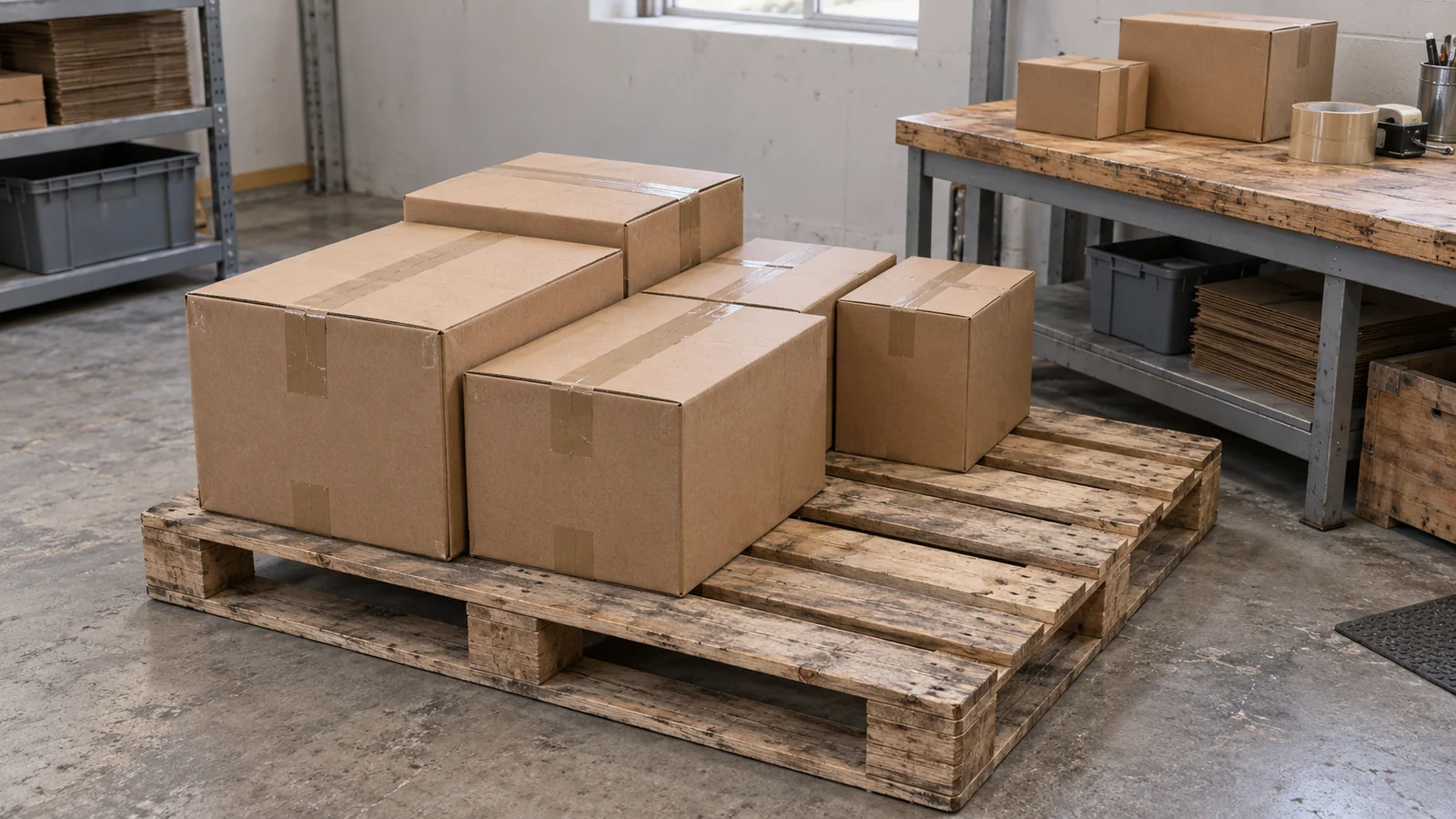
Mixed case sizes in one layer are the stack-shift case in the table above.
Rule of thumb: If faceplate distance exceeds 1756 mm, hold the loaded wrist at or under 25 kg. The brochure footnote and the datasheet asterisk open the space to 1,889 mm only in that mode. A faceplate point past 1,889 mm is outside both published envelopes. The 40 kg wrist-down block does not add a third reach.
How do you check wrist load and J6 moment?
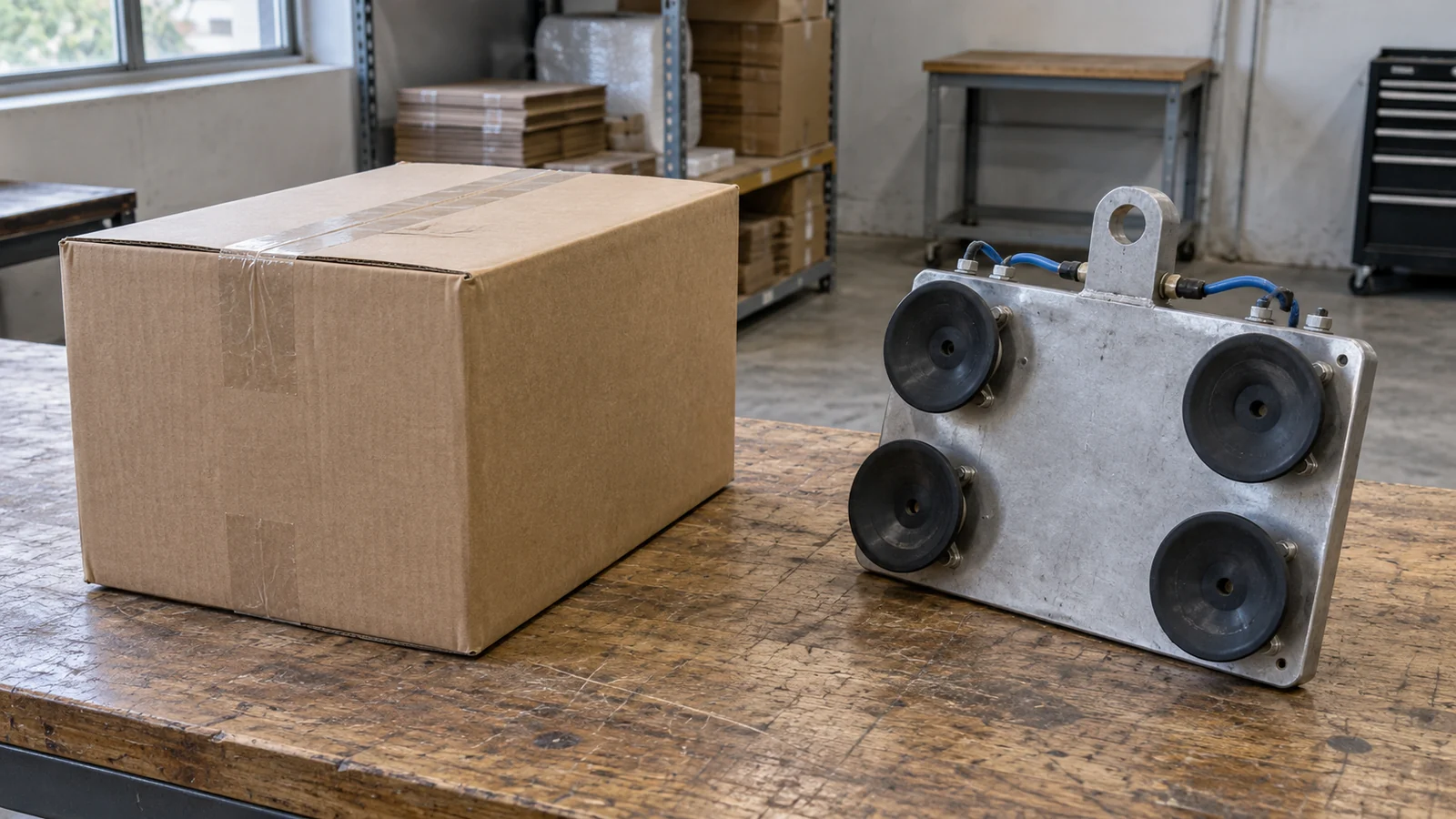
Add every mass the wrist carries, then check moment at J6 with the gripped center of gravity. FANUC’s phrase is max load capacity at the wrist, so the case, the tool, and the fittings all count while the robot is holding the case.
Wrist load:
m = m_case + m_tool + m_fittings
| Scope item | Written answer to obtain | Responsibility record |
|---|---|---|
| Robot, base and tool | Exact configuration and covered cases | Supply owner; configuration revision |
| Case infeed | Transfer, presentation and arriving-condition scope | Upstream/integration owners |
| Pallet positions and removal | Offered arrangements and leaving-load boundary | Equipment/site handling owners |
| Application safety | Assessment, protective measures and required evidence | Responsible integration and site parties |
| Controls and data | Included functions and network interfaces | Controls/data owners; exceptions |
| Delivery and site work | Transport, placement, services and commissioning scope | Supplier/buyer allocation |
| Handover and support | Documents, training, parts and service conditions | Named party and written terms |
23.8 kg is under 25 kg, so the mass still fits the expanded mode. Assume the far grip needs the faceplate at 1,820 mm on the same datum as the published reach. 1,820 mm is above 1,756 mm and under 1,889 mm, so the 25 kg mode is the published match, and 23.8 kg clears it.
Swap in a 9 kg tool:
m = 16 + 9 + 0.8 = 25.8 kg
25.8 kg is over the 25 kg mode and under the 30 kg mode. The 1,820 mm point then has no published mode that satisfies both mass and reach. Bring that faceplate point inside 1,756 mm, or lighten the tool until the load is 25 kg or less.
Use local costs and demonstrated task coverage to build an investment case. Keep every benefit attached to a real affected task and every cost attached to the proposed scope.
The case and the tool are separate objects. Both masses go into m.
J6 moment uses standard gravity, 9.81 m/s², and the distance from the J6 axis to the combined center of gravity:
M = m × 9.81 × d
For the 23.8 kg gripped load at an assumed d of 0.15 m:
M = 23.8 × 9.81 × 0.15 = 35.02 N·m
35.02 N·m is over the 32.0 N·m J6 limit printed in the brochure column and in the datasheet. The same mass at 0.12 m:
M = 23.8 × 9.81 × 0.12 = 28.02 N·m
Record case references, loaded tool, operating mode, pallet positions, accepted-case count, start/end time, stops and observed exceptions. Preserve the required leaving-load condition and its assessment method. Demonstration results apply to the conditions recorded; a substituted case or simulated infeed needs its limitation retained.
Takeaway: A wrist load under 25 kg still fails the cell when the grip point is past 1,889 mm or the J6 moment is past 32.0 N·m.
What does the 40 kg wrist-down option change?
It adds a product-page option beside the 30/25 kg table. On 17 October 2026 the FANUC America product page says the CRX-30iA offers an enhanced 40 kg wrist-down payload option for demanding palletizing, and that this option delivers 40 kg payload capability on CRX-30iA systems with the R-30iB Plus. The same sentence mentions seamless integration with R-50iA controlled CRX-30-18A robots. That block names no reach, speed, or wrist moment for the 40 kg option. The June 2024 datasheet table still tops out at 30/25 kg.
The product-page controller line in the technical block is R-30iB Plus. The CRX site lists compatible controllers as R-30iB Plus and R-50iA, and its spec block prints max payload 30 kg and reach 1,756 mm. Keep the 40 kg figure on the option that names it. Keep CRX-30-18A as the designation in that sentence, without borrowing CRX-30iA reach numbers for it.
Mounting labels also differ by page. The brochure installation row is floor, upside down, or wall. The product page says Floor / Angle / Inverted. Record the label from the document you are buying against.
Where do infeed and pallet position spend time?
The reach check is a layout check. The faceplate has to be at the case, and the case has to be where the program expects. A conveyor, a controller cabinet, and a pallet on the floor are three different stations. If the pallet sits too far out, the 30 kg mode never sees the far case, and the fix is a station move plus a new program, measured in lost minutes rather than in a catalog speed.
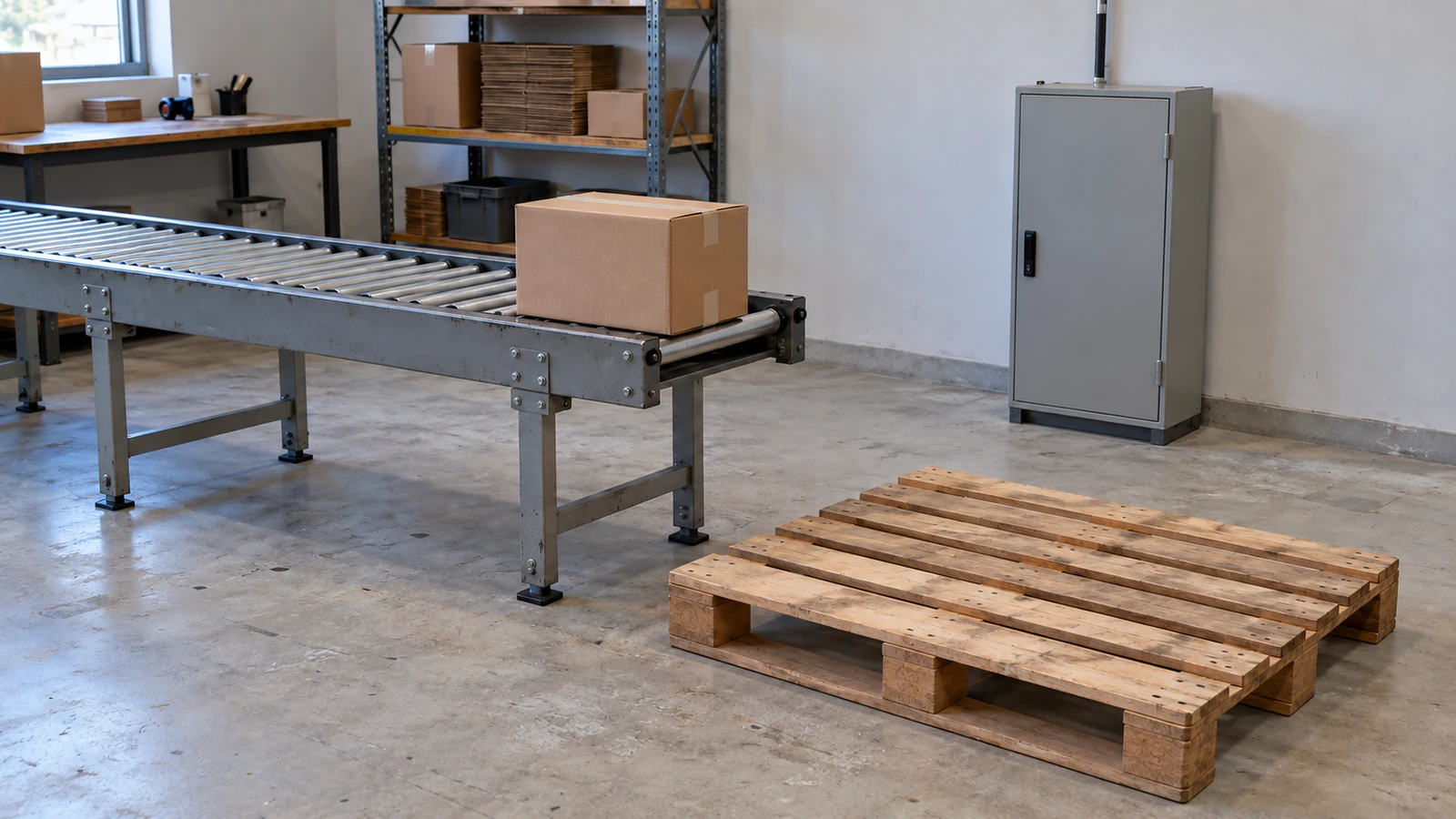
Infeed, cabinet, and pallet position are the three places that decide whether 1,756 mm is enough.
Lost time from a bad layer is a count of cases and minutes:
Lost cases = events × cases per event
Lost minutes = events × minutes per event
Worked example. Assume one shifted layer damages 8 cases and takes 12 minutes to rebuild, and that this happens twice in a shift.
Lost cases = 2 × 8 = 16
Lost minutes = 2 × 12 = 24
Those 16 cases and 24 minutes are the planning ledger for that assumption. Two events are enough to show why the mode check belongs before the pallet is bolted down.
Name the owners of the handoff before you place the robot. The machine-to-machine handoff record is where the case packer, the robot, and pallet removal each get an owner. State the output as accepted cases under named conditions in the output-target record. Keep 1,000 mm/s in the speed row. On the witness, tie the selected mode to a far-corner pick in the FAT record that links each requirement to evidence. For upstream fabrication cells that require 6-axis hollow-wrist torch routing and 100% thermal duty rather than end-of-line case handling, compare wrist moment budgets in our industrial MIG welding machine and robotic cell selection guide.
When this does not apply
Use this page to read the published CRX-30iA figures for a palletizing layout. Case rate, fencing, and the choice between the 115.0 N·m and 100.0 N·m J4 values stay with the robot documentation pack and the risk assessment. Speed still follows the risk-assessment footnote on the brochure and the datasheet. The food-grade CRX-30iA row in the 2026 brochure repeats 30/25 kg and 1,756/1,889 mm with the same mode footnote. That row identifies a variant. Washdown acceptance still follows the hygiene specification for the room.
Method and sources
This review draws on AMT’s September 2026 release and FANUC’s 2026 CRX brochure. The brochure’s mode-dependent figures are retained with their conditions. The editorial policy explains our treatment of manufacturer claims.
Takeaway: The usable FANUC CRX-30iA palletizer point is a mode, a faceplate distance, and a wrist moment, written down together.