Buying an automatic wood pallet making machine from one catalog rate wastes the comparison when the saw, the notcher, and the nailer are different rows. The production scope is the named model row: the operations it prints, the unit of its rate, and the feeding step it still assigns to people. Copy each published baseline into the tables, and mark any unstated figure as pending supplier documentation.
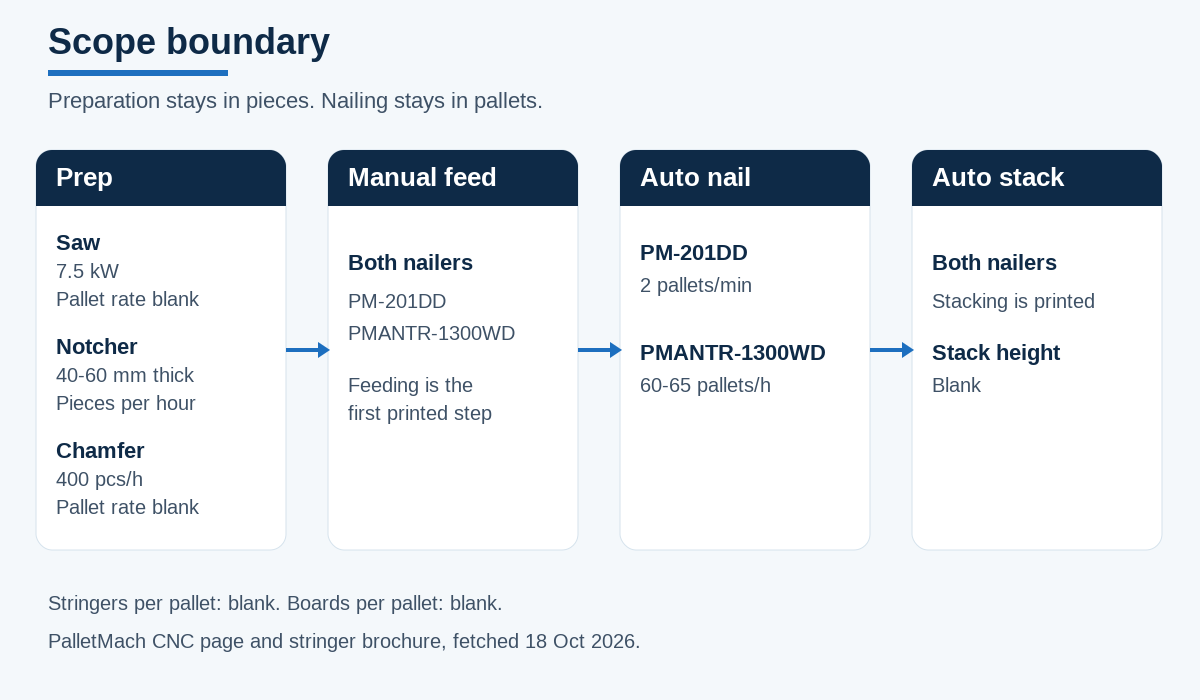
An automatic wood pallet making machine covers the operations printed on one named row, and the rate on that row keeps its own unit. PalletMach’s CNC page prints PM-201DD at 2 pallets/minute, working mode Manual feeding/Auto Nailing/Auto stacking, a 7.5 kW servo, nail size 32-90 mm, and 2-3 workers. The stringer brochure prints a different nailer, PMANTR-1300WD, at 60-65 pallets/h, with the same manual-feed flow, a 3.35 kW servo, and a separate 7.5 kW compressor at 0.8 MPa. HICAS lists cutting, nailing, and notching as separate headings and names SF1000, SF9026C, SF2000, and SF9020 without an attached rate or kilowatt rating on that overview page. Taurus Craco lists Bol-200, BOL-250, and Bol-300 beside truss and wall-panel systems.
| Input or item | Typical value or source | Why it matters |
|---|---|---|
| Nailer identity | PM-201DD on the CNC page. PMANTR-1300WD on the stringer brochure. Both fetched 18 October 2026. | Two published baselines. The hourly counts stay on their own rows. |
| Feeding | Both nailer rows print manual feeding before auto nailing | The crew row stays open on an automatic title |
| Stringer window | PMSRO-1800 and PMSRO-1200 print thickness 40-60 mm and width 80 mm | Thickness outside that window leaves those notcher rows |
| Preparation pallet rate | Blank on the saw, notcher, and chamfer tables | Those rows print pieces per hour, or no rate |
| Price | Blank on the four pages fetched for this guide | Money waits until each machine row is named |
The manufacturing equipment guides are the section that holds this record, next to the CNC router and spindle guides.
Which row is the automatic wood pallet nailer?
The automatic row is the model whose table prints the nailing and stacking steps. On the pages fetched 18 October 2026, that is PM-201DD or PMANTR-1300WD. HICAS and Taurus Craco name other nailers and print no rate beside those names.
| Named row, fetched 18 Oct 2026 | Printed operation and rate | Printed power, air, and workers | Dominant failure mode and prevention |
|---|---|---|---|
| PM-201DD, PalletMach CNC page | Manual feeding, auto nailing, auto stacking. 2 pallets/minute. Nail size 32-90 mm. Length, width, thickness, and voltage printed as Customized. | 7.5 kW servo. Air compressor 100 L. Compressor kW blank. Workers 2-3. Feeding speed 80 m/min. | Misalignment of a hand-placed board or stringer before the nail cycle. Prevent it by writing down the fixture for that pallet and keeping feeding on the labor row. |
| PMANTR-1300WD, PalletMach stringer brochure | Manual feeding, auto nailing, auto stacking. 60-65 pallets/h. Nail length printed as adjustable. Pallet size printed as adjustable. | 3.35 kW servo. Air pressure 0.8 MPa, with a 7.5 kW compressor named beside it. Tank printed as 0.2 cubic. Voltage cell prints 380V 3 phrase 50hz. Worker bullet: 1. | The compressor is a second nameplate. Prevent a nailer-only scope by putting 0.8 MPa and 7.5 kW on the utility row. |
| SF1000, SF9026C, SF2000, SF9020, HICAS application page | Titles name a production line, a 3800 mm stringer nailer with a rotary station, a deck nailer with a stacking table, and a block-leg nailer. | Rate blank. Power blank. Workers blank. | The page intro runs from cutting raw wood through assembly. Prevent that merge by giving each title its own row. |
| Bol-200, BOL-250, Bol-300, Taurus Craco pallet equipment | Nailer and stacker cards. BOL-250 prints stringers and blocks, and two pallets of the same size in one operation. | Rate blank. Power blank. Price blank. | The same category lists floor-truss and wall-panel systems. Prevent a mixed comparison by leaving those systems off the wood-pallet rows. |
The PM-201DD feature text calls the machine fully automated and says multiple processes finish at one time. The specification table on the same page prints the working mode as Manual feeding/Auto Nailing/Auto stacking and prints workers needed as 2-3. Copy the table. The page also says the machine produces CP1-CP9 pallets, including American and European pallets, by adjusting the fixture or changing the fixture. It prints no pallet length or width for those names, so those millimeter cells stay blank. Record the fixture that matches the drawing.
The brochure bullet under PMANTR-1300WD says there are 2 different models for a stringer pallet or a block pallet. The table names PMANTR-1300WD and leaves the other model name unprinted. PM-201DD is a separate page. Keep it on its own row until an offer states that the two names are the same machine.
HICAS states that most standard equipment models take 1-2 days to install under the guidance and technical support it describes. That sentence belongs on the HICAS row. The PalletMach pages fetched here print no installation days.
Which preparation row sits upstream of nailing?
On the stringer brochure, sawing, notching, and chamfering are earlier models. Their rates are in pieces per hour, or the rate cell is blank. None of those tables prints a pallet rate.
| Model | Printed window | Printed rate | Printed power and crew | Pallet rate |
|---|---|---|---|---|
| PMCS-4000 saw | Max cut length 4000 mm. Max cut width 200 mm. Max cut height 100-160 mm. Blade diameter 500 mm. Working table 5000*700*980 mm. | Blank | 7.5 kW. Spindle 3500/rpm. One worker. Automatic feeding is optional. | Blank |
| PMCS-6000 saw | Max cut length 6000 mm. Max cut width 200 mm. Max cut height 100-160 mm. Blade diameter 500 mm. Working table printed as 7000*700*980 with no unit on that cell. | Blank | 7.5 kW. Spindle 3500 rpm. One worker. Automatic feeding is optional. | Blank |
| PMSRO-1800 double-slot notcher | Stringer length less than 1400 mm. Thickness 40-60 mm. Width 80 mm. Max slot depth 230 mm. Max slot width 50 mm. Distance between slots 160 mm. | 1500-1800 pcs/h | 30 kW. One worker. | Blank |
| PMSRO-1200 single-slot notcher | Stringer length Unlimited. Thickness 40-60 mm. Width cell prints Stinger width 80 mm. Max slot depth 230 mm. Max slot width 45 mm. Distance between slots blank. | 800-1200 pcs/h | 15 kW. One worker. | Blank |
| PMKM-400 chamfer | Size printed as adjustable. Max speed 8000 rpm. Voltage 380 V 50 Hz 3P. | 400 pcs/h | 4.5 kW. One worker. | Blank |
Rule of thumb. If stringer thickness is below 40 mm, or the thickness is above 60 mm, PMSRO-1800 and PMSRO-1200 sit outside the window both rows print. If stringer length is over 1400 mm, the PMSRO-1800 length line is less than 1400 mm, and PMSRO-1200 prints Unlimited. Width on both rows is the single printed value 80 mm. A measured width other than 80 mm stays unresolved on these two models.
The saw line says it cuts pallet blocks, pallet planks, carton board, and small-diameter logs, and that automatic feeding is optional. Mark saw feeding as included only when the offer selects that option. The brochure prints one worker on the saw, one on each notcher, and one on the chamfer machine. Those are separate bullets. The cell headcount stays blank, because the brochure never adds them into one crew.
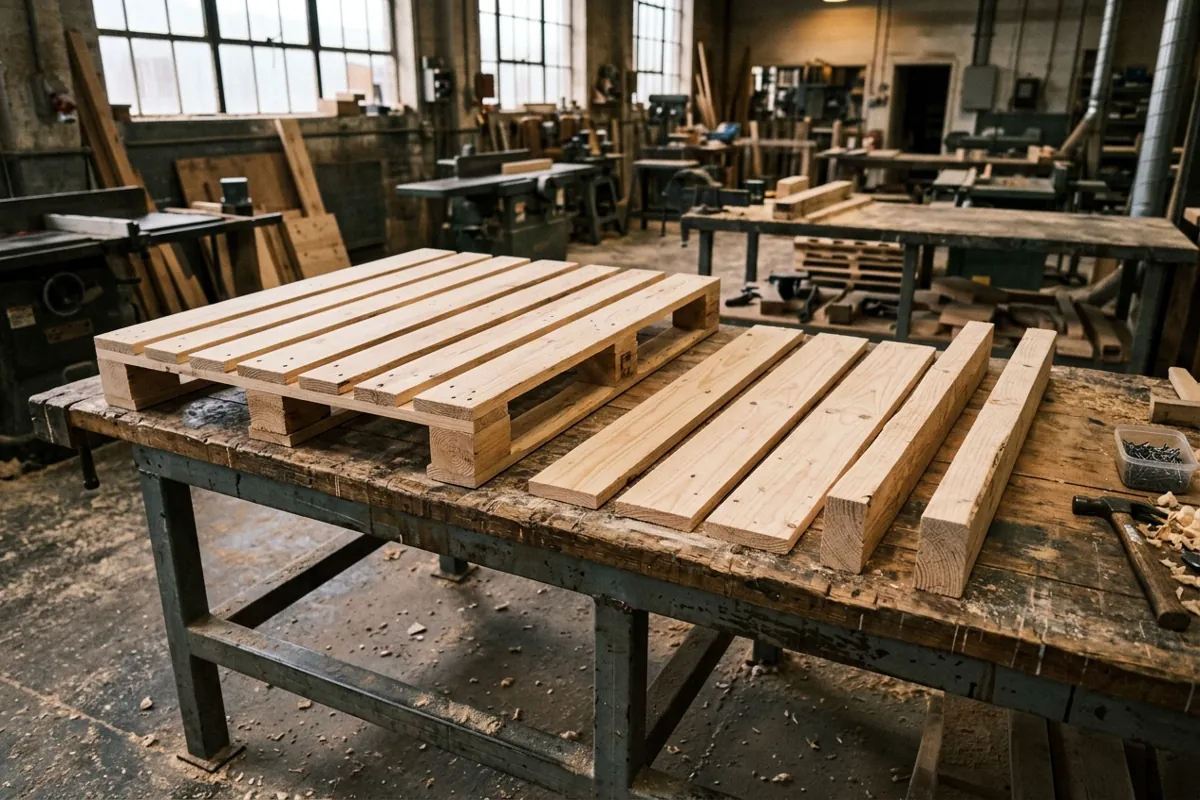
Printed envelopes, for floor space, stay on the model that prints them.
| Model | Overall size as printed | Mass as printed |
|---|---|---|
| PMCS-4000 | 7300*1200*1500 mm | 950 kg |
| PMCS-6000 | 9300*1200*1500 mm | 1100 kg |
| PMSRO-1800 | 2000*1200*1280 mm | 1000 KG |
| PMSRO-1200 | 1250*1250*1280 mm | 600 KG |
| PMKM-400 | 3000*700*1300 mm | 350 KG |
| PM-201DD | 4540*5200*1985 mm | 3500 kg |
| PMANTR-1300WD | Blank | Blank |
| SF1000, SF9026C, SF2000, SF9020 on the HICAS page read here | Blank | Blank |
| Bol-200, BOL-250, Bol-300 | Blank | Blank |
What does manual feeding keep on the crew?
Both PalletMach nailers print a person at the start of the cycle. PM-201DD prints workers needed 2-3. PMANTR-1300WD prints a bullet for 1 worker. Use the number on the row you are buying. Averaging 2-3 with 1 would invent a crew the pages never print.
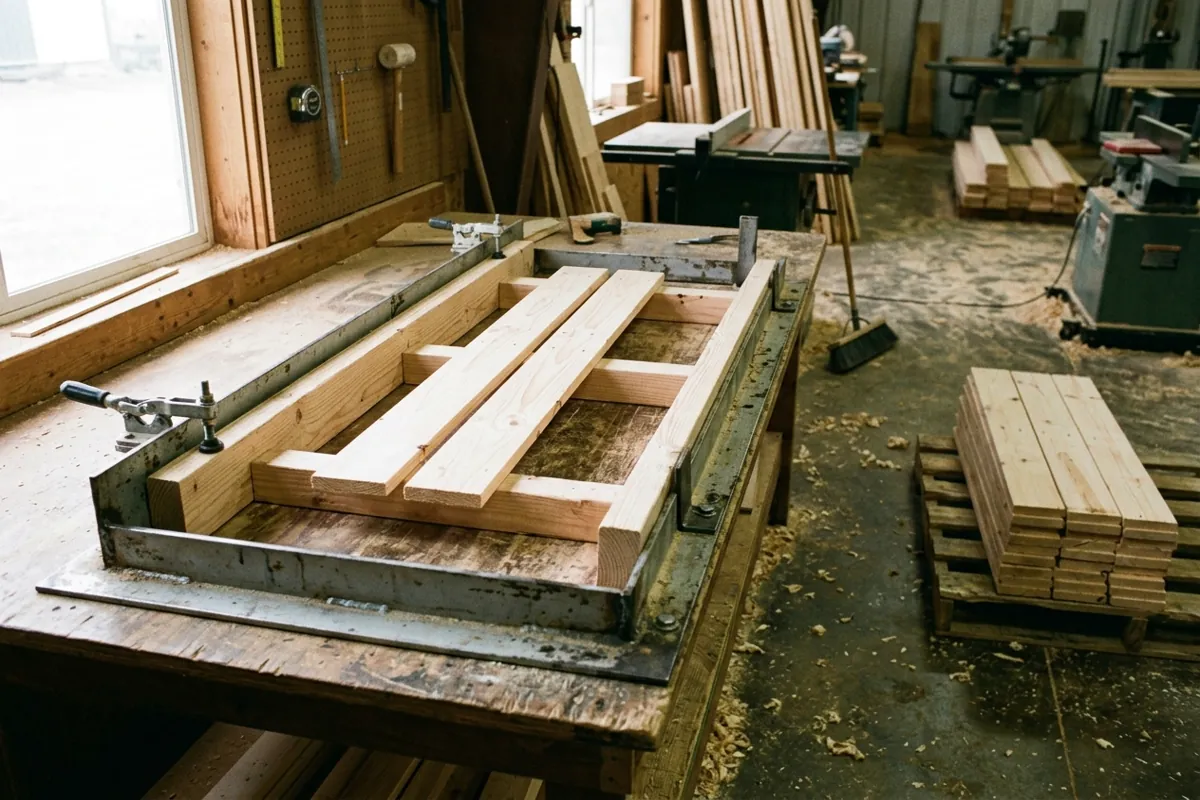
PM-201DD also prints feeding speed 80 m/min. The page does not say what moves at that speed. Keep 80 m/min on the PM-201DD row, and keep the person who places boards on the labor row, because the working mode still starts with manual feeding. The same table lists an industrial LCD computer. PMANTR-1300WD lists touch screen control and pneumatic operation. Those control lines stay on their own models.
The CNC page says finished pallets are conveyed onto the stacking platform and stacked for forklift transport, and that the machine removes the need for labor to stack or rotate the final product. The brochure working flow ends at auto stacking. Stack height, stack count, and who removes the stack are blank on both pages.
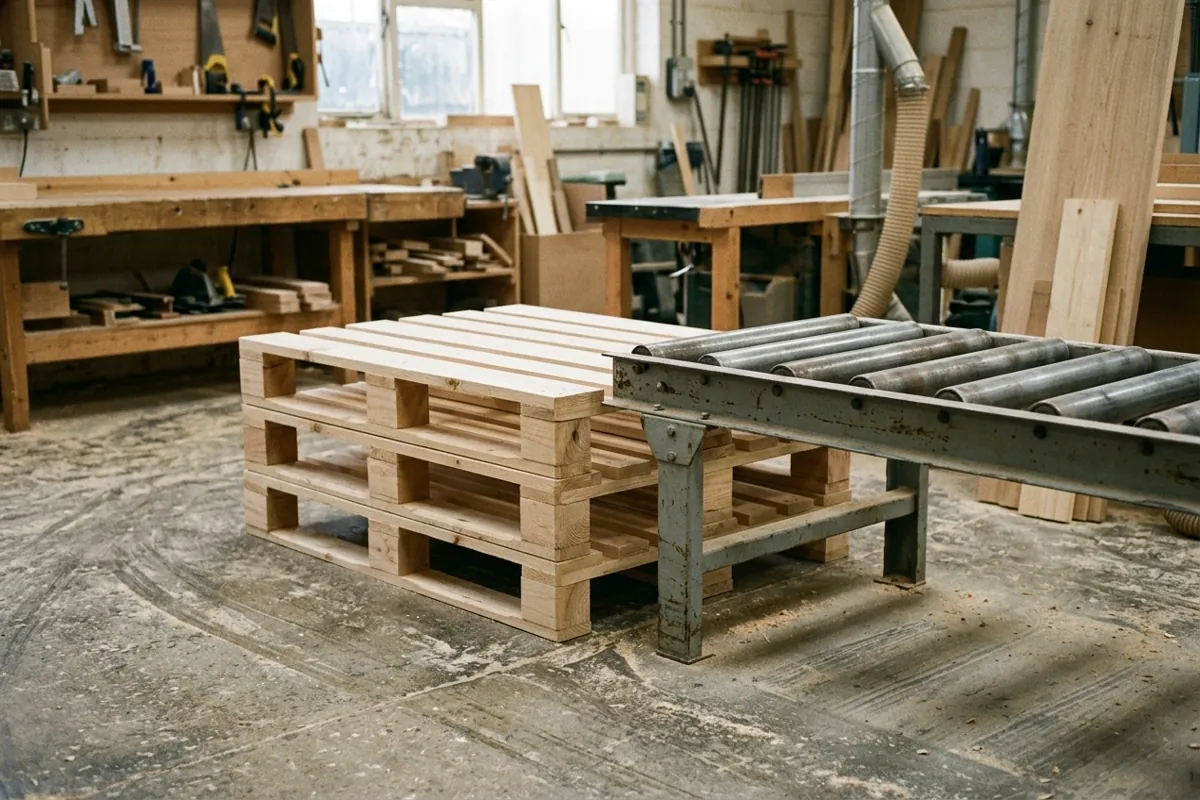
A used nailer still needs this row check, then the used pallet machine evidence register for the individual asset, its controls, and the move.
How does the printed rate convert?
Convert inside one named row. The formula uses only the unit that row prints.
pallets per hour = pallets per minute × 60
Worked example. PM-201DD prints 2 pallets/minute under Manual feeding/Auto Nailing/Auto stacking. Arithmetic, an editorial calculation: 2 × 60 = 120 pallets/hour. The 120 is the hourly form of that published baseline. PMANTR-1300WD already prints 60-65 pallets/h on a different model, with a 3.35 kW servo. Keep 120 on PM-201DD. Keep 60-65 on PMANTR-1300WD.
seconds per pallet = 3600 / pallets per hour
Arithmetic at the low end of the PMANTR band: 3600 / 60 = 60 seconds per pallet. Arithmetic at the high end: 3600 / 65 = 55.38 seconds per pallet, rounded to two decimals.
The same PMANTR row prints nail gun speed 7 sec/time. Arithmetic: 3600 / 7 = 514.29, rounded to two decimals. That quotient is a count the brochure never prints as pallets per hour. Leave 7 sec/time on the nail-gun line. Leave 60-65 pallets/h on the pallet line.
Pieces upstream use a different formula, and the divisor is missing.
pallet-equivalent rate = pieces per hour / pieces per pallet
PMSRO-1800 prints 1500-1800 pcs/h and PMSRO-1200 prints 800-1200 pcs/h. PMKM-400 prints 400 pcs/h. Stringers per pallet and boards per pallet are blank on the brochure, so each quotient stays blank. Scheduling the nailer at 60-65 pallets/h while notches are still a piece count leaves the nailer waiting on a queue the pallet rate does not measure.
Takeaway: One row, one unit. Label every hourly conversion as arithmetic.
What stays on the ledger while the price cell stays blank?
The four pages fetched for this guide print no price for these models. The ledger is the rows a nailer-only offer leaves out: upstream machines, the feeding crew the working mode still names, and the compressor named beside the servo.
connected nameplate kW = servo kW + compressor kW
Worked example for PMANTR-1300WD. The motor line prints 3.35 kW and the air line prints a need for a 7.5 kW air compressor. Arithmetic, an editorial calculation: 3.35 + 7.5 = 10.85 kW. That sum is the two nameplates added together. The brochure prints no duty cycle and no kWh, so the energy cell stays blank. PM-201DD prints a 7.5 kW servo and a 100 L compressor, and it prints no compressor kilowatts, so its nameplate sum stays blank. The 10.85 kW sum stays on PMANTR-1300WD.
Changeover minutes stay blank. PM-201DD names a fixture adjustment and a fixture change, and it prints no minutes. Scrap rate stays blank. Neither nailer page prints a reject count.
Utilities and the owner of each handoff belong on the complete packaging line specification. A witnessed run belongs on the packaging machinery FAT checklist. Write this pallet’s timber and the named model on that record. The checklist is built for packaging machinery. Use its evidence rows, and keep the pallet drawing as the acceptance piece.
Copy one blank matrix for each offer. An empty cell means the offer has not closed it.
| Operation | Scope status | Equipment reference | Printed figure, or blank | Owner |
|---|---|---|---|---|
| Pallet construction on the drawing | ||||
| Saw, including whether automatic feeding is selected | ||||
| Stringer notching, double slot or single slot | ||||
| Deck-board chamfer | ||||
| Manual feeding and replenishment | ||||
| Fixture for this pallet | ||||
| Nailing | ||||
| Stacking | ||||
| Stack removal and forklift handoff | ||||
| Compressor, air pressure, voltage | ||||
| Changeover minutes | ||||
| Installation days | ||||
| Accepted pallets in a witnessed run | ||||
| Price |
Where does this scope stop?
This page ends at the empty wood pallet. Placing cases on that pallet is a different machine. The FANUC CRX-30iA palletizer guide matches payload mode to reach for that job.
Method and sources
The four supplier pages were fetched on 18 October 2026. The stringer brochure prints no issue date. HICAS news lines that mention export dollars are not prices for SF1000, SF9026C, SF2000, or SF9020, so those dollars stay off the price row. Local library searches for wood pallet nailing and stringer pallet returned case palletizers and finished-pallet seller pages, so no machine figure in the tables above comes from those hits. A cached-SERP list for the phrase pallet making returned no row, and no new SERP was purchased. Each rate, kilowatt, millimetre, and worker count above is copied from the named row. Arithmetic is labeled where a published number is converted. A factory trial on the buyer’s timber is the check against those published baselines.