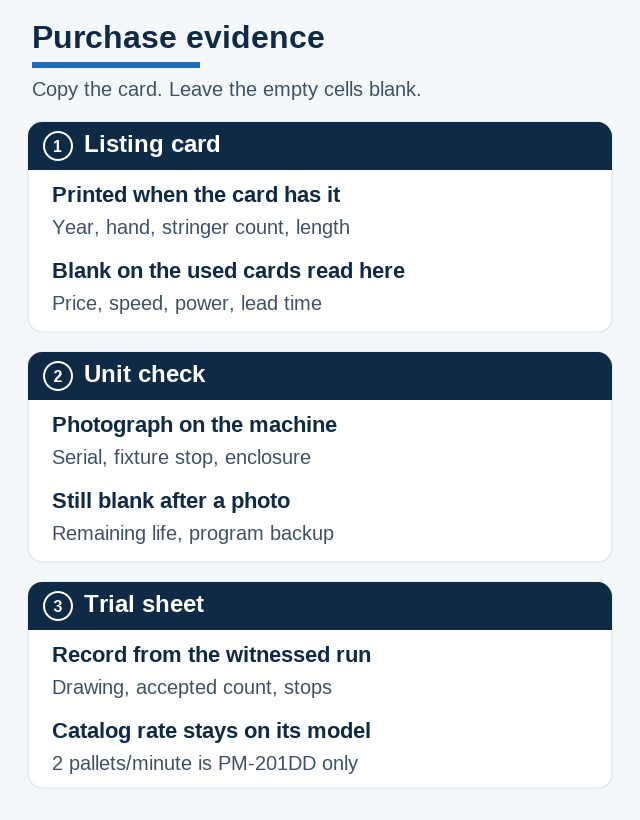
Used pallet machines need purchase evidence taken from the listing card for that stock number. A card that skips the fixture and the rate wastes the comparison, because haulage and a restart stay outside the offer. Copy the printed cells into the tables below, file them on the manufacturing equipment desk, and leave price, speed, power, and lead time blank when the saved page does not print them.
Purchase evidence for a used pallet machine is the cells one stock-number card prints. Viking’s used-equipment page, fetched 18 October 2026, prints five cards: 2018 Champion QC306, right hand, 4-stringer, 72 in.; 2017 Champion 304A Classic, left hand, 3-stringer, 60 in.; TC100 tandem, right hand, 4-stringer, length blank; 2001 Champion QC305/6, right hand, 4-stringer, 72 in., upgraded to QC306 in August 2003; 1999 Champion 304A, right hand, 4-stringer, 72 in. maximum. Those cards print no price, no pallets per minute, no kilowatts, and no lead time. Card #3466, Pallet Chief I, prints 2022, 34x34-48x48, and 110V, with rate and kilowatts blank. PM-201DD prints 2 pallets/minute and a 7.5 kW servo. That pair stays on PM-201DD.
| Input or item | Typical value or source | Why it matters |
|---|---|---|
| Listing identity | Five Viking cards and PMG #3466, fetched 18 October 2026 | Purchase evidence starts at one stock number |
| Stringer length | 72 in. on three Viking cards, 60 in. on the 2017 card, blank on the TC100 | One shared length would erase the printed gap |
| Price | Blank on the five Viking cards and on #3466 | A quote invitation is not a selling figure in this table |
| Speed | Blank on the used cards. PM-201DD prints 2 pallets/minute and feeding speed 80 m/min | The catalog rate stays on PM-201DD |
| Power | Blank on the used cards. PM-201DD prints a 7.5 kW servo. Compressor kW is blank on that page | 110V on card #3466 is a voltage token |
| Lead time | Blank on every page fetched for this guide | The parts clock is a separate row |
These cards name nailing and assembly machines for empty wooden pallets. A machine that builds a load of finished cases is a different purchase. The material-handling desk is where that load-building job is separated from pallet manufacture.
The listing card is the purchase evidence
Read one card at a time. Viking’s page states that used-equipment listings are an online advertising service for its customers. It states that Viking does not sell the listed equipment directly, is never a party to the buyer-seller transaction, does not claim the current state or condition, and does not warehouse, store, ship, or deliver the listed equipment unless otherwise agreed. The cells below are the lines that advertising page prints. They are not a condition report.
| Card, fetched 18 Oct 2026 | Price | Speed | Power | Lead time | Cells the page prints | Dominant failure mode and prevention |
|---|---|---|---|---|---|---|
| 2018 Champion QC306 | Blank | Blank | Blank | Blank | Right hand. 4-stringer. 72 in. length. Year 2018. | Misalignment of a 3-stringer drawing onto a 4-stringer card. Prevent it by writing the drawing’s stringer count beside 4-stringer. |
| 2017 Champion 304A Classic | Blank | Blank | Blank | Blank | Left hand. 3-stringer. 60 in. length. Year 2017. | A longer stringer misses the 60 in. line. Prevent it by keeping 60 in. on this card only. |
| TC100 upgraded tandem | Blank | Blank | Blank | Blank | Right hand. 4-stringer. The word Upgraded. Length blank. | Copying 72 in. from a neighboring card. Prevent it by leaving length blank. |
| 2001 Champion QC305/6 | Blank | Blank | Blank | Blank | Right hand. 4-stringer. 72 in. length. Upgrade from Champion 305 to QC306 in August 2003. | Parts ordered on the 305 name after the upgrade note. Prevent it by matching the parts book to QC306 and keeping August 2003 on the row. |
| 1999 Champion 304A | Blank | Blank | Blank | Blank | Right hand. 4-stringer. 72 in. maximum stringer length. Year 1999. | A stringer longer than the printed maximum. Prevent it by stopping the match at 72 in. |
| #3466 Pallet Chief I | Blank | Blank | Blank | Blank | Year 2022. Size token 34x34-48x48. Voltage token 110V. Sales-desk window 8am-4 pm EST. | Reading 110V as motor power. Prevent it by leaving the power cell blank. |
| PM-201DD, new-machine table | Blank | 2 pallets/minute. Feeding speed 80 m/min. | 7.5 kW servo. Compressor kW blank. | Blank | Manual feeding / auto nailing / auto stacking. Workers 2-3. Nail size 32-90 mm. Air compressor 100 L. Overall 4540*5200*1985 mm. Mass 3500 kg. Voltage word: Customized. | Pasting 2 pallets/minute onto a used card with a blank rate. Prevent it by keeping the rate on PM-201DD. |
Takeaway: Two used offers are ready to compare when each stock number still has its own hand, stringer count, and length, and the blank price, speed, power, and lead-time cells are still blank.
Card #3466 prints a quote invitation under the year and size line. This guide leaves that price cell blank. The size token prints no unit. Arithmetic on the numerals alone: 48 − 34 = 14. That 14 is the gap between the two end numbers in 34x34-48x48. It becomes a length after the seller names the unit. Until that unit is written down, a drawing in inches and a drawing in millimeters have nothing on the card to match.
The 2017 card is the only one that prints Left Hand. The other four Viking cards print Right Hand. The page does not define those words. Keep the printed hand on its own card and match it to the plant layout with the seller’s arrangement drawing.
A catalog rate stays on its own model row
PM-201DD is a new-machine row, fetched the same day. The full preparation split, including saws and notchers, is on the automatic wood pallet making machine scope. This section uses the nailer table only as the boundary a used card is not allowed to borrow.
One feature sentence on the PM-201DD page uses the words fully automated. The specification table is the line to keep: working mode Manual feeding/Auto Nailing/Auto stacking, and workers needed 2-3. The same table prints processing dimensions and voltage as Customized, nail size 32-90 mm, an air compressor of 100 L, overall size 4540*5200*1985 mm, and mass 3500 kg. Feeding speed prints as 80 m/min. The table does not name the part that travels at 80 m/min, so that name stays blank. CP1-CP9, American pallets, and European pallets are names the page says this machine can make by a fixture adjustment or a fixture change. No length is printed beside those names, so their length cell stays blank.
Printed length gap = longer card length − shorter card length
Worked example, arithmetic on the Viking cards: 72 − 60 = 12 inches between the 2018 Champion QC306 card and the 2017 Champion 304A Classic card.
Catalog count = printed rate × minutes
Worked example, arithmetic on the PM-201DD rate: 2 pallets/minute × 10 minutes = 20 pallets. The five Viking cards and card #3466 print no rate, so 20 stays on the PM-201DD row.
Rule of thumb. If stringer length is above 72 inches, the 2018 Champion QC306, the 2001 Champion QC305/6, and the 1999 Champion 304A sit outside the length those cards print. The 1999 line is a 72 in. maximum. If stringer length is above 60 inches, the 2017 Champion 304A Classic is outside the length that card prints. If nail length is below 32 mm, the fastener is outside the PM-201DD nail-size line, and the same is true when nail length is above 90 mm. That 32-90 mm window stays on PM-201DD.
The PM-201DD page prints a photoelectric switch and a safety light curtain on that model. None of the used cards print a guard list. Guarding on a Champion, a TC100, or a Pallet Chief stays an open item for the plant’s own review. The service page limits its installation sentence to new Viking machines: field technicians, setup, calibration, and hands-on operator training. The used-listings page does not attach that sentence to the five cards.
Stringer count and length decide the fixture match
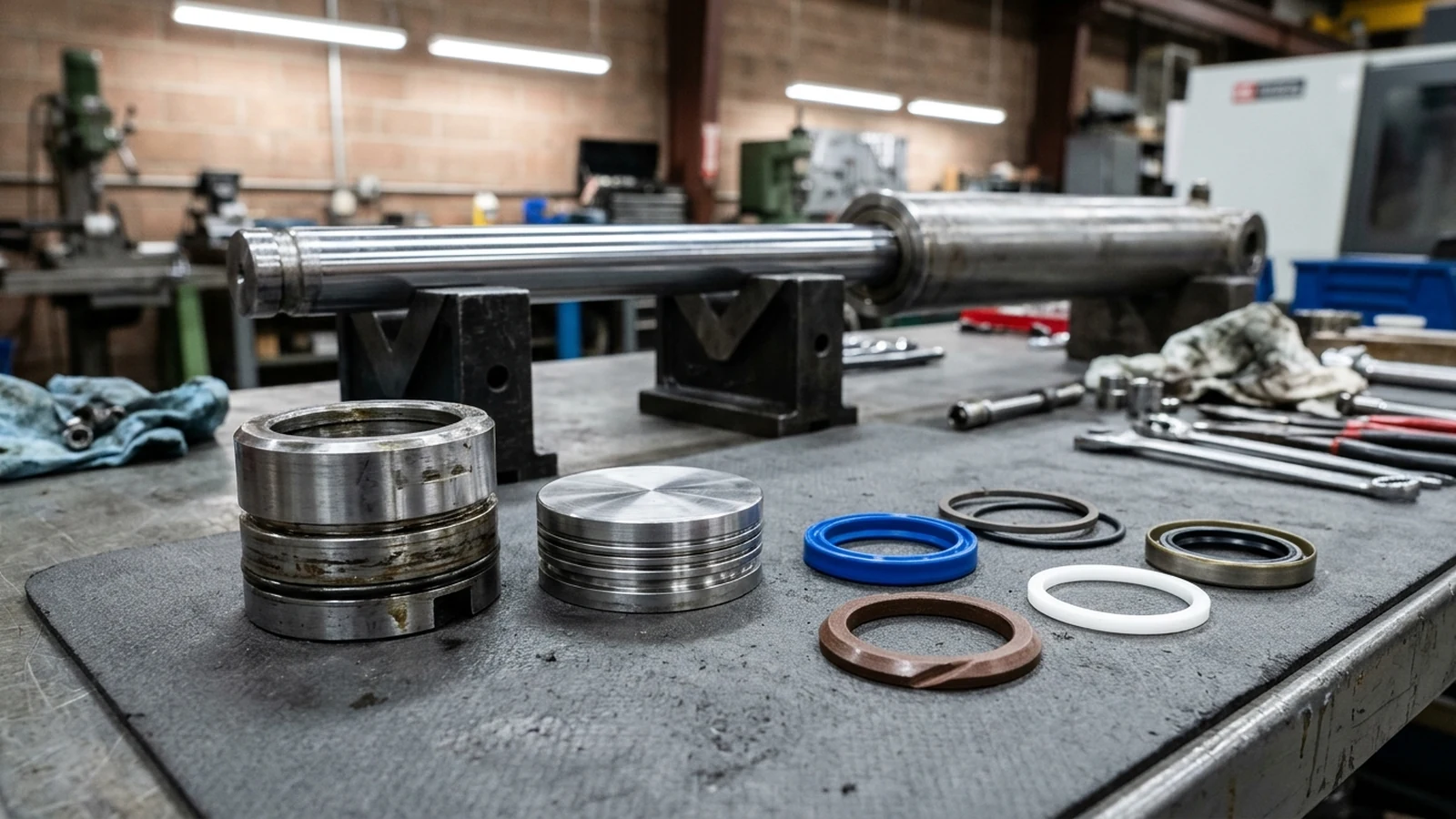
A locating stop shows where a board is supposed to sit. Wear on the stop is visible. The five Viking cards and card #3466 print no wear measurement and no remaining life, so a photograph can identify the stop and still leave service life blank.
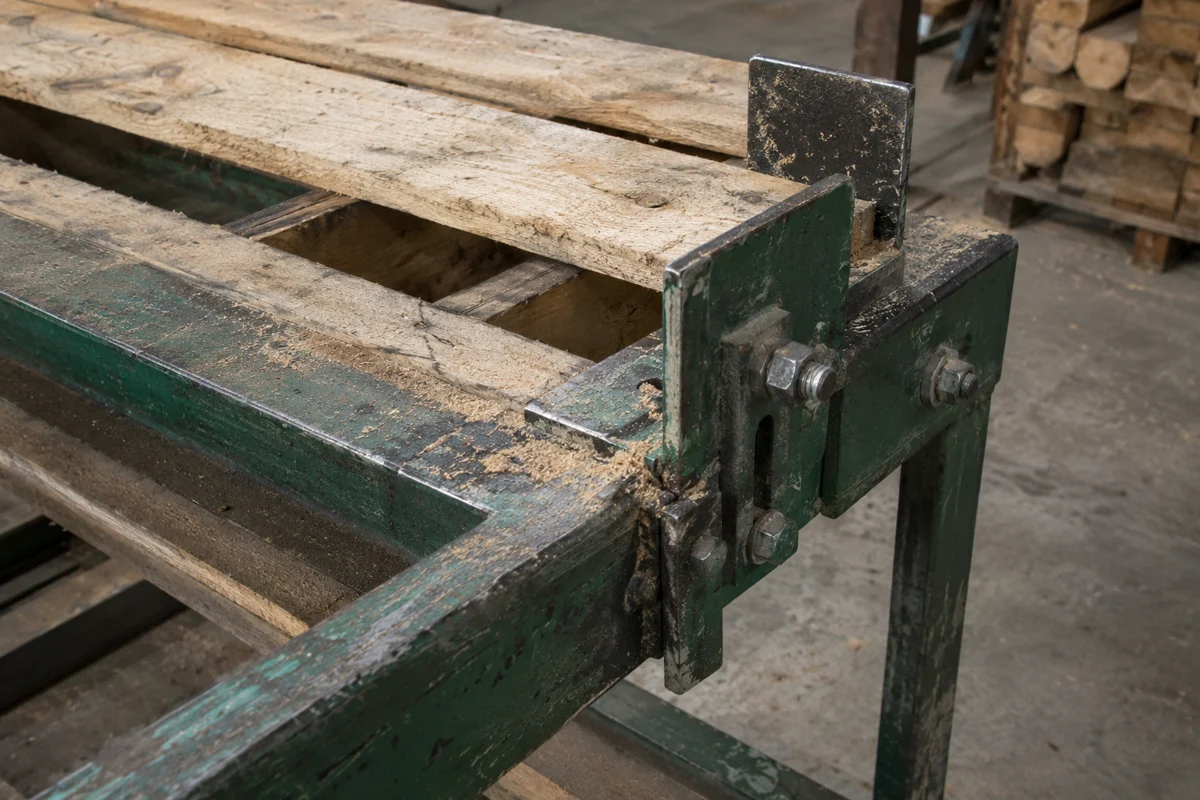
The dominant failure mode at this stop is misalignment, a board or stringer that sits off the drawing in the locating stop. Prevent it by pairing the stop photograph with the pallet drawing and with the stringer count on that card. A 4-stringer, 72 in. card and a 3-stringer, 60 in. card are different fixture questions. The TC100 card prints 4-stringer and leaves length blank, so its fixture match stays open on length.
Viking’s service page describes a maintenance assessment program for the fair market value of current Viking equipment, or for a detailed assessment of used equipment a buyer is considering. The page prints no duration, no checklist, and no fee. Phone support on that page is listed Monday to Friday, 7:30 AM to 4:30 PM CST. An assessment described there is a service the page offers. It is not a finding that any of the five advertising cards has been assessed. The used-listings page still states that Viking does not claim the current state or condition.
Controls and parts follow the name on the card
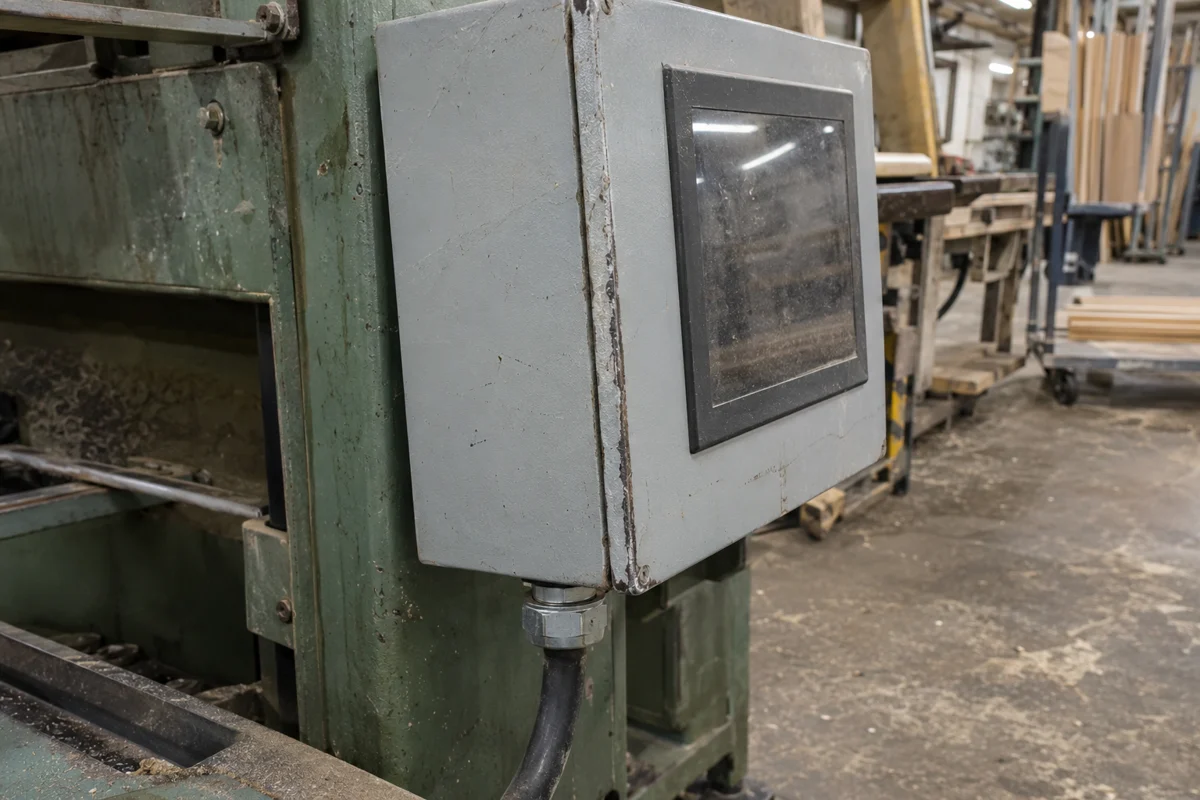
A closed enclosure shows a screen and a cable. It does not show who holds the program backup, the drawings, or the password. None of the used cards print those items. Record the handover as its own line, and leave the line blank until the seller names the files and the person allowed to transfer them.
Viking’s parts page names separate store links for Turbo 505, Turbo 606, Champion 304A Classic, and Champion QC306, plus legacy books titled Champion Parts Book, Champion 304A Parts Book, and Viking Tandem Parts Book. The 2001 card’s August 2003 note names QC306, so the QC306 link is the name to write on that row, with the 2003 note kept beside it. The 1999 and 2017 cards print Champion 304A, so the 304A book is the name to write on those rows. The TC100 card prints the word tandem, and the parts page names a Viking Tandem Parts Book. The page does not state that the book fits the TC100, so that pair stays a name check. Card #3466 prints Pallet Chief I. Viking’s parts page does not list a Pallet Chief book, so that parts row stays blank. None of these name matches is a stock confirmation. The cards print no serial.
The parts page says in-stock parts ordered before 1:30 PM CST ship the same day, and that next-day delivery is available on heavy wear and critical components. Rule of thumb. If the order clock is past the printed 1:30 PM CST cutoff, the same-day line on that page has closed for the day. The page limits the same-day line to in-stock parts. Machine lead time on every used card stays blank. The parts-page navigation names Rx3i Upgrade Kit, Champion RSTI Upgrade Kit, Silver Kit, and SmartCare Kits. It assigns none of those kits to the five used cards.
The trial count and the haul stay on separate rows
Agree the pallet drawing, the timber, and the fasteners before anyone runs the offered configuration. Keep the accepted count, the rejects, the stops, and the tasks a person still does, including replenishment and removal of finished pallets. A clip of an already-loaded cycle is a different record from a run that starts with empty fixtures.
| Trial field | What to write | What stays blank |
|---|---|---|
| Unit | Stock number and the hand, stringer count, and length from that card | A rate copied from PM-201DD |
| Product | Drawing revision, timber reference, fastener reference | Nail length, until it is measured against 32-90 mm only if the offer is PM-201DD |
| Count | Accepted pallets, rejects, reasons, start and finish | Catalog arithmetic presented as the machine’s result |
| People | Replenishment, stack removal, changeover | A crew number on the Viking cards, which print none |
| Open items | Stops, substitutions, items not run | Guarding, which the used cards do not list |
The packaging machinery FAT checklist is the record method for conditions and evidence. Use it on this nailing unit with the plant team. It is a packaging-acceptance record, and it does not set a pallet load rating. When the nailer has to meet boards coming in and pallets going out, the complete packaging line specification keeps those two boundaries in one register.
Stop count = printed rate × stop minutes
Worked example, arithmetic on the PM-201DD rate only: 2 pallets/minute × 15 minutes = 30 catalog pallets during that stop. The used cards print no rate, so their stop-count cells stay blank. That 30 is the hidden output account on the PM-201DD row. It is not a fee, and it is not a measured loss on a Champion, a TC100, or card #3466.
Haulage is the other open account. Viking’s used-listings page states that Viking does not warehouse, store, ship, or deliver the listed equipment unless otherwise agreed. Machine mass and overall size are blank on the five cards and on #3466. The only mass and envelope in the pages fetched here are PM-201DD at 3500 kg and 4540*5200*1985 mm. Those two figures stay on PM-201DD. A Champion move still needs the seller to print mass, envelope, and who loads the truck.
Method and sources
The card lines, the parts cutoff, the assessment description, and the PM-201DD table come from the five pages fetched on 18 October 2026 and saved with this revision. Library search on pallet nailing returned palletizer and finished-pallet pages, and no nailing-machine specification table, so no library figure is copied here. The cached SERP index had no row for this query. No new search purchase was made.
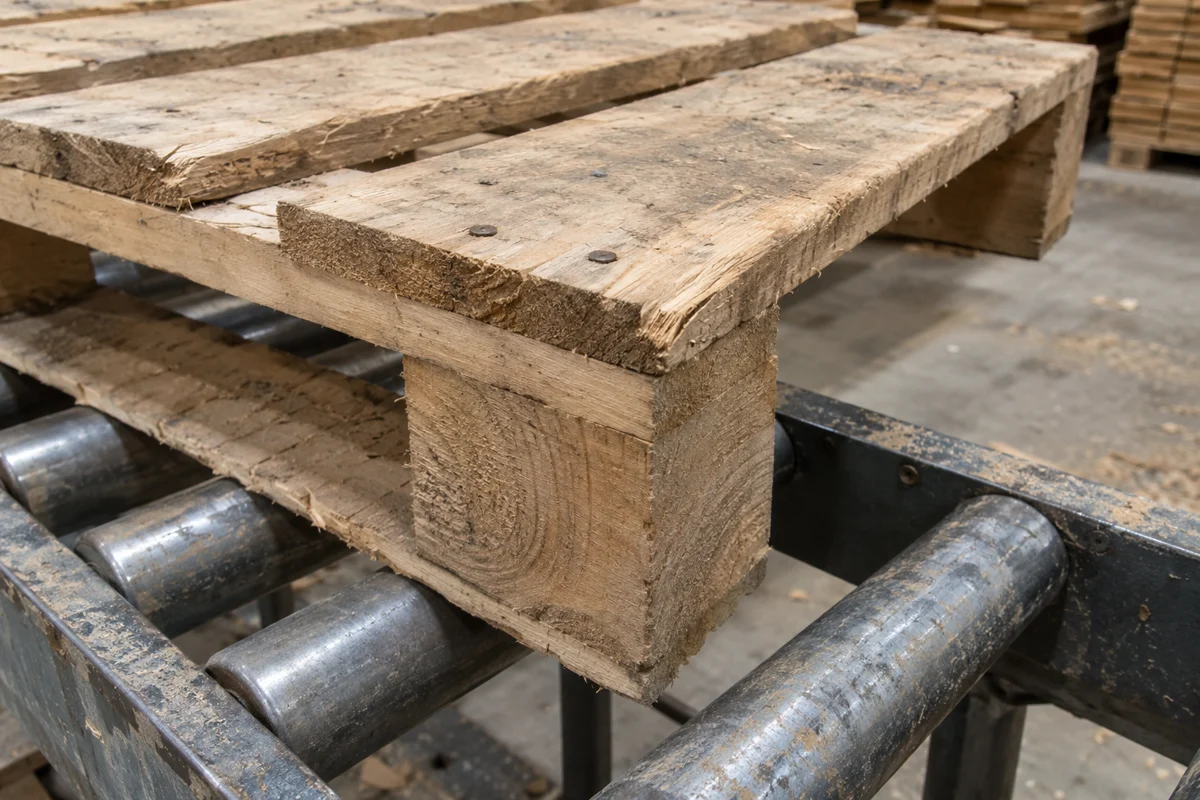
The length gap, the 20-pallet window, the 30-pallet stop, and the 14-numeral gap are arithmetic on figures those pages print. They are not trial results. The photographs are workshop illustrations of a locating stop, a closed enclosure, and a nailed block corner. They are not the Champion cards, card #3466, or a PM-201DD. Condition, program access, guarding, and delivered scope remain items for the unit file.