Placing a variable-data lane outside the 340 mm inkjet web of an MPS EF SYMJET wastes that image, and a US parts ticket sent to the European sales desk adds downtime while the press waits on the wrong party. Durst’s September 15, 2026 announcement plans to bring MPS Printing B.V. into the group on January 1, 2027, with closing conditions and regulatory approvals still open, while the published flexo presses stay in the portfolio. The tables below separate that plan from the web each named press publishes.
Durst announced on September 15, 2026 that MPS would join the group with a planned January 1, 2027 operating date, subject to closing conditions and regulatory approvals. For US buyers, the practical task is to obtain a project-specific answer about sales, service, existing commitments and the next procurement milestone. This article provides a responsibility register to structure those commercial and technical checks.
- Durst announced a conditional acquisition plan on September 15, 2026.
- The planned January 1, 2027 operating date remains subject to closing and approvals.
- Durst says the MPS flexographic portfolio and existing contractual commitments will continue.
- Its announced US sales/service arrangement needs a dated, project-specific responsibility answer.
What has Durst announced, and what remains conditional?
Read the announced arrangements as the company’s intentions and stated commitments. They do not supply a machine quotation or evidence that the proposed organizational change has occurred. The table separates what the announcement says from the project questions that a buyer still needs to resolve for a particular installation or order.
| Topic | Durst’s September 15 announcement | Buyer question still to answer |
|---|---|---|
| Operating date | January 1, 2027, if closing conditions and regulatory approvals are met (Durst, September 15, 2026) | An order dated before close still names today’s contract party |
| United States | Durst US takes sales and service of the MPS portfolio | A US ticket needs that party’s written acceptance |
| Europe | MPS direct sales channels remain | A European installation stays with the MPS channel on this page |
| EF next generation web | Extended to 680 mm (MPS EF page) | Sleeve pressure is set per station on this platform |
| EF SYMJET webs | Domino inkjet 340 mm, MPS flexo 430 mm, Kyocera heads at 600×600 dpi, up to six colors plus opaque white | Inkjet lanes and flexo-only lanes use different widths |
| EF Packaging web | 26 in on the MPS products index | 26 × 25.4 = 660.4 mm, which is 19.6 mm under the 680 mm EF next generation web |
| EXL-Offset speed | Up to 300 m/min, also written as 1000 ft/min | 300 m/min converts to 984 ft/min; keep the metric figure on the record |
| OMET hybrids | KJet and XJet continue independently of the MPS transaction | The offer has to name MPS or OMET |
The manufacturing equipment desk is the parent for this equipment record. The buying guides desk is the route for writing the job scope those presses have to cover.
What did Durst announce on September 15, 2026?
MPS Printing B.V. is planned to become part of Durst on January 1, 2027, through the acquisition of the holding company, and to operate as MPS - A Durst Group Company. Durst published that plan from Brixen/Chicago during LOUPE Americas 2026. Christoph Gamper, CEO and co-owner of Durst Group, and Michiel Borst, CEO of MPS Printing B.V., are the named speakers. Borst is planned to continue and to become managing director of MPS - A Durst Group Company.
Who answers an open service or parts question?
Make the responsible contact visible for the installation you own or the order you are placing. Our recommendation is to retain a dated answer alongside the machine identification, service agreement and open issue. A general statement of continuity is useful context, but it does not replace the terms and working contact for a specific request.
| Situation | Information to retain | Question for the responsible supplier |
|---|---|---|
| Close | Customary closing conditions and regulatory approvals still apply | The completion status on the day you sign |
| Portfolio | MPS keeps developing, manufacturing, and marketing its existing flexographic systems | The exact press, web, and converting units |
| People | The current MPS management team remains | The person who signs for this order |
| United States | Durst US assumes sales and service, using Durst’s regional organization | The contact who accepts this serial number, and from which date |
| Europe | Existing MPS direct sales channels remain | The MPS channel named on a European contract |
| Spare parts | MPS is to draw on Durst’s international service and spare-parts infrastructure | Availability of this part number, which the page does not locate |
| Contracts | Existing contracts and service commitments remain under their terms | The document that actually binds this installation |
| OMET | The partnership continues on its own. Durst and OMET still develop, manufacture, and market KJet and XJet | Which hybrid platform the offer is selling |
A continuing portfolio leaves price, lead time, and local stock as questions for the offer in hand. The scope register is the place to mark each of those answers included, excluded, or still open.
Which published MPS press matches the web and the process?
Match the job to the page that labels that web. The September 15 announcement names a flexographic portfolio. It publishes no web width. The widths below are from the MPS pages read on October 17, 2026.

The across-web pitch is measured on the label or sheet you will run. That pitch is what the published web has to hold.
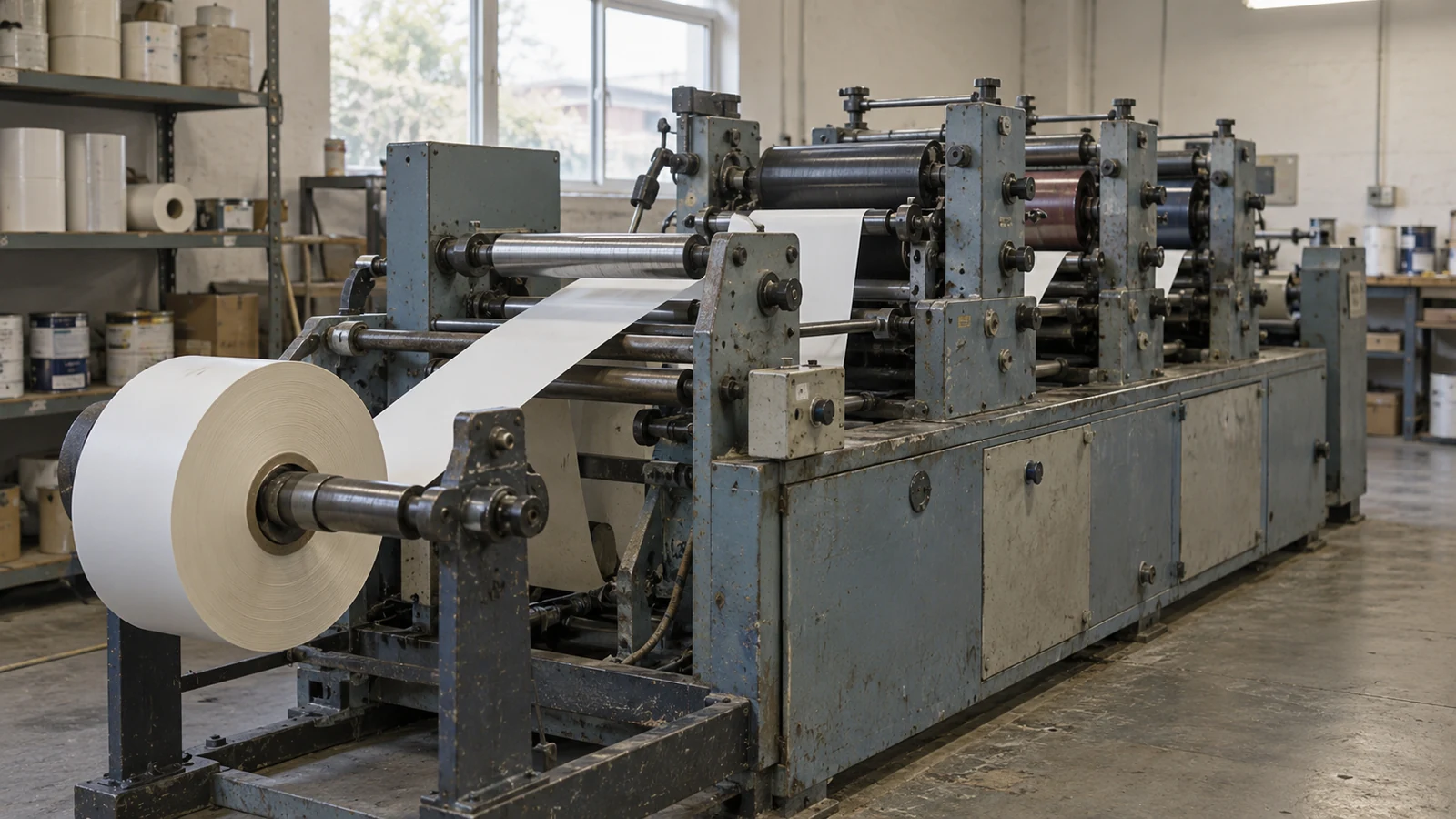
The products index calls the EF SYMJET a 22, 20, 17, or 13 inch hybrid and does not say whether those inches are web or repeat. The SYMJET page labels two webs in millimeters: 340 mm on the Domino inkjet unit and 430 mm on the MPS press. Converted at 25.4 mm per inch, 17 in is 431.8 mm and 13 in is 330.2 mm. Those sit near the labeled webs and are not equal to them (431.8 − 430 = 1.8 mm, and 340 − 330.2 = 9.8 mm). 22 in is 558.8 mm and 20 in is 508.0 mm. Neither equals 340 mm or 430 mm, so those two inch marks are a different dimension from the labeled webs. Put 340 mm and 430 mm on the SYMJET line of the order.
| Platform | Published scope, read October 17, 2026 | Dominant failure mode | Prevention |
|---|---|---|---|
| EF next generation | Multi-substrate flexo. Servo-controlled sleeve pressure at each station. Web extended to 680 mm. Job memory, slide-out ink drawer, quick-release E-sleeve. Ultraflex rail units (foil, turner bar, screen) can sit at any station | Sleeve pressure saved for another substrate over-impresses or skips the dot on this web | Recall the job memory for this substrate, then accept the print on that web |
| EF SYMJET | Hybrid on the EF platform with a Domino inkjet unit. Kyocera heads, 600×600 dpi, up to six colors and opaque white. Inkjet web 340 mm. Flexo web 430 mm. Gravure and screen are listed among converting options | A variable image imposed out to 430 mm misses the 340 mm inkjet heads | Keep every inkjet lane inside 340 mm. Use the extra 90 mm for flexo-only lanes |
| EXL-Offset | Offset and flexo, with variable sleeves for plates and blankets. Stated speed up to 300 m/min. A gravure unit dries solvent ink with hot air. Converting listed: hot foil, cold foil, delam/relam, die-cutting, laminating | Solvent ink on a unit with no hot-air path, or a repeat with no sleeve and blanket pair | Dry solvent on the gravure unit the page describes. Match the sleeve repeat to the job |
| EF Packaging | Products index: 26 in web for flexible packaging and shrink sleeve, on the EF narrow-web series. Detail page: E-sleeve, slide-out ink drawer, rotogravure and solvent flexo for whites, metallics, or coatings, turner bars for reverse-side printing, lamination in one pass | The 26 in web is copied onto an EF next generation line that publishes 680 mm | Write 660.4 mm on the EF Packaging line and 680 mm on the EF next generation line |
| EXL-Packaging | Flexo for narrow to mid-web packaging. The page lists UV, water-based, and solvent-based inks, automatic sleeve loading, and screen, gravure, laminating, hot foil, and cold foil as integrable units. It does not label a web width in the text read here | A solvent job is assumed to dry the same way as on the EXL-Offset gravure unit | Require the offer to name the dryer for the solvent unit on this press |
| OMET KJet / XJet | Durst page: hybrid platforms that continue with OMET, independent of the MPS transaction | The word hybrid on a purchase order, with no platform name | The offer names EF SYMJET or KJet/XJet, and names one contract party |
MPSConnect, on the EF next generation and products pages, is the connectivity layer: the products page says hundreds of sensors collect data from hundreds of events per second. That is the published baseline. The offer still has to list which signals are included. Connected-line questions sit on the automation desk. If the variable image is an imprinter added to a host line you already run, use the PROSPER Plus 5 retrofit record and its host-line checks. That record is a different machine from the EF SYMJET.
| Review dimension | Common buyer input | Evidence required in each proposal |
|---|---|---|
| Shortlist | Model, web in millimeters, process (flexo, inkjet, offset), and the units that are outside the offer | The person comparing offers |
| Contract | Contract party, service party, delivery conditions, and what FAT will witness | The party who signs |
| Handover | Named contacts, open items, and the date each answer applies | The party who accepts the serial |
Label a proposed hybrid by its actual modules and functions. Do not assume that the continued OMET relationship or the proposed MPS acquisition makes different configurations interchangeable. Ask who confirms each connection, the job types represented in a demonstration and the work that remains outside the offered boundary.
The line-interface matrix helps assign those boundaries. The automation desk helps define the required function before engineering implementation. For witnessed evidence, adapt the FAT record structure to the press and job rather than copying unrelated packaging criteria.
Common mistake: The comparison gives a higher score to a future group structure while leaving substrate, finishing and accepted output unmatched. Resolve the job comparison first; retain organizational questions beside it.
Takeaway: Match the job and configuration before comparing what a proposed corporate change means for the purchase.
What should be settled before a procurement milestone?
Use the next real project milestone to decide which answers are needed now. There is no universal instruction to delay or accelerate an order because of the announcement. Our suggested register links open questions to the point at which they affect a commitment, so a buyer can advance evidence gathering without pretending the deal’s conditions are already resolved.

| Project position | Evidence to settle | Record before progressing |
|---|---|---|
| Shortlisting | Offered configuration, job coverage and scope exclusions | Comparable responses and remaining technical questions |
| Contract review | Contract party, delivery conditions, service and acceptance scope | Applicable written terms and owners |
| Installation or handover | Actual coordination contacts, documents and outstanding tasks | Confirmed responsibilities and open-item closure plan |
For an order already underway, retain the current agreed baseline and ask which communication or administration changes affect it. Do not silently replace an existing contractual answer with a news summary. For a new purchase, request the current terms for the proposed configuration rather than expecting the announcement to supply them.
The requirement register helps version the actual task. The acceptance checklist helps retain the difference between demonstrated evidence and items still awaiting confirmation. Both are reference structures, not legal advice or promises of supplier behavior.
Common mistake: “Continuity” is recorded as a blanket warranty or delivery guarantee. Retain the actual agreement and ask about the specific unresolved responsibility.
Takeaway: Tie each unanswered question to the milestone it affects and obtain a dated written answer.
When this does not apply
Project and legal decisions require the applicable contractual documents, regulatory closing status, and technical review by the responsible procurement and engineering teams.
Takeaway: Use the register to organize questions; use the actual agreement and equipment evidence to resolve them.
Method and sources
This review draws on Durst’s September 15, 2026 announcement and technical references from Tamarack Products and DIC Corporation. The acquisition arrangements are attributed to Durst; the procurement registers are editorial frameworks for buyer verification. The editorial policy explains how we distinguish manufacturer statements from procurement checklists.
Takeaway: Separate announced intentions from current contractual answers and demonstrated equipment results.