Running the host faster than the published Plus 5 class wastes web that never receives a code. The Kodak PROSPER Plus 5 Imprinting System is a Stream inkjet unit for existing presses and finishing lines, and the current Kodak product page sets its integration class at 107 to 152 m/min (350 to 500 fpm) with 600 × 900 dpi.
Kodak’s October 6, 2026 issuing-company release announces the PROSPER Plus 5 as a 152 mpm (500 fpm) Stream inkjet imprinting system for existing presses and finishing lines. This creates a retrofit option to evaluate alongside line replacement. The decision framework below separates the required print task, host-line evidence and commissioning responsibilities before a production manager chooses a path.
| Item | Published value and source | Why it matters |
|---|---|---|
| Plus 5 integration class | 107 to 152 m/min (350 to 500 fpm) at 600 × 900 dpi. Kodak product page, 17 October 2026 | This is the only Kodak page that prints both ends of the band |
| Plus 5 headline speed | 152 m/min (500 fpm), 600 × 900 dpi. Issuing-company release, 6 October 2026 | Same ceiling, no printed floor |
| Plus 5 datasheet row | 500 fpm (152 mpm), resolution listed as 900, 600. N/A at 650 fpm and above. Datasheet footer K-941.26.05.26.EN.07 | A single speed row, and a different way of writing resolution |
| Print width | 4.16 in (105 mm). Product page and the same datasheet | One head’s lane. Wider codes need more heads |
| Drop size | 11.4 pL and 9.8 pL on a shared row under the Plus 5/10/20 table. The release says “flexible drop size options” and prints no picoliter value | Use the picoliter pair only as that shared row |
| Mounting web | 8 in (203.2 mm) to 60 in (1524 mm), 1 to 8 printhead rails. Datasheet | Host web width has to sit inside this mount range |
| Ink | Water-based KODAK EKTACOLOR. Release and datasheet | The datasheet also prints food-contact wording. See below |
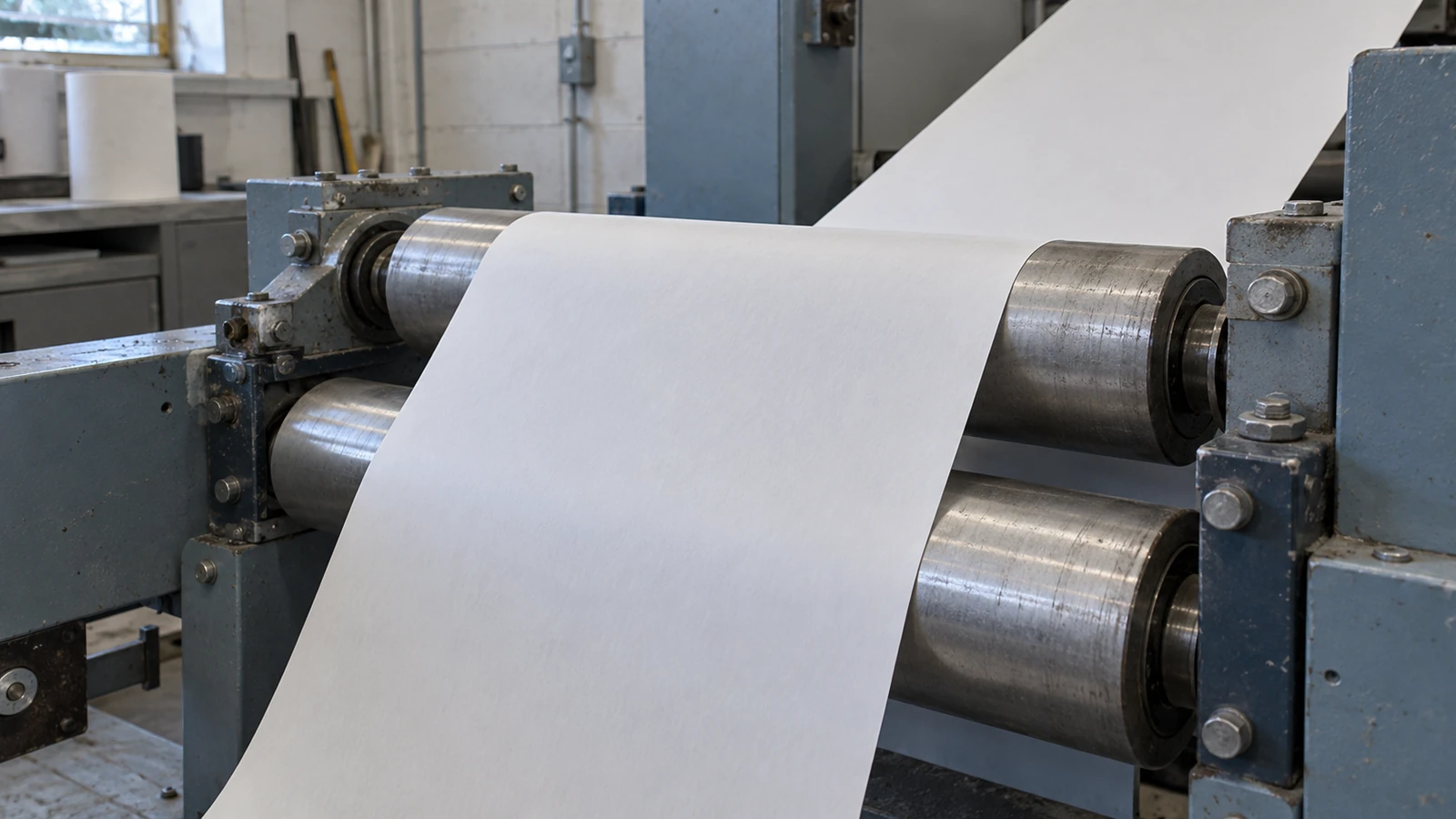
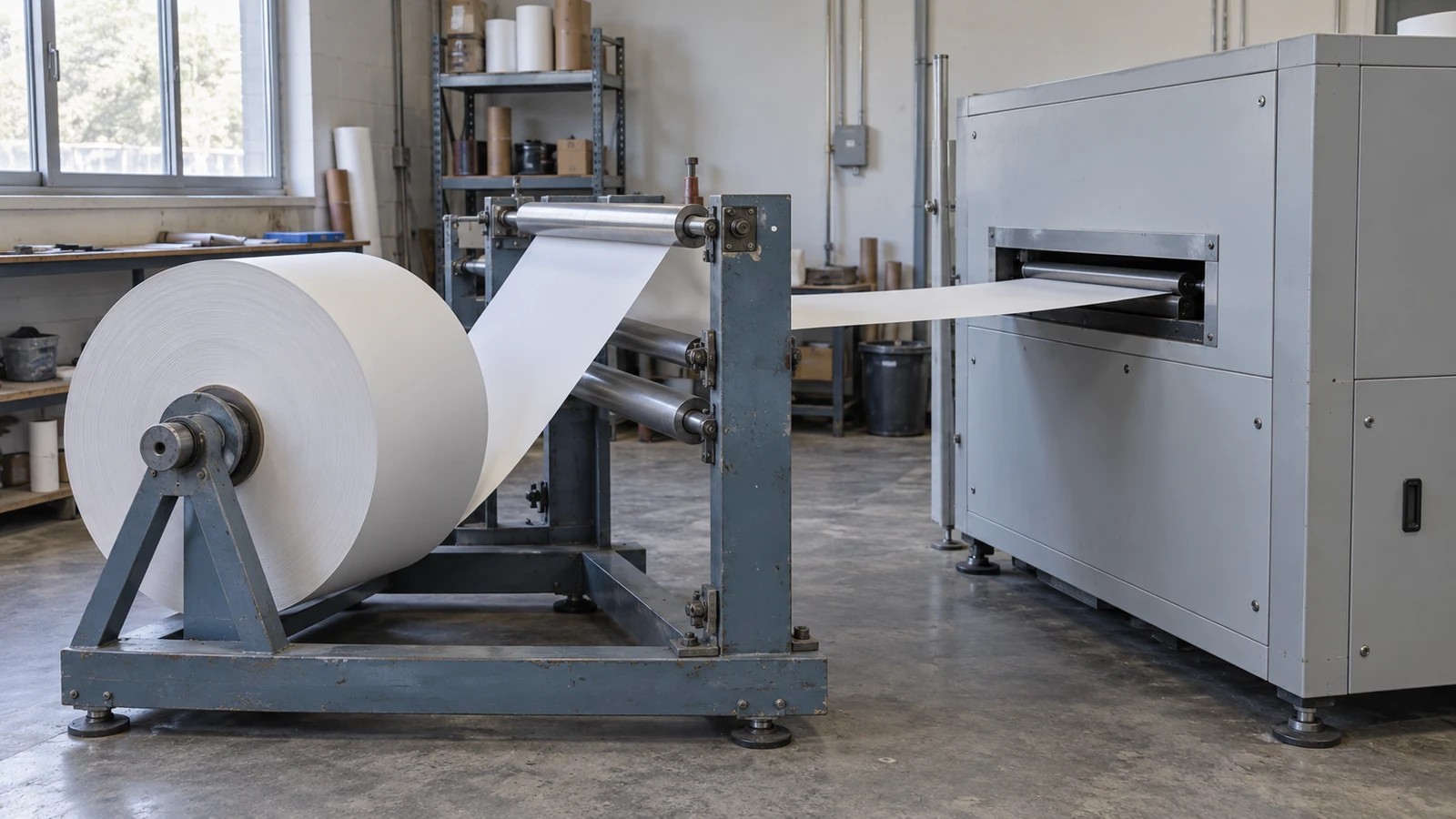
Example of web transport on idler rollers. The meters-per-minute figures above describe a moving web like this. The photo is not a Kodak printhead, a mounting drawing, or a measured tension.
Which Plus 5 speed and resolution pairing is on the page you are holding?
Read the three Kodak pairings side by side and keep the one that names the host speed you will actually run. They do not collapse into a single silent number.
Ask the host-equipment and imprinting parties to answer one interface record. Kodak’s current product description identifies existing offset, flexographic and gravure presses and finishing lines as integration applications. That description does not establish fit on an individual machine. Keep the actual host identification, proposed mounting boundary and material path attached to the supplier’s answer.
| Interface input | Buyer record to prepare | Proposed answer to obtain |
|---|---|---|
| Product page, fetched 17 October 2026 | 107 to 152 mpm (350 to 500 fpm), as the integration class | 600 × 900 dpi |
| Issuing-company release, 6 October 2026, via WhatTheyThink | 152 mpm (500 fpm) | 600 × 900 dpi |
| PROSPER Plus datasheet, visible pages, footer K-941.26.05.26.EN.07 | 500 fpm (152 mpm) only. The 650, 1000, 1500, and 2000 fpm rows print N/A in the Plus 5 column | 900, 600 under the heading Resolution (dpi) |
The product page and the release both print 600 × 900 dpi. The datasheet prints 900, 600 on the only Plus 5 speed row. Those are the pairings. This page does not rewrite 900, 600 as 600 × 900.
The metric figures are rounded conversions of the foot-per-minute figures Kodak prints beside them:
500 fpm × 0.3048 m/ft = 152.4 m/min. Kodak prints 152 mpm next to 500 fpm on all three documents.
350 fpm × 0.3048 m/ft = 106.68 m/min. Only the product page prints the low end, and it prints that end as 107 mpm (350 fpm).
A host whose steady speed sits between 107 and 152 m/min is inside the product-page class. The datasheet does not print a Plus 5 row below 500 fpm (152 mpm). A host whose steady speed is above 152 m/min is outside every Plus 5 row these documents print. The datasheet’s next listed speed, 650 fpm (200 mpm), is N/A for Plus 5.
Worked example. Running length at the shared ceiling uses the speed all three documents print:
L = v × t
| Trial record | Entry to agree | Evidence to retain |
|---|---|---|
| Steady web speed above 152 m/min (500 fpm) | The imprint is skipped, or the host is slowed off the recipe the line was built to run. Plus 5 is N/A on the datasheet from 650 fpm up | Lock the job to a speed a Plus 5 row prints. Leave Plus 20’s 2,000 fpm figures on the Plus 20 rows |
| Imprint wider than 4.16 in (105 mm) on one head | The code is cut off at the edge of the lane | n = ceil(W / 4.16 in). If one code crosses a joint, require a stitch sample. The datasheet prints three stitch algorithms and no overlap distance |
| A roller or rewind touches the web before the ink is dry | Smear, then an unreadable code | The datasheet recommends ADPHOS NIR inkjet drying or an equivalent for most applications. Put that dryer before the next hard contact |
| The variable record is not locked to the host repeat | Misalignment: the code lands on the wrong unit along the web | Trigger from the host repeat and stop the job when a record misses the window. These documents print no latency budget |
| Room outside the printed range | The datasheet no longer describes the room the acceptance ran in | The sheet prints 60.8°F to 104°F (16°C to 40°C) at 10% to 60% RH non-condensing, and 60.8°F to 86°F (16°C to 30°C) at 90% RH non-condensing |
Keep a printed-content success separate from the whole-job result. For example, if finishing is not represented, retain that limitation rather than reporting a complete production-line demonstration. Agree the relevant quality criteria with the responsible parties.
Example of aisle space beside a web line, where a print station and a dryer have to fit. This is not a Kodak station layout, a service procedure, or a measured installation.
Rule of thumb. If host web speed exceeds 152 m/min on the job you intend to run, keep Plus 5 off that recipe. The product page ends the Plus 5 class at 152 m/min. The datasheet marks Plus 5 N/A at 650 fpm (200 mpm) and on every faster row. A faster class has its own pairings: the product page prints Plus 20 at 600 mpm (2,000 fpm) and up to 600 × 300 dpi, the 6 October release prints Plus 20 at 609 mpm (2,000 fpm), and the datasheet marks the 2,000 fpm row N/A for Plus 20 as well. Write down which pairing the offer uses before you slow the host or change the model.
The release lists Plus 5 applications as direct mail, packaging, security printing, lottery, and personal care. The product page, for the Plus family, lists serialized, promotional, and regionalized packaging; personalized direct mail, coupons, and variable inserts; lottery, tax stamps, authentication, and anti-counterfeiting; and barcodes, QR codes, and track-and-trace on manufacturing and labels. Personal care is on the release. It is not in that product-page application list. For a packaging code, the packaging machinery guides cover the line around the press.
Compare the project sequence and its responsibilities alongside equipment capability. A retrofit keeps the host asset, so the project plan must specify which tasks use that asset, who performs them and what evidence allows production to resume.
What does a hold or a second pass cost in web length?
| Project question | Retrofit proposal | Replacement proposal |
|---|---|---|
| What is retained or removed? | Identify host and altered boundaries | Identify replaced and retained scope |
| What site work is required? | Record mounting, services and interfaces | Record placement, services and transfers |
| When is production interrupted? | Obtain task sequence and conditional timing | Obtain removal/installation sequence and timing |
| What releases the equipment to production? | Define integration and job evidence | Define full offered-job evidence |
| Who supports the resulting arrangement? | Assign host and imprinting responsibilities | Assign equipment and integration responsibilities |
Worked example. Use the shared ceiling, v = 152 m/min. Assume a 12 minute hold while the data path or the dryer is sorted. Twelve minutes is an assumption for the arithmetic, not a Kodak installation time.
L_lost = 152 m/min × 12 min = 1,824 m
That is 1,824 m of web that does not receive the code during the hold, at the published ceiling. At the product-page floor the same hold is 107 m/min × 12 min = 1,284 m. The product page is the only document that prints 107 m/min.
A second handling of the same web is the other cost. Kodak’s imprinting overview says variable content used to be added in a separate operation. The Plus datasheet says in-line imprint adds the variable content without an additional offline laser pass. The product page lists obsolete inventory, overproduction, and waste from versioning among the losses hybrid imprinting is meant to cut, by printing the version on the press you already run. No Kodak page fetched for this article prints a waste percentage, so this page does not supply one.
Use the factory acceptance evidence checklist to tie each row above to a sample, a speed, and a named owner. The release says Plus 5 is available worldwide as of 6 October 2026. It does not print a plant date, a power-up sequence, or a local outage.
Retain replacement when the desired finished job needs a capability beyond the proposed retrofit boundary, or when the retained host’s unresolved condition materially affects the decision. This is a conditional shortlist rule, not a prediction that one route costs less. Use the same job and scope boundary to decide what additional evidence is worth obtaining.
| Evidence position | Recommended next action | Decision to avoid |
|---|---|---|
| Host/task interfaces confirmed; representative job demonstrated | Compare complete retrofit scope and project sequence | Approving solely from system speed |
| Transport, material or finishing issue remains unresolved | Obtain the missing technical answer; retain alternatives | Assuming extra imprinting solves the host limitation |
| Required task exceeds the proposed retrofit scope | Seek a proposal covering the full task | Comparing different finished outputs as equivalent |
| Job requirement still changing | Revise the requirement baseline | Committing to either configuration too early |
Complete the requirement register with a status, document reference, owner and next action for every decisive row. Compare itemized costs only once both proposals answer the same finished-job requirement.
Common mistake: Retaining the host is assumed to guarantee a lower total cost. Compare the whole offered task, site work, interruption and support responsibilities.
Takeaway: Keep alternatives open until the unresolved host condition and full project scope have been answered.
When this does not apply
Obtain application-specific technical review and the responsible quality and data requirements before production approval, especially where regulatory acceptance of coding or serialization is required.
Takeaway: Use the framework to choose the next evaluation, not to approve a production application.
Method and sources
This review draws on Kodak’s October 6, 2026 announcement and current PROSPER Plus product documentation. Availability and speed are company statements; the decision branches, trial record and project-sequence table are editorial evaluation tools. The editorial policy describes our treatment of source claims and application evidence.
Live fetches on 17 October 2026: the PROSPER Plus product page (the kodak.com/go/plus5launch redirect lands on that page), the PROSPER Plus datasheet PDF linked from that page, the imprinting-systems overview, and the S-series page. The PDF’s file-property title reads “KODAK Finishing Solutions / Single Plow Station” and its creation stamp is 2026-05-27. The visible pages are titled “KODAK PROSPER PLUS IMPRINTING SYSTEM” and the footer is K-941.26.05.26.EN.07. Figures in this article come from the visible pages.
One datasheet cell prints umbilical length as 39.3 ft (11.978 mm). Those two units do not describe the same length, so this article does not use an umbilical length.
The editorial policy states how this site treats a manufacturer claim. Numbers above are Kodak’s printed pairings, with the document and date next to each one.