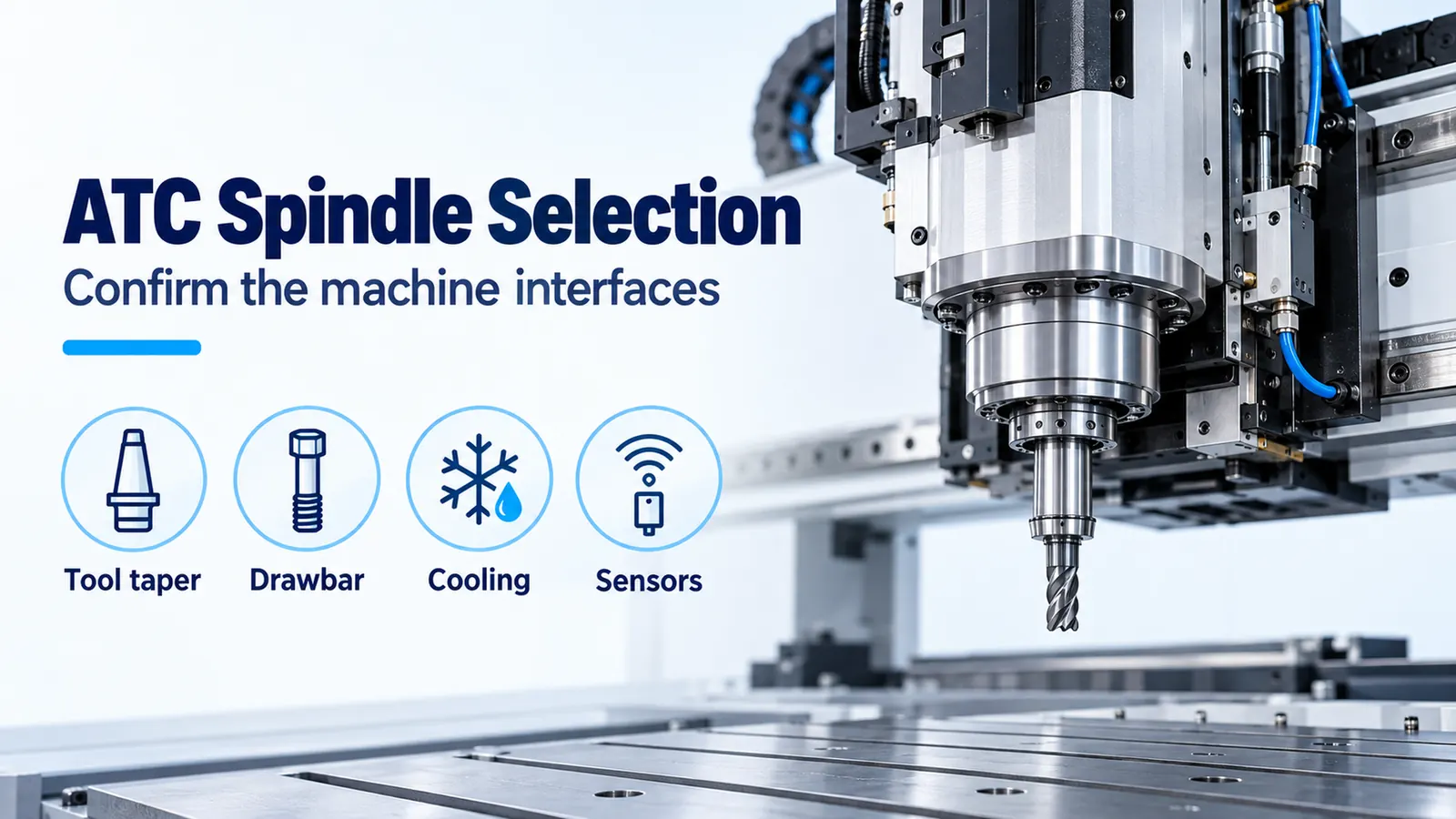
A mismatched ATC spindle interface causes rework before the first production part: the holder does not seat, the changer misses the grip, or heat jams the taper. Confirm the tool taper and form, the drawbar, the drive, the cooling, the sensors, and the changer as separate written items before the order.
An automatic-tool-change spindle is part of a machine system, not a complete tool-changing installation by itself. Colombo describes ATC spindles as integrating with a machine tool or robot for changes without manual intervention; MultiCam lists ATC as an option within an identified router configuration. This guide turns that system boundary into an interface record and written-confirmation checklist for a new machine or proposed replacement.
| Input or item | Typical value or source | Why it matters |
|---|---|---|
| Colombo ATC line span | 0.4 HP (0.3 kW) to 47 HP (35 kW); speeds up to 40,000 RPM. Colombo ATC page, 18 October 2026 | A line ceiling is not the nameplate of the spindle in the quote |
| Colombo tool connection | ISO 15, 20, 25, 30, 40. HSK 25, 32, 40, 50, 63, 80. Form F is the most popular; A, B, C and E on select models. Same page | Family, size, and form all have to match the holder and the changer |
| GC holder caution | ISO or HSK only. BT holders are not interchangeable. Colombo technical guide, same date | A shared “30” can still be the wrong family |
| Colombo cooling constructions | RA liquid (water + glycol, chiller). RC dry compressed air. RS powered fan, V230 or V24. RV shaft-mounted fan. Same guide | The utility and the fan supply are part of the purchase |
| Front bearing support | Normal band 100 to 140°F. Maximum 150°F, and excess heat jams holders in an ATC spindle. Same guide | The jam threshold is printed. A shop logger in °C still needs this band |
| Hiteco changer index | 6, 8, 12, 16 and 24 positions. Filter values ISO30, HSK63F, HSK63A, HSK63E. Hiteco tool-changer page, same date | Magazine capacity and holder family are changer fields, not spindle fields |
| Named model in the quote | Power, speed, release pressure, and coolant flow left blank until that model’s card or manual states them | Empty cells stay empty |
Is an ATC spindle the whole tool-changing system?
Colombo describes an ATC spindle as integrating with the CNC so the change needs no manual intervention. The housing still does not include the magazine or the gripper. Hiteco sells tool changers as a separate catalog: “from 6 to 24 positions in the Base or Plus version for ISO30 or HSK.” The same page’s filter is tighter than that sentence. It lists positions 6, 8, 12, 16 and 24, and holder values ISO30, HSK63F, HSK63A and HSK63E.
Plus units on that page are equipped with a LEXIUM motor. Base units have no motor. Hiteco writes that a Base changer, having no motor, “can be easily interfaced with any type of machine.” Record that as the maker’s description of a motor-less changer. The machine builder still has to confirm, in writing, the named spindle, the holder family, and that changer together. Fitment verification is the close of the record.
The CNC router buying guide keeps these questions inside the full machine offer. Start from the part and the operation sequence there, and add automatic changing only when the job actually changes tools.
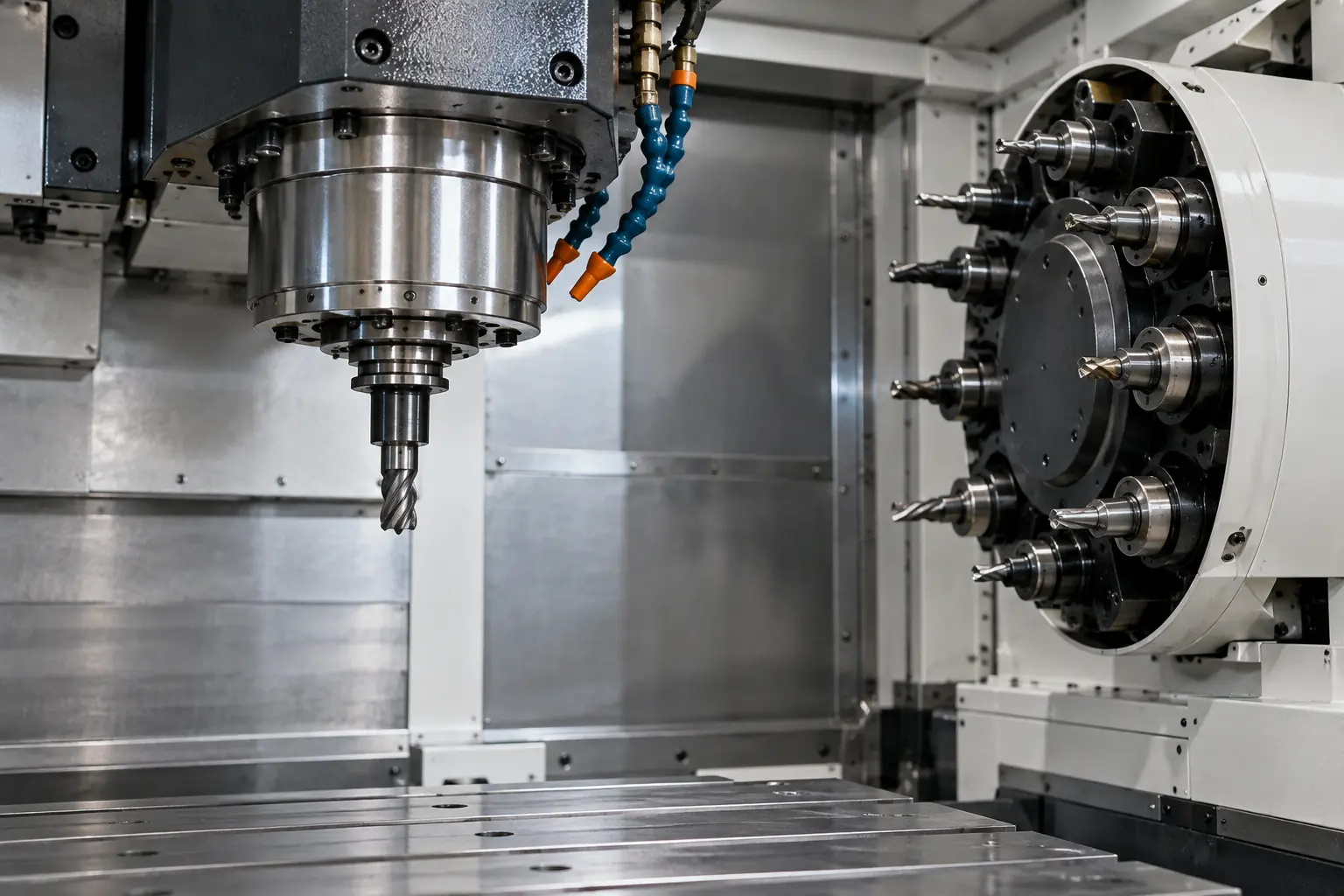
Example of a spindle nose and a tool magazine as two pieces of equipment. Editorial illustration, not a capacity rating.
Takeaway: Put the spindle and the changer on two lines, and copy the changer position count and holder filter from the changer page.
Which taper and holder family have to match?
Colombo’s ATC page equips the line with ISO tapers 15, 20, 25, 30 and 40, or HSK tapers 25, 32, 40, 50, 63 and 80. Form F is the most popular HSK form on that page. Forms A, B, C and E appear on select models. The technical guide then draws a hard line for GC spindles: they accept only ISO or HSK holders, and BT holders are not interchangeable.
Write three fields for every holder: family, size, and form. ISO 30, HSK 63F, and a BT taper are three records. A photo of a cone does not fill them. Colombo’s troubleshooting list asks whether the tool-holder taper fits the required one, and points to the manual for the holder choice.
| Holder record | Printed scope | Blank if missing |
|---|---|---|
| Colombo ATC line | ISO 15 / 20 / 25 / 30 / 40, or HSK 25 / 32 / 40 / 50 / 63 / 80, with form | Form, when the quote says only “HSK” |
| GC spindle caution | ISO or HSK. BT is not interchangeable | Any BT holder offered for a GC spindle |
| Hiteco changer filter | ISO30, HSK63F, HSK63A, HSK63E | A changer quoted as “HSK” with no form |
Rule of thumb. If the holder family is BT on a GC spindle, reject the match. Colombo states BT holders are not interchangeable with the ISO and HSK holders those spindles accept.
Takeaway: Family, size, and form are the match. Leave any missing field blank.
Which power and speed figures can go on the order?
Colombo prints one span for the ATC line: 0.4 HP (0.3 kW) to 47 HP (35 kW), speeds up to 40,000 RPM, for wood, plastic, aluminium, light alloy, glass and marble. That span is the catalog envelope. The spindle being ordered still needs its own card.
Hiteco’s ATC page prints a different summary in the same product introduction: capacities from 4 to 42 kW, rotation from 1,000 to 40,000 RPM, manual or automatic holders such as ISO or HSK, air or liquid cooling. The product index on that page does not sit inside the sentence. Speedtech is listed at 1.7 to 3.3 kW. Metaltech is listed at 31 to 60 kW. The RPM filter on the page includes 50,000, while the summary stops at 40,000. Copy the series card for the model in the quote. Leave power and speed blank when the card is not attached.
Worked example. Colombo prints horsepower and kilowatts on the same ATC line. Check a mixed quote with mechanical horsepower, where 1 HP = 0.746 kW.
0.4 × 0.746 = 0.298 kW, which rounds to the 0.3 kW printed on that page.
47 × 0.746 = 35.062 kW, which rounds to the 35 kW printed on that page.
A quote that pairs 0.4 HP with 35 kW has joined the two ends of the line. Mark the pair unresolved until one model card carries both units.
Keep model and document identities together before asking for a compatibility answer.
| Construction | What the guide prints | Utility to confirm | Dominant failure mode | Prevention |
|---|---|---|---|---|
| RA, liquid | Chiller holds coolant temperature. Coolant is water + glycol (the guide spells it glicole) | Chiller, flow, and pressure from the model manual. Leave blank if absent | Bearing support heat, then holders jam | Match the chiller to the named housing circuit |
| RC, compressed air | Dry compressed air holds motor temperature | Compressor flow and pressure from the model manual. Leave blank if absent | Same heat path if airflow is short | Confirm dry air and the printed circuit, not a generic shop header |
| RS, powered fan | Fan supply V230 or V24 | That fan voltage, separate from spindle motor voltage | Airflow independent of rpm, so a wrong fan supply stops cooling at any speed | Record V230 or V24 from the model, and leave motor voltage to the nameplate |
| RV, shaft fan | Fan on the shaft. Airflow depends on spindle speed | No auxiliary fan supply | Low rpm starves the fan during the cut that needs cooling | Use RV only where the duty rpm keeps the fan in its published role |
| Any of the four | Normal front-bearing-support band 100 to 140°F. Maximum 150°F | A place to measure the front bearing support | Above 150°F, excess heat jams tool holders in an ATC spindle | Hold the 100 to 140°F band. Replace dull tools when current rises |
For cooling and utilities, have the supplier list only the services required by the identified model. Compare each listed requirement with the verified site record, document the gap, identify included supporting equipment and name the resolution owner.
The automation desk helps define what a proposed function must accomplish before an engineering implementation is selected. The buying-guides desk offers methods for reviewing purchase scope; retain interface responses in your project’s own record.
Rule of thumb. If bearing support temperature is above 140°F on the front support Colombo uses for normal operation, treat cooling and tool sharpness as open before acceptance. The same page sets 150°F as the maximum on the bearing supports and states that excess heat jams holders in an ATC spindle.
Each surrounding interface needs a named response owner.
Example of the cables and hoses that sit outside the spindle shell. Editorial illustration, not a wiring diagram.
What jams, slips, or refuses the tool?
Colombo’s tooling notes and troubleshooting list name the failures that show up after a taper or a utility is guessed.
| Skipped interface | Dominant failure mode | Prevention |
|---|---|---|
| BT holder on a GC spindle | Taper does not interchange. The guide says BT holders are not interchangeable | Accept only ISO or HSK, with size and form copied from the manual |
| Worn, scratched, or deformed holder | Tool slip, heat, and run-out. Unbalance destroys bearings | Replace the holder. Rebalance after each sharpening. Colombo prints the balance line as 1.0 g (ANSI 1940/1) |
| Front bearing support above 150°F | Holders jam in the ATC spindle. Grease life falls | Stay inside 100 to 140°F on the front bearing support. Match RA, RC, RS, or RV to the model |
| Clamp does not open | Lack of pressure on the pneumatic circuit. The page says to check the pressure values required, and it does not print one | Copy the pressure from that model’s manual, or request the pneumatic specification sheet when the manual is missing |
| Tool-holder does not hook or eject | S2 sensor fault, or pressure short of the required value, or the machine will not command ejection | Name S1 or SP for “spindle does not run,” and S2 for “holder does not hook,” only when the manual for this spindle lists them |
| Dirty taper or a foreign body | Vibration, or the holder will not fit | Clean the taper as the manual describes before the fitment check |
| Spindle ordered with no changer | Changes stay manual | Copy Hiteco’s position count and holder filter onto a separate changer line. Note Plus (LEXIUM motor) or Base (no motor) |
Common mistake: Copying a clamp pressure or a sensor map from a different machine. Colombo sends a “rotation denied” fault to the machine, CNC, and inverter suppliers for the spindle that is actually connected. The technical guide never prints a universal bar value.
What overhead belongs on the job record?
Colombo prints a warm-up and a cool-down for GC spindles. Do not load a cold spindle. Run it at 9,000 rpm for 10 minutes, or until the bearing supports reach 98°F. After the work stops, leave the cooling system, and bearing pressurization if fitted, running for 10 minutes. Those steps are the maker’s published procedure. They are not a start-up sequence for every ATC brand, and this guide does not replace the spindle manual.
Worked example. Using both time gates on that page:
Thermal overhead per start-stop = 10 min warm-up + 10 min cool-down = 20 min.
Those 20 minutes are commanded spindle time with no cutting load. If the supports reach 98°F before 10 minutes, the warm-up gate closes earlier and the overhead is shorter. A second start in the same shift adds another 20 minutes under the same two gates. The 20 minutes are not a tool-change cycle and they are not a price.
That non-cutting time is the hidden account on an ATC spindle choice. Dull tools raise current, heat the grease, and push the support toward the 150°F jam point, which then consumes the repair-or-replace decision. The spindle repair and replacement scope separates the spindle shell from the drive, the cooling circuit, and the holders when that decision starts. Keep prices off this page.
The buying guides desk is where an offer-to-offer comparison of included scope and acceptance records belongs. A catalog sentence and a witnessed tool change are different evidence. The router sample-cut record is the place to write what the demonstration actually cut. A completed tool change does not by itself prove the part.
Takeaway: Book the printed warm-up and cool-down as time, and book power, pressure, and changer capacity only when the attached page states them.
What has to be on the confirmation sheet?
Close each row with a document title, a revision, and a named owner. Status is confirmed for this configuration, awaiting the manual, or outside the present offer.
| Confirmation row | Answer to copy | Leave blank when |
|---|---|---|
| Machine and job | Machine identity, material, operations, and the tool list | The part drawing is missing |
| Spindle identity | Exact model and the card that states its power and speed | Only a line range such as 0.4 to 47 HP is offered |
| Holder | Family, size, and form, identical on spindle, holder, and changer | The quote says “ISO” or “HSK” alone |
| Drawbar | Pneumatic or hydraulic, and the release pressure from the model manual | The manual does not print a pressure |
| Drive | 3-phase inverter identified to this nameplate, constant torque or constant power, and the speed band | Parameters are borrowed from another spindle |
| Cooling | RA, RC, RS, or RV, plus fan voltage or chiller scope | Flow and pressure are not in the manual |
| Sensors | Whichever of S1, SP, and S2 the manual lists, and who reads them | A generic “sensors included” line |
| Changer | Position count, holder filter, and Base or Plus | The spindle page is being used as the changer page |
| Thermal procedure | Whether acceptance uses 9,000 rpm for 10 minutes, the 98°F gate, and the 10 minute cool-down | The maker is not Colombo, so those gates do not transfer |
| Demonstration | Functions shown, on this configuration, with the part check kept separate | A bench spin is treated as the production part |
The router delivery-scope register sits beside this sheet. A complete spindle card can still leave the drive, the chiller, the holders, and the changer outside the shipment.
When this does not apply
An unsupported or undocumented existing machine needs a technical compatibility review from the machine builder or qualified integrator. Installation, VFD parameter configuration, PLC interlock wiring, safety and operation remain with the relevant supplier and responsible site procedures.
Takeaway: Use the checklist to request technical confirmation, not to execute an installation.
Method and sources
Public manufacturer documentation supports the component and machine distinctions:
- Colombo spindle categories: public distinction between collet, manual-change and automatic-change spindles.
- MultiCam Apex3R Evo: ATC and spindle choices within an offered router platform.
- HOLRY AC spindle overview: general motor terminology and application questions.
- MachSupport ATC discussion: user discussion illustrating common retrofit interface questions.
Our editorial policy explains source attribution.
Takeaway: Public categories help define the questions; written system-specific responses close them.
Related reading
- CNC router buying guide — start with the part and record the complete delivered workflow.
- Manufacturing equipment desk — distinguish job requirements from component options.
- Automation desk — define the scope of a proposed function before selecting its implementation.
Takeaway: Keep ATC compatibility within the machine and job requirement.