A CNC spindle repair quote and a replacement price compared before teardown leave shaft damage, stator damage, and downtime cost outside the scope. Saved supplier pages print different replacement bands, so the dollar amount for your spindle stays blank until a written quote names that unit.
How much it costs to replace a CNC spindle is the written quote for that serial number, plus removal, freight, the utilities that failed with it, and the hours the machine is down. HST Spindles, fetched 18 October 2026, prints an average repair at 25% to 30% of a new spindle and leaves the replacement dollar amount unprinted. DB Rubin, on a page dated 17 November 2022 and saved 11 October 2026, prints a typical replacement of $14,000 to $24,000. Motor City Spindle Repair, dated 25 August 2025 and fetched 18 October 2026, prints $15,000 to over $100,000. Those figures stay on the pages that printed them. The price cell for your spindle stays blank.
Published replacement and repair figures
The replacement price for an unnamed CNC spindle is blank. Three saved pages print three different bands, and none of them is a quote for your serial number.
| Input or item | Value on the page that prints it | Why it matters |
|---|---|---|
| Replacement price for your unit | Blank. No saved page names your serial number. | The cost question stays open until the written quote arrives. |
| HST average repair | 25% to 30% of a new spindle, from more than 100,000 previous repairs, estimated from make and model before examination. HST repair-cost page, fetched 18 October 2026. | A database average is the pre-teardown range. It is not the invoice. |
| DB Rubin repair share | 30% to 45% of a new spindle. New spindles up to three times a repaired spindle. Page dated 17 November 2022, saved 11 October 2026. | This share disagrees with HST’s 25% to 30%. The two percentages stay on their own pages. |
| DB Rubin replacement | $14,000 to $24,000, with lead times of up to 32 weeks. Same saved page. | A 2022 band. It does not update Motor City’s later band. |
| Motor City replacement | $15,000 to over $100,000. Page dated 25 August 2025, fetched 18 October 2026. | Wider than the DB Rubin band. It stays on Motor City’s page. |
| Motor City outage total | The page says downtime, expedited shipping, overtime repairs, and delayed deliveries can push the total to $50,000 to $200,000 for a mid-sized shop. Same page. | The spindle invoice and the outage are different lines. |
| Speed, power, and runout for your unit | Blank. | Setco prints a repair class up to 150,000 rpm. GMN USA prints 2 microns radial and 1 micron axial after its own repair. Neither figure is your nameplate. |
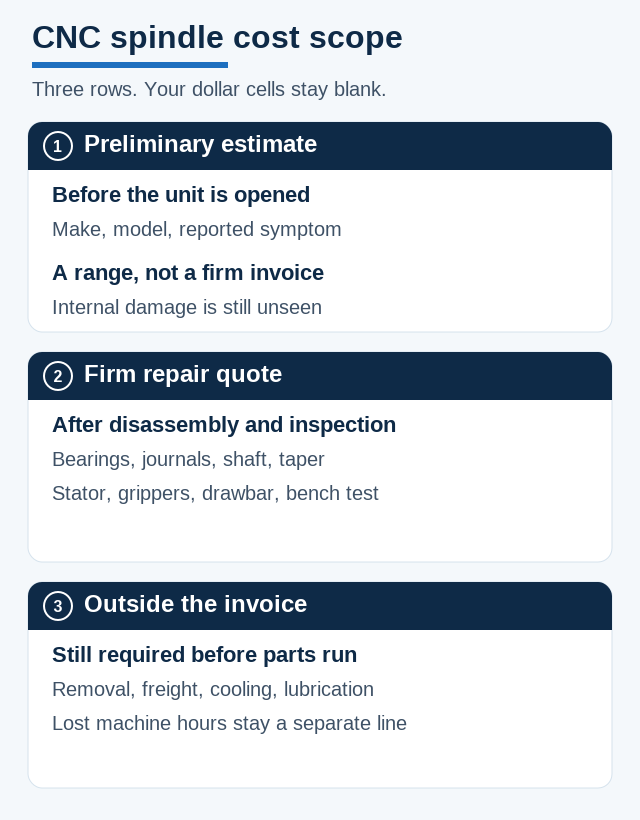
HST’s page splits the repair into two documents. Before examination, the estimate uses make and model and shows a low and a high. After an in-depth examination, HST writes an evaluation report and a firm quote, and starts repair after the buyer approves that quote. HST also prints evaluation and a firm quote within 24 to 48 hours of teardown. That clock is the quote after the unit is open. The repair-cost page does not print the rebuild duration.
Setco’s rebuild page, fetched the same day, puts disassembly and failure evaluation first, then inspection of shoulders, spacers, bearing journals, caps, bore, and bushings, then the firm price. The quote is free of charge and without obligation. Setco returns the spindle if the buyer declines it. GMN USA builds its quote from a damage report, then schedules the repair and orders parts. GMN prints no dollar amount on that page.
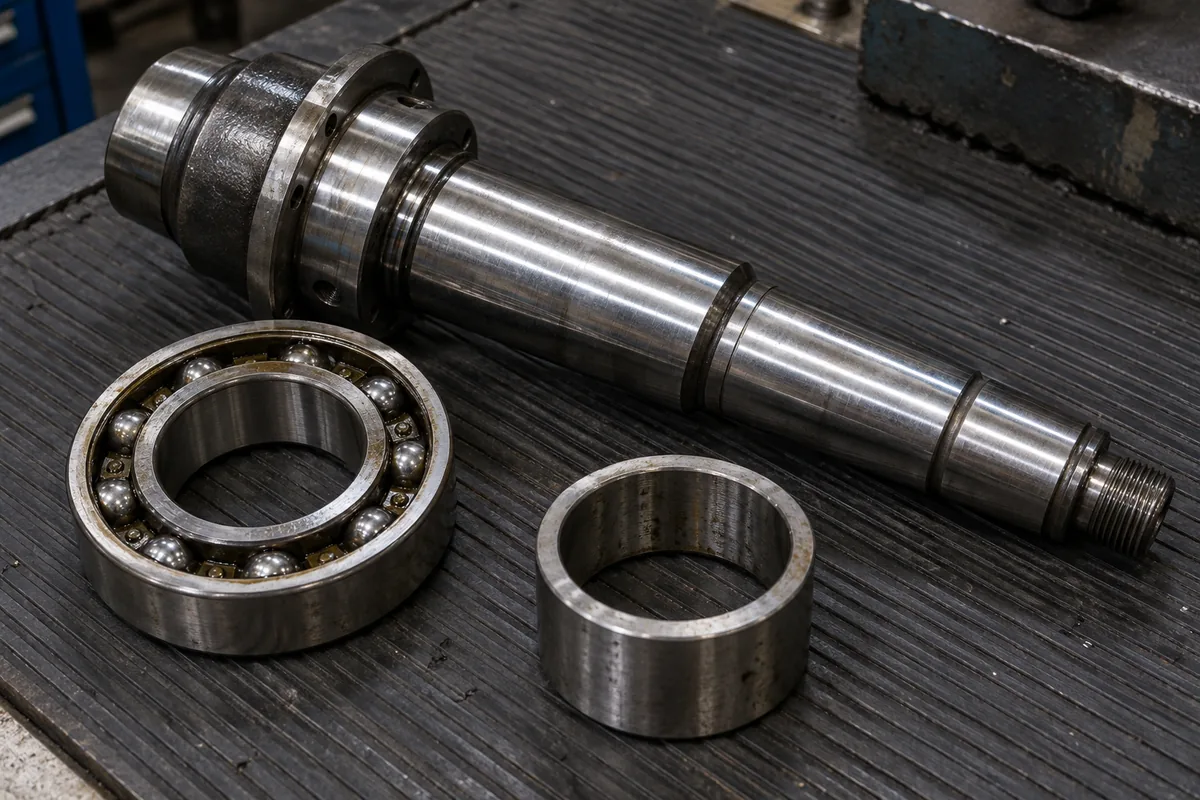
Repair adders HST prints, and the total that page leaves blank
HST lists adders that show up only after examination. Each figure below is copied from the HST repair-cost page fetched 18 October 2026. HST does not print a base repair in dollars.
| Damaged item on the HST page | Printed adder | What stays blank |
|---|---|---|
| Tool interface | $700 to $1,600, depending on size and style | Whether your taper is in that range |
| Bearing journals | $400 to $1,400 | The price of the bearing itself |
| Shaft | $4,000, which HST says often doubles a base repair | The base repair in dollars, so the doubled total is unprinted |
| Burned stator | $400 to $4,000 | Which end of the range applies |
| Gripper assemblies | $1,200 to $3,200 | Gripper price for any brand HST does not list |
| One spring from Mazak | $3,000 | Every other drawbar spring |
| Bearing price fluctuation | 10% to 30% | A bearing unit price |
A CNC spindle bearing price is blank. HST prints the journal adder and a 10% to 30% bearing-price fluctuation. It does not print the price of a named bearing.
Printed adder sum = tool interface + bearing journals + shaft
Worked example, arithmetic on the three adders HST prints in one paragraph, not a quote. Low ends: $700 + $400 + $4,000 = $5,100. High ends: $1,600 + $1,400 + $4,000 = $7,000. HST does not print $5,100 or $7,000, and does not say one spindle needs all three repairs. The stator, gripper, and Mazak-spring lines are separate printed adders and are not in this sum. The base repair is unprinted, so the repair total stays blank.
Failure modes that move the repair quote
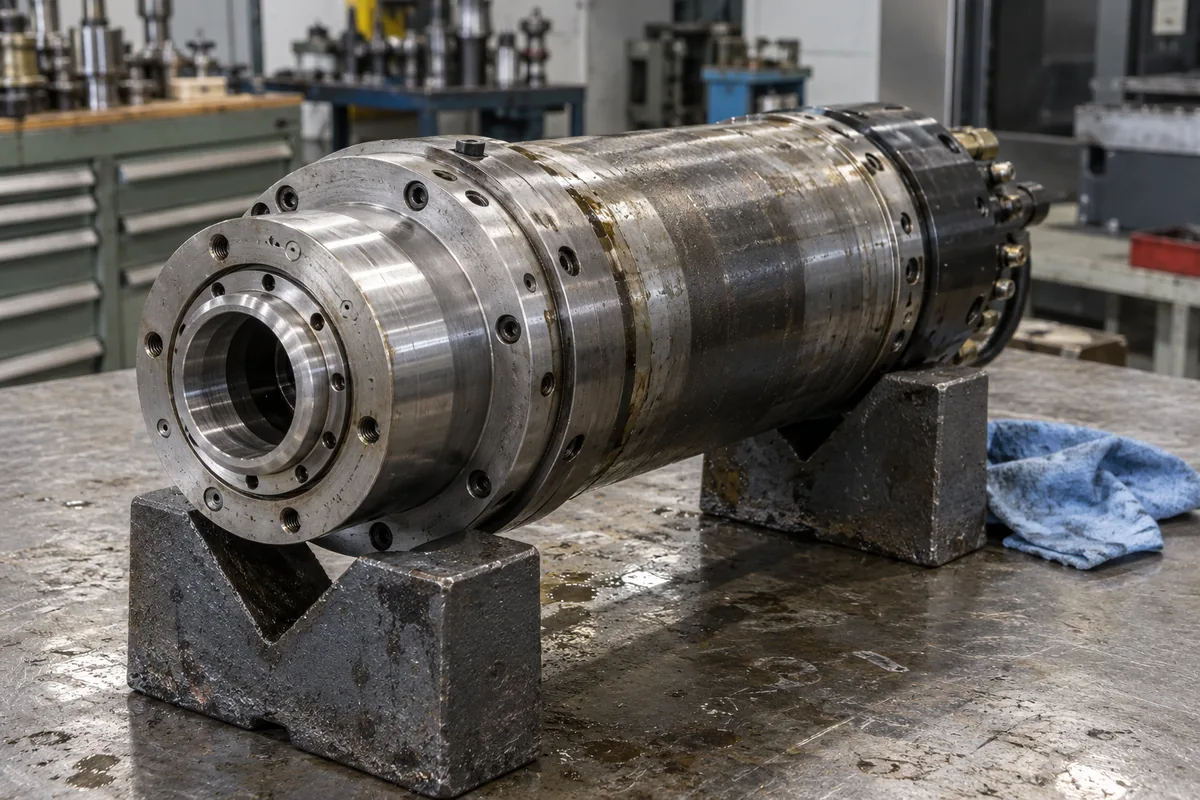
Setco’s first step evaluates the failure mode and the reason for failure, which is the root cause, before the firm price. The rows below keep each failure on the page that describes it.
| Assembly | Dominant failure mode | Prevention named on the same page | Figure that stays on that page |
|---|---|---|---|
| Tool interface, journals, shaft, stator, grippers | Damage HST says requires examination to confirm | Examination before the firm quote | The adder table above. HST, 18 October 2026 |
| Heat | Motor City assigns heat to 70% of spindle failures. Heat breaks down lubrication, expands metal, and speeds wear | Poor lubrication, inadequate cooling, and excessive cutting load | 70%, and a lubrication band of 40°C to 70°C (104°F to 158°F). Motor City, 25 August 2025 |
| Contamination | Chips, dust, and coolant through worn seals, tool changes, or cooling leaks (Motor City). Coolant mist, dust, and chips inside the spindle (GMN USA) | Motor City names those entry paths. GMN USA cleans components during repair, including ultrasonic cleaning | No dollar amount on either page |
| Imbalance and misalignment | GMN USA names bearing wear, misalignment, and imbalanced tooling. Motor City names poorly balanced tools, damaged holders, and tools seated wrong | GMN USA pre-balances rotating parts to G1 tolerances and trim-balances at operating speed | G1 stays on GMN USA’s page. The balance spec is not expanded here |
| Bore, shoulders, drawbar | Setco inspects shoulders, spacers, journals, caps, bore, and bushings for damage, wear, and fit | Sleeve and machine housings, chrome and regrind shafts, correct the taper, pilot, and face, replace the drawbar seal and springs, test draw bar pull force, replace bearings and seals | No dollars. Pull-force newtons are unprinted. Setco’s repair class goes up to 150,000 rpm. Your rpm stays blank |
Rule of thumb. If the firm repair quote exceeds 30 percent of the replacement price written for the same spindle and the same return-to-service boundary, that quote sits above the average band HST prints (25% to 30% of a new spindle). DB Rubin’s saved page still prints repair at 30% to 45% of a new spindle. Use the two written quotes. Do not average the percentages.
If lubrication temperature exceeds 70°C, the reading is above the top of the 40°C to 70°C band Motor City prints for spindles that perform best. The same page tells shops to keep load from exceeding 80% to 95% of capacity. Capacity in kilowatts is unprinted, so power stays blank.
GMN USA guarantees radial runout of 2 microns and axial runout of 1 micron after every spindle repair it performs, with the test run at maximum operating rpm and to OEM standards. That pair is GMN USA’s post-repair guarantee. A runout limit for any other shop is blank. Motor City says to measure runout weekly with a dial indicator and prints no micron limit.
Setco states that its quality management system is ISO 9001:2015 certified. That sentence prints a certificate name. It does not print runout, balance grade, speed of your spindle, or a price. Setco runs the rebuilt spindle until it is thermally stabilized at maximum speed, stores baseline vibration by serial number, and returns documentation, certification, and a written warranty. Warranty length is unprinted.
Hours, lead time, and the lines outside the spindle invoice
Motor City prints 10,000 to 15,000 hours or more for a well-maintained spindle. The same sentence describes a neglected spindle as failing in half that time. For grease lubrication at lower speeds, the same page prints a regrease interval of 500 to 2,000 hours. It does not print the rpm that counts as lower speed. Those hour figures stay on the 25 August 2025 page. They are not a warranty for your spindle.
Quoted outage days = quote-wait days + shop lead days + reinstall days
The three clocks are not on one page, so this formula has no numeric total. HST’s 24 to 48 hours is only the evaluation and firm quote after teardown. DB Rubin’s saved page prints repair lead time as a matter of days, new-spindle delivery as months, and replacement lead time as up to 32 weeks. Adding 48 hours to 32 weeks would mix two shops and two tasks.
Lead ceiling in days = 32 weeks × 7
Worked example, arithmetic on DB Rubin’s “up to 32 weeks” only: 32 × 7 = 224 days. That page does not print 224 days. Your lead-time cell stays blank.
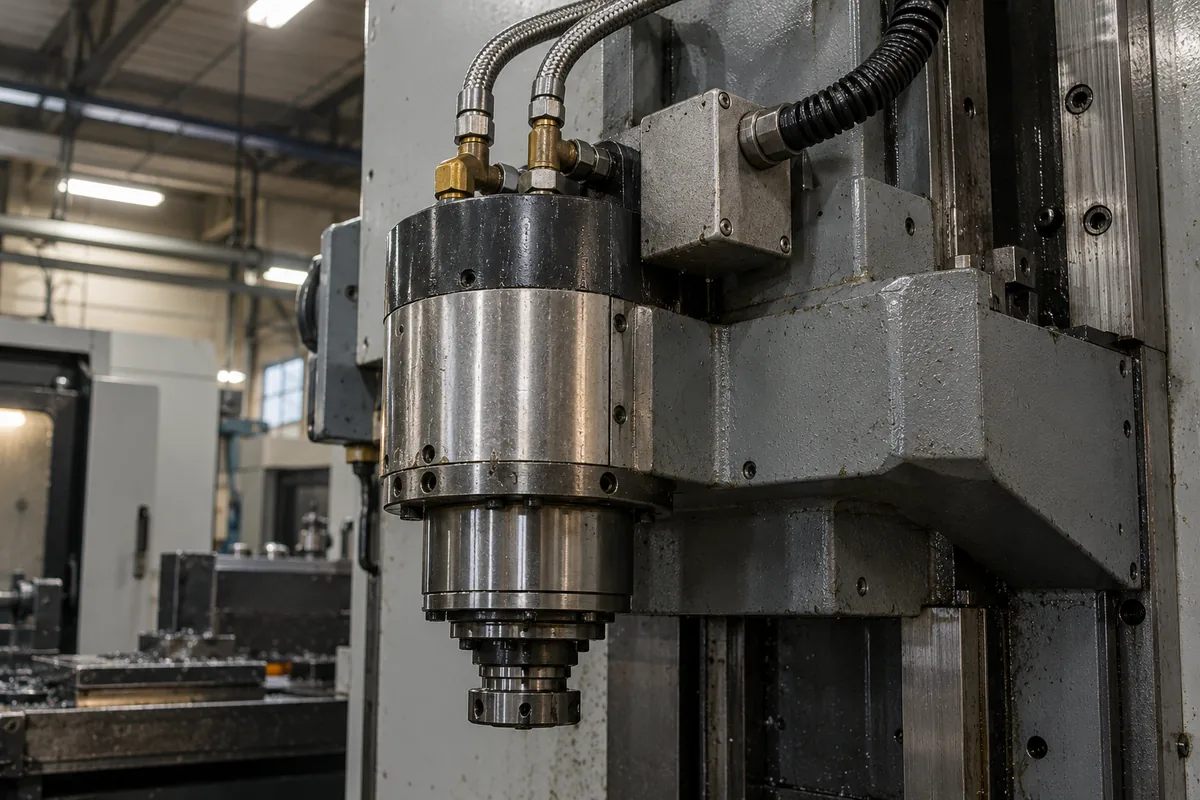
Motor City writes that downtime, expedited parts shipping, overtime repairs, and delayed deliveries can push a mid-sized shop’s total to $50,000 to $200,000. Scrap from worn bearings is the next point on that page, tied to dimensional error and surface finish, and it has no separate dollar amount. Reinstalling a spindle onto a contaminated cooling circuit, a failed lubricator, or a damaged holder repeats the failure mode the page already named.
When the replacement is a different spindle, record taper, drawbar, cooling, sensors, and the changer in the ATC spindle selection guide before you treat the replacement price as complete. If this spindle is the cutter drive on a router, keep workpiece size, published table travel, and the sample cut on the CNC router buying guide, separate from this cost sheet.
Blank comparison for this spindle
Copy this sheet. Leave a cell empty until the document in your hand prints the figure.
| Line | What a saved page already prints | Repair quote for this unit | Replacement quote for this unit |
|---|---|---|---|
| Spindle unit or rebuild | HST 25% to 30% of new. DB Rubin $14,000 to $24,000 and 30% to 45% repair share. Motor City $15,000 to over $100,000. | ||
| Removal and reinstall | Unprinted on the pages read here. | ||
| Freight and core return | Motor City folds expedited shipping into the $50,000 to $200,000 mid-sized-shop total. No freight dollar stands alone. | ||
| Cooling, lubrication, holders | Named as failure causes. No parts price. | ||
| Bench records | GMN USA: 2 microns radial, 1 micron axial, G1 pre-balance, drawbar pull force measured with no newton value. Setco: thermal run-off, serial-numbered vibration, written warranty with no term. | ||
| Lead time | HST: 24 to 48 hours after teardown for the quote. DB Rubin saved page: up to 32 weeks for replacement. Rebuild weeks unprinted. |
This sheet does not apply to a written quote you already hold for a named serial number. Copy that quote into the empty cells. It also does not move GMN USA’s 2 micron and 1 micron guarantee onto another shop’s certificate.
File the completed rows with the machine record on the manufacturing equipment desk.
Method and sources
Figures in the tables are copied from the supplier page named in the row. HST Spindles, Setco, GMN USA, and Motor City Spindle Repair were fetched on 18 October 2026. DB Rubin’s comparison is the page dated 17 November 2022 and saved 11 October 2026. A fetch of that URL on 18 October 2026 returned HTTP 403 and was not retried, so the $14,000 to $24,000 band, the 30% to 45% repair share, and the 32-week lead time stay on the saved copy. A local library search for spindle repair cost returned capping-machine pages, not these spindle documents, so no library number is used. Source handling follows the editorial policy.