A cross hole whose center sits outside the published Y travel fails on that turning center, and the part leaves for a second machine. A CNC lathe with live tooling is specified from the turret on that sheet, the live-tool speed printed for that turret, and the one-sided Y travel. Swing diameter is not the cutting diameter.
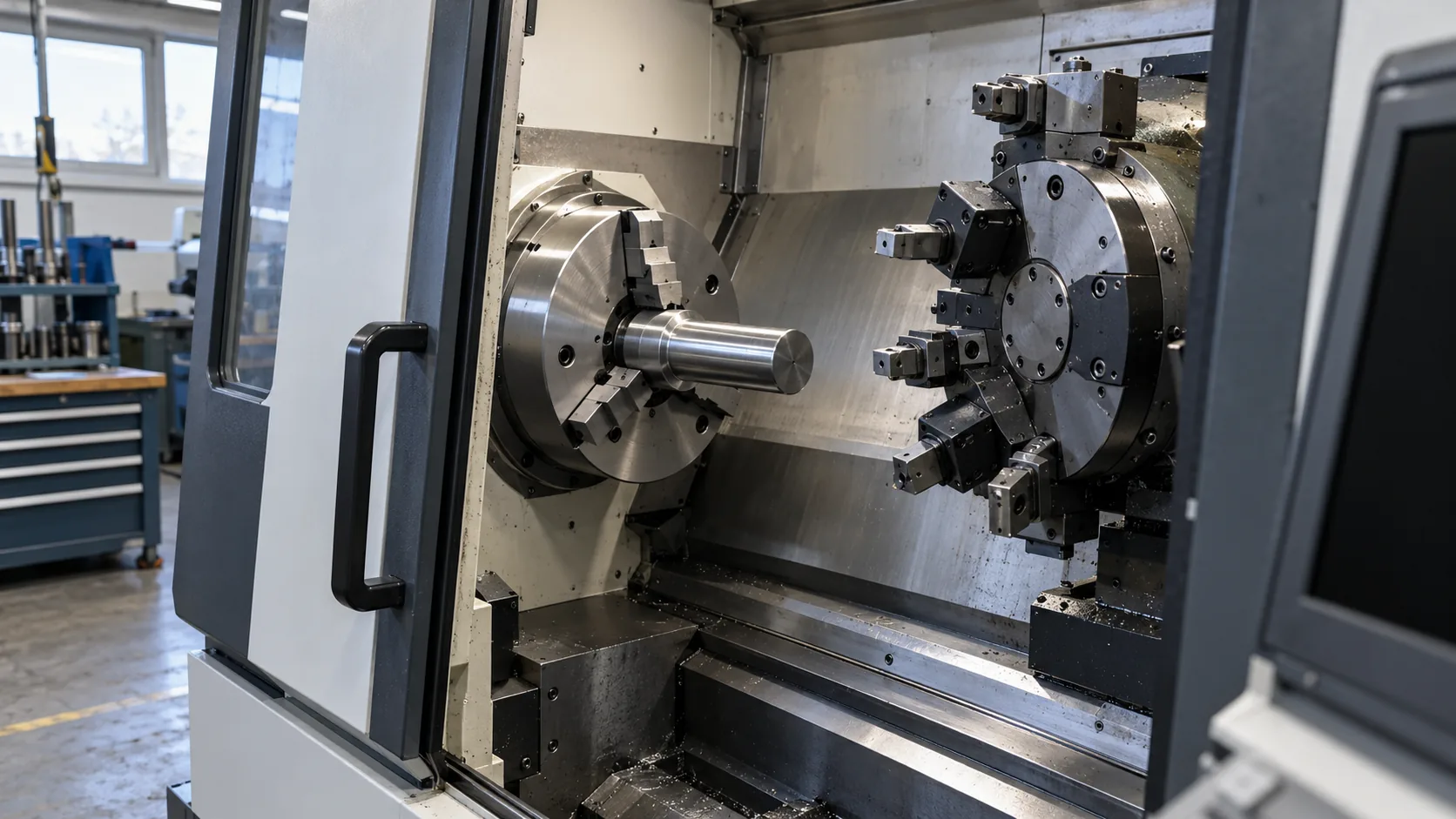
The three reference sheets compared below are the Haas series flyer (document 39-20021A), the Haas UK ST-20Y specification page, and the DMG MORI NLX 2500 2nd Generation product page. Older distributor PDFs that print a 51 mm bar and a BOT/VDI turret represent a different machine configuration.
What the three sheets actually print
| Sheet | Turret | Live tooling | One-sided Y | Diameter the sheet allows | Dominant failure and how to avoid it |
|---|---|---|---|---|---|
| Haas flyer, ST-20Y column | BMT65 standard. 12 stations standard, 24 optional by half-station indexing | 4,000 rpm standard, 6,000 rpm optional | ±2 in, printed as ±51 mm | BMT65 max cutting diameter 11.75 in (298 mm). Max part swing is a separate 21 in (533 mm) | Treating 533 mm swing as the cut. The Y-model footnote sets the cut at 298 mm |
| Haas UK ST-20Y page | 12-station BMT-65. The page does not print the 24-station option | Live-tooling max speed 6,000 rpm | ±50.8 mm | Max capacity 298 × 572 mm. Bar 63.5 mm | Reading the flyer’s ±51 mm as a looser limit. 2 × 25.4 = 50.8, so 51 mm is the flyer rounding |
| NLX 2500 2nd Generation | BMT up to 20 stations. The same sentence sets VDI at 12 stations | High-speed up to 12,000 rpm and 86 Nm. High-torque up to 6,000 rpm and 100 Nm | Headline +/- 60 mm. Technical block: Y stroke 120 mm. 120 / 2 = 60 | Max workpiece diameter 366 mm. Bar 105 mm. Length depends on the type | Comparing the 120 mm stroke with a one-sided 50.8 mm as if they were the same measurement |
The flyer leaves the BOT cutting-diameter cell blank on every Y column and prints 13 in (330 mm) only on the non-Y ST-20, ST-25 and ST-28. A Y-axis machine on that sheet is the BMT65 row.
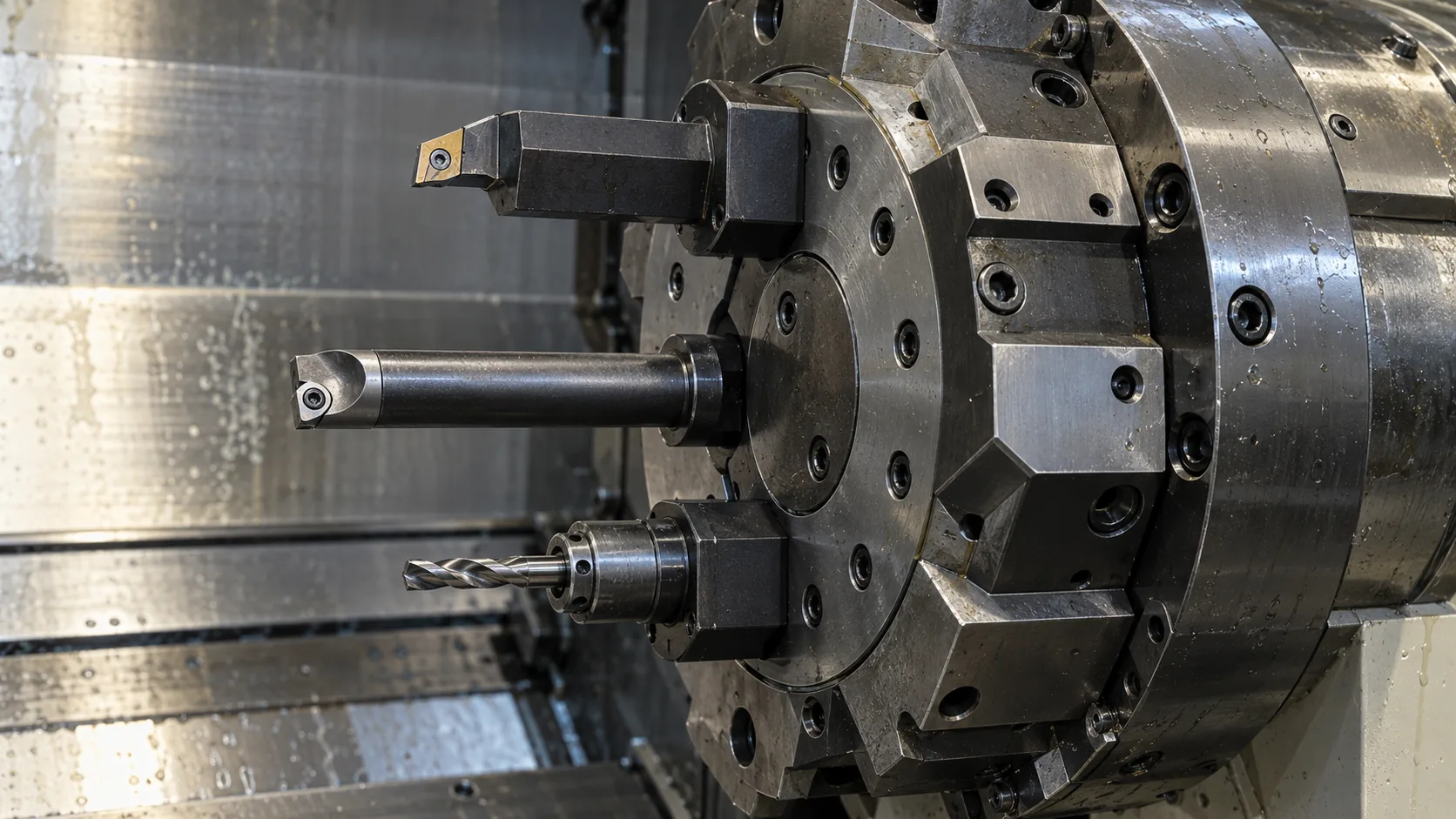
The UK page says the BMT65 turret and live tooling are standard on Haas Y-axis lathes from the ST-20Y through the ST-35Y, and optional on non-Y models. It does not print how many of the 12 stations are driven. The flyer does not either. Station count is not a driven-station count.
The letter of the Y travel
Off-center gap = feature distance from the spindle center − the one-sided Y printed on that sheet.
Use a one-sided number with a one-sided number. The NLX technical block prints a Y stroke of 120 mm, and the headline prints +/- 60 mm. Half of 120 is 60, so those two NLX figures describe one travel. The Haas flyer prints ±2 in and ±51 mm on the same cell. The UK page prints ±50.8 mm. Two inches times 25.4 mm is 50.8 mm, so the UK millimetre is the exact conversion and the flyer’s 51 mm is that sheet’s rounding.
A cross-hole center 55 mm from the spindle center:
- Against the UK page: 55 − 50.8 = 4.2 mm outside.
- Against the flyer millimetre: 55 − 51 = 4 mm outside.
- Against the NLX headline: 55 is less than 60, so it is inside that printed one-sided travel.
The 55 mm hole is not a reason to call one machine better. It is a reason to stop copying the Y figure from a different sheet.
A bar does the same kind of check. The UK page and the flyer both print 63.5 mm bar capacity on the ST-20Y. The NLX page prints 105 mm. An 80 mm bar is 80 − 63.5 = 16.5 mm over the ST-20Y line and inside the NLX line. Length is a separate NLX split: Type 700 prints 708 mm and a Z stroke of 795 mm; Type 1250 prints 1,258 mm and a Z stroke of 1,345 mm. The hero block prints 1,258 mm and 1,345 mm without the type name. Bar capacity is not cutting diameter. The ST-20Y cutting-diameter line on both Haas sheets is 298 mm, while the swing on the flyer is 533 mm.
Stations, holders and speed
The flyer splits the turret by column. On the ST-20, ST-25 and ST-28 the standard turret is BOT, with VDI and BMT65 optional. On the ST-20Y, ST-25Y and ST-28Y the standard turret is BMT65. In Europe the same flyer prints a 12-station VDI40 turret as standard, and says it accepts live-tooling heads when the live-tooling option is fitted. A VDI40 holder does not bolt onto a BMT65 face. The NLX sentence is the same kind of split: BMT up to 20 stations, and VDI equals 12 stations.
Half-station indexing on the Haas flyer raises the ST-20Y from 12 stations to 24 and includes half-index holders. It does not print a second live-tool rpm for those extra stations. Adding the option does not change the 4,000 rpm standard or the 6,000 rpm option.
The live-tool rpm is also not the main-spindle rpm. On the flyer the ST-20Y main spindle is 4,000 rpm and 20 hp (14.9 kW), nose A2-6. The ST-25Y main spindle is 3,400 rpm and 30 hp (22.4 kW). The ST-28Y main spindle is 3,200 rpm and 40 hp (29.8 kW). The same flyer prints an A2-5 finishing sub-spindle at 6,000 rpm with a 33 mm non-through bore. That 6,000 rpm belongs to the sub-spindle, not to the live tool, unless the live-tool option on that column is the line you are reading.
The UK page prints one live-tool max speed, 6,000 rpm, and does not repeat the flyer’s 4,000 rpm standard. Keep both. A proposal that says only “ST-20Y live tooling” has not said which of those two speeds is in the build.
The NLX page splits the driven turret the other way: high-speed up to 12,000 rpm and 86 Nm, high-torque up to 6,000 rpm and 100 Nm. A 7,000 rpm drill is above every Haas live-tool figure on these two sheets and below the NLX high-speed line. It is above the NLX high-torque line. The page does not print a torque at 7,000 rpm, so this note does not invent one.
Rules of thumb
If the turned diameter is above 298 mm, the ST-20Y BMT65 cutting-diameter line on both Haas sheets does not cover it. The flyer swing of 533 mm is the wrong row for that check.
If the hole center is more than 50.8 mm from the spindle center, it is outside the UK ST-20Y Y travel. The flyer’s ±51 mm does not bring 55 mm back inside, because 55 is also above 51.
If the live-tool speed on the drawing is above 6,000 rpm, the Haas lines on these sheets stop at 6,000. The NLX high-speed line prints up to 12,000 rpm and 86 Nm, and the high-torque line prints up to 6,000 rpm and 100 Nm. Those are different builds.
If the holder in the crib is VDI40, it does not satisfy a BMT65 standard turret. The flyer prints VDI40 as the Europe standard turret and BMT65 as the Y-model standard. Match the holder family to the turret that is actually on the order.
What a second setup costs when Y is short
These sheets do not print a price for a second operation. The cost of a hole outside Y is the handling between machines and the cycle on the second machine. A mill answers a different interface question: toolholder, spindle, and axis stack, which is the subject of the ATC spindle note and the 3-axis and 5-axis milling guide. A flat-bed router is the wrong envelope for a chucked shaft; that scope is on the CNC router guide.
The manufacturing equipment desk is the index for those guides. None of them prices a live-tool upgrade. The flyer prints 4,000 rpm as standard and 6,000 rpm as optional on the Y columns, and it does not print the price of the option.
When this does not apply
This page does not cover a vertical turret lathe, a Swiss-type sliding-head lathe, or a manual engine lathe. It does not give feeds, speeds, or a grade for the insert. It does not rank Haas against DMG MORI. A proposal still has to name the turret, the live-tool rpm, and the Y figure for the serial number being bought, because the two Haas sheets do not print the same live-tool speed.
This publication does not sell lathes or take equipment orders.
Method and sources
Turret type, station counts, the 4,000/6,000 rpm split, the ±51 mm cell, the 298 mm BMT65 cutting diameter, the 533 mm swing, the bar capacities, the main-spindle speeds, and the A2-5 sub-spindle are from Haas flyer 39-20021A. The 6,000 rpm live-tool max speed, the ±50.8 mm Y travel, the 298 × 572 mm capacity, the 63.5 mm bar, the 12-station BMT-65 description, and the dateModified of 7 July 2026 are from the Haas UK ST-20Y page. The +/- 60 mm headline, the 120 mm Y stroke, the 366 mm workpiece diameter, the 105 mm bar, the type-dependent lengths, and the BMT/VDI station and rpm/torque lines are from the DMG MORI NLX 2500 2nd Generation page. The quotients and the differences are arithmetic on those printed figures. Retrieved 20 October 2026.